
Me 163 Komet
The Luftwaffe’s rocket-powered interceptor
The fastest aircraft of the Second World War — and one of the deadliest to its own pilots. The Komet climbed like nothing before it, then ran out of fuel in eight minutes.
The Me 163 Komet: eight minutes of rocket power
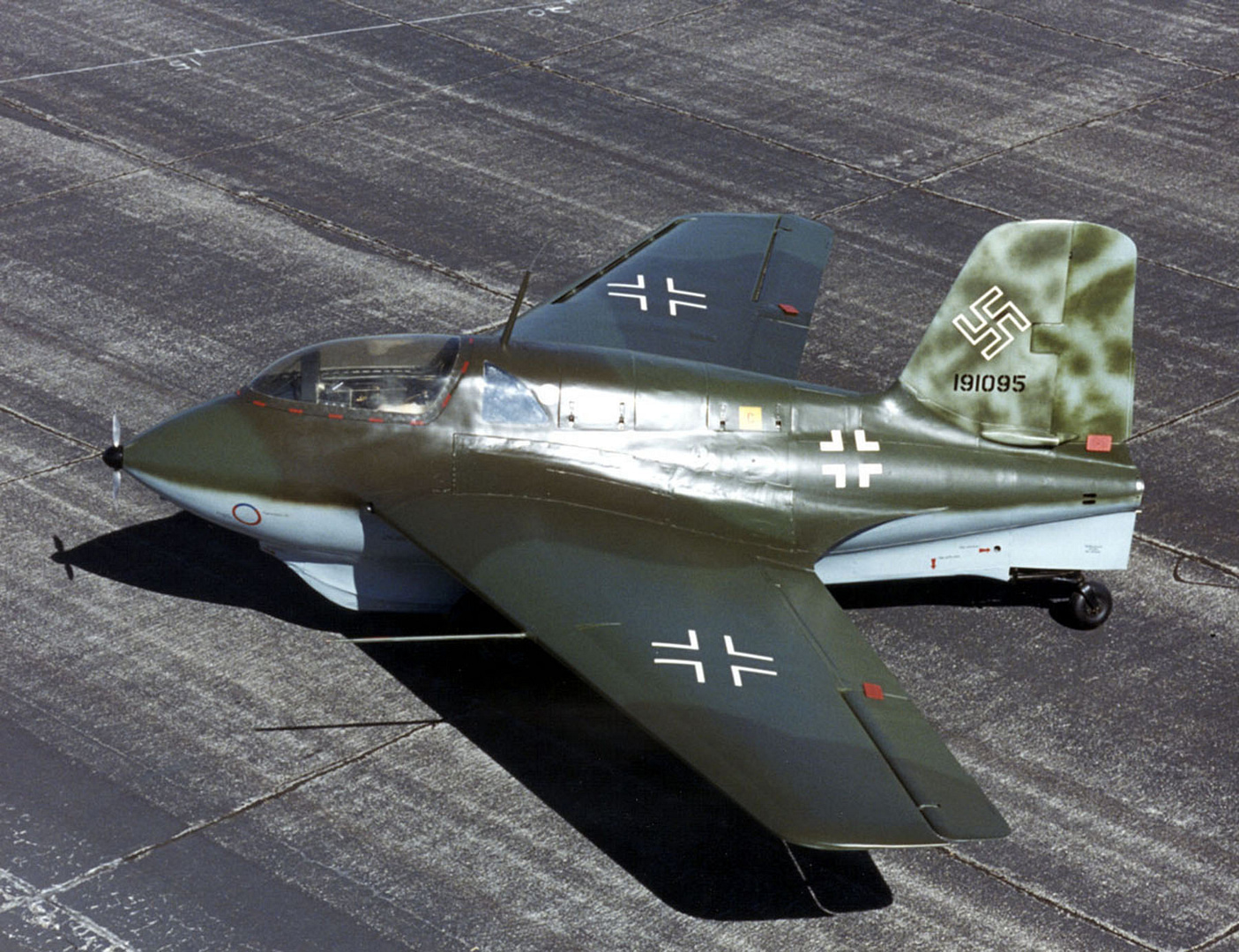
No aircraft of the Second World War flew faster — and few were more dangerous to the men who flew them. The Messerschmitt Me 163 Komet was a rocket-powered interceptor: a tiny, tailless swept-wing dart that climbed to 9,000 metres in about three minutes, faster than anything else in the sky, then glided home dead-stick when its rocket ran dry after seven or eight minutes. It remains the only rocket-powered fighter ever to see combat.
It grew out of the glider research of Alexander Lippisch, who had been building tailless swept-wing designs since the 1920s and moved his team to Messerschmitt in 1939. The power came from Hellmuth Walter’s rocket motor, which burned two hypergolic chemicals: T-Stoff, a concentrated hydrogen peroxide, and C-Stoff, a hydrazine-and-methanol fuel. Mixed, they ignited on contact — and they were monstrous to handle. T-Stoff was corrosive enough to dissolve organic matter, a pilot included; leaks and spontaneous explosions killed men on the ground, and at least one pilot died soaked in the stuff after a crash-landing.
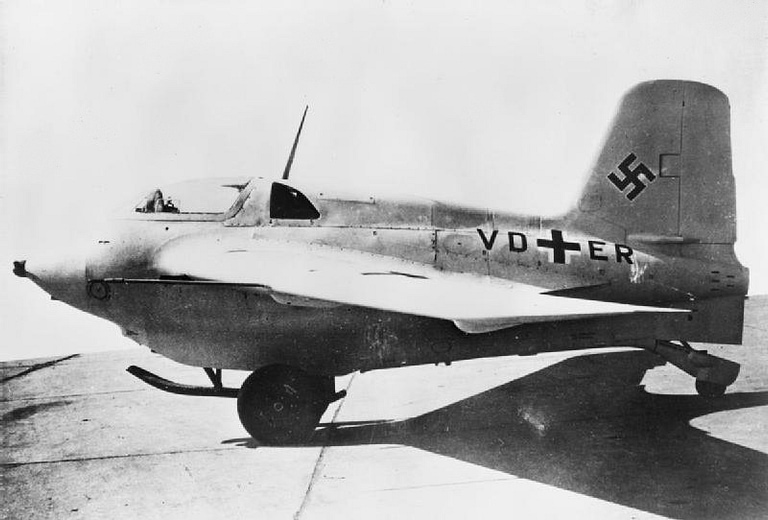
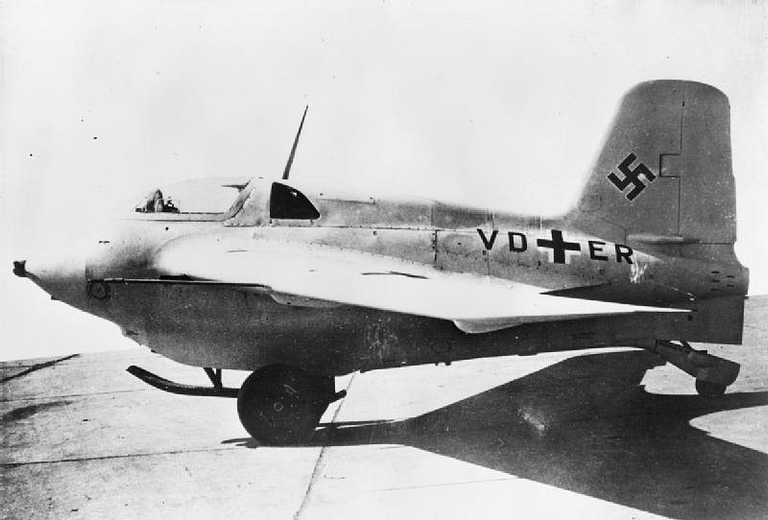
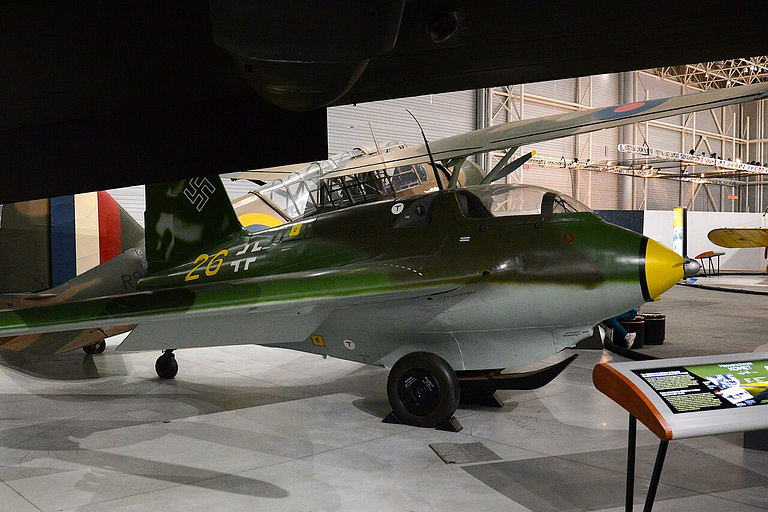
Flying it was a sequence of controlled emergencies. The Komet took off from a jettisonable two-wheeled dolly, which the pilot dropped once airborne; on return it landed on a retractable belly skid — and with the volatile remnants of its propellants still aboard, a heavy landing could detonate. Once down, it lay helpless on its belly until a special tractor came to lift it away.
In the air it was breathtaking. On 2 October 1941 the test pilot Heini Dittmar took an early Komet to 1,004 km/h — the first piloted aircraft ever to exceed 1,000 km/h, a record kept secret for years. In 1944 he pushed a later machine to an unofficial 1,130 km/h. Allied bomber crews who met the type in 1944 could scarcely believe how fast the little tailless speck closed on them.
And yet, as a weapon, it failed. The rocket gave only minutes of powered flight and a combat radius of barely 40 km, so Komets could defend only a small patch of sky — the synthetic-fuel plants around Leipzig that its single operational unit, JG 400, was formed to protect. A pilot got perhaps two firing passes, at a closing speed so high that hitting a bomber with the two slow-firing 30 mm cannon was desperately hard; it often took several hits to bring down a B-17. Across its whole career the type is credited with somewhere between nine and sixteen kills.
It killed more of its own than the enemy’s. Far more Komets were lost to takeoff and landing accidents, fuel fires and explosions than to Allied guns, and Allied pilots soon learned the safest tactic was simply to wait — and attack the Komet once its fuel ran out and it became a defenceless glider. By May 1945 the programme was over, its surviving pilots reassigned to Me 262 jets, and a handful of captured Komets were shipped to Britain and America as objects of fascination and dread.
01Why the Me 163 Komet was a brilliant technological dead end
Every quality that made the Komet astonishing also made it useless as a weapon. The rocket that gave it an unmatched climb also drained in minutes, tying it to the airfield it defended. The light, tailless airframe that let it reach 1,000 km/h left no room for the fuel a longer mission needed. And the hypergolic propellants that made the rocket so powerful made the whole aircraft a bomb on the ground.
The future of high-speed flight belonged not to the rocket but to the jet — the Me 262 could stay up for half an hour and fight on something like equal terms. Rocket research continued after the war, but no rocket-powered fighter ever entered service again. The Komet was a magnificent, terrifying blind alley.
How the Me 163 Komet was built
Tailless and swept
Alexander Lippisch’s design had no tail at all — just a short, fat fuselage and a swept wing, a shape drawn from his 1920s gliders. It was tiny, light and, for its day, radically fast; the same layout would reappear on jets decades later.
A rocket, not a jet
Power came from a Walter HWK 109-509 bi-propellant rocket of about 1,700 kg thrust — enough to climb at 81 m/s, faster than any fighter of the war. The price was endurance: at full thrust the propellants lasted only about seven and a half minutes.
Dolly, skid and cannon
The Komet took off on a jettisonable wheeled dolly and landed on a retractable belly skid. It carried two 30 mm MK 108 cannon; a few were fitted with the SG 500 Jägerfaust, ten upward-firing barrels triggered automatically as the Komet flashed beneath a bomber.
02The Me 163 Komet’s rocket engine: how T-Stoff and C-Stoff worked, and why they were lethal
The Walter motor burned two hypergolic propellants — chemicals that ignite the instant they meet, needing no spark. T-Stoff was concentrated hydrogen peroxide, a violent oxidiser; C-Stoff was a mix of hydrazine hydrate and methanol. Fed together into the combustion chamber they produced a controllable, throttleable thrust of up to about 1,700 kg — extraordinary for 1944.
They were also nightmarish. T-Stoff was corrosive enough to attack skin, cloth and organic tissue; the two fluids had to be trucked and stored entirely separately, because any accidental mixing could explode. Ground crews wore protective suits, aircraft blew up on the tarmac, and pilots died from leaks and fires. The test pilot Josef Pöhs was killed in 1943 in a takeoff accident compounded by T-Stoff exposure. The rocket gave the Komet its magic — and much of its menace.
03The Me 163 Komet’s takeoff and landing: the dolly, the skid and the tractor
With no undercarriage to save weight, the Komet used a two-wheeled dolly for takeoff, accelerating to around 320 km/h before lifting off and dropping the dolly. That was the easy part. Landing meant gliding back, unpowered, and setting down on a sprung belly skid — often with unburned, volatile propellant still sloshing in the tanks, so that a hard arrival could ignite or explode.
Once stopped, the Komet was immobile, lying on its belly in the open, and had to be hauled clear by a purpose-built tractor, the Scheuch-Schlepper. Many pilots were injured in landing accidents; the recovery process left the aircraft — and the pilot — dangerously exposed on the airfield.
Messerschmitt Me 163B Komet specifications
Airframe & Performance
- Bemanning
- 1
- Lengte
- 5.7 m (18 ft 8 in)
- Spanwijdte
- 9.3 m (30 ft 6 in)
- Leeggewicht
- 1,905 kg (4,200 lb)
- Max takeoff weight
- 4,309 kg (9,500 lb)
- Max speed
- ~1,000 km/h (620 mph) — a WWII first
- Klimsnelheid
- 81 m/s (16,000 ft/min)
- Serviceplafond
- ~12,000 m (39,000 ft), reached in ~3 min
- Powered endurance
- ~7.5 min; combat radius ~40 km
Propulsion, Armament & Programme
- Motor
- 1 × Walter HWK 109-509A rocket, ~14.7 kN (~1,700 kg / 3,300 lbf)
- Propellants
- T-Stoff (hydrogen peroxide) + C-Stoff (hydrazine/methanol), hypergolic
- Bewapening
- 2 × 30 mm MK 108 cannon; some fitted with the SG 500 Jägerfaust
- First flight
- 1 September 1941 (powered)
- Built
- ~370
- Operator
- Nazi Germany (Luftwaffe — JG 400)
- Combat kills
- ~9–16 (contested)
- Cost per flight hour
- Not recorded — a WWII type, retired 1945
04The Me 163 Komet’s numbers: how many were built, and how many it shot down
Around 370 Komets were built, but only one unit — Jagdgeschwader 400 — ever flew them in anger, and only a fraction were airborne at any time thanks to chronic shortages of the exotic propellants. Its confirmed tally is usually given as between nine and sixteen Allied aircraft, mostly heavy bombers, across roughly a year of operations.
Set against that are the Komets lost to accidents — takeoff and landing crashes, fuel fires and explosions — which outnumbered those lost to the enemy. One historian’s verdict was blunt: for all its speed, the Komet “did not warrant the effort put into the project.”
05After the Komet: the Me 263, the Japanese J8M and the end of the rocket fighter
The Komet spawned a short-lived family. The Me 263 (originally the Junkers Ju 248) was a larger, longer-ranged redesign with retractable landing gear; it was completed but never flew under power, and its lineage was continued after the war by the Soviet Mikoyan-Gurevich I-270. Germany also shipped plans and an example to its ally Japan, which developed the Mitsubishi J8M Shūsui — whose prototype crashed on its first powered flight.
None entered service. The rocket fighter, for all its thrilling performance, had reached a dead end — outlived within months by the turbojet.
The Me 163 Komet, from record-breaker to last resort
First powered flight
The Me 163 makes its first rocket-powered flight on 1 September.
Past 1,000 km/h
On 2 October Heini Dittmar reaches 1,004 km/h — a secret world first.
A propellant claims a pilot
Test pilot Josef Pöhs is killed in a takeoff accident involving T-Stoff.
JG 400 formed
The only operational Komet unit stands up to defend the synthetic-fuel plants near Leipzig.
Into combat
The first combat sortie flies on 13 May; regular operations begin on 28 July.
Unofficial 1,130 km/h
On 6 July Dittmar pushes a twin-chamber Komet to an unofficial 1,130 km/h.
The upward gun scores
On 10 April an SG 500 Jägerfaust brings down a Lancaster — its only recorded kill.
The end
Operations cease in May; surviving JG 400 pilots move to the Me 262 jet.
The Me 163 Komet in nine stories
Eric Brown flies the Komet
Britain’s greatest test pilot took one up under power.
The full story
T-Stoff, C-Stoff and the men they killed
The propellants were as dangerous as the enemy.
The full story
1,000 km/h — and no one could know
Heini Dittmar broke a barrier the world wasn’t told about.
The full story
A fighter tied to its own airfield
The rocket that gave everything also took it away.
The full story
How the Allies beat the fastest fighter
The counter to the Komet was patience.
The full story
The Jägerfaust and its single Lancaster
A weapon that fired straight up, once.
The full story
The skid, the tractor and the injuries
Getting down was the hardest part.
The full story
More lost to accidents than to the enemy
The Komet killed more of its own than it downed.
The full story
The Me 263, the J8M and the I-270
The rocket fighter’s brief family tree.
The full story
The Me 163 Komet in photographs
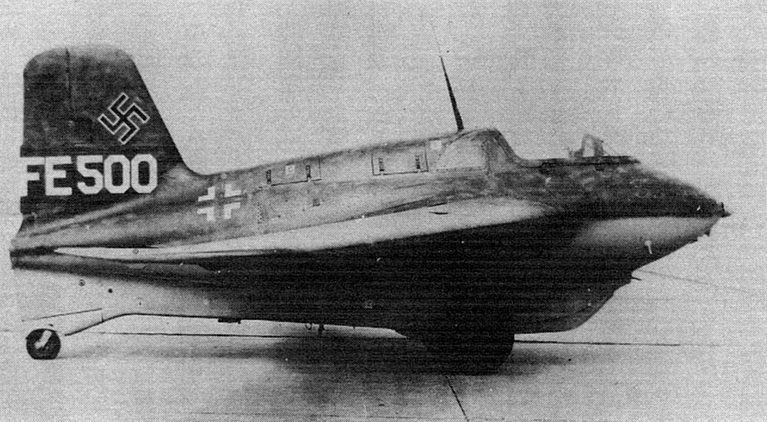
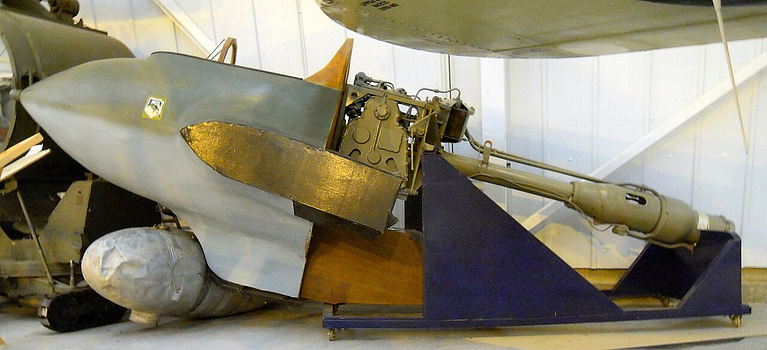
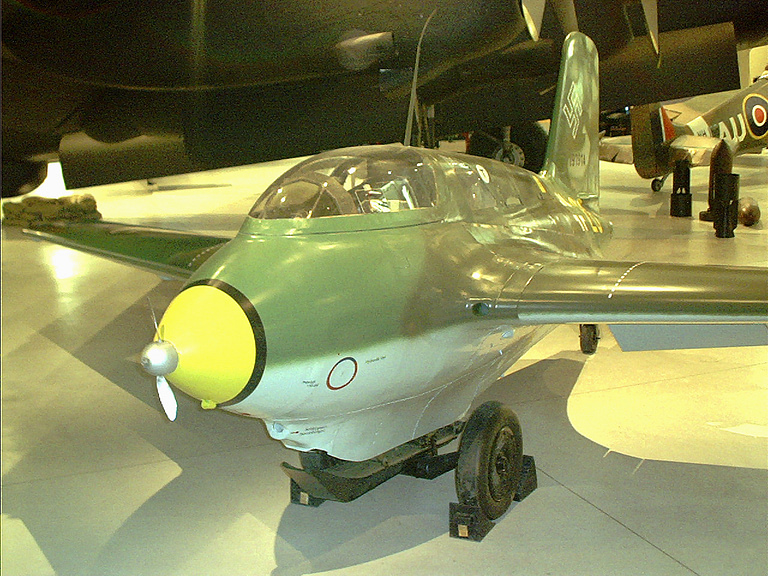
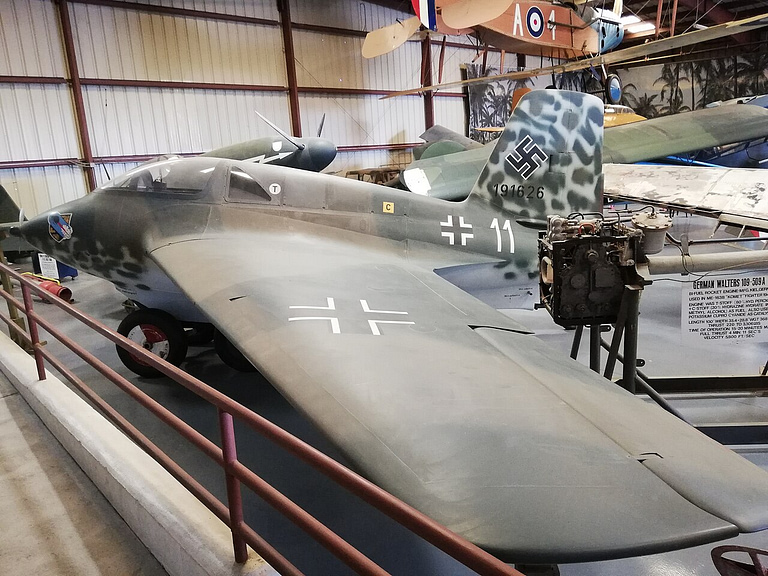
The Komet, filmed in 1944
Rare wartime footage of the Me 163 in service — its rocket launch, its skid landing, and the ground crews who handled its lethal fuel.
A wartime Luftwaffe instructional film on the Me 163 B, c. late 1944 (German WWII Archive).
Where the Me 163 Komet flew — and survives
The score: speed without result
The Komet was the fastest thing in the sky and one of the least effective weapons of the war. In roughly a year of operations it downed a handful of bombers — and lost more of its own to fuel, fire and failed landings than to the enemy.
Faster than anything the Allies flew, the Komet was defeated by its own tiny endurance, its lethal fuel, and the simple tactic of waiting for it to glide. Compare the combat record of every military aircraft.
Me 163 Komet: your questions, answered
Can I fly in a Me 163 Komet?
No — only a handful survive, all in museums, and none are airworthy. But you can fly in a real military jet today: MiGFlug offers flights in genuine fighters and jet trainers such as the L-39 Albatros and the MiG-29. See migflug.com/flights-prices.
Was the Me 163 the fastest aircraft of World War II?
Yes. It reached about 1,000 km/h (620 mph), and in 1941 became the first piloted aircraft ever to exceed 1,000 km/h — a record kept secret at the time.
Why did the Me 163 only fly for a few minutes?
Its rocket burned propellant at an enormous rate. Powered flight lasted only about seven and a half minutes, giving a combat radius of roughly 40 km — after which it glided home unpowered.
Why was the Me 163 so dangerous to its own pilots?
Its hypergolic propellants, T-Stoff and C-Stoff, were corrosive and explosive, and the dolly takeoff and skid landing caused many crashes. More Komets were lost to accidents than to the enemy.
How many aircraft did the Me 163 shoot down?
Between about nine and sixteen Allied aircraft over its whole career — a tiny return for the effort the programme consumed.
How did the Me 163 take off and land?
It took off from a jettisonable two-wheeled dolly and landed on a retractable belly skid, then had to be towed off the airfield by a special tractor.
What happened to the Me 163 after the war?
The programme ended in May 1945. Captured examples went to Britain and the United States, and the design influenced the Me 263, the Japanese J8M and the Soviet I-270 — but no rocket fighter entered service again.
You can’t fly the Me 163 Komet.
These, you can.
The Komet is long gone, and no one will ever fly one again — but you can still strap into a genuine military jet. MiGFlug flies civilians in real fighters and jet trainers around the world.
 Fly the L-39 AlbatrosThe world’s most-flown jet trainer — aerobatics included
 Fly the F-104 Starfighter“The missile with a man in it”
 Fly the MiG-21The Cold War’s most-produced jet
 Vlieg met de T-33 Shooting StarAmerica’s first jet trainer
 Fly the DH VampireA piece of early jet history
 Fly the S.211Agile Italian jet trainer
 Fly the MB-326The classic Aermacchi jet
 Fly the MiG-15The Soviet legend of the Korean War
Related aircraft
Where this chapter comes from
- National Museum of the U.S. Air ForceFact sheets on the Me 163 and its captured, restored examples.
- Smithsonian National Air and Space MuseumThe Me 163 B at the Udvar-Hazy Center, with technical and historical detail.
- Royal Air Force MuseumOn the captured Komets brought to Britain for evaluation in 1945.
- Imperial War MuseumWartime context on the Reich air-defence campaign the Komet was built to fight.
- Deutsches Museum, MunichHolds an original Me 163 and documents the Walter rocket technology.
- MiGFlug — AfterburnerMiGFlug’s aviation magazine, on the wonder-weapons of the Luftwaffe and the dawn of jet and rocket flight.
The Komet’s kill and loss figures are contested; the commonly cited range of nine to sixteen victories is used here, and performance figures are drawn from period records and postwar evaluation.