

Fairey Barracuda
The Royal Navy’s first all-metal monoplane torpedo and dive bomber — ungainly, delayed and underpowered, yet the aircraft that crippled the Tirpitz.
At a Glance
Fairey Barracuda: key facts
Het verhaal
The Fairey Barracuda: the ugly monoplane that finally retired the Swordfish
By the late 1930s the Royal Navy’s Fleet Air Arm still went to war in open-cockpit biplanes. The Fairey Swordfish and its intended successor, the Fairey Albacore, were fabric-covered, fixed-undercarriage machines that looked — and flew — like relics of the previous war. The Admiralty knew it needed a modern, all-metal monoplane to carry torpedoes and dive-bombs from its carriers. The aircraft it got, the Fairey Barracuda, would be one of the most awkward-looking warplanes of the conflict, and one of the most misunderstood.
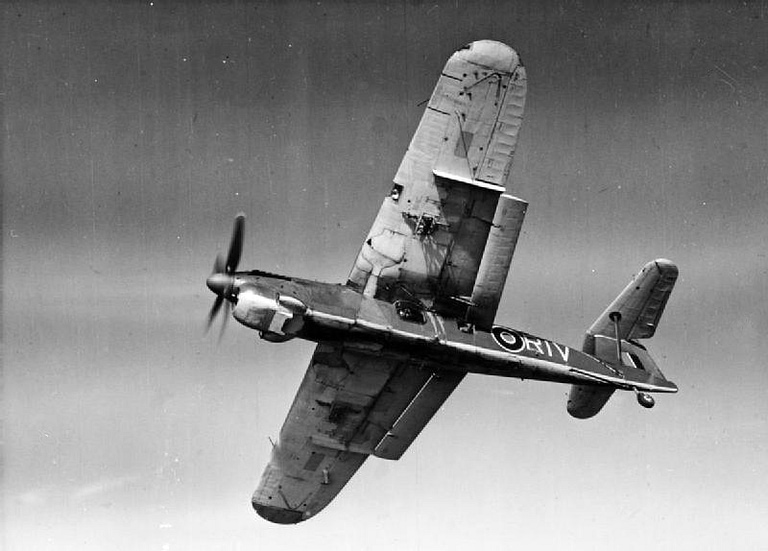
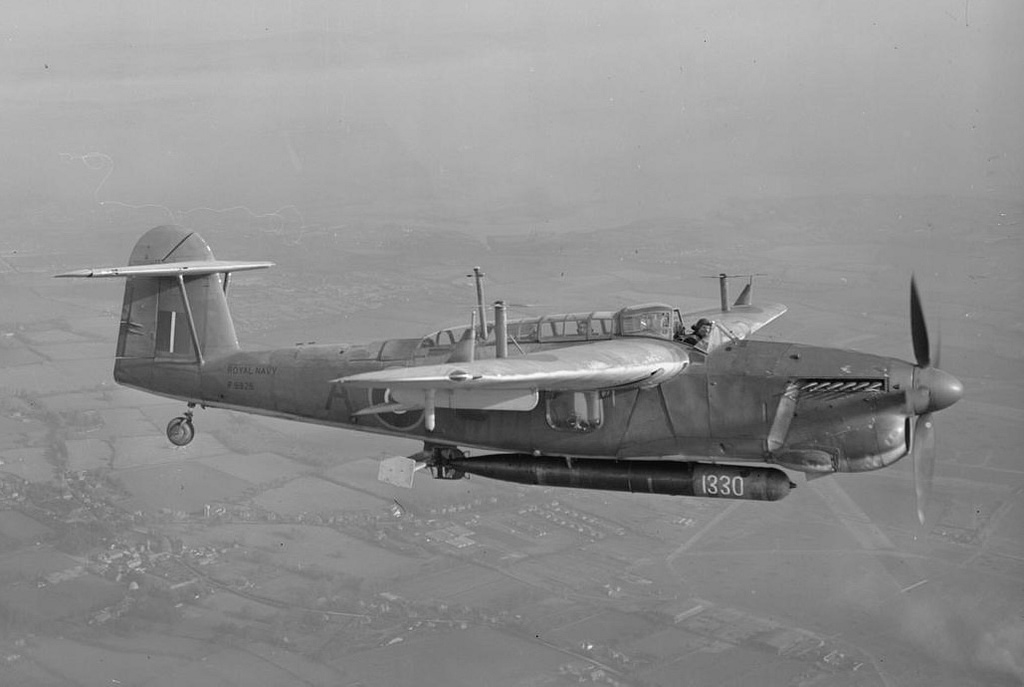
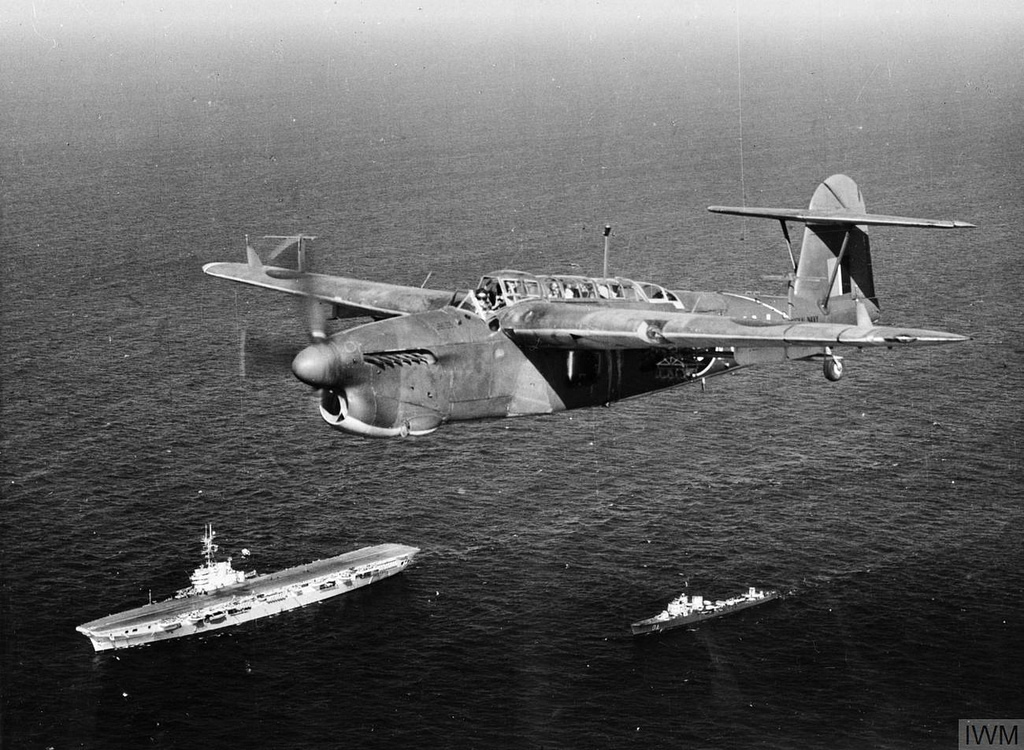
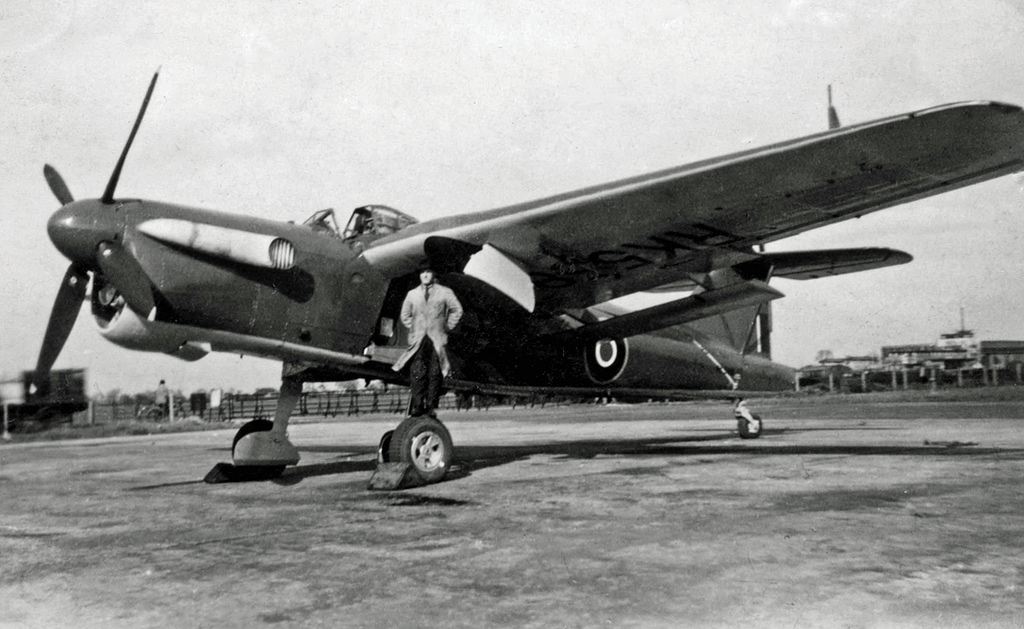
The Barracuda answered Specification S.24/37. It was Fairey’s first monoplane torpedo bomber: an all-metal, shoulder-winged aircraft with a deep, slab-sided fuselage, a tall undercarriage to give a torpedo ground clearance, and a distinctive tailplane braced high on the fin to keep it clear of the wing’s wake. Most striking of all were the large Fairey-Youngman flaps beneath the wing, which could be lowered for take-off and landing and angled down to act as dive brakes. The result was an aeroplane that almost everyone agreed was ugly — a jumble of struts, flaps and angles that crews affectionately, or not so affectionately, mocked.
Its development was painfully slow. The Barracuda had been designed around the Rolls-Royce Exe, a 24-cylinder sleeve-valve engine that promised smooth power. When the Exe was abandoned so that Rolls-Royce could concentrate on the Merlin, the whole aircraft had to be re-engineered around the lower-set Merlin instead. That, the fall of France re-ordering Britain’s aircraft priorities, and the sheer novelty of the design pushed the first flight back to December 1940 and front-line service to 1943 — years later than the Navy had hoped.
“It was never going to win a beauty contest — but over Kaafjord in April 1944 the Barracuda did something no Swordfish could have done.”On Operation Tungsten and the strikes against the Tirpitz
When it did arrive, the Barracuda was heavy and, with the Merlin, somewhat underpowered — a shortfall that became acute in the heat of the tropics, where its range and bomb load fell away sharply. Early in its career the type also suffered a spate of unexplained fatal accidents, aircraft diving into the sea for no obvious reason. The causes were argued over at the time and since: control or hydraulic problems, structural limits in the dive, or aircrew blacking out under high g were all suggested, and the truth was probably a combination that has never been pinned down with certainty.
And yet the Barracuda did important, sometimes decisive, work. Flying from Royal Navy fleet carriers, Barracudas dive-bombed the German battleship Tirpitz in her Norwegian fjord and put her out of action for months. They struck Japanese-held targets in Sumatra with the Eastern and British Pacific Fleets, hunted U-boats over the Atlantic and Mediterranean, and covered amphibious landings. It was, in the end, a workmanlike aircraft that history has treated more harshly than its record deserves.
Part of the reason the Barracuda is remembered so unkindly is timing. It arrived in the middle of a war in which naval aviation was changing faster than at any point before or since, and it was overtaken almost as soon as it appeared. American industry was pouring out the Grumman Avenger, a bigger, longer-legged, more reliable torpedo bomber, and Britain received it in quantity through Lend-Lease. Placed beside the Avenger the Barracuda looked exactly what it was: a home-grown compromise, competent but outclassed, kept in production because it existed and worked rather than because it was the best available. That is a hard reputation to shake, and the Barracuda never has.
But reputations built on comparison can be unfair. The Barracuda has to be judged against the biplanes it actually replaced, not only the American monoplanes that eventually replaced it. Measured that way it was a genuine step forward: faster, better protected, able to dive-bomb accurately, and flexible enough to carry radar, mines, depth charges or an airborne lifeboat as the mission demanded. For two critical years in the middle of the war it was one of the standard strike aircraft of the Royal Navy’s carriers, and in that time it earned a place in history that its awkward looks and short career have tended to obscure.
01Why the Fairey Barracuda looked so strange — and why it worked anyway+
The Barracuda’s ungainly silhouette was the product of hard naval requirements rather than poor design. A carrier torpedo bomber needs to fly slowly and controllably for a torpedo drop, dive steeply and accurately as a bomber, fold its wings to fit a hangar, and give a slung torpedo enough ground clearance on a pitching deck. The high shoulder wing kept the wing and its Youngman flaps clear of the torpedo and gave the observer a good downward view; the tall, spindly undercarriage provided clearance; and the tailplane was mounted high, with bracing struts, to keep it out of the disturbed air coming off the wing and flaps. Each solution was sensible on its own; together they produced an aeroplane only its crews could love.
The Fairey-Youngman flaps were the cleverest feature. Set to a small positive angle they added lift for slow flying and deck landing; set to a steep negative angle they became airbrakes that let the Barracuda dive at a controlled speed and pull out without over-stressing the airframe. That dive-bombing capability, unusual in a torpedo aircraft, is exactly what made the Tirpitz strikes possible.
There was a price for all this cleverness. The high wing and deep fuselage created a lot of drag; the fixed structure and heavy naval equipment added weight; and the tall undercarriage, while it gave torpedo clearance, made the aircraft sit nose-high and tricky to taxi. On a carrier deck the Barracuda was a big, tall machine that demanded respect from its deck crews as much as its pilots. Nothing about it was sleek, and everything about it was a compromise between competing demands — which is precisely why aeronautical engineers, rather than the general public, tend to find it interesting.
02The Fairey Barracuda’s troubled reputation: how bad was it really?+
The Barracuda is often dismissed as a failure, but the picture is more nuanced. It was late, it was heavy, and the Merlin gave it barely adequate performance — genuine faults. The early run of fatal dives badly dented confidence, and in the tropics the aircraft was clearly out of its depth. But it was also strong, stable in the dive, able to carry a torpedo or a useful bomb load, and forgiving enough to operate from small escort carriers. Crews who flew it in the North Atlantic and off Norway generally rated it a sound, if unlovely, tool. Judged against what it actually achieved rather than how it looked, “troubled but effective” is closer to the mark than “failure”.
Design & Engineering
How the Fairey Barracuda was designed and built
Three engineering choices defined the Barracuda: an all-metal monoplane airframe, the Fairey-Youngman flaps that let it dive-bomb, and a Merlin engine adopted only after its intended powerplant was cancelled.
An all-metal monoplane at last
Where the Swordfish and Albacore were fabric biplanes, the Barracuda was a stressed-skin, all-metal shoulder-wing monoplane with hydraulically folding wings for the hangar. It was a generation ahead of what the Fleet Air Arm had been flying — even if it arrived later than anyone wanted.
Youngman flaps: lift and dive brake in one
The large flaps under the wing, designed by Arthur Youngman, could be set positive for slow deck work or steeply negative to brake a dive. That single feature turned a torpedo carrier into a credible dive bomber and made the accurate attacks on the Tirpitz possible.
The engine it never wanted
The airframe was drawn around the Rolls-Royce Exe. When that sleeve-valve engine was abandoned, the Merlin was substituted — lighter on power for the weight, and the root cause of the Barracuda’s chronic lack of urgency, especially in hot climates.
03The Fairey Barracuda’s structure and folding wings, explained+
The Barracuda used a light-alloy monocoque fuselage and a mid-set, all-metal wing that folded hydraulically just outboard of the main spar for carrier stowage. The deep fuselage housed a crew of three in tandem — pilot, observer/navigator and telegraphist air gunner — under a long greenhouse canopy that gave the observer an excellent field of view for navigation, spotting and directing an attack. Beneath the belly and wings were racks for a torpedo, bombs, depth charges, mines or, in some marks, air-to-surface radar and lifeboat containers for air-sea rescue. It was a genuinely multi-role naval aircraft, which is part of why the Navy kept ordering it despite its faults.
04Inside the Fairey Barracuda’s cockpit and crew stations+
The three crew sat in tandem under one long, heavily framed canopy. The pilot had a conventional cockpit up front, with the bombsight and torpedo-release gear to hand; because the nose sloped down from the high wing, forward and downward visibility was better than the aircraft’s bulk suggested, which helped in the dive and on the approach to a deck. Immediately behind sat the observer, arguably the most important crew member on a long over-water sortie: he navigated, worked the radio, spotted for the guns or the fleet, and on radar aircraft operated the ASV set that turned the Barracuda into a night and all-weather submarine hunter. Facing aft at the rear was the telegraphist air gunner, responsible for wireless traffic and for the single or twin .303-inch Vickers K guns that were the aircraft’s only defensive armament.
That layout reflected the Fleet Air Arm’s philosophy: its aircraft were flying teams, not single-seat weapons, and the observer’s skill was often what made the difference between finding the carrier again and ditching in the sea. The Barracuda’s roomy, well-glazed crew compartment was one of its genuine strengths, and one reason it was valued for reconnaissance and patrol as much as for strike.
Full Specifications
Fairey Barracuda Mk II — specifications
Figures are for the most numerous mark, the Barracuda Mk II. Sources vary; performance quoted is at typical operational weights and should be treated as representative rather than absolute.
| Bemanning | 3 (pilot, observer, telegraphist air gunner) |
|---|---|
| Powerplant | 1 × Rolls-Royce Merlin 32 V-12, ~1,640 hp |
| Lengte | ~12.1 m (39 ft 9 in) |
| Spanwijdte | ~14.99 m (49 ft 2 in); wings folded for stowage |
| Hoogte | ~4.6 m (15 ft 1 in) |
| Wing | All-metal shoulder wing with Fairey-Youngman flaps |
| Leeggewicht | ~4,240 kg (9,350 lb) — approx. |
| Maximaal startgewicht | ~6,400 kg (14,100 lb) — approx. |
| Maximale snelheid | ~367 km/h (228 mph) — falls in the tropics |
|---|---|
| Bereik | ~1,850 km (1,150 mi) ferry; far less with a torpedo |
| Serviceplafond | ~5,000 m (16,000 ft) — approx. |
| Main weapon | 1 × 1,620 lb torpedo, or up to 6 × 250 lb bombs |
| Alternative loads | Depth charges, mines, flares, ASV radar, lifeboat |
| Defensive armament | 1–2 × .303 in Vickers K guns (rear cockpit) |
| Unit cost | Not reliably recorded (wartime production) |
| Cost per flight hour | Not reliably recorded (WWII) |
04The Fairey Barracuda’s operating costs: what the records do — and don’t — tell us+
Meaningful per-hour operating costs simply were not tracked for a wartime naval type the way they are for a modern jet. The Barracuda was built in large numbers under wartime contracts by Fairey, Blackburn, Boulton Paul and Westland; unit prices were bound up in bulk government orders and are not reliably published. What can be said is that it was a mainstream mass-produced aircraft rather than an exotic one — a Merlin, an all-metal airframe and standard naval equipment — so its cost sat in the same broad band as other British single-engined carrier aircraft of the day. For this exhibit we record cost as “not reliably recorded (WWII)” rather than invent a figure.
05Fairey Barracuda variants and how the specifications changed+
The Mk I was a small pre-production and early batch with a lower-powered Merlin 30; only around two dozen were built. The Mk II, with the more powerful Merlin 32 and a four-blade propeller, became the definitive wartime version and the most numerous. The Mk III added air-to-surface radar in a bulged radome under the rear fuselage for anti-submarine work. The post-war Mk V was a substantially revised aircraft with a Rolls-Royce Griffon, a longer fuselage and a squared-off fin, built only in small numbers as the type wound down. Weights rose and equipment multiplied across the marks, but the underlying performance never dramatically improved.
Reference Data
Fairey Barracuda: origins, production and service
A quick-reference summary of who built the Barracuda, when it served and where it went. As with all wartime figures, production totals and dates vary slightly between sources; the values here follow the mainstream consensus and are hedged where that consensus is soft.
| Designer | Fairey Aviation Company |
|---|---|
| Specification | Air Ministry S.24/37 |
| First flight | 7 December 1940 |
| Built by | Fairey, Blackburn, Boulton Paul, Westland |
| Number built | Commonly cited as ~2,500–2,607 (all marks) |
| Primary user | Royal Navy Fleet Air Arm |
| Service entry | 1943 (No. 827 Naval Air Squadron among the first) |
|---|---|
| Major action | Operation Tungsten vs Tirpitz, 3 April 1944 |
| Other theatres | Norway, Mediterranean, Indian Ocean, Pacific |
| Post-war operators | Royal Canadian Navy; French Aeronavale |
| Withdrawn | Mid-1950s (second-line by the late 1940s) |
| Survivors | No complete original; a reconstruction under way |
Powerplant & Heritage
The engine, the name and the Fairey Barracuda’s place in history
The Barracuda’s story is, at heart, an engine story. Fairey drew the aircraft around the Rolls-Royce Exe (also called the Boreas), an air-cooled 24-cylinder X-block sleeve-valve engine that was expected to give around 1,200 hp with unusual smoothness. But the Exe was experimental, its development ran into trouble, and Rolls-Royce — stretched by the demands of the Merlin for Spitfires, Hurricanes and bombers — abandoned it. The Barracuda had to be re-worked around the Merlin, an engine that sat differently, weighed differently and, crucially, gave the heavy naval aircraft only just enough power.
Successive Merlin marks were fitted — the Merlin 30 in the Mk I, the more powerful Merlin 32 with a four-blade propeller in the Mk II — but no version of the Barracuda ever felt over-endowed with power. The final Mk V turned to the much larger Rolls-Royce Griffon, but by then the war was over and the moment had passed. The name followed Fairey’s habit of naming aircraft after fish and creatures — Swordfish, Albacore, Firefly, Fulmar — the barracuda being a fast, predatory fish, a more flattering image than the aircraft’s looks suggested.
It is easy, in hindsight, to blame the Merlin for the Barracuda’s shortcomings, but that is not quite fair to the engine. The Merlin was one of the great aero-engines of the century; the problem was that it was being asked to haul a heavy, draggy naval aircraft loaded with a torpedo, three crew and a mass of equipment, when it had been optimised as a fighter engine. Every extra pound the Navy hung on the airframe — radar, armour, folding gear, rescue equipment — ate further into a power margin that was never generous. In cold northern air the aircraft coped; in the heat and humidity of the tropics, where engines make less power and wings less lift, the margin all but vanished, and the Barracuda’s range and load fell to the point where the Americans’ Avenger simply had to take over.
The Exe episode also tells a wider story about wartime engineering. Britain could not afford to develop every promising idea at once, and when hard choices had to be made the Merlin — proven, in mass production, and needed everywhere — won every time. The Exe, the Vulture and several other ambitious engines fell by the wayside, and aircraft designed around them, the Barracuda among them, had to make do. The Barracuda is, in that sense, a monument to a decision that was probably correct for the war as a whole even though it left one particular aeroplane permanently short of breath.
Variants
Every major Fairey Barracuda version
For all its fame resting on a single mark and a single mission, the Barracuda actually evolved through a clear sequence of versions, each shaped by hard operational lessons. The early Mk I was really a stepping-stone; the Mk II was the aircraft that did the fighting; the Mk III specialised in the patient anti-submarine war; and the post-war Mk V was an attempt to fix the type’s fundamental lack of power that arrived just as the whole piston-engined carrier era was ending. Reading the marks in order is, in effect, reading the aircraft’s attempt to overcome the compromises built into it from the start.
| Barracuda Mk I | Early version, Merlin 30; ~two dozen built, largely for trials and training |
|---|---|
| Barracuda Mk II | Definitive wartime type; Merlin 32, four-blade prop; the most numerous mark |
| Barracuda Mk III | Mk II with ASV Mk X radar in a belly radome for anti-submarine work |
| Barracuda Mk V (TF.V) | Post-war redesign with Rolls-Royce Griffon, longer fuselage, squared fin; ~37 built |
|---|---|
| Target-tug / trainers | Second-line conversions used into the early 1950s |
| Experimental fits | Trials with lifeboats, mines, rockets and radar variants |
Production
Building the Fairey Barracuda: four factories, thousands of aircraft
Meeting the Fleet Air Arm’s demand for a modern strike aircraft meant building the Barracuda in numbers that a single factory could not manage. Fairey Aviation, the designer, built the aircraft at its own works, but the bulk of production was farmed out to a group of established manufacturers: Blackburn Aircraft, Boulton Paul and Westland all built Barracudas under contract. This kind of dispersed, sub-contracted production was standard practice in wartime Britain, spreading the work, reducing the risk of a single factory being knocked out, and drawing on labour and floor-space across the aircraft industry.
The definitive Mk II accounted for the great majority of the roughly 2,500–2,600 aircraft built, with the radar-equipped Mk III next most numerous and the early Mk I and post-war Mk V produced only in small quantities. Because the totals are drawn from the records of several firms and many separate contracts, published figures differ — which is why any honest account gives the production run as an approximate range rather than a single precise number.
The Barracuda’s production also has to be seen against the flood of American aircraft arriving under Lend-Lease. Even as British factories turned out Barracudas, the Royal Navy was receiving Grumman Avengers and other US types that were, in several respects, better suited to the job. That Britain kept building the Barracuda anyway reflects both national self-sufficiency in aircraft production and the simple fact that a working, available aircraft in the hand was worth a great deal in the middle of a war.
Flying the Barracuda
What the Fairey Barracuda was like to fly
Contemporary pilots’ accounts paint the Barracuda as a heavy, honest aircraft that demanded attention but rewarded a careful hand. On the ground it sat high and nose-up, so taxiing needed care and forward visibility was limited — a familiar penalty for a tail-wheel aircraft with a torpedo’s worth of clearance built in. Getting airborne from a carrier deck, especially loaded and in warm air, was a deliberate business; the aircraft used its Youngman flaps to claw its way off, and pilots learned not to ask more of the Merlin than it could give.
In the air the Barracuda was stable and reasonably pleasant to handle at cruising speeds, if never sprightly. Its party trick was the dive. With the flaps set to their steep, negative “dive-brake” angle, the aircraft could be pushed over into a genuine dive-bombing attack and held there at a controlled speed, giving the pilot time to aim without the machine running away or over-stressing itself in the pull-out. This was unusual for a torpedo-carrying aircraft and was the single capability that made attacks like Operation Tungsten possible. Flown well, within its limits, it was a precise bombing platform.
The flip side was that near those limits the Barracuda could be unforgiving, and the unexplained early dive accidents cast a long shadow over how confidently crews approached steep attacks in the type’s first months. Deck landing, the perennial test of any naval aircraft, was regarded as manageable: the good downward visibility from the cockpit helped, and the sturdy undercarriage soaked up the arrival, though the aircraft’s weight meant there was little margin for a badly judged approach. Overall the picture that emerges is of a workmanlike aeroplane — not a thoroughbred, but a sound tool in trained hands.
Notable Operations
The Fairey Barracuda in action — and afterwards
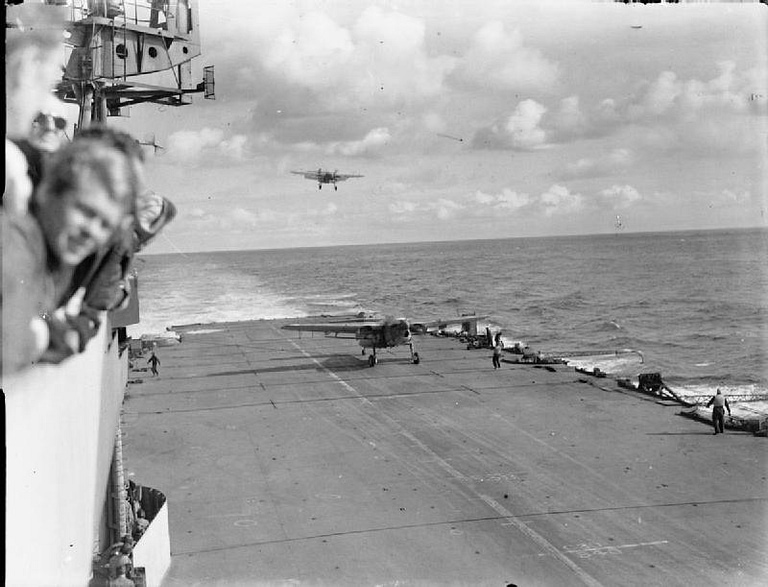
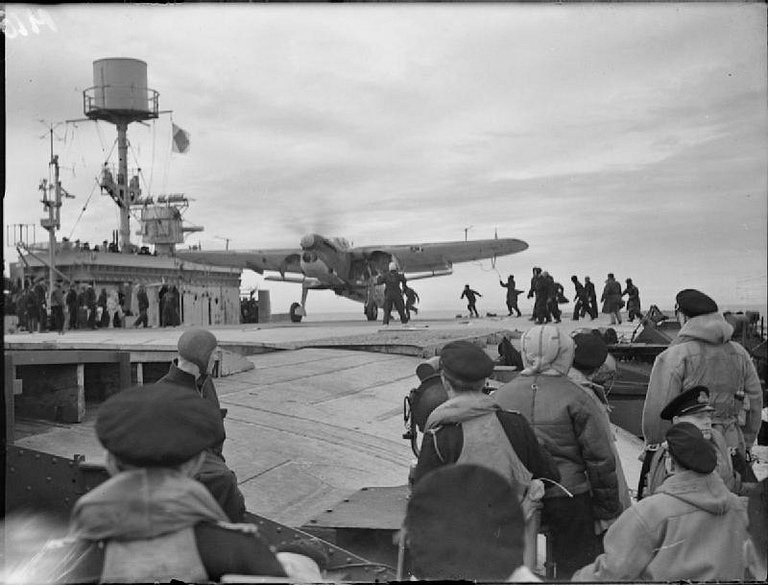
Operation Tungsten, 3 April 1944. This was the Barracuda’s finest hour. The German battleship Tirpitz, a constant threat to Arctic convoys, lay repairing in Kaafjord in northern Norway. Two waves of Barracudas — several dozen aircraft flying from Royal Navy carriers including HMS Victorious and HMS Furious, escorted by fighters — dive-bombed the ship at anchor. They scored around a dozen or more direct hits, killed and wounded hundreds of the crew and put Tirpitz out of action for months, all for very light losses. It was one of the most successful carrier strikes of the European war, and further Barracuda raids (Operations Mascot and Goodwood) followed through the summer.
The Pacific and Indian Ocean. With the Eastern Fleet and later the British Pacific Fleet, Barracudas struck Japanese-held oil facilities and airfields around Sumatra and at Sabang in 1944 (Operations Cockpit and Sunfish). Here the aircraft’s weaknesses showed: in tropical heat its performance, range and bomb load fell away, and it was progressively replaced by the American Grumman Avenger for Pacific operations.
Atlantic and Mediterranean. Barracudas, especially the radar-equipped Mk III, flew anti-submarine and convoy-protection patrols from escort carriers, and provided cover and strike for amphibious operations including the Salerno landings of September 1943. This maritime patrol work — long, cold, uneventful hours punctuated by sudden action — was arguably the aircraft’s most sustained contribution, even though it left almost no mark on popular memory. Keeping a convoy’s escort carrier air group flying in the North Atlantic was a grind of bad weather, pitching decks and constant vigilance, and the Barracuda, with its endurance, crew station and radar, was well suited to it.
After the war. The Barracuda was quickly overtaken. It soldiered on in second-line and training roles into the 1950s, and small numbers served briefly with the Royal Canadian Navy (aboard HMCS Warrior from 1946) and the French Aeronavale before disappearing almost entirely.
10Operation Tungsten in detail: how the Barracudas crippled the Tirpitz+
By early 1944 the Tirpitz, sister ship of the Bismarck, had been damaged by British midget submarines and was undergoing repairs in Kaafjord, a remote anchorage in the far north of Norway. Her mere existence tied down major Allied naval forces and threatened the Arctic convoys to Russia, so the Home Fleet planned a carrier strike to hit her before she could put to sea again.
The plan, Operation Tungsten, sent a powerful task force north in late March 1944. On the morning of 3 April two waves of Barracudas — roughly forty aircraft in total, drawn from several Naval Air Squadrons and flying from the fleet carriers HMS Victorious and HMS Furious, with the escort carriers providing fighters — swept in over the mountains at the moment the battleship was raising steam. Escorting American-built fighters (Corsairs, Hellcats and Wildcats) strafed the flak positions and the ship’s upper deck, keeping the German gunners’ heads down while the Barracudas dived.
Using their Youngman flaps to hold a steady, controlled dive, the Barracudas planted their bombs across the ship. Accounts differ on the exact tally, but something on the order of a dozen or more direct hits were scored for the loss of only a couple of aircraft. The bombs — a mix of armour-piercing and general-purpose types — could not penetrate the battleship’s main armoured deck, so Tirpitz was not sunk; but they wrecked her upper works, started fires, and killed and wounded several hundred of her crew. She was put out of action for around two months. It was, by any measure, one of the most effective carrier air strikes mounted in European waters, and it was flown by an aircraft the world remembers as a joke.
In Context
The Fairey Barracuda among its contemporaries
The Barracuda is best understood alongside the aircraft it replaced and those it flew beside. It succeeded the Fairey Swordfish and Albacore — both biplanes — and represented a genuine generational leap for the Fleet Air Arm, even if its looks and performance never inspired the affection the “Stringbag” Swordfish earned. Against the American Grumman TBF Avenger, the standard Allied carrier torpedo bomber of the later war, the Barracuda came off second best on range, load and reliability, which is why the Avenger increasingly took over front-line duties in the Pacific.
As a dive bomber it invites comparison with the American Douglas SBD Dauntless and Curtiss SB2C Helldiver; the Barracuda was slower and more lightly built but uniquely combined torpedo and dive-bombing roles in one carrier airframe. Its true peer group, though, is the small club of aircraft judged mainly on a single spectacular success: like the Doolittle B-25s or the Dam Busters’ Lancasters, the Barracuda is remembered above all for one operation — the strikes on Tirpitz.
It is worth pausing on the Japanese comparison too. The Imperial Japanese Navy’s carrier torpedo bomber, the Nakajima B5N “Kate”, was faster and longer-ranged than the Barracuda but far more lightly protected; the later B6N “Jill” narrowed the gap further. Set against these, the Barracuda’s modest performance looks less like British incompetence and more like the general truth that a single-engined carrier aircraft asked to do everything — torpedo, dive-bomb, scout and hunt submarines — will always be a compromise. Nations that specialised their carrier types tended to get better individual aircraft; Britain, short of resources and carrier deck space, asked one airframe to do the lot, and the Barracuda is what that philosophy produced.
There is also the question of what came next. The Barracuda’s intended Fleet Air Arm successor, the Fairey Spearfish, was a much larger and more powerful aircraft that never entered service, cancelled as the war ended and jet aircraft loomed. In that sense the Barracuda was the last of a line: the final British piston-engined carrier strike aircraft to see major service, standing at the very end of the era it had helped begin when it retired the biplanes.
Timeline
The Fairey Barracuda: a service history
Stories & Eyewitnesses
The Fairey Barracuda in the words of its war
Replacing a biplane in a hurry
Specification S.24/37 demanded a monoplane to replace the Swordfish and Albacore. Fairey’s answer was radical for the Fleet Air Arm — and would take years to reach the front line.
Lees meer
The requirement asked for torpedo attack, dive bombing, reconnaissance and more from one carrier aircraft. Meeting all of it at once helped produce the Barracuda’s famously awkward shape.
Trying to satisfy every role in one airframe is a recurring theme in naval aviation, and it almost always produces compromise; the Barracuda is one of the clearest examples of the pattern at work.
When the Exe was cancelled
The aircraft was drawn around the Rolls-Royce Exe. Its cancellation forced a redesign around the Merlin and set the programme back by years.
Lees meer
Rolls-Royce, overwhelmed by Merlin demand, abandoned the experimental Exe. The heavier, differently mounted Merlin left the Barracuda chronically short of power.
It is one of the great “what ifs” of British naval aviation: a Barracuda with the smooth, purpose-built engine it was designed for might have been remembered very differently.
7 December 1940
The prototype finally flew in December 1940, but front-line squadrons would not embark the type until 1943.
Lees meer
War-time priorities, the engine change and teething troubles all delayed the Barracuda’s path from prototype to operational service.
By the time it was ready, the shape of the war at sea had already shifted, and American aircraft were beginning to arrive in quantity — part of why the Barracuda always seemed to be catching up.
Losses no one could explain
Early in service, Barracudas were lost in unrecovered dives. The causes were argued over and never fully resolved.
Lees meer
Explanations ranged from control and hydraulic faults to aircrew blacking out under g. The losses were real and damaged confidence, but were not typical of the type’s whole career.
Contemporary investigations struggled to reproduce or pin down a single cause, and the episode remains one of the genuine unsolved questions in the Barracuda’s history — best treated with honesty rather than a tidy answer.
Operation Tungsten, 3 April 1944
Two waves of Barracudas dive-bombed the Tirpitz at anchor in a Norwegian fjord, scoring many hits.
Lees meer
Flying from HMS Victorious and Furious with fighter escort, the Barracudas left the battleship badly damaged and out of action for months, for the loss of very few aircraft.
The attack was pressed home just as the battleship was raising steam to move, catching her at her most vulnerable and demonstrating exactly what the Barracuda’s dive-bombing capability was for.
Mascot and Goodwood
After Tungsten, further Barracuda raids were flown against Tirpitz through the summer of 1944.
Lees meer
Heavier German defences and smoke screens made later strikes far less effective, and the job of finishing the ship eventually fell to RAF Lancasters with Tallboy bombs.
The contrast between Tungsten’s success and the later strikes’ frustration is a reminder of how much surprise and timing, not just the aircraft, decide the outcome of a raid.
Sumatra and Sabang
With the Eastern and British Pacific Fleets, Barracudas struck Japanese-held targets around Sumatra in 1944.
Lees meer
In tropical heat the aircraft’s performance, range and load fell away, and it was progressively replaced by the Grumman Avenger for Pacific work.
Operations Cockpit and Sunfish showed the Barracuda could reach and hit Japanese targets, but also exposed the hard limits that made the Avenger the better Pacific choice.
The radar-equipped Mk III
The Mk III carried air-to-surface radar in a belly radome for the patient work of anti-submarine patrol.
Lees meer
From escort carriers in the Atlantic and Mediterranean, radar Barracudas searched for surfaced U-boats by night and in poor weather — unglamorous but vital.
This was the Barracuda’s quiet, unrecorded war: long hours over grey water protecting convoys, a role that saved ships and lives without ever making the headlines.
Covering the landings
In September 1943 Barracudas helped provide carrier air cover for the Allied landings at Salerno.
Lees meer
Anti-submarine and spotting patrols over the Mediterranean were a staple of Barracuda work away from the headline strikes.
Supporting an amphibious landing meant flying constant defensive patrols to keep submarines and aircraft away from the invasion fleet — essential, exhausting and rarely remembered.
HMCS Warrior
The Royal Canadian Navy took about a dozen radar Barracuda Mk IIs into service with 825 Squadron from 1946.
Lees meer
The Canadian Barracudas served only briefly, embarking on HMCS Warrior before being returned to Britain in 1948.
The brief Canadian episode is a small footnote, but it shows the Barracuda’s reach extended, just, beyond the Royal Navy and beyond the war itself.
Griffon-engined Mk V
The post-war Mk V had a Rolls-Royce Griffon, a longer fuselage and a squared fin — but arrived too late to matter.
Lees meer
Only around three dozen Mk Vs were built as the type wound down; the Barracuda’s front-line days were already over.
The Mk V finally gave the airframe the power it had always lacked, but by 1945 the piston-engined carrier bomber was a dead end, and the jet age was already arriving on deck.
Why none survive
Retired quickly and championed by no one, the Barracuda was scrapped almost to extinction.
Lees meer
No complete original survives; the Fleet Air Arm Museum’s long reconstruction from wrecks is the nearest thing to a surviving Barracuda.
The near-total disappearance of an aircraft built in the thousands is a lesson in how quickly and completely the unloved can vanish once a war is over.
The Fairey Barracuda in Depth
The Fairey Barracuda: the questions people actually ask
06Was the Fairey Barracuda really that ugly — and did it matter?+
Yes, by common consent it was among the least elegant aircraft of the war, and crews joked about it freely. But the ungainliness was functional, not careless: every awkward line served a naval requirement. Looks did not stop it dive-bombing the Tirpitz with precision. If anything, the Barracuda is a useful reminder that combat aircraft are shaped by their jobs, not by aesthetics.
07What caused the Fairey Barracuda’s early fatal dives?+
This has never been settled definitively. Early in service a number of Barracudas dived into the ground or sea from which they did not recover. Contemporary and later explanations variously blamed hydraulic or control issues, aircrew becoming disoriented or losing consciousness under g in the dive, and the aircraft exceeding its limits. It is most honest to say the losses were real, alarming and probably multi-causal, and that they hurt the type’s reputation more than its overall combat record warranted. One point often missed is that the Barracuda was pushed into a demanding dive-bombing role that few naval crews had trained for, in an aircraft with unfamiliar handling near its limits; some of the early losses may owe as much to the steepness of that learning curve as to any single mechanical fault.
08How important was the Fairey Barracuda to the war against the Tirpitz?+
Very. The long campaign to neutralise Tirpitz involved midget submarines, RAF heavy bombers and the Fleet Air Arm. The Barracuda strike of April 1944 was the single most effective carrier attack in that campaign, inflicting serious damage and keeping the ship out of action for months at a stage when the RAF’s Tallboy raids had not yet finished her. It was a genuine strategic contribution.
11Was the Fairey Barracuda a torpedo bomber or a dive bomber?+
Both, which is exactly the point. The Barracuda was designed as a torpedo/dive/reconnaissance aircraft — the Fleet Air Arm wanted one airframe that could do all three. In practice it is remembered mainly as a dive bomber, because its most famous action, the Tirpitz strike, was flown as a dive-bombing attack using the Youngman flaps as air brakes. But it could and did carry an aerial torpedo, and it spent much of its career on reconnaissance and anti-submarine patrol. Pigeonholing it as one type of bomber misses what made it distinctive.
12How did the Fairey Barracuda perform in the tropics?+
Poorly, by common account. In the heat and humidity of the Indian Ocean and Pacific, the Merlin made less power and the wing generated less lift, so an aircraft that was only adequately powered in northern air became distinctly marginal. Range and bomb load fell — some sources cite a reduction in combat radius of roughly a third in tropical conditions — and this, more than anything, is why the British Pacific Fleet increasingly turned to the American Grumman Avenger. The Barracuda’s tropical weakness was a real operational limitation, not just a talking point.
13What made the Fairey Barracuda good at anti-submarine work?+
Endurance, a good crew station and, on the Mk III, radar. Anti-submarine patrol is a game of searching large empty areas patiently and then attacking quickly when a target appears. The Barracuda’s roomy observer’s position and excellent downward view suited the searching; its ASV radar let it find a surfaced U-boat by night or in cloud; and it could carry depth charges to press home the attack. Flown from small escort carriers, radar Barracudas did a great deal of this quiet, cold, dangerous convoy-protection work in the Atlantic and Mediterranean — a part of the aircraft’s record almost entirely overshadowed by the Tirpitz strikes.
14Why did the Grumman Avenger replace the Fairey Barracuda?+
Range, load and reliability — especially in the Pacific. The American Grumman Avenger was a larger, radial-engined torpedo bomber with a big two-row engine, long legs and a heavy load, and Britain received many under Lend-Lease. In the vast distances and tropical heat of the Pacific, where the Barracuda’s performance sagged, the Avenger’s advantages were decisive, and the British Pacific Fleet standardised on it for carrier strike. The Barracuda continued in home and second-line waters, but the front-line Pacific job passed to the Avenger.
More on the Fairey Barracuda
The Fairey Barracuda: legacy, survivors and myths
The Barracuda’s legacy is oddly quiet for an aircraft with such a dramatic high point. Because it was retired quickly, disliked by some of its crews and overshadowed by more glamorous types, almost none were preserved — a fate it shares with several worthy but unloved wartime aircraft. That near-total disappearance is itself part of the story: the Barracuda is the classic example of a machine that did serious work and then vanished from public memory.
Several myths cling to it. One is that it was simply a bad aeroplane; in truth it was a competent, strong, multi-role naval type hampered by a weak power-to-weight ratio and a difficult birth. Another is that it achieved nothing; the Tirpitz strikes alone disprove that. A third is that its accident record marks it as a death-trap; the early dive losses were serious but were not typical of its whole service life, much of which was unremarkable maritime patrol and strike work.
The Barracuda has, in recent years, begun a modest rehabilitation among aviation historians and enthusiasts — helped, ironically, by its very rarity. The Fleet Air Arm Museum’s reconstruction project has drawn fresh attention to an aircraft most people had forgotten, and a run of well-researched documentaries and articles has encouraged a more balanced view. The story that emerges is not one of triumph or disaster, but of a workmanlike, honestly flawed aircraft that did its job in a fast-moving war and then quietly disappeared — which is, in its way, more interesting than either the caricature or the whitewash.
If there is a single lesson in the Barracuda’s legacy, it is about how reputations form. An aircraft that looks graceful and is wrapped in glamour — the Spitfire, the Mustang — is remembered fondly almost regardless of the details. An aircraft that looks ungainly, arrives late and is retired quickly gets written off, even when it did serious work. The Barracuda is the standing example of the second category, and correcting the record on it is a small act of historical fairness.
09Why so few Fairey Barracudas survive today+
When the war ended, the Barracuda was already obsolescent. Unlike Spitfires or Swordfish, which attracted preservationists, the Barracuda had few champions; surplus airframes were scrapped, dumped or lost. As a result no complete original Barracuda exists anywhere in the world. What survives are recovered wrecks and salvaged components — enough, the Fleet Air Arm Museum hopes, to rebuild one representative aircraft over a long-running project.
Equipment & Operations
The Fairey Barracuda: crew, kit and how it was flown
A Barracuda went to war with three men. The pilot flew the aircraft and aimed the torpedo or bombs; the observer, seated in the middle under the long canopy with an excellent downward view, handled navigation, spotting and radio direction; the telegraphist air gunner worked the radio and manned the rear guns. On anti-submarine marks the observer also operated the ASV radar, hunting surfaced U-boats by night and in poor weather.
In the strike role the Barracuda could carry a standard 18-inch aerial torpedo slung beneath the fuselage, or a mix of bombs up to six 250-pounders, or depth charges and mines. Attacks were made either as a low torpedo run or, using the Youngman flaps as dive brakes, as a steep dive-bombing pass — the technique used against Tirpitz. Some aircraft carried flares for night work or an airborne lifeboat for air-sea rescue, underlining how much the Fleet Air Arm asked of a single airframe.
The torpedo attack and the dive-bombing attack asked almost opposite things of a crew. A torpedo run had to be flown low, straight and slow, holding a steady course toward the target while every gun in range concentrated on the approaching aircraft — the classic, nerve-shredding profile that had made the Swordfish crews of Taranto and the Bismarck chase famous. A dive-bombing attack, by contrast, meant hauling the aircraft up, rolling into a steep dive with the flaps braking the speed, holding the aim as the ship swelled in the sight, releasing, and pulling out hard before the sea or the flak got you. That the same aircraft and the same crews could do both is a real, if under-appreciated, tribute to the Barracuda’s flexibility.
Sitting behind it all was the observer’s navigation. Carrier operations depend on being able to find a small, moving airfield in a large, featureless ocean, often in bad weather and radio silence, after a strike that may have scattered the formation. The Barracuda’s roomy observer’s station, good downward visibility and, on radar marks, its ASV set made it a capable platform for exactly this kind of work — which is why so much of its actual career was spent not attacking battleships but flying long, patient reconnaissance, spotting and anti-submarine patrols that never made the newsreels.
Mark by Mark
The Fairey Barracuda, variant by variant and carrier by carrier
The Barracuda story runs mark by mark. The Mk I, underpowered with its Merlin 30, was really a service-test aircraft. The Mk II, with the Merlin 32 and a four-blade propeller, was the version that fought the important battles — it was Mk IIs that struck the Tirpitz from HMS Victorious and Furious. The radar-equipped Mk III, easily recognised by the bulged radome under its tail, specialised in the patient, unglamorous business of anti-submarine patrol from escort carriers. The Griffon-engined Mk V, longer and cleaner, came only at the very end and in tiny numbers.
Across those marks the Barracuda embarked on a long list of Royal Navy carriers — fleet carriers like Victorious, Furious, Formidable, Indefatigable and Illustrious, and smaller escort carriers — and served with numerous Naval Air Squadrons at home, in the Mediterranean and East of Suez. It was, for a couple of critical years, one of the standard aircraft of Britain’s carrier fleet.
Production was spread across four manufacturers to reach the numbers the Navy wanted. Fairey built the aircraft at its own works, but the bulk of Mk IIs and IIIs came from Blackburn and Boulton Paul, with Westland contributing a smaller share. This kind of dispersed, sub-contracted production was typical of Britain’s wartime aircraft industry, and it is one reason the exact total built is quoted differently by different sources — the paperwork of several firms and many contracts does not always add up neatly. The commonly seen figures of roughly 2,500 to 2,600 aircraft should be read as the best consensus rather than a precise count.
The Mk III’s radar deserves a note of its own. Fitting ASV (air-to-surface-vessel) radar in a radome under the rear fuselage turned the Barracuda from a daylight strike aircraft into an all-weather submarine hunter, able to find a surfaced U-boat at night or in cloud and then attack it with depth charges. It was slow, cold, exhausting work flown from small escort carriers in the Atlantic, and it never made headlines, but it was exactly the sort of maritime patrol that kept the convoys moving — and it is a side of the Barracuda’s career that the Tirpitz story tends to eclipse.
Squadrons & Crews
The Fairey Barracuda: squadrons, crews and the human story
Behind the specifications were the Fleet Air Arm squadrons and the young aircrew who flew from pitching decks in the Arctic and the tropics. Units such as Nos. 827, 829, 810, 847 and many others took the Barracuda into action; their crews learned to nurse a heavy aircraft off a short deck, to hold a steady dive under fire, and to trust an aeroplane that had, early on, killed some of their friends for reasons no one could fully explain. The strikes on Tirpitz were flown by ordinary naval airmen in their early twenties, pressing home dive attacks through flak in a fjord ringed by mountains.
That human context is why the Barracuda deserves more than a punchline about its looks. For the men who flew and maintained it, it was simply the tool they had — imperfect, demanding, but capable of doing something that mattered on the day it counted most.
The units themselves tell part of the story. Squadrons re-equipped from Swordfish and Albacores had to learn a wholly new kind of aircraft — monoplane handling, hydraulics, folding wings, dive-bombing technique — often at speed and under wartime pressure, before embarking to fight. Some worked up in the cold of home waters for the Norway strikes; others trained for the heat and distance of the Indian Ocean and Pacific. Each had to master not just the flying but the whole choreography of carrier operations with a big, heavy aircraft, from ranging and arming on a crowded deck to recovering a scattered strike in poor weather. It was, in every sense, a demanding aircraft to bring to war.
Deck crews had their own relationship with the aircraft. The Barracuda was tall, heavy and awkward to move, and ranging a deck full of them for a strike — folding and spreading wings, arming torpedoes and bombs, fuelling and marshalling in the cold spray of a northern morning — was hard, dangerous physical work. The observers, meanwhile, occupied a curious middle-of-the-aircraft world under the long canopy, surrounded by charts, radio and radar sets, largely trusting the pilot with their lives while they did the navigation that got the formation to a target the size of a ship in a fjord and back to a moving carrier afterwards. Naval aviation has always been a team effort, and the Barracuda, with its crew of three and its small army of deck and hangar personnel, was a particularly team-dependent aircraft.
It is also worth remembering how young everyone was. The pilots pressing home dive attacks on the Tirpitz through mountain-ringed flak, the observers hunched over their instruments, the gunners watching the sky astern — most were in their late teens or early twenties, trained at speed and thrown into some of the most demanding flying of the war. Whatever the aircraft’s failings, the standard of airmanship its crews reached in it was remarkable, and the type’s successes belong at least as much to them as to Fairey’s drawing office.
Anatomy
The Fairey Barracuda, part by part
Look past the awkward silhouette and the Barracuda is a logical piece of naval engineering, every part of it answering a requirement of carrier flying. The all-metal fuselage was a slab-sided box, deep enough to house three crew in tandem and strong enough to take the shock of arrested landings and steep dives. Behind the pilot sat the observer, the tactical brain of the aircraft, with charts, radio and — on radar marks — the ASV set; behind him, facing aft, the telegraphist air gunner worked the wireless and the rear guns. The long, framed “greenhouse” canopy that ran the length of this arrangement gave superb all-round and downward visibility, which mattered enormously for navigation and for spotting ships and submarines.
The wing was the aircraft’s defining feature. Mounted high on the shoulder to keep it and its flaps clear of a slung torpedo, it was an all-metal, two-spar structure that folded hydraulically outboard of the main spar so the aircraft could be struck down into a carrier’s hangar. Beneath it hung the Fairey-Youngman flaps — large auxiliary aerofoils on external arms that could be lowered for lift or angled down as dive brakes. It was these, more than anything, that gave the Barracuda its cluttered look and its unusual dual torpedo-and-dive-bomber capability.
The undercarriage was tall and narrow, sprung to absorb deck landings and set high to give the torpedo clearance; the tailwheel was likewise sturdy, for the aircraft sat markedly nose-up on the ground. The tail itself was carried high on the fin and braced with struts, keeping the horizontal surfaces out of the turbulent air shed by the wing and flaps — another sensible solution that added to the aircraft’s ungainly appearance. Under the belly and wings were the racks and crutches for the aircraft’s war load: a torpedo, bombs, depth charges, mines, flares, or the containers and lifeboats of the air-sea rescue role.
Powering all of this was a single Rolls-Royce Merlin, driving a three- or four-blade propeller depending on the mark, fed from fuel tanks in the fuselage and wings. It was a clean, conventional installation of an outstanding engine — and the fact that even so the aircraft was underpowered says everything about how much the Fleet Air Arm had asked one airframe to carry.
Photo Gallery
The Fairey Barracuda in photographs
On Film
The Fairey Barracuda on film
A concise, well-researched history of the Barracuda — its troubled development, its faults and its real achievements — from an established aviation-history channel.
“A Decent Plane With A Deadly Problem: Fairey Barracuda” by the aviation-history channel IHYLS (approximately 93,000 views at the time of writing). Chosen for its balanced, sourced treatment of the type’s reputation.
Operations Map
Where the Fairey Barracuda operated
Britain designed and flew the Barracuda; its war took it to Norway, the Mediterranean and the Indian Ocean and Pacific; and a handful served post-war with Canada and France. Toggle the categories to explore. (Combat markers show the theatre — where the fighting happened — not the home nation.)
Combat Record
The Fairey Barracuda’s war in numbers
Figures for a mass-produced wartime type are necessarily approximate; treat these as indicative of scale rather than exact.
Where to See One
Surviving Fairey Barracudas
There is no complete, original Fairey Barracuda anywhere in the world — a striking fact for an aircraft built in the thousands. None was set aside for preservation when the type was scrapped, and for decades the Barracuda existed only in photographs and in scattered relics.
Today the Fleet Air Arm Museum at Yeovilton is working to change that, assembling recovered wrecks and components — parts pulled from crash sites and the sea — into a single representative airframe. It is a long-term reconstruction rather than a restoration of one surviving aircraft, and it has been described as a years-long “giant jigsaw”. If it succeeds, it will give the public the only Barracuda they can stand in front of. Until then, the honest answer to “where can I see one?” is: nowhere intact yet — but a reconstruction is slowly taking shape.
The project draws on parts recovered over many years — airframe sections pulled from crash sites, components salvaged from the sea, and pieces held in store — combined with newly manufactured structure where nothing original survives. It is painstaking, expensive and slow, dependent on funding and volunteer expertise, and it has attracted public support including high-profile visits. Whether one calls the result a “survivor” is partly a matter of definition: it will be a genuine Barracuda assembled from real Barracuda parts, but not a single aircraft that came down through the decades intact. Either way, it will be the closest thing the world has to a complete example, and a fitting memorial to an aircraft that has been unfairly forgotten.
Legacy
The Fairey Barracuda’s place in naval aviation
Step back from the individual battles and the Barracuda occupies a specific, important place in the history of the Fleet Air Arm. It was the aircraft that finally took British naval aviation out of the biplane era for the strike role — the bridge between the fabric-and-wire world of the Swordfish and Albacore and the powerful, specialised carrier aircraft of the post-war years. For all its faults, that transitional role was genuinely significant: someone had to make the leap to the all-metal monoplane, and for the Royal Navy’s torpedo and dive-bombing squadrons, that aircraft was the Barracuda.
It also embodied a distinctly British approach to carrier aviation. Where the United States and Japan built specialised carrier aircraft — separate torpedo bombers, dive bombers and scouts — Britain, with fewer carriers, less deck space and stretched resources, tended to ask a single airframe to do everything. The Barracuda was the purest expression of that philosophy: torpedo bomber, dive bomber, reconnaissance aircraft and submarine hunter rolled into one ungainly package. That it did all of these jobs adequately, rather than any of them superbly, is a fair criticism of the individual aircraft — but also an honest reflection of the constraints the Royal Navy worked under.
Finally, the Barracuda stands as a reminder that the aircraft history remembers are not always the ones that mattered most on a given day. The Swordfish is loved, the Spitfire adored, the Avenger respected; the Barracuda is mocked or forgotten. Yet on 3 April 1944 it was a force of Barracudas, not any of those more famous types, that flew into a Norwegian fjord and crippled the most powerful warship in the German navy. An aircraft capable of that has earned its place in the record, whatever it looked like.
In the End
The Fairey Barracuda: how history should remember it
The Fairey Barracuda is easy to caricature: ugly, late, underpowered, prone to mysterious crashes, and gone almost without trace. Each charge holds some truth. But reduce the aircraft to those faults and you miss the point. This was the machine that dragged the Fleet Air Arm out of the biplane age, that could carry a torpedo one day and dive-bomb a battleship the next, and that on 3 April 1944 flew into a Norwegian fjord and left the mightiest ship in the German navy crippled at her moorings.
Remember it, then, not as a failure but as an honest, hard-working aircraft asked to do a great deal with too little power — and which, on its best day, did something that genuinely mattered.
There is a neat symmetry to the Barracuda’s place in history. It began by retiring the biplanes, the last of the fabric-and-wire generation that had carried the Fleet Air Arm into the war, and it ended as the last major British piston-engined carrier strike aircraft, retired in its turn as jets took over the decks. For a few short years in the middle it was the aircraft in the middle of that transition — modern enough to matter, old-fashioned enough to be overtaken — and it spent them working hard in every ocean the Royal Navy fought in. Not many aircraft that people remember as failures can say as much.
So the next time the Barracuda comes up as the punchline to a joke about ugly aeroplanes, it is worth remembering the fjord at Kaafjord on the morning of 3 April 1944, and the young naval airmen who took that awkward, underpowered, unloved machine down through the flak and left the pride of the German surface fleet burning at her moorings. History could afford to be a little kinder to the Fairey Barracuda.
Questions & Answers
Fairey Barracuda: your questions answered
Can I fly in a Fairey Barracuda?
No. No complete, airworthy Fairey Barracuda exists anywhere — not a single original survives intact, and the only example being assembled (from recovered wrecks by the Fleet Air Arm Museum) is a static reconstruction, not a flyable aircraft. There is no way to book a flight in a Barracuda, and MiGFlug does not offer one.
However, you can fly in genuine ex-military aircraft today — from jet warbirds to fighter jets. See what you can actually fly at migflug.com/flights-prices.
Why was the Fairey Barracuda considered so ugly?
Its awkward look came from combining hard naval requirements in one airframe: a high shoulder wing, tall undercarriage for torpedo clearance, a strut-braced high tailplane and large under-wing flaps. Each feature was functional, but together they produced an angular, ungainly aeroplane that crews cheerfully mocked.
What was the Fairey Barracuda’s most famous mission?
Operation Tungsten on 3 April 1944, when carrier-borne Barracudas dive-bombed the German battleship Tirpitz in Kaafjord, Norway. They scored numerous direct hits and put the ship out of action for months for very light losses — one of the most successful carrier strikes of the European war.
Why did the Fairey Barracuda use a Rolls-Royce Merlin?
It was not the original plan. The aircraft was designed around the Rolls-Royce Exe sleeve-valve engine; when that was cancelled, the Merlin was substituted. The Merlin was excellent, but for such a heavy naval aircraft it left the Barracuda somewhat underpowered, especially in tropical heat.
How many Fairey Barracudas were built?
Sources vary, but the total is commonly cited as roughly 2,500 to 2,607 across all marks, built by Fairey, Blackburn, Boulton Paul and Westland. The Mk II was by far the most numerous version.
Did the Fairey Barracuda serve outside the Royal Navy?
Yes, briefly and in small numbers after the war. The Royal Canadian Navy operated about a dozen radar-equipped Mk IIs from 1946, and the French Aeronavale used a few in second-line roles. The overwhelming majority of Barracudas, however, served with Britain’s Fleet Air Arm.
Are any Fairey Barracudas left today?
No complete original survives. The Fleet Air Arm Museum is rebuilding one from recovered wrecks and salvaged parts — a long-term reconstruction project — so in time there may be a single representative airframe to see, but there is currently no intact Barracuda on display and none that flies.
How fast was the Fairey Barracuda?
The most numerous version, the Mk II, had a maximum speed of roughly 228 mph (about 367 km/h) at its best altitude and weight — and appreciably less when fully loaded or flying in tropical heat. By the standards of mid-war monoplanes it was slow, which is one of the fair criticisms of the type; it was never going to outrun trouble, and relied instead on fighter escort, surprise and its dive-bombing accuracy.
Who designed and built the Fairey Barracuda?
The Barracuda was designed by the Fairey Aviation Company to Air Ministry Specification S.24/37. Because the Navy needed large numbers, production was shared among four firms: Fairey itself, plus Blackburn, Boulton Paul and Westland. This spread of manufacturers is one reason the exact number built is quoted slightly differently in different sources.
What replaced the Fairey Barracuda?
In front-line Pacific service the Barracuda was largely replaced by the American Grumman Avenger, which had better range and load. Its intended British successor, the larger Fairey Spearfish, was cancelled at the end of the war as jets arrived, so the Barracuda was effectively the last of the Royal Navy’s wartime piston-engined carrier strike aircraft, lingering in second-line roles into the 1950s before disappearing.
Did the Fairey Barracuda sink the Tirpitz?
No — but it came closer than anything else for a long time. During Operation Tungsten on 3 April 1944, Barracudas scored numerous bomb hits that badly damaged the battleship and put her out of action for around two months, though their bombs could not penetrate her main armoured deck to sink her. The Tirpitz was finally destroyed later in 1944 by RAF Lancasters dropping Tallboy bombs. The Barracuda’s contribution was to cripple, not sink, her — which at that point in the war was itself a major achievement.
You can’t fly the Fairey Barracuda. These, you can.
No Barracuda survives to fly — but MiGFlug puts you in the cockpit of genuine military jets and warbirds, from Cold War trainers to supersonic fighters. Real aircraft, real pilots, real afterburner.
Fighter Jet Flights
Take the controls of a real ex-military jet with an experienced fighter pilot.
L-39 Albatros
The classic jet trainer — aerobatics and low-level fun, in several countries.
MiG-29 Fulcrum
Ride a genuine air-superiority fighter toward the edge of space.
Related Aircraft
More from the Aircraft Museum
 Fairey SwordfishThe fabric biplane “Stringbag” the Barracuda was built to replace — and which outlived it in service.
 Fairey FireflyFairey’s two-seat naval fighter-reconnaissance aircraft, another Fleet Air Arm all-rounder.
 Vought F4U CorsairThe bent-wing American carrier fighter that flew alongside British types in the Pacific.
Sources & Further Reading
Fairey Barracuda: sources and further reading
Photographs are public-domain Royal Navy / Fleet Air Arm official images or Creative Commons works via Wikimedia Commons, credited individually in each caption. Specifications and production figures vary between sources and are given as representative, hedged values rather than definitive numbers.