

Avro 504
The Avro 504: from Friedrichshafen raider to the world’s flying classroom
Some aircraft are remembered for a single spectacular moment. The Avro 504 is remembered for two utterly different careers, lived one after the other. It began the First World War as a front-line machine and one of the pioneers of strategic bombing, and it ended the 1920s as the aeroplane on which most British and Commonwealth pilots had first learned to fly. Between those two roles lies one of the longest and most influential production runs in aviation history.
The design came from Alliott Verdon Roe, whose company Avro had been building aircraft since 1909. When his new two-seat biplane first flew in September 1913, it was strikingly clean and well-mannered for its day: tandem cockpits, a rotary engine, and handling gentle enough that a nervous pupil could be talked through a mistake rather than killed by it. That temperament would define everything the 504 became.
War came within a year. In November 1914, three Royal Naval Air Service 504s flew from eastern France to bomb the Zeppelin sheds at Friedrichshafen on Lake Constance — one of the earliest strategic air raids ever attempted. Over the Western Front, 504s flew reconnaissance and light bombing, and one is frequently named as the first British aeroplane brought down by ground fire. Later, stripped-out single-seat versions climbed into the night sky over Britain to hunt German airships as improvised Home Defence fighters.
But it was as a teacher that the 504 changed the world. In 1917 Robert Smith-Barry built his revolutionary School of Special Flying at Gosport around it, replacing terrifying trial-and-error with a real syllabus: spins practised deliberately, recoveries rehearsed, instructor and pupil talking through a speaking tube between the cockpits. The Gosport system spread across the globe, and the forgiving, aerobatic 504 was the aircraft that made it work.
Because it was simple to build and could take almost any available rotary engine, the 504 was produced in staggering numbers — more than 8,000 in wartime Britain alone, with total output across all variants and countries commonly estimated at around ten thousand or more. It was exported and licence-built from Canada to Japan, copied wholesale by the Soviet Union as the U-1, and, after the Armistice, sold off cheaply to become the definitive barnstorming and joy-riding aeroplane of the 1920s. Re-engined with a radial as the 504N, it soldiered on in RAF service into the early 1930s.
Today a handful still fly, most famously the Shuttleworth Collection’s 1918 original. When it drifts across the airfield at Old Warden, it is not just an old aeroplane — it is the direct ancestor of every structured flying lesson given since.
It is worth pausing on just how strange the 504’s career is. Most military aircraft are obsolete within a few years; the 504 was ordered, built and flown across roughly two decades, spanning the transition from the fragile stringbags of 1913 to the metal monoplanes looming at the end of its life. It began before the tank and the practical machine-gun-armed fighter existed, and it was still training RAF pilots when Frank Whittle was sketching the jet engine. Very few machines bridge so much change, and fewer still stay relevant across it by doing one thing supremely well.
That one thing was making pilots. It is easy, looking back, to be seduced by the fighters and the aces and to overlook the aircraft that quietly stood behind them all. But an air force is only as good as its aircrew, and aircrew have to be made somewhere, by someone, on something. For a decisive span of aviation history, that ‘something’ was the Avro 504, and the ‘somewhere’ was a training system — Gosport — built around it. Strip the 504 out of the story and you do not just lose a nice biplane; you lose the machine that industrialised the production of pilots at the exact moment the world first needed them in their thousands.
There is also something quietly democratic about the 504’s legacy. It did not only make military pilots; through the barnstorming boom it introduced flight to the general public, and through export and licence-build it did the same job for air forces and flying clubs on nearly every continent. It was, for a while, the shared starting point of world aviation — a common ancestor that a remarkable proportion of interwar pilots, in a remarkable number of countries, could trace their first hours to. That is a rare kind of importance, and it is why the 504 deserves a place in this museum every bit as much as the fighters whose pilots it trained.
01The Avro 504’s two lives: why one aeroplane was both a combat pioneer and a classroom
It is genuinely unusual for one aircraft type to matter twice, for opposite reasons. In 1914 the 504 was a weapon: a raider over Friedrichshafen, a reconnaissance and bombing machine over the Western Front, and a night hunter of Zeppelins. By 1918 it was something quieter but arguably more important — the standard on which pilots were made. Historians tend to conclude that its training legacy outweighs its combat record, precisely because that legacy compounds: every well-trained pilot went on to fly, and often to teach, others. The 504 did not win battles so much as build the people who did.
That dual identity is why museums display surviving 504s in such different guises — some in the drab of a Home Defence night fighter, others in the bright dope and roundels of a training school. Both are true. Keep the contrast in mind as you read on: nearly every technical choice in the design served the goal of making a safe, teachable, endlessly reproducible aeroplane.
How the Avro 504 was built to be forgiving, teachable and endlessly reproducible
A gentle rotary and honest handling
The 504’s rotary engine and well-balanced controls gave it docile, predictable behaviour and genuine aerobatic ability. It would spin when asked and recover cleanly — exactly what an instructor needs to demonstrate danger safely.
Built around the Gosport method
Tandem cockpits with dual controls and a speaking tube let an instructor fly with a pupil and actually talk to them. The 504 was the physical platform for Smith-Barry’s structured teaching system.
Simple wood, fabric and a universal engine mount
Spruce, ash and doped linen made the 504 cheap and fast to build and repair. The 504K’s universal mounting accepted several different rotaries, freeing production from any single engine supply.
02The Avro 504’s rotary engine: how a spinning-cylinder motor shaped the way it flew
A rotary engine is a curiosity today: the whole cylinder block spins with the propeller around a fixed crankshaft. That mass of whirling metal produced strong gyroscopic effects a pupil had to learn to anticipate, and the engines were controlled as much by a fuel/air ‘blip’ switch as by a throttle. On the 504 these quirks were mild enough to teach on and characterful enough to teach with — a student who mastered a Le Rhone-powered 504 was well prepared for the temperamental fighters ahead. The common wartime engines were the Gnome, the Le Rhone and the Clerget, broadly in the 80 to 130 horsepower range depending on variant. Exact outputs vary by source and sub-type, so treat specific numbers as approximate.
Crucially for a training aeroplane, the rotary’s behaviour on the 504 was character without cruelty. The gyroscopic effect meant turns in one direction came more readily than the other, and the pupil learned to feel and correct for it; the lack of a conventional throttle taught careful engine management from the very first hour. These were exactly the habits a pilot would need on the far more demanding rotary-engined fighters of the day, so the 504 did double duty: it kept a beginner alive while quietly rehearsing the reflexes of the front line. Managing the engine well — nursing the oil, blipping the ignition on the approach, judging the glide with a windmilling prop — was part of the curriculum, not an obstacle to it.
03The Gosport system and the Avro 504: the teaching revolution that outlived the aeroplane
Before 1917, flying instruction was often lethally casual. Robert Smith-Barry’s School of Special Flying at Gosport changed that by treating instruction as a skill in its own right. Pupils were deliberately taught to enter and recover from spins and stalls; instructors communicated through a simple speaking tube (the ‘Gosport tube’) between cockpits; and a genuine syllabus replaced guesswork. The Avro 504 was the aircraft this system was built on, because it was safe, aerobatic and forgiving enough to make deliberate practice of dangerous manoeuvres survivable. The method spread worldwide and shaped pilot training for decades — a legacy that outlived the aeroplane itself.
What made Gosport revolutionary was not any single trick but the shift in philosophy: instruction became a discipline to be studied and taught in its own right, with instructors themselves trained in how to train. Pupils were shown the aeroplane’s limits deliberately and repeatedly, until a spin was a manoeuvre to be managed rather than a death sentence. The 504 was inseparable from this because the method only works if the aircraft is forgiving enough to survive the deliberate mistakes — and honest enough that the lessons transfer. Long after the last 504 left the flight line, the assumptions baked into Gosport — dual controls, a real syllabus, spin awareness, clear instructor-pupil communication — remained the bedrock of how the world teaches people to fly.
04The Avro 504’s structure: spruce, ash and doped linen, and why simplicity mattered
The 504 was a wood-and-fabric aeroplane of its time: a wire-braced wooden box girder fuselage, two-bay wings built up from spruce spars and ribs, and a skin of Irish linen shrunk tight and weatherproofed with dope. There was nothing exotic about it, and that was the point. It could be built quickly in quantity by furniture-makers and sub-contractors, repaired in the field with basic materials, and rigged by mechanics who had learned on it. That simplicity, more than any single clever feature, is why the type could be produced in the thousands and kept flying for twenty years.
Simplicity also made the 504 forgiving to own as well as to fly. A damaged rib or a torn panel of fabric could be repaired by a skilled mechanic with everyday materials rather than replaced from a distant factory, and the modular, wire-braced structure could be rigged and re-rigged as needed. For a training unit flying hundreds of hours a week with inevitable heavy landings, that repairability was as valuable as any performance figure. The aeroplane was designed, in effect, to be knocked about and put right again — which is exactly what a machine used to teach beginners has to endure.
Avro 504K specifications, dimensions and cost data
| Tipo | Two-seat biplane trainer / general-purpose aircraft |
|---|---|
| Manufacturer | A.V. Roe & Co. (Avro) and many sub-contractors |
| First flight | 18 September 1913 |
| Equipe | 2 (instructor & pupil, tandem, dual controls) |
| Engine (504K) | One rotary — e.g. 110 hp Le Rhone 9J, or Gnome / Clerget (universal mount) |
| Power | ~80–130 hp depending on engine (estimate) |
| Engine (504N) | Air-cooled radial: Armstrong Siddeley Lynx (~180 hp) |
| Envergadura | ~36 ft (10.97 m) |
|---|---|
| Comprimento | ~29 ft 5 in (8.97 m) |
| Altura | ~10 ft 5 in (3.17 m) |
| Peso vazio | ~1,230 lb (560 kg), approx. |
| Max speed | ~90–110 mph (145–180 km/h), engine-dependent (estimate) |
| Armament (when fitted) | Light: small bombs (early war); one upward-firing Lewis gun (Home Defence) |
| Cost per flight hour | Not reliably recorded (WWI-era aircraft) |
| Avro 504 (1913) | Original two-seat biplane; pre-war sporting and record machine, then early military service. |
|---|---|
| 504A / 504B / 504C | Wartime sub-types for reconnaissance, naval and single-seat anti-airship duties, with detail changes to wings, tanks and equipment. |
| 504J | Dedicated trainer variant that helped standardise wartime flight instruction. |
| 504K | Definitive WWI trainer with a universal engine mounting accepting several rotaries (Gnome / Le Rhone / Clerget); the most-produced version. |
| 504N | Interwar rebuild with an air-cooled Armstrong Siddeley Lynx radial and revised undercarriage; RAF trainer into the early 1930s. |
| U-1 / MU-1 (USSR) | Soviet copy of the 504K, mass-produced without licence as the standard 1920s primary trainer; MU-1 was the floatplane version. |
Variant boundaries and production totals vary between sources; figures on this page are given as estimates and hedged accordingly.
05Avro 504 variants: from the 504A to the 504K and the radial-engined 504N
The 504 evolved continuously. Early sub-types (504A, 504B, 504C and others) covered reconnaissance, naval and single-seat anti-airship roles with detail changes to wings, tanks and equipment. The 504J became a dedicated trainer, and the 504K — the definitive wartime version — added a universal engine mounting so it could take several different rotaries as supplies allowed. In the 1920s the 504N replaced the rotary with an air-cooled Armstrong Siddeley Lynx radial and modernised the undercarriage, keeping the type in RAF service into the early 1930s. In the Soviet Union the design was mass-produced as the U-1 (and floatplane MU-1). Exact variant boundaries and production totals differ between sources.
06The Avro 504’s operating costs: what a 1910s trainer really cost to run
Meaningful modern-style cost-per-hour figures simply do not exist for a First World War trainer, so any precise number would be invented. What can be said is qualitative: the 504 was deliberately cheap. It was built from common woods and fabric by a wide network of sub-contractors, used relatively low-powered engines, and was easy to repair in the field. That low cost of ownership was itself a strategic feature — it is exactly why so many could be built and kept flying, and why surplus examples were affordable enough after 1918 to create the barnstorming boom. In our cost data the per-hour row is therefore marked ‘not reliably recorded (WWI)’.
The Avro 504 timeline: 1913 to today
A.V. Roe’s new two-seat biplane makes its maiden flight at Brooklands on 18 September 1913.
504s enter service; on 21 November three RNAS machines bomb the Zeppelin works at Friedrichshafen — one of the first strategic air raids. A 504 is also often cited as the first British aeroplane downed by ground fire.
Single-seat conversions with an upward-firing Lewis gun are used against German airships over Britain.
Robert Smith-Barry builds his School of Special Flying around the 504, revolutionising pilot training.
The universal-engine 504K becomes the standard trainer; over 8,000 504s are built in Britain during the war.
The USSR mass-produces the design as the U-1; surplus 504s flood the civil market as joy-riding and barnstorming aircraft worldwide.
The Lynx-engined 504N keeps the type in RAF training service into the early 1930s — about two decades after the prototype flew.
Museums preserve 504s worldwide; the Shuttleworth Collection’s 1918 original still flies at Old Warden.
Twelve stories from the Avro 504’s long life
The first flight, 1913
A.V. Roe’s clean new biplane
When the prototype Avro 504 first flew at Brooklands on 18 September 1913, it was one of the most refined aeroplanes in the world: a slim two-bay biplane with a rotary engine, tandem cockpits and genuinely pleasant handling at a time when many machines were barely controllable. Leia mais
When the prototype Avro 504 first flew at Brooklands on 18 September 1913, it was one of the most refined aeroplanes in the world: a slim two-bay biplane with a rotary engine, tandem cockpits and genuinely pleasant handling at a time when many machines were barely controllable. Leia mais
Friedrichshafen, 21 November 1914
One of history’s first air raids
Three Royal Naval Air Service Avro 504s took off from Belfort in eastern France and flew roughly 120 miles to bomb the Zeppelin airship works at Friedrichshafen on Lake Constance. It is remembered as one of the earliest strategic bombing raids ever mounted. Leia mais
Three Royal Naval Air Service Avro 504s took off from Belfort in eastern France and flew roughly 120 miles to bomb the Zeppelin airship works at Friedrichshafen on Lake Constance. It is remembered as one of the earliest strategic bombing raids ever mounted. Leia mais
The first British aeroplane lost to ground fire
A contested distinction
An Avro 504 of the Royal Flying Corps is frequently cited as the first British aircraft brought down by enemy fire from the ground, in the opening weeks of the war over the Western Front. Leia mais
An Avro 504 of the Royal Flying Corps is frequently cited as the first British aircraft brought down by enemy fire from the ground, in the opening weeks of the war over the Western Front. Leia mais
Home Defence against the Zeppelins
A night fighter, briefly
As German airships raided Britain, some Avro 504s were stripped to single-seaters, fitted with an upward-firing Lewis gun and sent up at night to hunt Zeppelins. It was a stopgap role, but a real one. Leia mais
As German airships raided Britain, some Avro 504s were stripped to single-seaters, fitted with an upward-firing Lewis gun and sent up at night to hunt Zeppelins. It was a stopgap role, but a real one. Leia mais
The Gosport system
How a generation learned to fly
In 1917 Major Robert Smith-Barry set up the School of Special Flying at Gosport and built his revolutionary teaching method around the Avro 504. Speaking tubes between the cockpits, deliberate practice of spins and recoveries, and a structured syllabus replaced the old sink-or-swim approach. Leia mais
In 1917 Major Robert Smith-Barry set up the School of Special Flying at Gosport and built his revolutionary teaching method around the Avro 504. Speaking tubes between the cockpits, deliberate practice of spins and recoveries, and a structured syllabus replaced the old sink-or-swim approach. Leia mais
The 504K: one airframe, many engines
A wartime production masterstroke
The definitive wartime trainer, the 504K, had a universal engine mounting that could take almost any available rotary — Gnome, Le Rhone or Clerget — so squadrons were no longer held hostage to any single engine’s supply. Leia mais
The definitive wartime trainer, the 504K, had a universal engine mounting that could take almost any available rotary — Gnome, Le Rhone or Clerget — so squadrons were no longer held hostage to any single engine’s supply. Leia mais
The Soviet U-1 ‘Avrushka’
Built by the thousand, without a licence
After 1918 the young Soviet aircraft industry reverse-engineered the 504K and put it into mass production as the U-1 (a floatplane version was the MU-1). Nicknamed the ‘Avrushka’, it became the standard Red Air Force primary trainer of the 1920s. Leia mais
After 1918 the young Soviet aircraft industry reverse-engineered the 504K and put it into mass production as the U-1 (a floatplane version was the MU-1). Nicknamed the ‘Avrushka’, it became the standard Red Air Force primary trainer of the 1920s. Leia mais
Licence-built around the world
From Denmark to Japan
The 504 was manufactured under licence and assembled far beyond Britain — in Denmark, and in Japan by Nakajima, whose 504-derived machines seeded early Imperial Japanese Navy flight training and led on to types such as the K2Y. Leia mais
The 504 was manufactured under licence and assembled far beyond Britain — in Denmark, and in Japan by Nakajima, whose 504-derived machines seeded early Imperial Japanese Navy flight training and led on to types such as the K2Y. Leia mais
Barnstormers and joy-rides
The aeroplane that sold flight to the public
When the war ended, surplus 504s flooded the civil market. Cheap, docile and roomy, they became the classic barnstorming and joy-riding machine, giving hundreds of thousands of ordinary people their very first flight in the 1920s. Leia mais
When the war ended, surplus 504s flooded the civil market. Cheap, docile and roomy, they became the classic barnstorming and joy-riding machine, giving hundreds of thousands of ordinary people their very first flight in the 1920s. Leia mais
The 504N Lynx
The radial-engined survivor
In the 1920s the RAF re-engined the design with an air-cooled radial (the Armstrong Siddeley Lynx) as the 504N. It kept the type in RAF service as a trainer into the early 1930s — roughly two decades after the prototype first flew. Leia mais
In the 1920s the RAF re-engined the design with an air-cooled radial (the Armstrong Siddeley Lynx) as the 504N. It kept the type in RAF service as a trainer into the early 1930s — roughly two decades after the prototype first flew. Leia mais
Reach for the Sky and the film world
A movie star in old age
One preserved 504 was restored to K specification for the 1956 film ‘Reach for the Sky’, the story of Douglas Bader. Vintage 504s have appeared in film and pageant flying ever since, their slow, graceful flight perfect on camera. Leia mais
One preserved 504 was restored to K specification for the 1956 film ‘Reach for the Sky’, the story of Douglas Bader. Vintage 504s have appeared in film and pageant flying ever since, their slow, graceful flight perfect on camera. Leia mais
Still flying today
Airworthy after more than a century
Several Avro 504s survive, and a handful are airworthy — most famously the Shuttleworth Collection’s 1918 original at Old Warden, which still displays alongside a modern-built replica. Static examples are held by the RAF Museum, IWM Duxford and museums in Canada, Australia and beyond. Leia mais
Several Avro 504s survive, and a handful are airworthy — most famously the Shuttleworth Collection’s 1918 original at Old Warden, which still displays alongside a modern-built replica. Static examples are held by the RAF Museum, IWM Duxford and museums in Canada, Australia and beyond. Leia mais
The Avro 504 in photographs
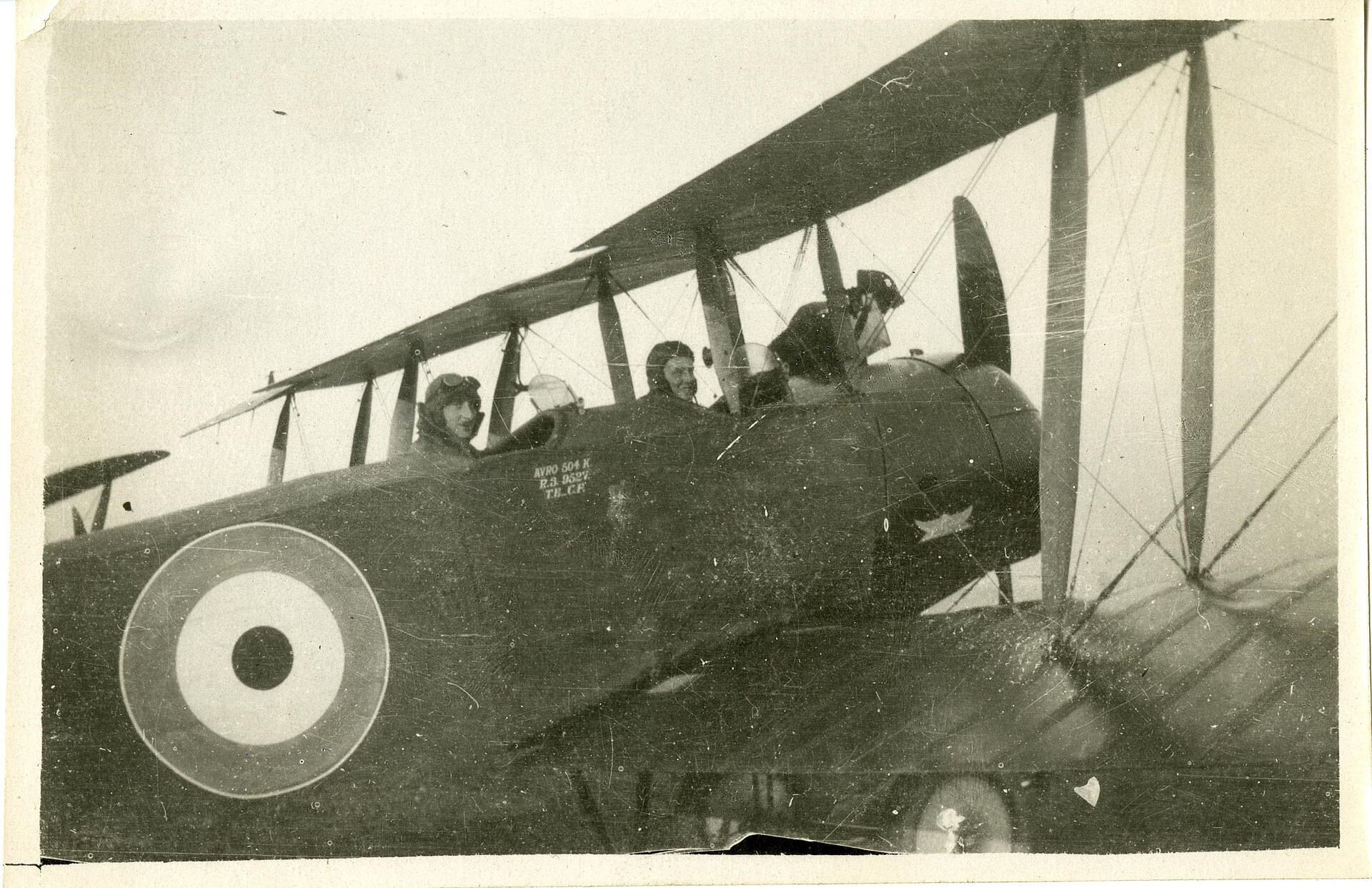
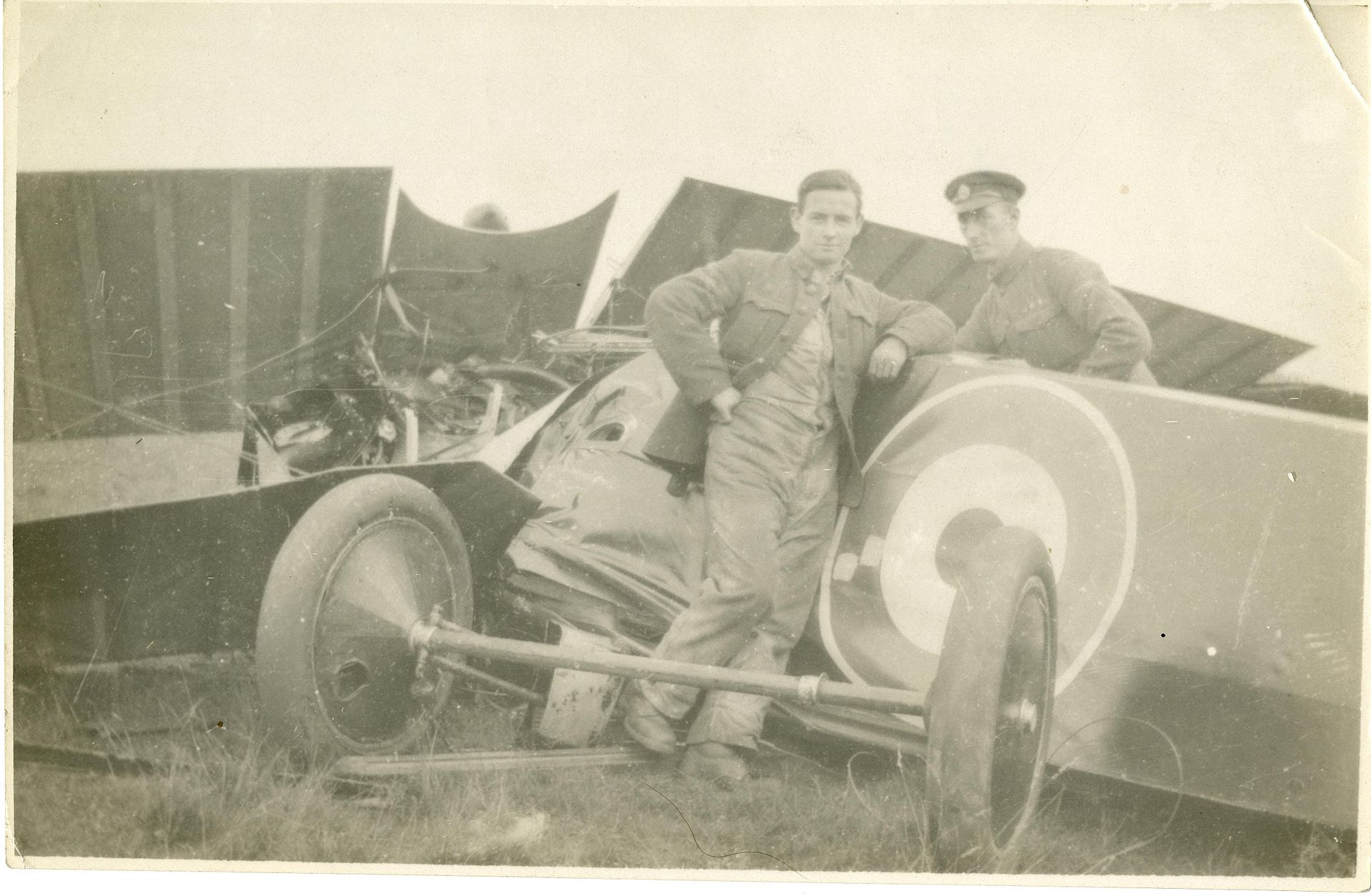
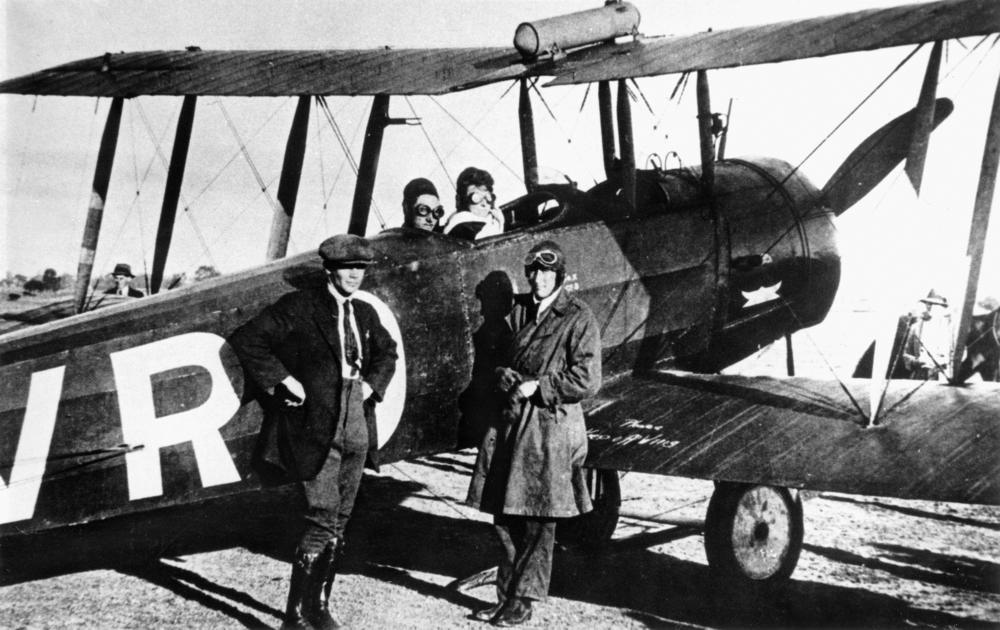
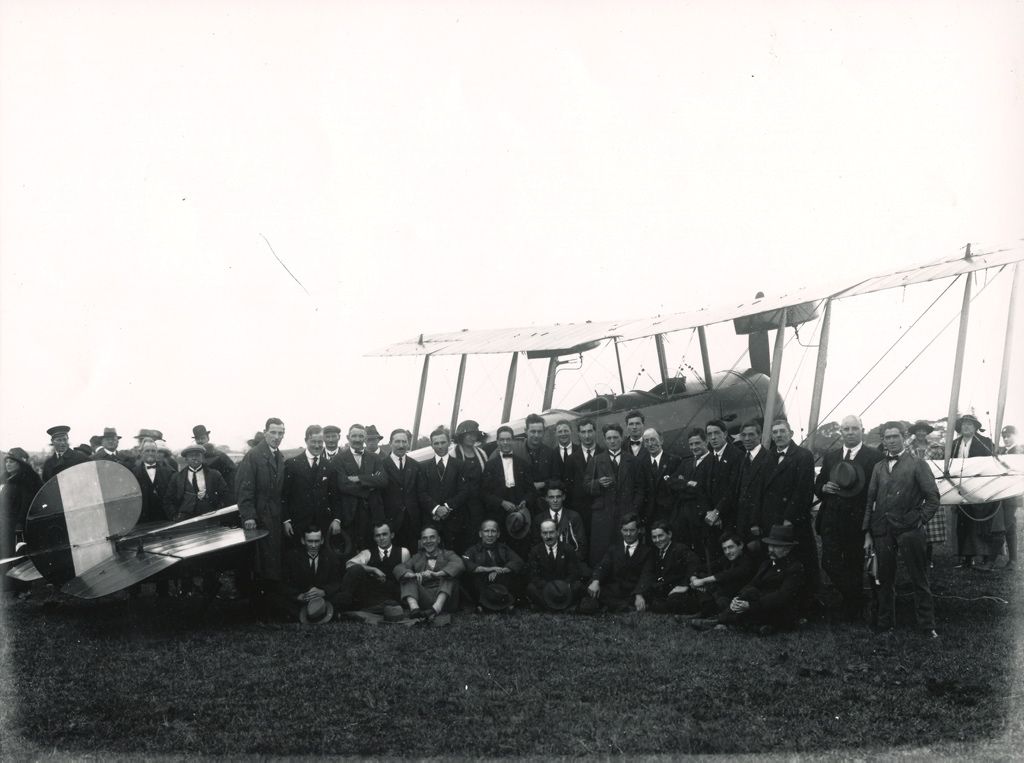
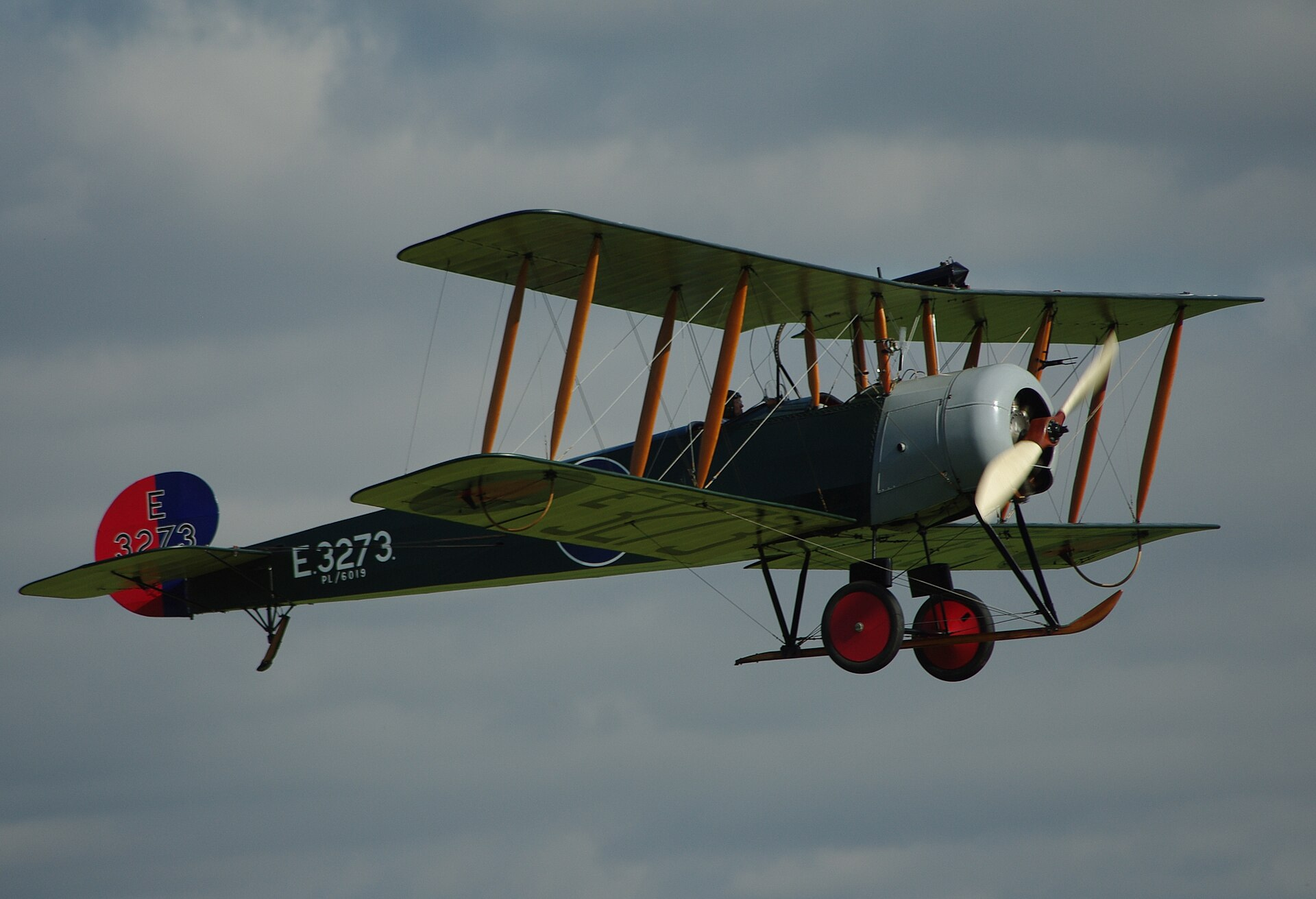
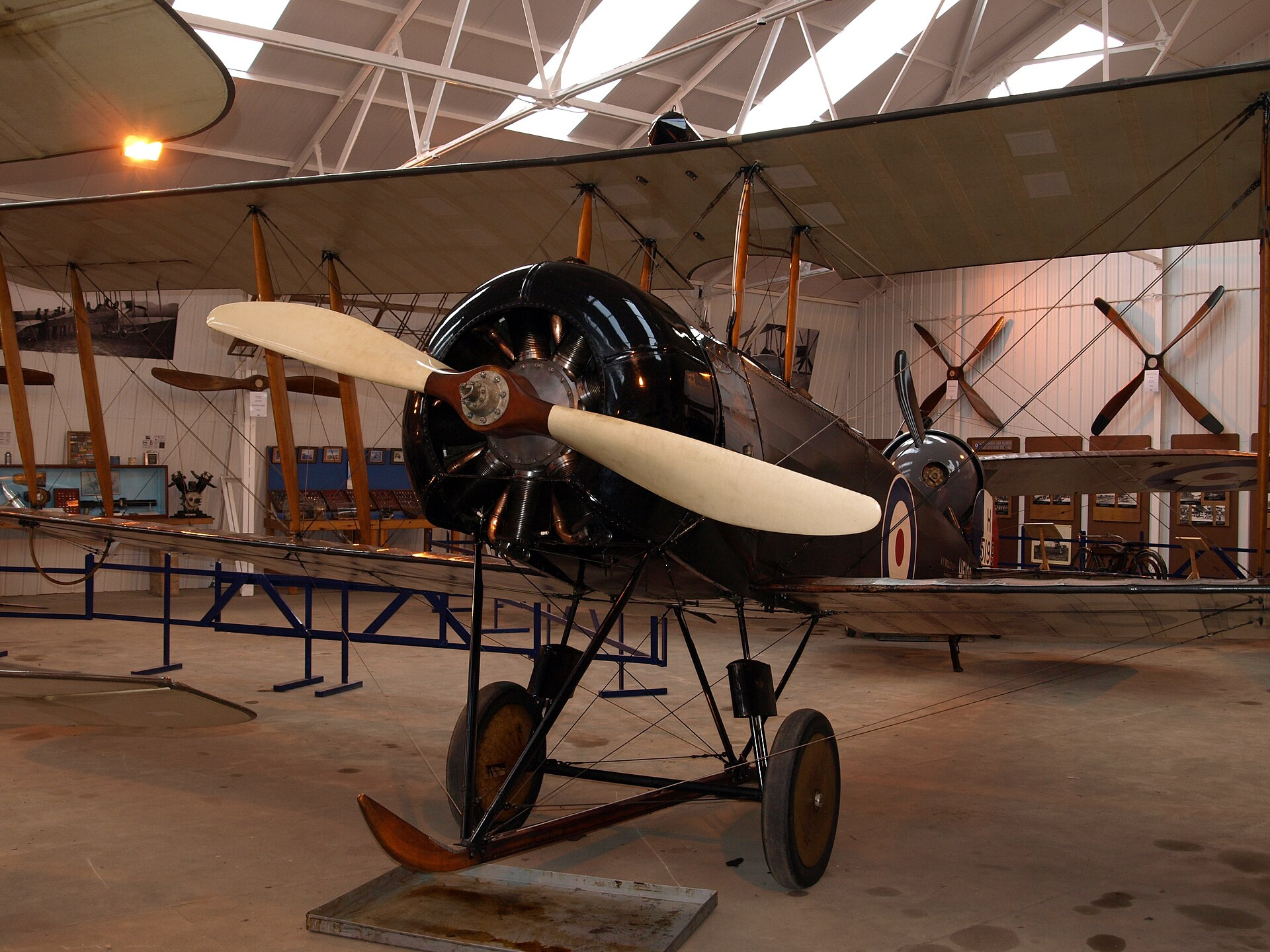
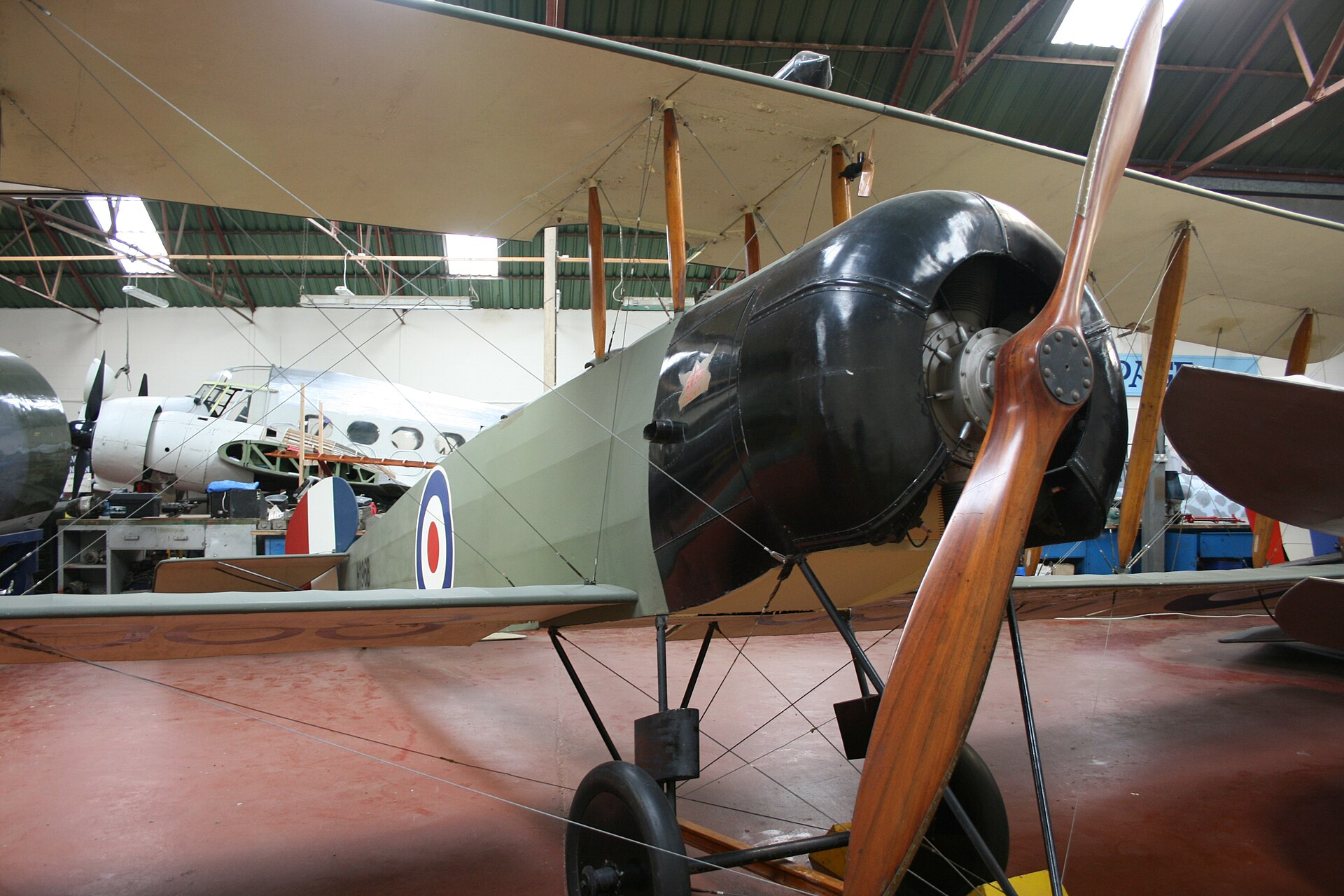
The Avro 504 in the air
The Avro 504 around the world: how one British trainer went global
Few aircraft of the First World War era travelled as far, or served as many flags, as the Avro 504. Its combination of low cost, docile handling and simple construction made it the natural choice for any air arm or flying club that needed to make pilots cheaply — and in the 1920s, almost everyone did. What follows is a tour of where the 504 went and what it did there. Because its use was so widespread and the records so scattered, treat the details as a well-sourced sketch rather than a complete census; the operations map below deliberately shows the best-documented operators.
Britain and the Commonwealth. At home the 504 was the standard primary trainer of the Royal Flying Corps, the Royal Naval Air Service and, from 1918, the Royal Air Force, and it stayed in RAF service — as the radial-engined 504N — into the early 1930s. Across the Empire it did the same job: Canada, Australia, New Zealand and South Africa all used 504s to train their earliest military and civil pilots, and Canadian and Australian operators kept them flying commercially long after the war. Australian photographs from the early 1920s, including machines associated with the young Qantas, capture the 504 in its post-war civil prime.
The Soviet Union. The most numerically dramatic chapter took place far from Britain. Soviet industry reverse-engineered the 504K and mass-produced it as the U-1 (and the floatplane MU-1), building it in the thousands as the standard primary trainer of the Red Air Force and the civilian Osoaviakhim movement throughout the 1920s. Nicknamed the ‘Avrushka’, it trained the first generation of Soviet pilots and is a large part of why total 504-family production, counting copies, runs so far ahead of the already huge British figure.
Europe, Asia and the Americas. Denmark built its own 504s in the army and navy workshops; Japan produced the type under Nakajima licence, seeding early Imperial Japanese Navy training and a line of derivatives. Belgium, the Netherlands, Norway, Sweden, Finland, Estonia, Ireland, Greece, Turkey and others operated the type militarily or commercially, while in South America Argentina, Brazil, Chile and Peru all flew 504s, and examples reached China, Thailand, Mexico, Spain and Portugal. The United States saw imported machines and, later, replicas. The exact roll-call varies between sources — another reason the map here highlights well-attested operators rather than every claimed one.
The lasting legacy. Strip away the geography and the numbers and one thing remains: the Avro 504 was, above all, the aeroplane that taught the world to fly. Through the Gosport system it standardised instruction; through sheer production it put that standard everywhere; and through the U-1 and its many licence-built cousins it did the same job for rival nations. When aviation historians reach for a single machine to represent the birth of modern, systematic pilot training, they reach for the 504 — and that legacy, more than any raid or record, is why it still matters.
Where the Avro 504 flew: origin, WWI service, worldwide operators and survivors
Categories are indicative and compiled from published operator histories; the Avro 504’s export and licence use was so widespread that this map shows the best-documented operators rather than an exhaustive list.
The Avro 504 by the numbers
Twelve deeper dives into the Avro 504’s story
07A.V. Roe and the birth of Avro: the company behind the 504
Alliott Verdon Roe was one of the true pioneers of British aviation. In 1909 he became the first Englishman to fly an all-British machine of his own design, and the following year he and his brother Humphrey founded A.V. Roe & Company — Avro — in Manchester. The firm’s early triangular trademark and its Roe-designed biplanes established a reputation for sound engineering that the 504 would cement. It is worth remembering that the 504 was not a lucky one-off but the product of a company already steeped in the craft of flight: Avro had learned, aircraft by aircraft, what made a machine controllable, repairable and safe. That institutional knowledge is why the 504 emerged so mature in 1913, and why Avro went on to become one of Britain’s great aircraft houses, later famous for very different machines such as the Anson and, in the Second World War, the Lancaster. The 504 sits at the hinge of that story: the aircraft that made Avro’s name and paid for everything that followed. The company’s Manchester roots and its network of skilled woodworkers and engineers were exactly what a design like the 504 needed to be turned out in quantity, and the profits and prestige of the 504 helped carry Avro through the lean years after the Armistice, when so many wartime aircraft firms collapsed. In a real sense, the aeroplane that taught pilots to fly also taught a great British aircraft company how to survive.
08The Friedrichshafen raid in detail: 21 November 1914
The raid on the Zeppelin works at Friedrichshafen was audacious to the point of recklessness. Airships were, in late 1914, terrifying strategic weapons, and the works on Lake Constance built them. Rather than wait to be bombed, the Royal Naval Air Service resolved to strike the source. Four 504s were shipped in crates to Belfort in eastern France and assembled in secrecy; three got away on the morning of 21 November. The little biplanes navigated by map and compass across roughly 120 miles of hostile territory, then dived on the sheds through rifle and anti-aircraft fire, each releasing its four small bombs. They hit the works and a hydrogen gas-generating plant, causing real damage and, briefly, real alarm in Germany about the vulnerability of its airship programme. One 504 was forced down and its pilot captured; the other two returned. Measured against later thousand-bomber raids the physical damage was tiny, but the raid’s significance is conceptual: it was one of the first deliberate attempts to reach past the front line and destroy war-making capacity from the air. The idea of strategic bombing — for good and ill one of the defining military concepts of the twentieth century — has one of its earliest practical expressions in three Avro 504s over Lake Constance. There is a deep irony in the fact that the aircraft most associated with gently teaching people to fly also helped inaugurate one of the most destructive doctrines of modern war. But it captures the 504’s peculiar place in history perfectly: for a brief moment in 1914 it was at the cutting edge of offensive air power, before settling into the role that would define it. Both facts are true, and holding them together is the only honest way to tell the story.
09Rotary versus radial: the engines that powered the 504
To modern eyes the rotary engine is almost unbelievable: the entire cylinder assembly spins with the propeller around a stationary crankshaft, and the whole thing is total-loss lubricated with castor oil that the pilot breathes and wears. Rotaries were light and produced useful power for their weight in 1914, which is why they dominated early aviation, but they had real drawbacks — strong gyroscopic effects that tugged an aircraft in turns, crude throttling that often meant cutting and restoring ignition with a ‘blip’ switch, and a thirst for scarce oil. On the 504 these traits were mild enough to teach on and, arguably, useful to teach with: a pupil who could handle a Le Rhone-powered 504 had already met the gyroscopic quirks they would face on hotter machines. By the 1920s, though, the air-cooled radial — cylinders fixed in a circle around a spinning crankshaft, the modern arrangement — had matured into something far more practical. The 504N’s Armstrong Siddeley Lynx radial was more powerful, more reliable and far less thirsty, and it let the fundamental 504 soldier on into a new decade. The engine change, more than anything else, is what separates the wartime 504K from its interwar descendant. It is a neat illustration of a general truth about the 504: the airframe was so fundamentally right that it could absorb a complete change of powerplant — from spinning rotary to fixed radial — and carry on doing its job for another decade. Few designs are robust enough to survive that kind of transplant; the fact that the 504 did, and did it well, is part of why its service life reads more like that of a whole family of aircraft than a single type.
10The barnstorming boom: how surplus 504s put the public in the air
The Armistice left the world awash in war-surplus aircraft, and the Avro 504 — cheap, docile, roomy and available in huge numbers — was ideal for the freewheeling civil aviation that followed. Ex-military 504s were sold for a fraction of their cost, and enterprising former pilots bought them to make a living giving joy-rides. The pattern was the same on several continents: fly into a field near a town, put up a sign, and for a modest fee take locals aloft for a circuit of the aerodrome. For an enormous number of ordinary people in the 1920s, the first time they ever saw their own town, farm or coastline from the air was from the front cockpit of an Avro 504. In Australia the type was especially prominent, used for joy-flights and pioneering commercial work by operators including the young Qantas, and captured in crowds-and-canvas photographs from Brisbane, Windsor and Tweed Heads. This civil chapter matters because it changed public attitudes: the 504 helped turn flight from a remote wartime marvel into something an ordinary person could experience, and imagine being part of. In that sense the aeroplane that trained the pilots also helped create the passengers. The barnstorming years were often shabby and sometimes dangerous — the aircraft were ageing, the flying was seat-of-the-pants, and the business was precarious — but their cultural effect was enormous. They normalised the aeroplane, seeded a generation of enthusiasts, and kept flying skills and airfields alive through the lean post-war decade until commercial aviation found its feet. The Avro 504, cheap and available and safe, was the workhorse of that quiet revolution as much as it had been the workhorse of military training.
11Surviving Avro 504s and replicas around the world
For such an old design, the 504 is unusually well represented today, thanks to a mix of genuine survivors, long-term rebuilds and faithful replicas. The best known is the Shuttleworth Collection’s airframe at Old Warden in England — a genuine 1918 aircraft kept in flying condition and displayed regularly, sometimes alongside a more recently built replica so audiences can see two 504s aloft together. In Britain, the Royal Air Force Museum and the Imperial War Museum at Duxford both hold examples, and other 504s or 504-derived airframes are preserved in Canada, Australia and elsewhere among the type’s many former operators. Because the 504 was so widespread and so long-lived, and because its simple wood-and-fabric construction lends itself to sympathetic restoration, new-build and rebuilt examples continue to appear. The exact global tally shifts as projects are completed or airframes change hands, and enthusiast resources such as the Official Avro 504 Web Page track originals and survivors in detail. The headline, though, is simple and rather wonderful: more than a century after the prototype first flew, you can still stand at an airfield fence and watch an Avro 504 fly. Keeping one airworthy is no small undertaking — rotary engines demand specialist knowledge, spares must often be made by hand, and every hour flown is a careful negotiation between preservation and use. That collections such as Shuttleworth judge it worth the effort says a great deal about what the 504 represents: not just a rare old airframe, but a living demonstration of how flight was taught at the dawn of military aviation. Each display flight is, in effect, a moving exhibit that no static museum can match.
12From the 504 to the Tutor: the trainer bloodline it founded
The Avro 504’s real monument is not a single airframe but a whole philosophy of training that outlived it. By proving that a safe, forgiving, aerobatic biplane plus a structured syllabus could turn raw recruits into competent pilots at scale, the 504 set the template for the purpose-built primary trainers that followed. Avro’s own Tutor, which replaced the 504N in RAF service, was a direct spiritual successor — a radial-engined, dual-control biplane built to do the same job with 1930s refinement. Across the world, the generation of trainers that followed the 504 inherited its assumptions about what ab-initio instruction should look like: dual controls, deliberate practice of spins and recoveries, and an aeroplane chosen for its manners rather than its performance. Even as trainers became monoplanes and then jets, the underlying Gosport principles — codified around the 504 — persisted. When a student pilot today is deliberately taught to recognise and recover from a stall under a calm instructor’s guidance, they are, at several removes, heirs to a lesson first taught systematically in the back seat of an Avro 504.
13Handling the 504: what pilots say it is like to fly
Accounts from pilots who have flown preserved 504s — including material published by the Historic Aircraft Association — paint a consistent picture of an honest, gentle, low-and-slow aeroplane that rewards a light touch and punishes nothing very hard. The controls are effective but unhurried; the rotary must be managed with care on the ground and on approach; and the whole experience unfolds at a pace that feels almost stately compared with later types. That is precisely the point. The 504 was never meant to thrill an expert; it was meant to let a beginner make mistakes and live to learn from them. Flying one today is described less as a performance and more as a conversation with 1918 — the smell of castor oil, the crackle of the rotary, the wires singing, and a view of the world at the speed of a fast car. For the collections that keep them airworthy, that experience is the whole reason to do it: not to demonstrate speed or agility, but to preserve, in the air, the feel of the aeroplane on which flight itself was first taught methodically.
14Why the numbers are hard to pin down: production figures and their caveats
Any confident single figure for how many Avro 504s were built should be treated with suspicion, and this exhibit deliberately hedges. The commonly repeated statement is that more than 8,000 were built in Britain during the First World War, a figure supported by institutions such as the Royal Air Force Museum. Add post-war British production of the 504N, licence manufacture abroad, and the very large but separately-counted Soviet U-1 programme, and totals climb well past ten thousand — but exactly how far depends on what you count and which records you trust. Wartime and interwar production was spread across many firms and several countries, some record series are incomplete, and different historians draw the boundary between ‘a 504’ and ‘a 504-derived type’ in different places. Do we count the Soviet U-1? The Japanese Nakajima machines? Every field rebuild? Reasonable sources answer differently. The honest summary is the one used throughout this page: the 504 was one of the most-produced aircraft of its era, with British wartime output alone exceeding 8,000 and grand totals, including copies and licence-builds, commonly estimated at ten thousand or more.
15The 504 as a naval and floatplane aircraft
Although it is remembered mainly as a land-based trainer, the 504 family also went to sea in various guises. Early in the war the Royal Naval Air Service operated 504s — it was RNAS machines that flew the Friedrichshafen raid — and floatplane conversions extended the type’s reach over water. The clearest example of the waterborne branch is the Soviet MU-1, the floatplane version of the U-1 copy, used to give Soviet naval and civil pupils their first flights from water in the 1920s. Seaplane training has its own demands — judging height over a featureless surface, handling on the step, coping with swell — and the 504’s forgiving nature made it as suitable for that as for conventional instruction. This maritime thread is a small but real part of the type’s astonishing versatility: the same basic airframe served as land trainer, reconnaissance-bomber, night fighter, joy-ride machine and floatplane, across two decades and dozens of operators.
16The Avro 504 in the wider story of 1914 to 1918 aviation
It helps to place the 504 alongside its contemporaries. The glamorous names of First World War aviation are the fighters — the Sopwith Camel, the S.E.5a, the Fokker triplane — and the strategic bombers that came later. The 504 belongs to a quieter but arguably more consequential category: the aircraft that made the aircrew. Every celebrated ace had, somewhere behind them, hours in a trainer, and for a huge proportion of British and Commonwealth pilots that trainer was a 504. In that sense the 504 is the connective tissue of the era’s air war: less a single weapon than the tool that produced the people who wielded all the others. Its contemporaries in this encyclopedia — the S.E.5a, the Bristol F.2 Fighter, the Sopwith 1½ Strutter — each made their name in combat; the 504 made its name by outlasting them all and by being the machine on which their pilots first learned the craft. When the histories of 1914 to 1918 aviation are written, the fighters get the headlines, but the humble Avro 504 quietly underwrites the whole story.
17Cockpit, controls and instruments: flying by feel in 1918
Sitting in a 504 is a lesson in how little a pilot of 1918 had to work with, and how much they relied on feel. The instrument panel was sparse by any later standard — an engine tachometer, fuel and oil indications, perhaps an altimeter and a simple air-speed indicator — and much of the information a modern pilot reads off a screen was instead sensed through the seat, the wind on the face, the note of the engine and the song of the bracing wires. Control was by stick and rudder bar, with the rotary engine managed through fuel and air levers and the ignition ‘blip’ switch rather than a smooth throttle. Because so little was instrumented, the aeroplane itself had to communicate clearly, and the 504 did: it gave honest, progressive warnings as it approached a stall and behaved predictably when handled firmly. That transparency is exactly what makes an aircraft good to learn on. The 504 taught pupils to fly by feel and by attitude — skills that underpin all flying — precisely because it could not lean on instruments the way later machines would.
18The two-seat, dual-control layout: designing an aeroplane to be taught in
The single most important design feature of the 504 as a trainer is easy to overlook because it seems obvious today: two seats in tandem, with a full set of working controls in each. That arrangement let an instructor sit behind a pupil, let the pupil actually fly the aeroplane, and let the instructor take over instantly if things went wrong — the fundamental safety mechanism that makes structured ab-initio training possible at all. Pair it with the Gosport speaking tube for communication and you have, in embryo, the basic architecture of essentially every primary flight-training aircraft since. Many wartime types could be flown from either seat in a pinch, but the 504 was used, refined and produced specifically to exploit this layout at scale, and the Gosport system was built to make the most of it. When you strip the 504 down to its essentials, this is what you find at the core: not a weapon adapted to teaching, but an aeroplane whose whole configuration was bent towards letting one person safely teach another to fly.
Avro 504: your questions answered
Can I fly in an Avro 504?
No — the Avro 504 is a century-old two-seat trainer, and MiGFlug does not offer flights in one. A few airworthy examples do still fly at collections and airshows (the Shuttleworth Collection’s 1918 original is the best known), but they are not bookable rides. If you want to actually fly in a genuine vintage military aircraft, you can: MiGFlug flies paying passengers in warbirds and jets such as the L-39 Albatros, MiG-15 and de Havilland Vampire. See migflug.com/flights-prices.
Why is the Avro 504 so historically important?
Because it did two rare things at once. It flew some of the earliest offensive air operations of the First World War — including the 1914 Friedrichshafen raid — and it then became the standard primary trainer of the RFC, RNAS and RAF, teaching the overwhelming majority of British and Commonwealth pilots for years. Very few aircraft are both a combat pioneer and the machine a whole generation learned to fly on.
How many Avro 504s were built?
More than 8,000 were built in Britain during the war alone, and total production across all variants and years is commonly put at around 10,000 or more — figures vary between sources, so they are best treated as estimates. That does not even count the thousands of Soviet U-1 copies built separately. By any measure it was one of the most-produced aircraft of its era.
What engine did the Avro 504 use?
Wartime 504s used rotary engines — typically the Gnome, Le Rhone or Clerget, commonly around 80 to 130 horsepower depending on the variant. The 504K had a universal mounting that accepted several of these. In the 1920s the 504N switched to an air-cooled radial, the Armstrong Siddeley Lynx.
How fast was the Avro 504?
Top speed depended heavily on the engine fitted, but it was modest — roughly 90 to 110 mph (about 145 to 180 km/h). It was never meant to be fast; it was meant to be forgiving, aerobatic and easy to teach on, and it excelled at exactly that.
Was the Avro 504 armed?
Usually only lightly, and only in specific roles. Early war machines could carry small bombs for reconnaissance-bomber work, and the Home Defence night-fighter conversions carried a single upward-firing Lewis gun. As a trainer, the vast majority flew unarmed.
What was the Soviet U-1?
The U-1 was a Soviet copy of the Avro 504K, reverse-engineered and mass-produced without a licence after 1918. Nicknamed the ‘Avrushka’, it became the standard Red Air Force primary trainer of the 1920s, with a floatplane version called the MU-1. Thousands were built, spreading the 504’s influence deep into Soviet aviation.
Are there any Avro 504s left, and do any still fly?
Yes. Several survive in museums including the RAF Museum, IWM Duxford, and collections in Canada and Australia, and a small number are airworthy. The most famous flyer is the Shuttleworth Collection’s 1918 original at Old Warden, which still displays regularly — sometimes alongside a modern-built replica.
Who designed and built the Avro 504?
It was designed by Alliott Verdon Roe, whose company A.V. Roe & Co. — Avro — gave the aircraft its name. Because demand was so vast, it was also built by a large network of British sub-contractors, and later under licence or by direct copying in several other countries, from Denmark and Japan to the Soviet Union.
What was the Gosport system, and why does it matter?
The Gosport system was a structured method of flight instruction developed by Robert Smith-Barry at the School of Special Flying in 1917, built around the Avro 504. It introduced a real syllabus, deliberate practice of spins and stalls, and in-flight communication through a speaking tube. It replaced a lethal ‘sink or swim’ culture and became the foundation of modern flight training worldwide — arguably the 504’s single most important legacy.
How does the Avro 504 compare with other WWI aircraft?
Unlike fighters such as the S.E.5a or Sopwith Camel, the 504 was not built to win dogfights — its importance is in numbers, longevity and training. Where a Camel was fast and vicious, the 504 was slow and kind. It shares the era’s wood-and-fabric, rotary-engined technology with types like the Sopwith 1½ Strutter and Bristol F.2 Fighter, but outlived nearly all of them in service by being the machine that made the pilots who flew everything else.
Where can I see an Avro 504?
In the UK, the Shuttleworth Collection (Old Warden), the Royal Air Force Museum and IWM Duxford all hold examples, and Shuttleworth’s is airworthy. Museums in Canada, Australia and other former operator countries preserve their own airframes and replicas. Airshow appearances are seasonal, so check a collection’s flying calendar before travelling.
Fly a real military jet or warbird with MiGFlug
The Avro 504 taught a generation to fly, but you can’t book a ride in one. What you can do is take the controls of a genuine military jet — from the L-39 Albatros to the mighty F-104 Starfighter — with a professional pilot beside you.
Related aircraft
Royal Aircraft Factory S.E.5aBritain’s great WWI fighterBristol F.2 FighterThe rugged two-seat ‘Brisfit’Sopwith 1½ StrutterPioneer two-seat multi-role biplaneWhere these facts come from