
Avro 504
The Avro 504: from Friedrichshafen raider to the world's flying classroom
Some aircraft are remembered for a single spectacular moment. The Avro 504 is remembered for two utterly different careers, lived one after the other. It began the First World War as a front-line machine and one of the pioneers of strategic bombing, and it ended the 1920s as the aeroplane on which most British and Commonwealth pilots had first learned to fly. Between those two roles lies one of the longest and most influential production runs in aviation history.
The design came from Alliott Verdon Roe, whose company Avro had been building aircraft since 1909. When his new two-seat biplane first flew in September 1913, it was strikingly clean and well-mannered for its day: tandem cockpits, a rotary engine, and handling gentle enough that a nervous pupil could be talked through a mistake rather than killed by it. That temperament would define everything the 504 became.
War came within a year. In November 1914, three Royal Naval Air Service 504s flew from eastern France to bomb the Zeppelin sheds at Friedrichshafen on Lake Constance — one of the earliest strategic air raids ever attempted. Over the Western Front, 504s flew reconnaissance and light bombing, and one is frequently named as the first British aeroplane brought down by ground fire. Later, stripped-out single-seat versions climbed into the night sky over Britain to hunt German airships as improvised Home Defence fighters.
But it was as a teacher that the 504 changed the world. In 1917 Robert Smith-Barry built his revolutionary School of Special Flying at Gosport around it, replacing terrifying trial-and-error with a real syllabus: spins practised deliberately, recoveries rehearsed, instructor and pupil talking through a speaking tube between the cockpits. The Gosport system spread across the globe, and the forgiving, aerobatic 504 was the aircraft that made it work.
Because it was simple to build and could take almost any available rotary engine, the 504 was produced in staggering numbers — more than 8,000 in wartime Britain alone, with total output across all variants and countries commonly estimated at around ten thousand or more. It was exported and licence-built from Canada to Japan, copied wholesale by the Soviet Union as the U-1, and, after the Armistice, sold off cheaply to become the definitive barnstorming and joy-riding aeroplane of the 1920s. Re-engined with a radial as the 504N, it soldiered on in RAF service into the early 1930s.
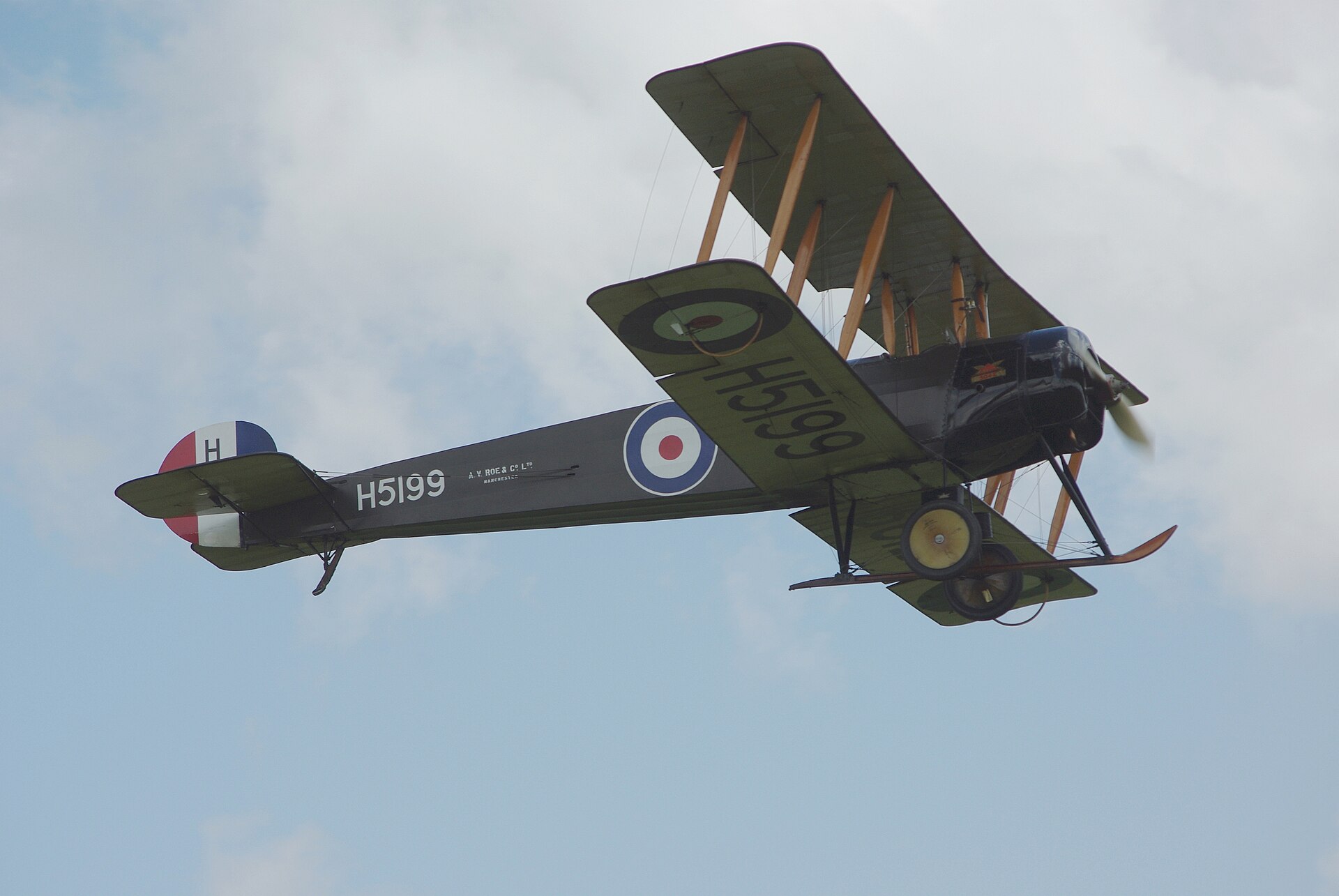
Today a handful still fly, most famously the Shuttleworth Collection's 1918 original. When it drifts across the airfield at Old Warden, it is not just an old aeroplane — it is the direct ancestor of every structured flying lesson given since.
It is worth pausing on just how strange the 504's career is. Most military aircraft are obsolete within a few years; the 504 was ordered, built and flown across roughly two decades, spanning the transition from the fragile stringbags of 1913 to the metal monoplanes looming at the end of its life. It began before the tank and the practical machine-gun-armed fighter existed, and it was still training RAF pilots when Frank Whittle was sketching the jet engine. Very few machines bridge so much change, and fewer still stay relevant across it by doing one thing supremely well.
That one thing was making pilots. It is easy, looking back, to be seduced by the fighters and the aces and to overlook the aircraft that quietly stood behind them all. But an air force is only as good as its aircrew, and aircrew have to be made somewhere, by someone, on something. For a decisive span of aviation history, that 'something' was the Avro 504, and the 'somewhere' was a training system — Gosport — built around it. Strip the 504 out of the story and you do not just lose a nice biplane; you lose the machine that industrialised the production of pilots at the exact moment the world first needed them in their thousands.
There is also something quietly democratic about the 504's legacy. It did not only make military pilots; through the barnstorming boom it introduced flight to the general public, and through export and licence-build it did the same job for air forces and flying clubs on nearly every continent. It was, for a while, the shared starting point of world aviation — a common ancestor that a remarkable proportion of interwar pilots, in a remarkable number of countries, could trace their first hours to. That is a rare kind of importance, and it is why the 504 deserves a place in this museum every bit as much as the fighters whose pilots it trained.
01The Avro 504's two lives: why one aeroplane was both a combat pioneer and a classroom
It is genuinely unusual for one aircraft type to matter twice, for opposite reasons. In 1914 the 504 was a weapon: a raider over Friedrichshafen, a reconnaissance and bombing machine over the Western Front, and a night hunter of Zeppelins. By 1918 it was something quieter but arguably more important — the standard on which pilots were made. Historians tend to conclude that its training legacy outweighs its combat record, precisely because that legacy compounds: every well-trained pilot went on to fly, and often to teach, others. The 504 did not win battles so much as build the people who did.
That dual identity is why museums display surviving 504s in such different guises — some in the drab of a Home Defence night fighter, others in the bright dope and roundels of a training school. Both are true. Keep the contrast in mind as you read on: nearly every technical choice in the design served the goal of making a safe, teachable, endlessly reproducible aeroplane.
How the Avro 504 was built to be forgiving, teachable and endlessly reproducible
A gentle rotary and honest handling
The 504's rotary engine and well-balanced controls gave it docile, predictable behaviour and genuine aerobatic ability. It would spin when asked and recover cleanly — exactly what an instructor needs to demonstrate danger safely.
Built around the Gosport method
Tandem cockpits with dual controls and a speaking tube let an instructor fly with a pupil and actually talk to them. The 504 was the physical platform for Smith-Barry's structured teaching system.
Simple wood, fabric and a universal engine mount
Spruce, ash and doped linen made the 504 cheap and fast to build and repair. The 504K's universal mounting accepted several different rotaries, freeing production from any single engine supply.
02The Avro 504's rotary engine: how a spinning-cylinder motor shaped the way it flew
A rotary engine is a curiosity today: the whole cylinder block spins with the propeller around a fixed crankshaft. That mass of whirling metal produced strong gyroscopic effects a pupil had to learn to anticipate, and the engines were controlled as much by a fuel/air 'blip' switch as by a throttle. On the 504 these quirks were mild enough to teach on and characterful enough to teach with — a student who mastered a Le Rhone-powered 504 was well prepared for the temperamental fighters ahead. The common wartime engines were the Gnome, the Le Rhone and the Clerget, broadly in the 80 to 130 horsepower range depending on variant. Exact outputs vary by source and sub-type, so treat specific numbers as approximate.
Crucially for a training aeroplane, the rotary's behaviour on the 504 was character without cruelty. The gyroscopic effect meant turns in one direction came more readily than the other, and the pupil learned to feel and correct for it; the lack of a conventional throttle taught careful engine management from the very first hour. These were exactly the habits a pilot would need on the far more demanding rotary-engined fighters of the day, so the 504 did double duty: it kept a beginner alive while quietly rehearsing the reflexes of the front line. Managing the engine well — nursing the oil, blipping the ignition on the approach, judging the glide with a windmilling prop — was part of the curriculum, not an obstacle to it.
03The Gosport system and the Avro 504: the teaching revolution that outlived the aeroplane
Before 1917, flying instruction was often lethally casual. Robert Smith-Barry's School of Special Flying at Gosport changed that by treating instruction as a skill in its own right. Pupils were deliberately taught to enter and recover from spins and stalls; instructors communicated through a simple speaking tube (the 'Gosport tube') between cockpits; and a genuine syllabus replaced guesswork. The Avro 504 was the aircraft this system was built on, because it was safe, aerobatic and forgiving enough to make deliberate practice of dangerous manoeuvres survivable. The method spread worldwide and shaped pilot training for decades — a legacy that outlived the aeroplane itself.
What made Gosport revolutionary was not any single trick but the shift in philosophy: instruction became a discipline to be studied and taught in its own right, with instructors themselves trained in how to train. Pupils were shown the aeroplane's limits deliberately and repeatedly, until a spin was a manoeuvre to be managed rather than a death sentence. The 504 was inseparable from this because the method only works if the aircraft is forgiving enough to survive the deliberate mistakes — and honest enough that the lessons transfer. Long after the last 504 left the flight line, the assumptions baked into Gosport — dual controls, a real syllabus, spin awareness, clear instructor-pupil communication — remained the bedrock of how the world teaches people to fly.
04The Avro 504's structure: spruce, ash and doped linen, and why simplicity mattered
The 504 was a wood-and-fabric aeroplane of its time: a wire-braced wooden box girder fuselage, two-bay wings built up from spruce spars and ribs, and a skin of Irish linen shrunk tight and weatherproofed with dope. There was nothing exotic about it, and that was the point. It could be built quickly in quantity by furniture-makers and sub-contractors, repaired in the field with basic materials, and rigged by mechanics who had learned on it. That simplicity, more than any single clever feature, is why the type could be produced in the thousands and kept flying for twenty years.
Simplicity also made the 504 forgiving to own as well as to fly. A damaged rib or a torn panel of fabric could be repaired by a skilled mechanic with everyday materials rather than replaced from a distant factory, and the modular, wire-braced structure could be rigged and re-rigged as needed. For a training unit flying hundreds of hours a week with inevitable heavy landings, that repairability was as valuable as any performance figure. The aeroplane was designed, in effect, to be knocked about and put right again — which is exactly what a machine used to teach beginners has to endure.
Baseline: the Avro 504K as it was built from 1918 and flown for the next fifteen years — two open cockpits in tandem, a 110 hp Le Rhône 9J rotary sitting on the universal engine bearers, and no armament whatever — because that is the machine that taught most of the pilots the Royal Air Force ever had, that filled the British civil register after the Armistice, and that nearly every surviving airframe in the world actually is. Deltas for the 80 hp Gnome-engined original of 1913, the single-seat 504C and 504D anti-Zeppelin machines, the 100 hp 504J of Smith-Barry's Gosport school, the Lynx-engined 504N of 1925 and the Soviet U-1 are in grey. Five corrections before the figures. First, the production totals. Four different numbers circulate and they are all quoted as if they meant the same thing: 8,340 completed by the end of 1918; roughly 8,970 built in Britain during the war years; more than 10,000 built in Britain across the whole 1913–1932 run; and 11,303 including Japanese, Soviet and other foreign production. They do not reconcile in detail and cannot be made to, because more than thirty British subcontractors built 504s, wartime returns counted contracts and deliveries rather than airframes, and heavily rebuilt machines were frequently recorded twice. What is safe to say is that the Avro 504 was built in greater numbers than any other aircraft that served in a military capacity in the First World War, and that only the Polikarpov Po-2 — the aeroplane that replaced its Soviet copy — has out-produced it among biplanes. Second, the claim that the 504 made the first British bombing raid on Germany. It is repeated constantly and it is wrong. RNAS aircraft operating from Antwerp bombed Düsseldorf and Cologne on 22 September 1914, and Flight Lieutenant Reginald Marix destroyed the Zeppelin Z IX in its shed at Düsseldorf on 8 October 1914 flying a Sopwith Tabloid — both before the Avro 504s went to Friedrichshafen on 21 November. What the Friedrichshafen raid genuinely was, and it is a larger claim than the false one, is the first British air operation planned from the outset as a long-range strike against a specific war industry deep inside enemy territory: strategic bombing, in embryo, four years before the Independent Force. Third, the first British aircraft lost. Avro 504 serial 390 of No. 5 Squadron RFC, flown by Second Lieutenant Vincent Waterfall with Lieutenant Charles George Gordon Bayly as observer, was brought down in Belgium on 22 August 1914 and both men were killed. It was destroyed by rifle and machine-gun fire from German troops on the ground, not in air combat — a distinction worth keeping, because in August 1914 there was as yet almost no air combat to be shot down in. Fourth, the 504N total. The same reference work gives both 592 and 598 in different places. The figure used here is 592 built by Avro between 1925 and 1932, with the balance most likely accounted for by prototypes and rebuilds; foreign licence production is additional and is listed separately in the variants. Fifth, what the 504 was designed for. It is often described as the first aeroplane designed as a trainer. It was not. It was drawn as a fast, tractable general-purpose biplane for sport and reconnaissance, competed in the 1913 Aerial Derby, and became the standard trainer of the English-speaking world because it turned out to have exactly the qualities a teaching aeroplane needs — docility with just enough vice to be instructive — and because Robert Smith-Barry noticed.
Dimensions & weights
- Crew
- 2 in open tandem cockpits, the pupil normally in front Both cockpits had full dual control, which sounds obvious and was not. The pre-Gosport method was to put a pupil in an aeroplane with no dual control and a shouted briefing; the Smith-Barry system depended on an instructor who could take control instantly, demonstrate a spin, hand it back, and talk about it afterwards. The 504's two identical working cockpits are the hardware of that idea.
- Length
- 8.97 m (29 ft 5 in)
- Wingspan
- 10.97 m (36 ft 0 in), equal span upper and lower A very large wing for 110 hp, and the source of everything likeable about the aeroplane.
- Height
- 3.18 m (10 ft 5 in)
- Wing area
- 30.66 m² (330 sq ft)
- Wing structure
- Two-bay wooden biplane, unstaggered equal-span wings, spruce spars and ribs, fabric covered, wire braced, with ailerons on both upper and lower planes There is no aerofoil designation worth quoting: the section was a thick, high-lift profile of the period, arrived at by eye and by tunnel work rather than catalogue. The one experiment that changed it, the Avro 582, flew with RAF 30 section wings and Frise ailerons and was converted back to 504N standard in 1928.
- Fuselage
- Square-section wire-braced wooden box girder, fabric covered Cheap, light, repairable in a squadron workshop with glue, tacks and a length of piano wire, and forgiving of the sort of arrival a pupil makes on his fourth flight. A steel-tube fuselage would have been stronger and would have made the aeroplane useless for its actual job, which was to be crashed gently and often.
- Undercarriage
- Cross-axle main gear on rubber-cord sprung V struts, with a long central skid ahead of the wheels — the "toothpick" The skid existed to stop the aeroplane going over on its nose when a pupil braked with the tailskid or hit a rut. The 504N of 1925 threw it away for a wide-track split V oleo undercarriage, which is the quickest way to tell a 504N from a 504K in a photograph at any distance.
- Empty weight
- 558 kg (1,231 lb)
- Loaded weight
- 830 kg (1,829 lb) The 504N, with a heavier engine and a stronger structure, went up to about 1,016 kg (2,240 lb) loaded, and it shows in the handling: solid, honest and noticeably less lively than the rotary machines.
- Useful load
- 272 kg (598 lb) of crew, fuel, oil and whatever else was carried — a third of the loaded weight
- Fuel and oil
- 116 L (25.5 imp gal) petrol and 27 L (6 imp gal) castor oil Six gallons of oil for twenty-five of petrol looks absurd until you remember that a rotary loses all of it: the lubricant is fed in, flung out through the exhaust and sprayed over the aeroplane and the crew. Castor oil is also a purgative, which is why every rotary pilot's memoir contains the same joke.
- Wing loading
- 27.0 kg/m² (5.54 lb/sq ft) at loaded weight Low even for 1918, and the single number that explains the type. A Sopwith Camel sat near 8 lb/sq ft and a Bristol Fighter above 9. At 5.5 the 504 flew slowly, stalled gently, landed in a field, floated a long way in ground effect and could be put down almost anywhere by somebody who had been flying for four hours in his life.
- Power loading
- 7.5 kg/hp (16.6 lb/hp) on 110 hp
Performance
- Maximum speed, sea level
- 153 km/h (95 mph)
- Maximum speed at 2,440 m
- 140 km/h (87 mph at 8,000 ft); 137 km/h (85 mph) at 3,050 m (10,000 ft) The 504 loses almost nothing with height, because it had almost nothing to lose. The Lynx-engined 504N was slightly faster, usually quoted at about 160 km/h (100 mph).
- Cruising speed
- 119 km/h (74 mph) at 75 per cent power at 2,440 m (8,000 ft)
- Stalling speed
- 64 km/h (40 mph) And it stalls straight ahead, with warning, and recovers when you let go. That sentence is the aeroplane's whole claim on history. A machine that drops a wing viciously at the stall kills pupils; a machine that will not stall at all teaches them nothing. The 504 sat exactly where a trainer should.
- Climb to 1,070 m
- 5 min (3,500 ft)
- Climb to 2,440 m
- 10 min (8,000 ft)
- Climb to 3,050 m
- 16 min (10,000 ft) Quoted as times to height rather than a rate, which is how performance was stated and compared in the period. The falling-off between 8,000 and 10,000 ft is the honest shape of a rotary's power curve.
- Initial rate of climb
- 3.6 m/s (700 ft/min) at sea level
- Service ceiling
- 4,900 m (16,000 ft) This is why the 504 was pressed into home defence in 1918. The B.E.2c it replaced took the better part of an hour to reach a Gotha's operating height; a 504K on a 110 hp Le Rhône got there in under twenty minutes. It was still not enough — a Gotha G.V cruising at 15,000 ft was at the edge of the trainer's useful envelope — but it was the difference between a chance and none.
- Endurance
- 3 h at 3,050 m (10,000 ft) at maximum speed, rising to 4 h 15 min at cruising power at the same height; 2 h at sea level at maximum speed Endurance rather than range is the meaningful figure for this aeroplane, as it is for almost everything of its generation. A training sortie lasted twenty to forty minutes and the tank was sized for circuits, not for journeys; when a 504 did go somewhere — Belfort to Friedrichshafen and back, or Manchester to Blackpool with a fare-paying passenger — the fuel state was the whole planning problem.
- Range
- About 400 km (250 miles) in still air, which is a paper figure The four Friedrichshafen machines needed extra tankage to make roughly 400 km there and back at all, and one of the three that started did not come home.
- Aerodrome performance
- Grass field, no wheel brakes, tailskid steering, three-point landing Take-off and landing runs are not usefully quotable for a type with this wing loading: into any breeze at all a 504 was off in a couple of hundred feet and stopped in less. It was flown from farm fields, seafronts, racecourses and the infield at Alexandra Park, and the absence of brakes mattered less than the absence of a tailwheel, which is why the type bequeathed a generation of pilots an instinctive fear of ground loops.
Propulsion & systems
- Engine, baseline
- One Le Rhône 9J nine-cylinder air-cooled rotary, 110 hp (82 kW) In a rotary the crankshaft is bolted to the airframe and the entire engine spins with the propeller. The gyroscopic couple that results is why a rotary-engined aeroplane turns willingly one way and reluctantly the other, and learning to fly one meant learning that asymmetry in the first hour. Every pupil who went on to a Camel had already met the phenomenon on a 504, in a machine that forgave him.
- The universal engine mount
- The 504K's revised engine bearers and open-bottomed horseshoe cowling accepted the 100 hp Gnome Monosoupape, the 110 hp Le Rhône 9J and the 130 hp Clerget 9B interchangeably; the 150 hp Bentley BR1 went into some machines and into the 504L floatplane This is the most consequential engineering decision in the aeroplane's history and it is not an aerodynamic one. Rotary engine supply in 1917–18 was chaotic: Gnomes, Clergets and Le Rhônes came in unpredictable batches from British and French sources, and a trainer tied to one type would have sat in rows waiting for engines. Making the mount indifferent to which rotary arrived turned an engine shortage into a paperwork problem. It is also why so many surviving 504s carry an engine their airframe was not born with, and why "504K" describes a mounting standard rather than a particular powerplant.
- Engine control
- No throttle in the modern sense: a blip switch on the control column cutting the ignition, plus separate petrol and air fine-adjustment levers A rotary ran best at one speed. Power was managed by cutting cylinders out with the blip switch, which is why film of period aircraft landing has that stuttering, machine-gun engine note. Teaching a pupil to judge an approach on an engine with two settings — on and off — produced pilots who could glide accurately, a skill the 504N's throttled radial promptly began to erode.
- Propeller
- Two-blade fixed-pitch wooden airscrew, 2.74 m (9 ft 0 in) diameter, 2.64 m (8 ft 8 in) pitch
- Fuel system
- Single gravity-fed main tank in the fuselage ahead of the front cockpit; no fuel pump Gravity feed is the reason a 504 will not run inverted for more than a second or two, and one of several reasons the type was not aerobatted the way a Camel was.
- Lubrication
- Total-loss castor oil system with a pulsator sight glass in the cockpit as the pilot's only positive indication that oil was flowing
- Starting and ground handling
- Hand-swung propeller, chocks and two men on the wingtips; no self-starter and no wheel brakes The 504 could not be taxied anywhere it did not want to go, and could not be held on the ground at power. Both facts shaped the routines of every flying school that used it.
- Instruments
- Rev counter, airspeed indicator, altimeter, compass, oil pulsator and a watch No artificial horizon, no turn and slip on the early machines. Blind flying was not taught on the 504 because it could not honestly be taught on the 504; that arrived with the 504N era and the instrument panels of the late 1920s.
- Crew communication
- The Gosport tube — a flexible speaking tube from a mouthpiece in the instructor's cockpit to earpieces in the pupil's helmet Devised at Smith-Barry's School of Special Flying at Gosport in 1917 and quite possibly the most durable single artefact of the whole programme: Gosport tubes are still fitted to gliders, tailwheel trainers and vintage aircraft a century later, and the word survives in aviation English as a noun.
- Gun synchronisation gear
- None. No production Avro 504 of any mark carried an interrupter or synchronising gear This is worth stating plainly because the period demands it. Britain had four gears in service or trial by 1917 — the Vickers-Challenger, the Scarff-Dibovski, the Ross and the definitive Constantinesco-Colley CC hydraulic gear — and none of them was fitted to the 504. The home defence single-seaters got round the propeller by putting a Lewis gun on a Foster mounting on the top wing centre section, firing over the arc; the 504G gunnery trainer put its gun on a Scarff ring in the rear cockpit, behind the propeller entirely. The absence is informative: a synchronised gun is fitted to an aeroplane somebody expects to fight, and nobody expected the 504 to fight.
- Electrical and radio
- Neither as standard Home defence machines flying at night carried the barest navigation and instrument lighting, run off a wind-driven generator or accumulators, and pilots complained about all of it.
- Powerplant, 504N delta
- One Armstrong Siddeley Lynx seven-cylinder air-cooled radial Quoted at 160 hp for the 504N in most references; the Lynx family ran from about 150 hp to 225 hp across its marks between 1920 and 1930, and figures of 180 hp and 215 hp for later 504Ns are also published. The important change is not the number but the architecture: a static radial with a real throttle, ordinary mineral oil and none of the rotary's gyroscopic manners. The 504N was a better aeroplane and, by the standards of what pupils would meet next, a slightly less educational one.
Armament & payload
The Avro 504 bombed a Zeppelin works in 1914 and carried a Lewis gun over London in 1918, but for almost all of its life its payload was two men and a speaking tube
An armament section for the Avro 504 has to be honest about what it is describing: a trainer with a short, sharp and genuinely consequential combat career at either end of the First World War, and nineteen years of unarmed service in between. In 1914 the RNAS put four 20 lb Hales bombs under a 504 and sent three of them 250 miles to Friedrichshafen, which remains one of the most remarkable single operations of the early war. In 1918 the RFC bolted a Lewis gun to a Foster mounting on the top wing of 274 converted 504Js and 504Ks and made them home defence night fighters, because they climbed better than the B.E.2cs they replaced. Between and after those two episodes the aeroplane carried an instructor, a pupil, a compass and nothing else — and the six headings below are therefore repurposed to describe what was actually fitted, aimed, dropped and, importantly, deliberately left off. Fits varied enormously by mark, by squadron and by year, and a great deal of what is written about armed 504s describes local modifications rather than official standards. A 1915 RNAS 504C on anti-Zeppelin patrol from Eastchurch, a 1918 home defence 504K at Sutton's Farm, a 504G on the gunnery ranges and a 1925 504N at a flying training school were, in armament terms, four unrelated aeroplanes.
Guns and gun mountings
- Home defence single-seat conversions, 1917–18: one fixed .303 in Lewis gun on a Foster mounting on the top wing centre section, firing above the propeller arc; the front cockpit faired over and an extra fuel tank fitted in its place
- Avro 504G, the RNAS gunnery trainer: one .303 in Lewis gun on a Scarff ring in the rear cockpit, plus provision for a forward-firing gun on some aircraft — the only 504 variant designed from the start around guns
- Avro 504C and 504D single-seat anti-Zeppelin machines, 1915: an upward-firing Lewis gun for attacking an airship from beneath, an idea that made sense on paper and almost never worked in practice
- Standard two-seat trainers: no guns, no mountings, no provision. The overwhelming majority of the 10,000-odd 504s built were never armed at all
- The Foster mounting is the interesting choice. It was a curved rail allowing the Lewis to be pulled down and back for drum-changing or for firing upwards into the belly of an airship — the same fitting the S.E.5a used. On a 504 at night, one-handed, in an open cockpit, at 12,000 ft, changing a 97-round drum on a Foster rail was an act of some athleticism, and the surviving accounts do not suggest it was often done twice in a sortie.
Ammunition, sights and gunnery training
- Lewis guns fed from 47-round or 97-round drums changed by hand; the larger drum was standard on home defence machines for the obvious reason
- Sighting was by ring-and-bead or by an Aldis tube on some home defence conversions; against a Gotha at night the practical sight was the target's exhaust glow
- Incendiary and explosive ammunition — Buckingham, Pomeroy and Brock rounds, usually loaded in a mixed belt with tracer — was the whole point of a night fighter's armament, since a rifle-calibre ball round does nothing useful to a hydrogen airship or a wooden bomber
- The 504G existed to teach gunnery rather than to do it: camera guns, drogue shoots and Scarff-ring drill for observers at the RNAS gunnery schools, 50 built between June 1917 and January 1918, thirty by Avro and twenty by the Regent Carriage Company
- It is worth saying what the 504 taught that no gunnery course could. Smith-Barry's insistence that pupils be shown the spin, the stall and the sideslip deliberately, and taught to recover from them, changed the survival odds of a new pilot arriving in France more than any weapon fitted to the aeroplane ever did. The 504's contribution to the air war was made almost entirely by aircraft that carried no gun.
Synchronisation gear, and why there was none
- No Avro 504 of any production mark carried gun synchronisation or interrupter gear
- The British gears of the period — the Vickers-Challenger of 1916, the Scarff-Dibovski, the Ross, and from 1917 the excellent Constantinesco-Colley CC hydraulic gear — were fitted to fighters and to armed two-seaters, never to the trainer
- Where a 504 needed to shoot forward, the propeller was avoided rather than timed: the Foster rail put the Lewis above the disc on the home defence single-seaters, and the 504G put it behind the disc on a Scarff ring
- The practical consequence was a fighter conversion whose gun could not be cleared or reloaded from the cockpit without the pilot standing up and reaching over his head at night in an open cockpit
- There is a real design argument here rather than an oversight. Fitting CC gear to a training fleet of eight thousand aeroplanes would have consumed a scarce, precisely made mechanism for no teaching benefit, and would have put a timed gun in front of pupils with fifteen hours in their logbooks. The RFC made the right call, and paid for it in 1918 with home defence fighters that were awkward to arm.
Bombs and the Friedrichshafen raid
- Four 20 lb (9 kg) Hales bombs per aircraft on the Friedrichshafen machines, carried on underfuselage racks with extra fuel tankage fitted for the range
- Three of the four aircraft prepared took off from Belfort on 21 November 1914 and flew roughly 125 miles each way over the Vosges and Lake Constance to the Zeppelin works at Friedrichshafen, attacking from low level
- The hydrogen generating plant was destroyed and the airship sheds hit; one aircraft was brought down by ground fire and its pilot taken prisoner, the other two returning to Belfort
- Light bomb racks for practice bombs were a routine fit on training 504s throughout the 1920s, since bombing was part of the syllabus at flying training schools
- The material damage at Friedrichshafen was modest and the German airship programme was not meaningfully delayed. The significance is elsewhere: an unarmoured 80 hp trainer flew a planned, briefed, deep-penetration strike against a named war factory with a fuel state that left no margin, and two thirds of the force came back. That is the template of everything the RAF would later call strategic bombing, executed in the fourth month of the war by three aeroplanes.
Payload: pupils, passengers and the joyriding fleet
- The standard payload was one pupil, one instructor and about 272 kg (598 lb) of crew, fuel and oil — and for most 504s that was the entire operational story
- More than 300 surplus 504Ks went onto the British civil register after 1919, flying pleasure trips, banner towing and barnstorming exhibitions from beaches, racecourses and farm fields
- The Avro 536 was the purpose-built joyrider: a widened 504K fuselage seating four passengers behind the pilot, built specifically for the pleasure-flight trade
- The Avro 548 and 552 re-engined the airframe for civil use with air-cooled and water-cooled inline engines when rotaries and castor oil became expensive and tiresome to maintain; the 504Q was a three-seat cabin machine built for the 1924 Oxford University Arctic expedition
- The joyriding fleet deserves more respect than it usually gets. For most Britons alive in the 1920s, the first aeroplane they ever saw close up, and very often the only one they ever flew in, was a war-surplus Avro 504K with a five-shilling ticket. The type did more to make aviation ordinary in Britain than any airliner of the decade.
What the 504 did not carry
- No armour, of any kind, anywhere — not even the seat-back plate that some 1918 types received
- No parachute for most of its service life; the RAF did not issue parachutes to its pilots until 1926, by which time the 504K had been teaching men to fly for eight years
- No radio as standard, no electrical system, no self-starter, no wheel brakes, no blind-flying instruments and no navigation lights except as local night-flying modifications
- No bomb sight worth the name on the Friedrichshafen machines: the bombs were aimed by eye, low, by pilots flying the aeroplane at the same time
- The list is not a criticism. Every omission bought lightness, simplicity or cost, and the 504's job was to exist in thousands, be repaired in a shed and be flown badly without killing anybody. Judged against that specification it is one of the most completely successful aeroplanes ever designed, and the things it lacks are the reason.
Three typical loadouts
- Friedrichshafen strike, RNAS, Belfort, 21 November 1914
- One pilot, 80 hp Gnome, four 20 lb Hales bombs on underfuselage racks, additional fuel for a 250-mile round trip, no gun and no armour. Three aircraft despatched of four prepared; two returned.
- Home defence night patrol, RFC and RAF, 1918
- Single-seat 504K conversion, 110 hp Le Rhône, front cockpit faired over with an additional tank, one .303 in Lewis gun on a Foster mounting with 97-round drums of mixed incendiary and tracer, minimal instrument lighting. 274 aircraft converted; 226 still on charge as fighters at the Armistice.
- Ab initio instruction, School of Special Flying, Gosport, 1918
- Two-seat 504J or 504K, 100 hp Gnome Monosoupape or 110 hp Le Rhône, full dual control, Gosport speaking tube, no armament, no bomb racks, fuel for forty minutes of circuits, spins and forced-landing practice. The configuration in which the type did its real work.
Sourcing caveat. Armament details for the 504 are unusually badly documented because most armed machines were field or depot conversions rather than factory builds, and because the home defence programme of 1917–18 was improvised at speed under the pressure of the Gotha raids. Bomb loads for Friedrichshafen are consistently given as four 20 lb bombs per aircraft in British accounts, but the number of aircraft that actually crossed the German frontier, and the precise damage done, vary between sources and between the British and German records. Home defence conversion totals of 274 aircraft issued and 226 still in use at the Armistice are official RAF figures and are the firmest numbers in this section.
Variants
The Avro 504's variant list is really an engine list, and the one mark that mattered was the one that stopped caring which engine arrived
Nineteen years of production and something over ten thousand airframes produced a variant sequence that runs from 504 to 504R and then out into foreign designations, and almost every step in it is a powerplant change rather than an aerodynamic one. The airframe of 1932 is recognisably the airframe of 1913: same span, same two bays, same square wooden fuselage. What changed was what was bolted to the front — 80 hp Gnome, 100 hp Gnome Monosoupape, 110 hp Le Rhône, 130 hp Clerget, 150 hp Bentley, 160 hp Armstrong Siddeley Lynx, 150 hp Mongoose — and, once, the undercarriage.
The pivot is the 504K of 1918. By making the engine bearers and cowling indifferent to which rotary the supply system delivered, Avro decoupled the production of a training fleet from the chaos of the engine market, and the result was the mark that was built in the greatest numbers, sold surplus in the greatest numbers, and survives today in the greatest numbers. The 504N of 1925 is the other genuine break: a static Lynx radial, a wide-track split V oleo undercarriage in place of the skid, and 592 built for the RAF's five flying training schools between 1925 and 1932 before the Avro Tutor replaced it in 1933.
Beyond Britain the type became something close to a world standard for primary training, licence-built or copied in Belgium, Canada, Denmark, Mexico, Argentina, Japan, Siam and the Soviet Union, and operated by something over thirty air arms from Afghanistan to Uruguay. The Soviet U-1 is the most consequential of these, because the Red Air Force learned to fly on it and then replaced it with the Polikarpov U-2 — the aeroplane that would go on to out-produce even the 504.
- 504, 504A and 504B (1913–1916)
- The original with an 80 hp Gnome Lambda rotary, first flown at Brooklands on 18 September 1913 by Fred Raynham and placed fourth in the Aerial Derby two days later. Twelve were ordered by the War Office and one by the Admiralty. The 504A introduced smaller ailerons and broader centre-section struts and became the main RFC production version; the 504B was the RNAS equivalent with a larger fin and a modified rudder.
- 504C and 504D (1915–1916 / about 80 and 6 respectively)
- Single-seat anti-Zeppelin machines for the RNAS and RFC, the front cockpit replaced by a large additional fuel tank for long standing patrols and an upward-firing Lewis gun fitted. Endurance of eight hours was claimed. They achieved essentially nothing against airships, which is less an indictment of the aeroplane than of the interception problem in 1915. The 504H was a 504C modified for the Royal Navy's catapult trials.
- 504E, 504F and 504G (1916–1918 / 10, 1 and 50)
- Engine and role experiments. The 504E moved the cockpits and fitted the 100 hp Gnome Monosoupape; the single 504F tried the 75 hp Rolls-Royce Hawk inline. The 504G was the RNAS armament trainer with a Scarff ring, 50 built between June 1917 and January 1918, thirty by Avro and twenty by the Regent Carriage Company.
- 504J (1916–1918)
- The Gosport aeroplane. A 100 hp Gnome Monosoupape installation on the 504A airframe, and the mount on which Robert Smith-Barry built the School of Special Flying at Gosport in 1917 and the system of instruction — dual control, deliberate demonstration of spins and stalls, the speaking tube, and instructors trained as instructors — that underlies essentially all primary flying training conducted anywhere since. The 504J is the single most historically important variant and it is not the one that was built in the largest numbers.
- 504K (1918–1920s / the great bulk of production)
- The definitive mark and the subject of this page: modified engine bearers and an open-bottomed cowling accepting the 100 hp Gnome Monosoupape, 110 hp Le Rhône 9J or 130 hp Clerget 9B without alteration. Built by Avro and by more than thirty subcontractors including Humber, Sunbeam, Parnall, Harland and Wolff, Brush Electrical, Grahame-White, Hewlett and Blondeau, Frederick Sage, Eastbourne Aviation, the Henderson Scottish Aviation Factory and Savages of King's Lynn, the fairground engineers. The 504K Mk II hybrid combined the 504K fuselage with 504N wings and undercarriage on rotary power.
- 504N (1925–1932 / 592 built by Avro)
- The postwar rebuild. Two prototypes were evaluated, one with a Bristol Lucifer and one with an Armstrong Siddeley Lynx, and the Lynx machine was selected to replace the 504K in RAF service. Static radial with a proper throttle, strengthened structure, and the wide-track split V oleo undercarriage that finally deleted the toothpick skid. Equipped the RAF's five flying training schools, served as a communications hack, was exported to Belgium, Brazil, Chile, Denmark, Greece, Siam and South Africa, and was replaced by the Avro Tutor in 1933. The 504O was the twin-float seaplane version, one of which became the first aircraft to fly north of the Arctic Circle during the 1923 Oxford expedition.
- 504R Gosport (1926–1937 / 5 prototypes plus export and licence production)
- A lightened redesign of the structure intended to reduce cost and weight, flown with the Gnome Monosoupape, the Avro Alpha, the Armstrong Siddeley Genet Major and the 150 hp Armstrong Siddeley Mongoose, the last of which was chosen for production. The RAF did not buy it. Ten went to Argentina with a further 100 built under licence by FMA, twelve to Estonia where they served until 1940, and an unknown number to Peru. A good aeroplane that arrived at the moment the market for wooden primary trainers was closing.
- Floatplanes, cabin machines and civil conversions (1918–1930s / several hundred conversions)
- The 504L was the twin-float trainer and joyriding seaplane, flown with the Bentley BR1, Clerget or Le Rhône; the 504M and 504Q were three-seat cabin machines, the latter built for the Oxford University Arctic Expedition. On the civil side the Avro 536 widened the fuselage to seat four passengers for the pleasure-flight trade, while the Avro 548 and 552 re-engined the airframe with the air-cooled Renault or ADC Airdisco and the water-cooled Wolseley Viper respectively, escaping the cost and mess of rotaries and castor oil.
- U-1 and MU-1 (Soviet Union, about 1922–1931 / roughly 700)
- The Soviet copy, universally called the Avrushka or "little Avro", built at the former Lebedev works in Petrograd and powered by the M-2, a Russian copy of the Gnome Monosoupape. The MU-1 was the float-equipped naval version. Every Red Air Force pilot of the 1920s learned on one, including the generation that would command in 1941, and the U-1 was replaced by the Polikarpov U-2 — later the Po-2 — which went on to become the most-produced biplane in history.
- Foreign licence production (1918–1930s / well over a thousand aircraft)
- Japan built the type in quantity: Nakajima produced 504Ks, and the Yokosuka K2Y, the Navy Type 3 Primary Trainer, was a 504N derivative with a Mitsubishi-built Mongoose in the K2Y1 and a Gasuden Jimpu 2 in the K2Y2, 360 of the two together. SABCA built 27 504Ks and 31 504Ns in Belgium; Canadian Aeroplanes Ltd built the type in Toronto; TNCA built the 504K Mk II in Mexico as the Anahuac; the Danish Orlogsværftet built it as the LB.I; Siam built the 504N as the B.F.4; FMA built the Gosport in Argentina; and the Brazilian Navy operated the 504K and 504N as the I1A and I2A.
Survivors, stated precisely, because for this type the distinction matters more than for almost any other. Genuine original airframes number roughly nine or ten worldwide. In Britain there are three: D7560 at the Science Museum in London, generally reckoned the oldest surviving Avro 504 and presented to the museum shortly after the war; H2311 at the Science and Industry Museum in Manchester, the city where Avro built them; and the Shuttleworth Collection's airworthy machine at Old Warden, registered G-ADEV, built in 1918 as H5199, converted to 504N standard in the 1920s, impressed into the RAF in 1940 as BK892 for glider towing, returned to civil use and flown today in 504K configuration with a rotary. A fourth British aircraft, the RAF Museum's E449, is an original composite rather than a single airframe: the fuselage of G-EBJE married to the wings of G-EBKN. Overseas, original airframes survive at the Australian War Memorial in Canberra (A3-4, built as H2174, later restored to represent the first Qantas aircraft and returned to original condition in 1987), the Canada Aviation and Space Museum in Ottawa (H2453, once owned by Cole Palen), the Finnish Air Force Museum at Tikkakoski (AV-57, in storage), the Norwegian Aviation Museum at Bodø (a 1921–28 service machine, displayed in the markings of a different aircraft), and The Vintage Aviator at Masterton in New Zealand, whose A202 is an original and airworthy ex-New Zealand Permanent Air Force aircraft. A further original, A201, is under long-term restoration in Virginia. Everything else flying or displayed as an Avro 504 is a reproduction, however good, and several are routinely miscaptioned as originals: the RAAF Museum machine at Point Cook is a replica incorporating an original engine, fittings and instruments; the Brooklands Museum aircraft marked G-AACA began life as a taxiable replica built for the BBC series Wings in the 1970s and was later fitted with an original rotary; the National Museum of the United States Air Force aircraft was built in 1966–67 by the Royal Canadian Air Force; the Old Rhinebeck machine, flying since 1971, and the Qantas Founders Museum and Sydney Airport aircraft marked G-AUBG, built in 1988, are all new-build; Solent Sky's C4451 is a 504J replica; and G-EROE, flown by the Great War Display Team, was built by Pursang in Argentina in 2010. One further correction while we are here: G-EROE's owner is Eric Verdon-Roe, grandson of Alliott Verdon Roe — the name is routinely misspelled "Alliot Vernon-Roe" in print and online, including in the aircraft's own Wikipedia entry. For a type built in five figures, a survival rate of about one in a thousand is poor even by wooden-aeroplane standards, and the reason is simply that a training aircraft is flown until it is worn out and then burned.
The Avro 504 timeline: 1913 to today
A.V. Roe's new two-seat biplane makes its maiden flight at Brooklands on 18 September 1913.
504s enter service; on 21 November three RNAS machines bomb the Zeppelin works at Friedrichshafen — one of the first strategic air raids. A 504 is also often cited as the first British aeroplane downed by ground fire.
Single-seat conversions with an upward-firing Lewis gun are used against German airships over Britain.
Robert Smith-Barry builds his School of Special Flying around the 504, revolutionising pilot training.
The universal-engine 504K becomes the standard trainer; over 8,000 504s are built in Britain during the war.
The USSR mass-produces the design as the U-1; surplus 504s flood the civil market as joy-riding and barnstorming aircraft worldwide.
The Lynx-engined 504N keeps the type in RAF training service into the early 1930s — about two decades after the prototype flew.
Museums preserve 504s worldwide; the Shuttleworth Collection's 1918 original still flies at Old Warden.
Twelve stories from the Avro 504's long life
The first flight, 1913A.V. Roe's clean new biplaneWhen the prototype Avro 504 first flew at Brooklands on 18 September 1913, it was one of the most refined aeroplanes in the world: a slim two-bay biplane with a rotary engine, tandem cockpits and genuinely pleasant handling at a time when many machines were barely controllable. Read more
When the prototype Avro 504 first flew at Brooklands on 18 September 1913, it was one of the most refined aeroplanes in the world: a slim two-bay biplane with a rotary engine, tandem cockpits and genuinely pleasant handling at a time when many machines were barely controllable. Read more
Friedrichshafen, 21 November 1914One of history's first air raidsThree Royal Naval Air Service Avro 504s took off from Belfort in eastern France and flew roughly 120 miles to bomb the Zeppelin airship works at Friedrichshafen on Lake Constance. It is remembered as one of the earliest strategic bombing raids ever mounted. Read more
Three Royal Naval Air Service Avro 504s took off from Belfort in eastern France and flew roughly 120 miles to bomb the Zeppelin airship works at Friedrichshafen on Lake Constance. It is remembered as one of the earliest strategic bombing raids ever mounted. Read more
The first British aeroplane lost to ground fireA contested distinctionAn Avro 504 of the Royal Flying Corps is frequently cited as the first British aircraft brought down by enemy fire from the ground, in the opening weeks of the war over the Western Front. Read more
An Avro 504 of the Royal Flying Corps is frequently cited as the first British aircraft brought down by enemy fire from the ground, in the opening weeks of the war over the Western Front. Read more
Home Defence against the ZeppelinsA night fighter, brieflyAs German airships raided Britain, some Avro 504s were stripped to single-seaters, fitted with an upward-firing Lewis gun and sent up at night to hunt Zeppelins. It was a stopgap role, but a real one. Read more
As German airships raided Britain, some Avro 504s were stripped to single-seaters, fitted with an upward-firing Lewis gun and sent up at night to hunt Zeppelins. It was a stopgap role, but a real one. Read more
The Gosport systemHow a generation learned to flyIn 1917 Major Robert Smith-Barry set up the School of Special Flying at Gosport and built his revolutionary teaching method around the Avro 504. Speaking tubes between the cockpits, deliberate practice of spins and recoveries, and a structured syllabus replaced the old sink-or-swim approach. Read more
In 1917 Major Robert Smith-Barry set up the School of Special Flying at Gosport and built his revolutionary teaching method around the Avro 504. Speaking tubes between the cockpits, deliberate practice of spins and recoveries, and a structured syllabus replaced the old sink-or-swim approach. Read more
The 504K: one airframe, many enginesA wartime production masterstrokeThe definitive wartime trainer, the 504K, had a universal engine mounting that could take almost any available rotary — Gnome, Le Rhone or Clerget — so squadrons were no longer held hostage to any single engine's supply. Read more
The definitive wartime trainer, the 504K, had a universal engine mounting that could take almost any available rotary — Gnome, Le Rhone or Clerget — so squadrons were no longer held hostage to any single engine's supply. Read more
The Soviet U-1 'Avrushka'Built by the thousand, without a licenceAfter 1918 the young Soviet aircraft industry reverse-engineered the 504K and put it into mass production as the U-1 (a floatplane version was the MU-1). Nicknamed the 'Avrushka', it became the standard Red Air Force primary trainer of the 1920s. Read more
After 1918 the young Soviet aircraft industry reverse-engineered the 504K and put it into mass production as the U-1 (a floatplane version was the MU-1). Nicknamed the 'Avrushka', it became the standard Red Air Force primary trainer of the 1920s. Read more
Licence-built around the worldFrom Denmark to JapanThe 504 was manufactured under licence and assembled far beyond Britain — in Denmark, and in Japan by Nakajima, whose 504-derived machines seeded early Imperial Japanese Navy flight training and led on to types such as the K2Y. Read more
The 504 was manufactured under licence and assembled far beyond Britain — in Denmark, and in Japan by Nakajima, whose 504-derived machines seeded early Imperial Japanese Navy flight training and led on to types such as the K2Y. Read more
Barnstormers and joy-ridesThe aeroplane that sold flight to the publicWhen the war ended, surplus 504s flooded the civil market. Cheap, docile and roomy, they became the classic barnstorming and joy-riding machine, giving hundreds of thousands of ordinary people their very first flight in the 1920s. Read more
When the war ended, surplus 504s flooded the civil market. Cheap, docile and roomy, they became the classic barnstorming and joy-riding machine, giving hundreds of thousands of ordinary people their very first flight in the 1920s. Read more
The 504N LynxThe radial-engined survivorIn the 1920s the RAF re-engined the design with an air-cooled radial (the Armstrong Siddeley Lynx) as the 504N. It kept the type in RAF service as a trainer into the early 1930s — roughly two decades after the prototype first flew. Read more
In the 1920s the RAF re-engined the design with an air-cooled radial (the Armstrong Siddeley Lynx) as the 504N. It kept the type in RAF service as a trainer into the early 1930s — roughly two decades after the prototype first flew. Read more
Reach for the Sky and the film worldA movie star in old ageOne preserved 504 was restored to K specification for the 1956 film 'Reach for the Sky', the story of Douglas Bader. Vintage 504s have appeared in film and pageant flying ever since, their slow, graceful flight perfect on camera. Read more
One preserved 504 was restored to K specification for the 1956 film 'Reach for the Sky', the story of Douglas Bader. Vintage 504s have appeared in film and pageant flying ever since, their slow, graceful flight perfect on camera. Read more
Still flying todayAirworthy after more than a centurySeveral Avro 504s survive, and a handful are airworthy — most famously the Shuttleworth Collection's 1918 original at Old Warden, which still displays alongside a modern-built replica. Static examples are held by the RAF Museum, IWM Duxford and museums in Canada, Australia and beyond. Read more
Several Avro 504s survive, and a handful are airworthy — most famously the Shuttleworth Collection's 1918 original at Old Warden, which still displays alongside a modern-built replica. Static examples are held by the RAF Museum, IWM Duxford and museums in Canada, Australia and beyond. Read more
The Avro 504 in photographs
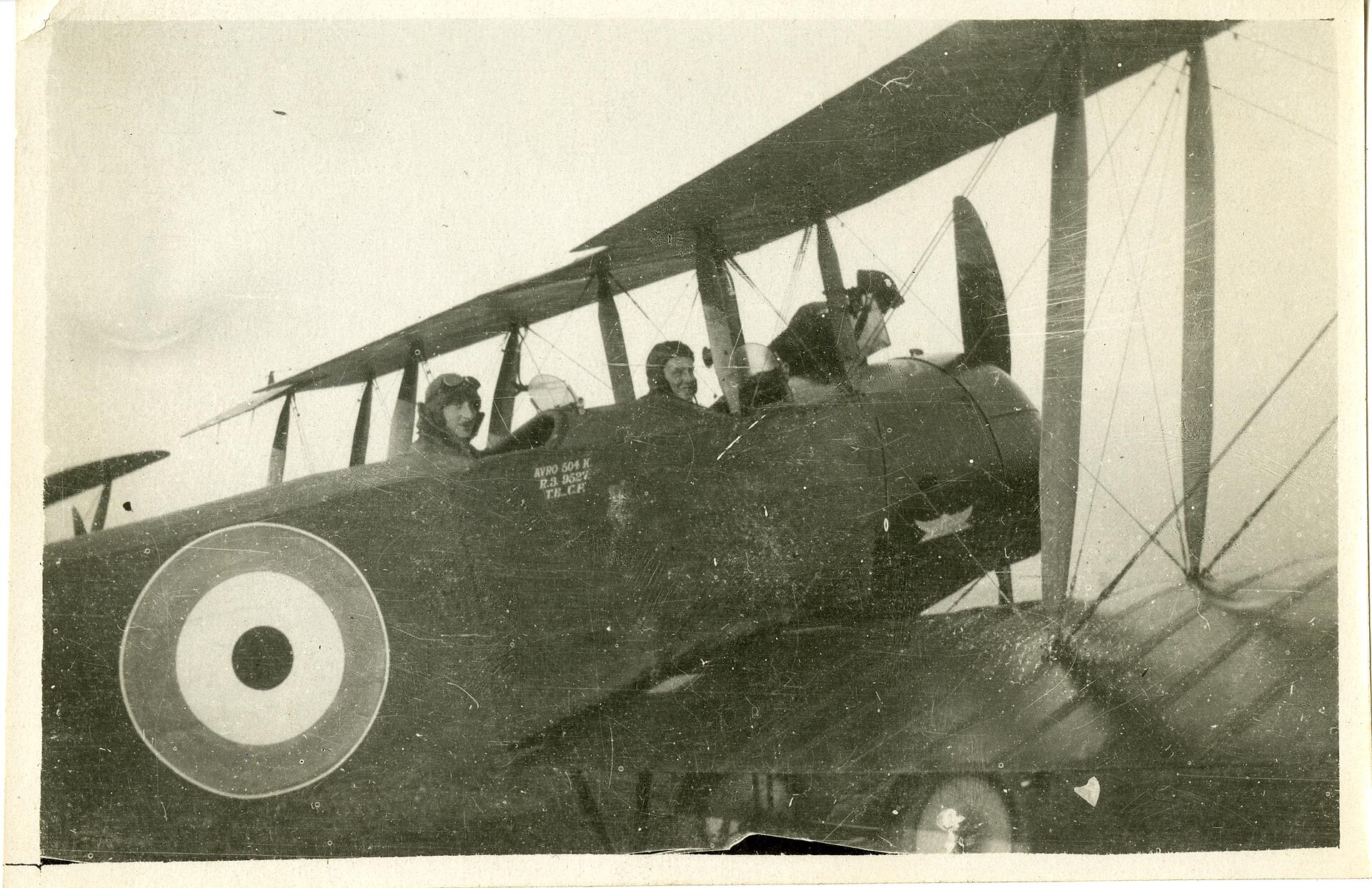
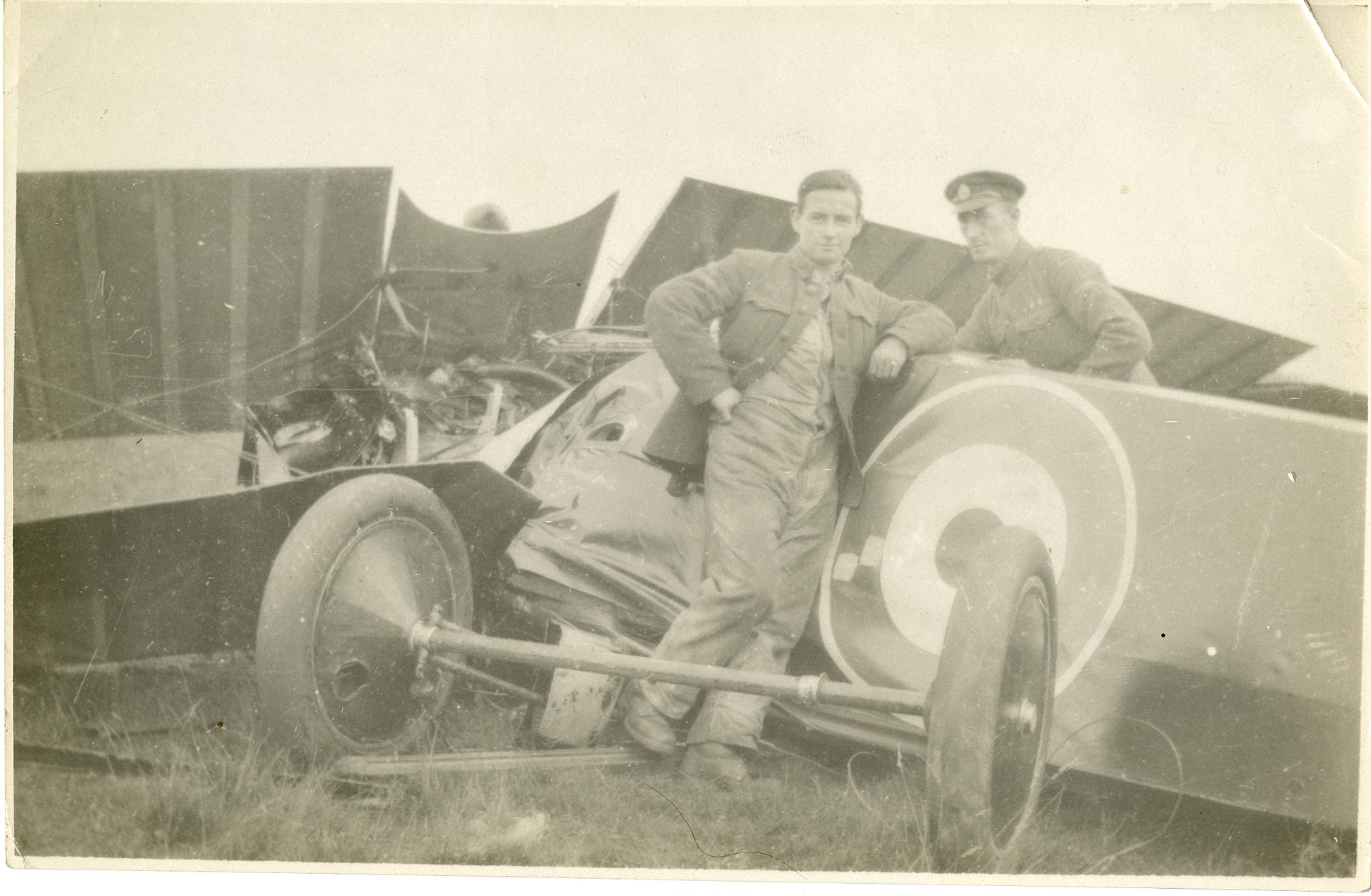
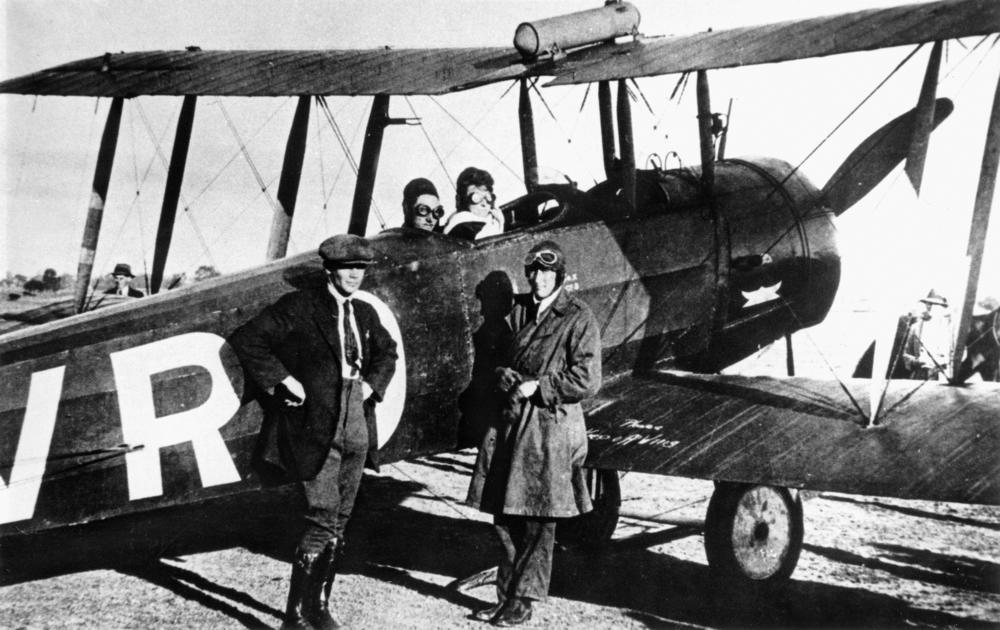
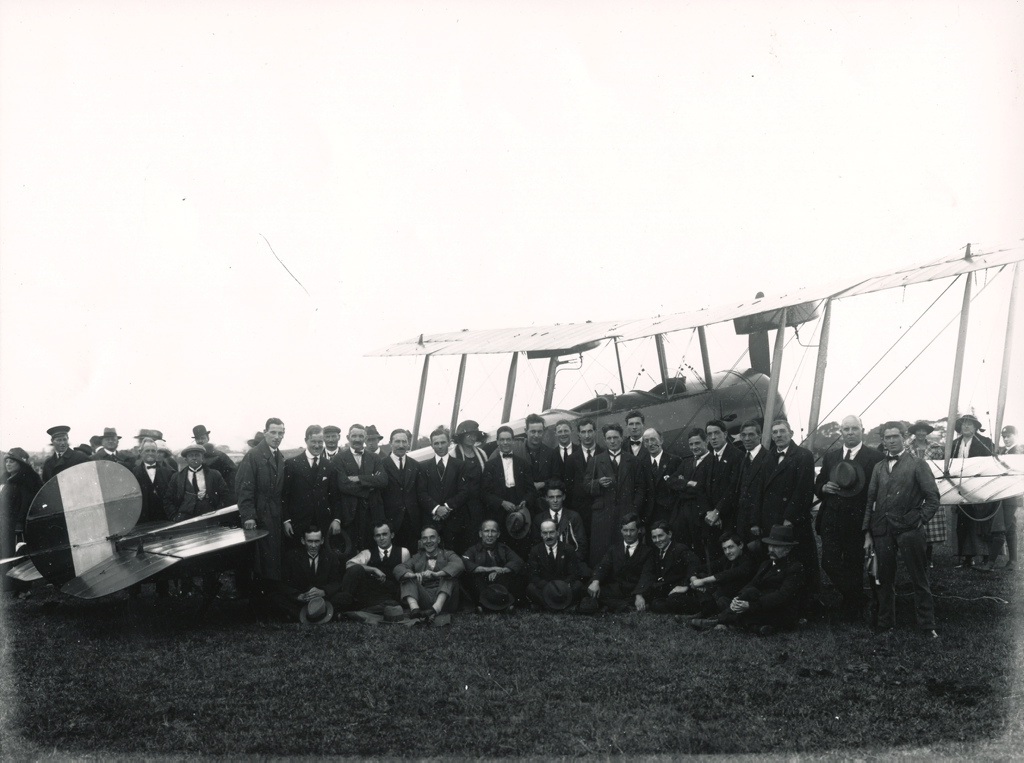
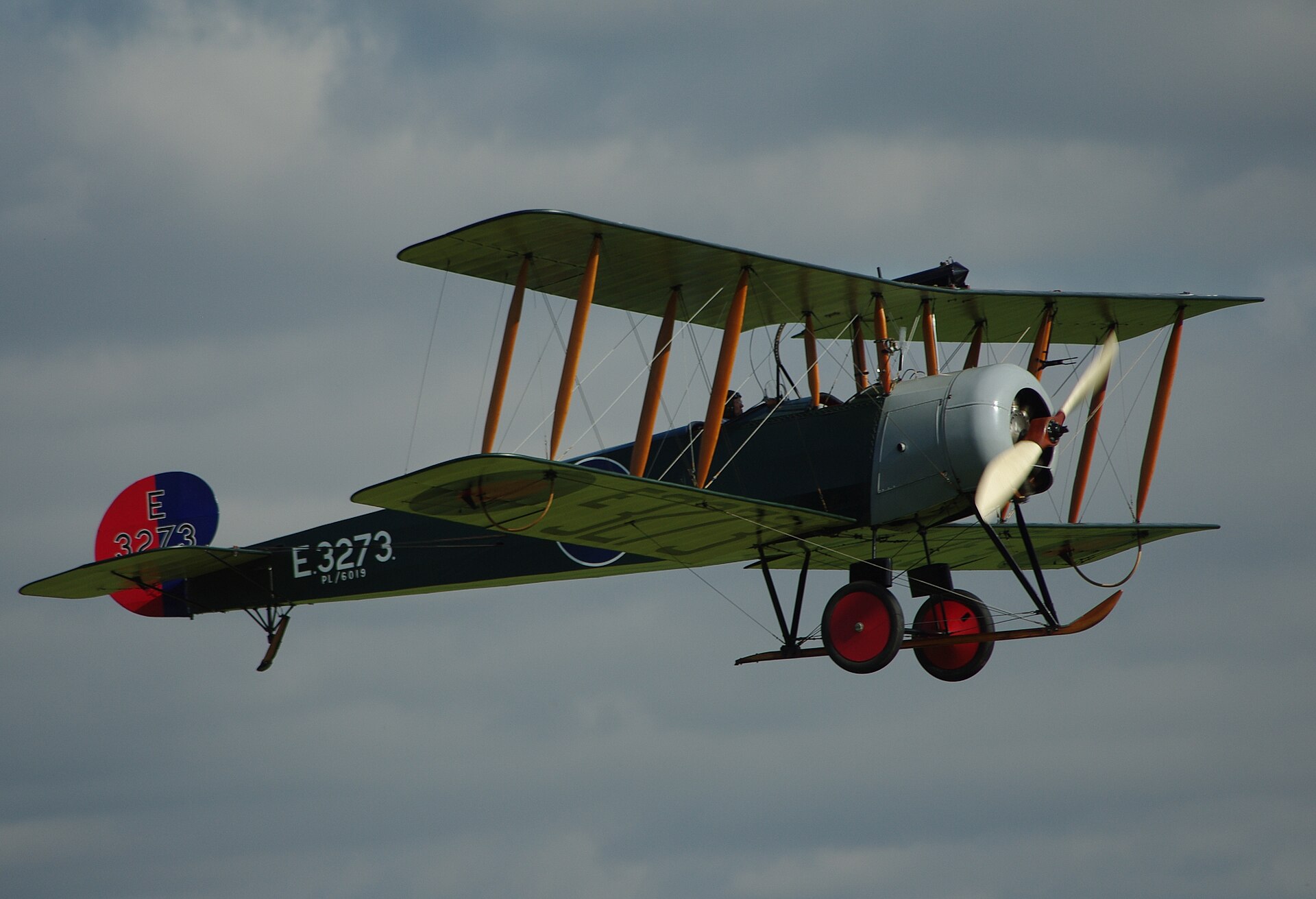
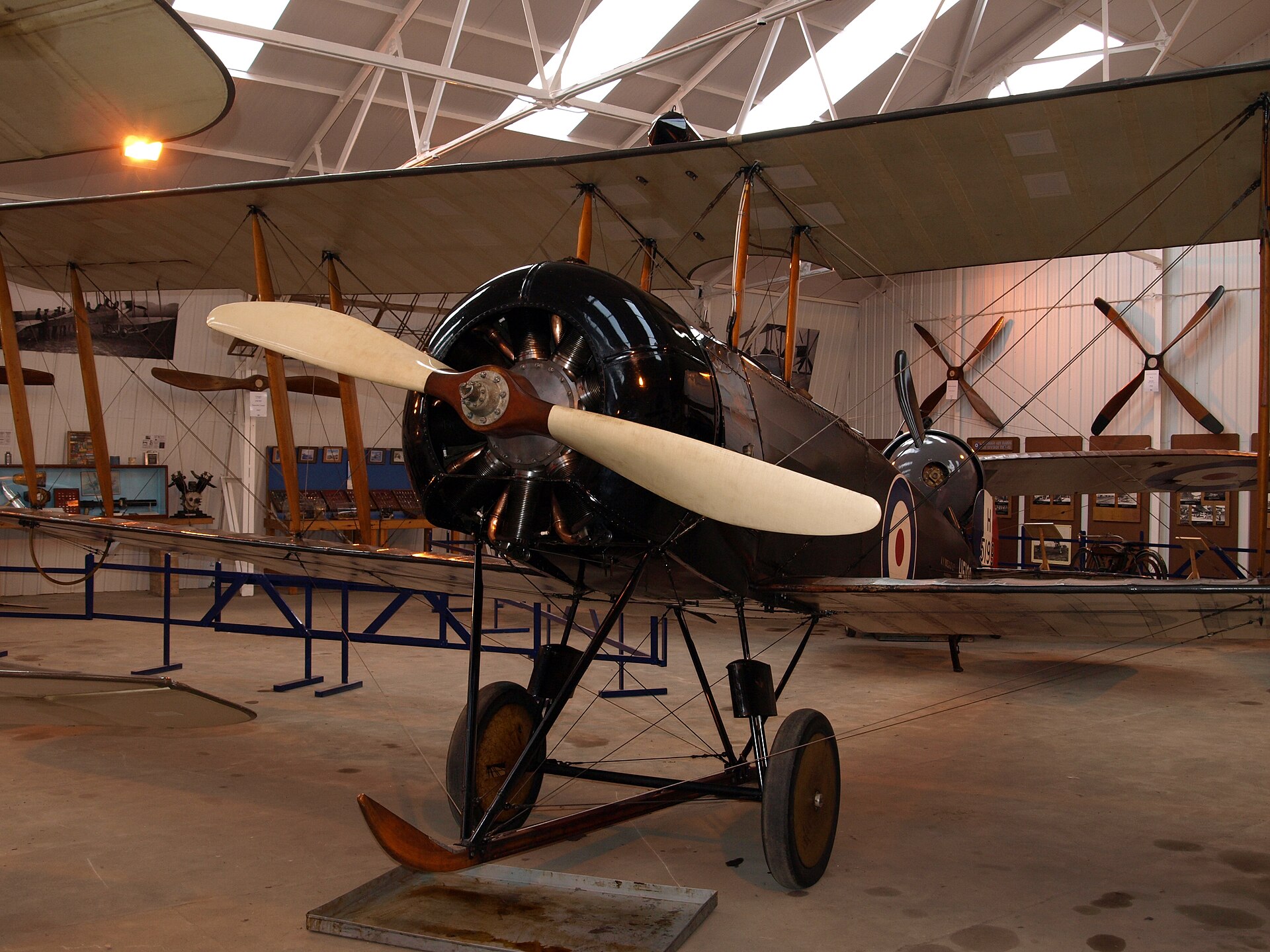
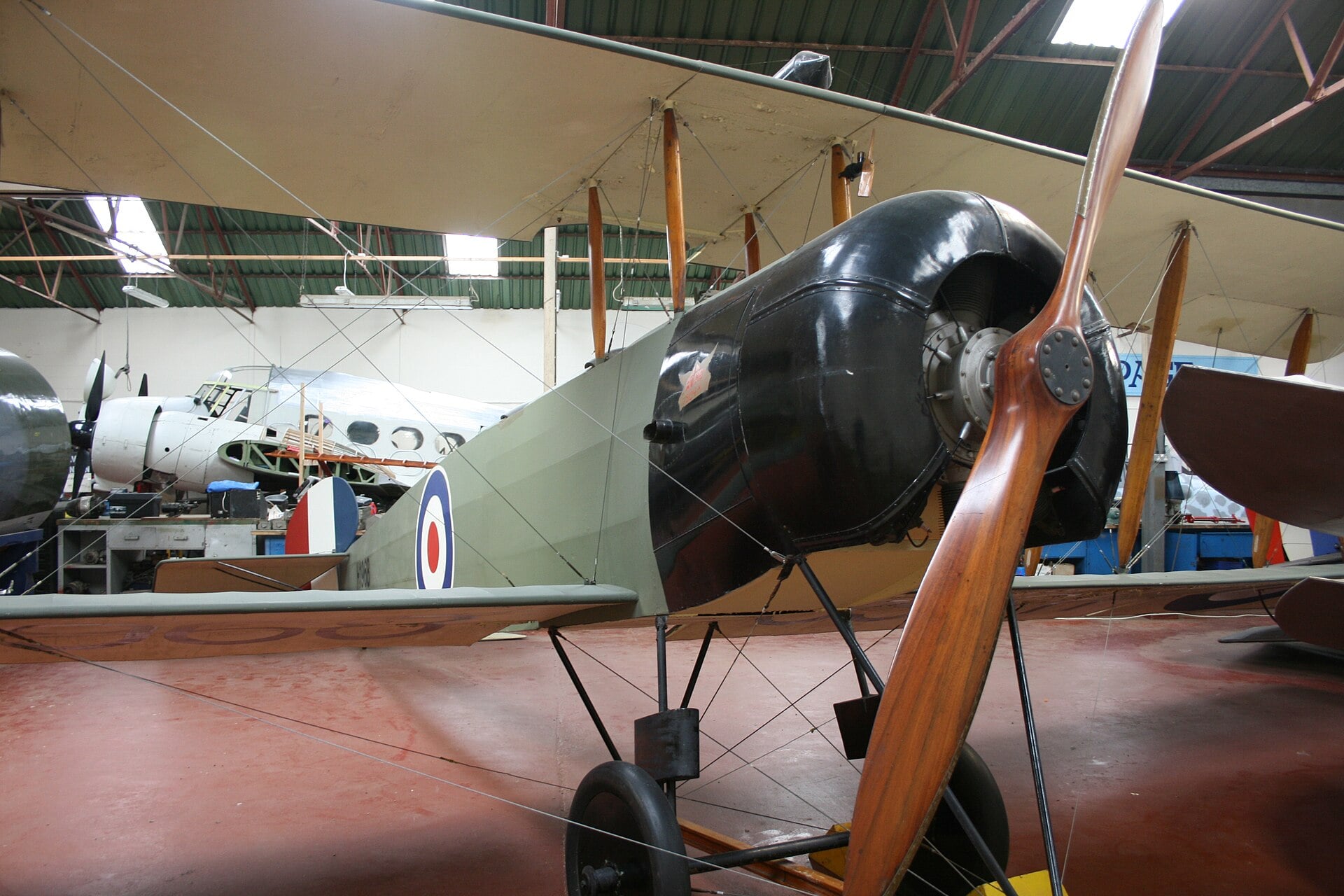
The Avro 504 in the air
The Avro 504 around the world: how one British trainer went global
Few aircraft of the First World War era travelled as far, or served as many flags, as the Avro 504. Its combination of low cost, docile handling and simple construction made it the natural choice for any air arm or flying club that needed to make pilots cheaply — and in the 1920s, almost everyone did. What follows is a tour of where the 504 went and what it did there. Because its use was so widespread and the records so scattered, treat the details as a well-sourced sketch rather than a complete census; the operations map below deliberately shows the best-documented operators.
Britain and the Commonwealth. At home the 504 was the standard primary trainer of the Royal Flying Corps, the Royal Naval Air Service and, from 1918, the Royal Air Force, and it stayed in RAF service — as the radial-engined 504N — into the early 1930s. Across the Empire it did the same job: Canada, Australia, New Zealand and South Africa all used 504s to train their earliest military and civil pilots, and Canadian and Australian operators kept them flying commercially long after the war. Australian photographs from the early 1920s, including machines associated with the young Qantas, capture the 504 in its post-war civil prime.
The Soviet Union. The most numerically dramatic chapter took place far from Britain. Soviet industry reverse-engineered the 504K and mass-produced it as the U-1 (and the floatplane MU-1), building it in the thousands as the standard primary trainer of the Red Air Force and the civilian Osoaviakhim movement throughout the 1920s. Nicknamed the 'Avrushka', it trained the first generation of Soviet pilots and is a large part of why total 504-family production, counting copies, runs so far ahead of the already huge British figure.
Europe, Asia and the Americas. Denmark built its own 504s in the army and navy workshops; Japan produced the type under Nakajima licence, seeding early Imperial Japanese Navy training and a line of derivatives. Belgium, the Netherlands, Norway, Sweden, Finland, Estonia, Ireland, Greece, Turkey and others operated the type militarily or commercially, while in South America Argentina, Brazil, Chile and Peru all flew 504s, and examples reached China, Thailand, Mexico, Spain and Portugal. The United States saw imported machines and, later, replicas. The exact roll-call varies between sources — another reason the map here highlights well-attested operators rather than every claimed one.
The lasting legacy. Strip away the geography and the numbers and one thing remains: the Avro 504 was, above all, the aeroplane that taught the world to fly. Through the Gosport system it standardised instruction; through sheer production it put that standard everywhere; and through the U-1 and its many licence-built cousins it did the same job for rival nations. When aviation historians reach for a single machine to represent the birth of modern, systematic pilot training, they reach for the 504 — and that legacy, more than any raid or record, is why it still matters.
Where the Avro 504 flew: origin, WWI service, worldwide operators and survivors
Categories are indicative and compiled from published operator histories; the Avro 504's export and licence use was so widespread that this map shows the best-documented operators rather than an exhaustive list.
The Avro 504 by the numbers
Twelve deeper dives into the Avro 504's story
07A.V. Roe and the birth of Avro: the company behind the 504
Alliott Verdon Roe was one of the true pioneers of British aviation. In 1909 he became the first Englishman to fly an all-British machine of his own design, and the following year he and his brother Humphrey founded A.V. Roe & Company — Avro — in Manchester. The firm's early triangular trademark and its Roe-designed biplanes established a reputation for sound engineering that the 504 would cement. It is worth remembering that the 504 was not a lucky one-off but the product of a company already steeped in the craft of flight: Avro had learned, aircraft by aircraft, what made a machine controllable, repairable and safe. That institutional knowledge is why the 504 emerged so mature in 1913, and why Avro went on to become one of Britain's great aircraft houses, later famous for very different machines such as the Anson and, in the Second World War, the Lancaster. The 504 sits at the hinge of that story: the aircraft that made Avro's name and paid for everything that followed. The company's Manchester roots and its network of skilled woodworkers and engineers were exactly what a design like the 504 needed to be turned out in quantity, and the profits and prestige of the 504 helped carry Avro through the lean years after the Armistice, when so many wartime aircraft firms collapsed. In a real sense, the aeroplane that taught pilots to fly also taught a great British aircraft company how to survive.
08The Friedrichshafen raid in detail: 21 November 1914
The raid on the Zeppelin works at Friedrichshafen was audacious to the point of recklessness. Airships were, in late 1914, terrifying strategic weapons, and the works on Lake Constance built them. Rather than wait to be bombed, the Royal Naval Air Service resolved to strike the source. Four 504s were shipped in crates to Belfort in eastern France and assembled in secrecy; three got away on the morning of 21 November. The little biplanes navigated by map and compass across roughly 120 miles of hostile territory, then dived on the sheds through rifle and anti-aircraft fire, each releasing its four small bombs. They hit the works and a hydrogen gas-generating plant, causing real damage and, briefly, real alarm in Germany about the vulnerability of its airship programme. One 504 was forced down and its pilot captured; the other two returned. Measured against later thousand-bomber raids the physical damage was tiny, but the raid's significance is conceptual: it was one of the first deliberate attempts to reach past the front line and destroy war-making capacity from the air. The idea of strategic bombing — for good and ill one of the defining military concepts of the twentieth century — has one of its earliest practical expressions in three Avro 504s over Lake Constance. There is a deep irony in the fact that the aircraft most associated with gently teaching people to fly also helped inaugurate one of the most destructive doctrines of modern war. But it captures the 504's peculiar place in history perfectly: for a brief moment in 1914 it was at the cutting edge of offensive air power, before settling into the role that would define it. Both facts are true, and holding them together is the only honest way to tell the story.
09Rotary versus radial: the engines that powered the 504
To modern eyes the rotary engine is almost unbelievable: the entire cylinder assembly spins with the propeller around a stationary crankshaft, and the whole thing is total-loss lubricated with castor oil that the pilot breathes and wears. Rotaries were light and produced useful power for their weight in 1914, which is why they dominated early aviation, but they had real drawbacks — strong gyroscopic effects that tugged an aircraft in turns, crude throttling that often meant cutting and restoring ignition with a 'blip' switch, and a thirst for scarce oil. On the 504 these traits were mild enough to teach on and, arguably, useful to teach with: a pupil who could handle a Le Rhone-powered 504 had already met the gyroscopic quirks they would face on hotter machines. By the 1920s, though, the air-cooled radial — cylinders fixed in a circle around a spinning crankshaft, the modern arrangement — had matured into something far more practical. The 504N's Armstrong Siddeley Lynx radial was more powerful, more reliable and far less thirsty, and it let the fundamental 504 soldier on into a new decade. The engine change, more than anything else, is what separates the wartime 504K from its interwar descendant. It is a neat illustration of a general truth about the 504: the airframe was so fundamentally right that it could absorb a complete change of powerplant — from spinning rotary to fixed radial — and carry on doing its job for another decade. Few designs are robust enough to survive that kind of transplant; the fact that the 504 did, and did it well, is part of why its service life reads more like that of a whole family of aircraft than a single type.
10The barnstorming boom: how surplus 504s put the public in the air
The Armistice left the world awash in war-surplus aircraft, and the Avro 504 — cheap, docile, roomy and available in huge numbers — was ideal for the freewheeling civil aviation that followed. Ex-military 504s were sold for a fraction of their cost, and enterprising former pilots bought them to make a living giving joy-rides. The pattern was the same on several continents: fly into a field near a town, put up a sign, and for a modest fee take locals aloft for a circuit of the aerodrome. For an enormous number of ordinary people in the 1920s, the first time they ever saw their own town, farm or coastline from the air was from the front cockpit of an Avro 504. In Australia the type was especially prominent, used for joy-flights and pioneering commercial work by operators including the young Qantas, and captured in crowds-and-canvas photographs from Brisbane, Windsor and Tweed Heads. This civil chapter matters because it changed public attitudes: the 504 helped turn flight from a remote wartime marvel into something an ordinary person could experience, and imagine being part of. In that sense the aeroplane that trained the pilots also helped create the passengers. The barnstorming years were often shabby and sometimes dangerous — the aircraft were ageing, the flying was seat-of-the-pants, and the business was precarious — but their cultural effect was enormous. They normalised the aeroplane, seeded a generation of enthusiasts, and kept flying skills and airfields alive through the lean post-war decade until commercial aviation found its feet. The Avro 504, cheap and available and safe, was the workhorse of that quiet revolution as much as it had been the workhorse of military training.
11Surviving Avro 504s and replicas around the world
For such an old design, the 504 is unusually well represented today, thanks to a mix of genuine survivors, long-term rebuilds and faithful replicas. The best known is the Shuttleworth Collection's airframe at Old Warden in England — a genuine 1918 aircraft kept in flying condition and displayed regularly, sometimes alongside a more recently built replica so audiences can see two 504s aloft together. In Britain, the Royal Air Force Museum and the Imperial War Museum at Duxford both hold examples, and other 504s or 504-derived airframes are preserved in Canada, Australia and elsewhere among the type's many former operators. Because the 504 was so widespread and so long-lived, and because its simple wood-and-fabric construction lends itself to sympathetic restoration, new-build and rebuilt examples continue to appear. The exact global tally shifts as projects are completed or airframes change hands, and enthusiast resources such as the Official Avro 504 Web Page track originals and survivors in detail. The headline, though, is simple and rather wonderful: more than a century after the prototype first flew, you can still stand at an airfield fence and watch an Avro 504 fly. Keeping one airworthy is no small undertaking — rotary engines demand specialist knowledge, spares must often be made by hand, and every hour flown is a careful negotiation between preservation and use. That collections such as Shuttleworth judge it worth the effort says a great deal about what the 504 represents: not just a rare old airframe, but a living demonstration of how flight was taught at the dawn of military aviation. Each display flight is, in effect, a moving exhibit that no static museum can match.
12From the 504 to the Tutor: the trainer bloodline it founded
The Avro 504's real monument is not a single airframe but a whole philosophy of training that outlived it. By proving that a safe, forgiving, aerobatic biplane plus a structured syllabus could turn raw recruits into competent pilots at scale, the 504 set the template for the purpose-built primary trainers that followed. Avro's own Tutor, which replaced the 504N in RAF service, was a direct spiritual successor — a radial-engined, dual-control biplane built to do the same job with 1930s refinement. Across the world, the generation of trainers that followed the 504 inherited its assumptions about what ab-initio instruction should look like: dual controls, deliberate practice of spins and recoveries, and an aeroplane chosen for its manners rather than its performance. Even as trainers became monoplanes and then jets, the underlying Gosport principles — codified around the 504 — persisted. When a student pilot today is deliberately taught to recognise and recover from a stall under a calm instructor's guidance, they are, at several removes, heirs to a lesson first taught systematically in the back seat of an Avro 504.
13Handling the 504: what pilots say it is like to fly
Accounts from pilots who have flown preserved 504s — including material published by the Historic Aircraft Association — paint a consistent picture of an honest, gentle, low-and-slow aeroplane that rewards a light touch and punishes nothing very hard. The controls are effective but unhurried; the rotary must be managed with care on the ground and on approach; and the whole experience unfolds at a pace that feels almost stately compared with later types. That is precisely the point. The 504 was never meant to thrill an expert; it was meant to let a beginner make mistakes and live to learn from them. Flying one today is described less as a performance and more as a conversation with 1918 — the smell of castor oil, the crackle of the rotary, the wires singing, and a view of the world at the speed of a fast car. For the collections that keep them airworthy, that experience is the whole reason to do it: not to demonstrate speed or agility, but to preserve, in the air, the feel of the aeroplane on which flight itself was first taught methodically.
14Why the numbers are hard to pin down: production figures and their caveats
Any confident single figure for how many Avro 504s were built should be treated with suspicion, and this exhibit deliberately hedges. The commonly repeated statement is that more than 8,000 were built in Britain during the First World War, a figure supported by institutions such as the Royal Air Force Museum. Add post-war British production of the 504N, licence manufacture abroad, and the very large but separately-counted Soviet U-1 programme, and totals climb well past ten thousand — but exactly how far depends on what you count and which records you trust. Wartime and interwar production was spread across many firms and several countries, some record series are incomplete, and different historians draw the boundary between 'a 504' and 'a 504-derived type' in different places. Do we count the Soviet U-1? The Japanese Nakajima machines? Every field rebuild? Reasonable sources answer differently. The honest summary is the one used throughout this page: the 504 was one of the most-produced aircraft of its era, with British wartime output alone exceeding 8,000 and grand totals, including copies and licence-builds, commonly estimated at ten thousand or more.
15The 504 as a naval and floatplane aircraft
Although it is remembered mainly as a land-based trainer, the 504 family also went to sea in various guises. Early in the war the Royal Naval Air Service operated 504s — it was RNAS machines that flew the Friedrichshafen raid — and floatplane conversions extended the type's reach over water. The clearest example of the waterborne branch is the Soviet MU-1, the floatplane version of the U-1 copy, used to give Soviet naval and civil pupils their first flights from water in the 1920s. Seaplane training has its own demands — judging height over a featureless surface, handling on the step, coping with swell — and the 504's forgiving nature made it as suitable for that as for conventional instruction. This maritime thread is a small but real part of the type's astonishing versatility: the same basic airframe served as land trainer, reconnaissance-bomber, night fighter, joy-ride machine and floatplane, across two decades and dozens of operators.
16The Avro 504 in the wider story of 1914 to 1918 aviation
It helps to place the 504 alongside its contemporaries. The glamorous names of First World War aviation are the fighters — the Sopwith Camel, the S.E.5a, the Fokker triplane — and the strategic bombers that came later. The 504 belongs to a quieter but arguably more consequential category: the aircraft that made the aircrew. Every celebrated ace had, somewhere behind them, hours in a trainer, and for a huge proportion of British and Commonwealth pilots that trainer was a 504. In that sense the 504 is the connective tissue of the era's air war: less a single weapon than the tool that produced the people who wielded all the others. Its contemporaries in this encyclopedia — the S.E.5a, the Bristol F.2 Fighter, the Sopwith 1½ Strutter — each made their name in combat; the 504 made its name by outlasting them all and by being the machine on which their pilots first learned the craft. When the histories of 1914 to 1918 aviation are written, the fighters get the headlines, but the humble Avro 504 quietly underwrites the whole story.
17Cockpit, controls and instruments: flying by feel in 1918
Sitting in a 504 is a lesson in how little a pilot of 1918 had to work with, and how much they relied on feel. The instrument panel was sparse by any later standard — an engine tachometer, fuel and oil indications, perhaps an altimeter and a simple air-speed indicator — and much of the information a modern pilot reads off a screen was instead sensed through the seat, the wind on the face, the note of the engine and the song of the bracing wires. Control was by stick and rudder bar, with the rotary engine managed through fuel and air levers and the ignition 'blip' switch rather than a smooth throttle. Because so little was instrumented, the aeroplane itself had to communicate clearly, and the 504 did: it gave honest, progressive warnings as it approached a stall and behaved predictably when handled firmly. That transparency is exactly what makes an aircraft good to learn on. The 504 taught pupils to fly by feel and by attitude — skills that underpin all flying — precisely because it could not lean on instruments the way later machines would.
18The two-seat, dual-control layout: designing an aeroplane to be taught in
The single most important design feature of the 504 as a trainer is easy to overlook because it seems obvious today: two seats in tandem, with a full set of working controls in each. That arrangement let an instructor sit behind a pupil, let the pupil actually fly the aeroplane, and let the instructor take over instantly if things went wrong — the fundamental safety mechanism that makes structured ab-initio training possible at all. Pair it with the Gosport speaking tube for communication and you have, in embryo, the basic architecture of essentially every primary flight-training aircraft since. Many wartime types could be flown from either seat in a pinch, but the 504 was used, refined and produced specifically to exploit this layout at scale, and the Gosport system was built to make the most of it. When you strip the 504 down to its essentials, this is what you find at the core: not a weapon adapted to teaching, but an aeroplane whose whole configuration was bent towards letting one person safely teach another to fly.
Avro 504: your questions answered
Can I fly in an Avro 504?
No — the Avro 504 is a century-old two-seat trainer, and MiGFlug does not offer flights in one. A few airworthy examples do still fly at collections and airshows (the Shuttleworth Collection's 1918 original is the best known), but they are not bookable rides. If you want to actually fly in a genuine vintage military aircraft, you can: MiGFlug flies paying passengers in warbirds and jets such as the L-39 Albatros, MiG-15 and de Havilland Vampire. See migflug.com/flights-prices.
Why is the Avro 504 so historically important?
Because it did two rare things at once. It flew some of the earliest offensive air operations of the First World War — including the 1914 Friedrichshafen raid — and it then became the standard primary trainer of the RFC, RNAS and RAF, teaching the overwhelming majority of British and Commonwealth pilots for years. Very few aircraft are both a combat pioneer and the machine a whole generation learned to fly on.
How many Avro 504s were built?
More than 8,000 were built in Britain during the war alone, and total production across all variants and years is commonly put at around 10,000 or more — figures vary between sources, so they are best treated as estimates. That does not even count the thousands of Soviet U-1 copies built separately. By any measure it was one of the most-produced aircraft of its era.
What engine did the Avro 504 use?
Wartime 504s used rotary engines — typically the Gnome, Le Rhone or Clerget, commonly around 80 to 130 horsepower depending on the variant. The 504K had a universal mounting that accepted several of these. In the 1920s the 504N switched to an air-cooled radial, the Armstrong Siddeley Lynx.
How fast was the Avro 504?
Top speed depended heavily on the engine fitted, but it was modest — roughly 90 to 110 mph (about 145 to 180 km/h). It was never meant to be fast; it was meant to be forgiving, aerobatic and easy to teach on, and it excelled at exactly that.
Was the Avro 504 armed?
Usually only lightly, and only in specific roles. Early war machines could carry small bombs for reconnaissance-bomber work, and the Home Defence night-fighter conversions carried a single upward-firing Lewis gun. As a trainer, the vast majority flew unarmed.
What was the Soviet U-1?
The U-1 was a Soviet copy of the Avro 504K, reverse-engineered and mass-produced without a licence after 1918. Nicknamed the 'Avrushka', it became the standard Red Air Force primary trainer of the 1920s, with a floatplane version called the MU-1. Thousands were built, spreading the 504's influence deep into Soviet aviation.
Are there any Avro 504s left, and do any still fly?
Yes. Several survive in museums including the RAF Museum, IWM Duxford, and collections in Canada and Australia, and a small number are airworthy. The most famous flyer is the Shuttleworth Collection's 1918 original at Old Warden, which still displays regularly — sometimes alongside a modern-built replica.
Who designed and built the Avro 504?
It was designed by Alliott Verdon Roe, whose company A.V. Roe & Co. — Avro — gave the aircraft its name. Because demand was so vast, it was also built by a large network of British sub-contractors, and later under licence or by direct copying in several other countries, from Denmark and Japan to the Soviet Union.
What was the Gosport system, and why does it matter?
The Gosport system was a structured method of flight instruction developed by Robert Smith-Barry at the School of Special Flying in 1917, built around the Avro 504. It introduced a real syllabus, deliberate practice of spins and stalls, and in-flight communication through a speaking tube. It replaced a lethal 'sink or swim' culture and became the foundation of modern flight training worldwide — arguably the 504's single most important legacy.
How does the Avro 504 compare with other WWI aircraft?
Unlike fighters such as the S.E.5a or Sopwith Camel, the 504 was not built to win dogfights — its importance is in numbers, longevity and training. Where a Camel was fast and vicious, the 504 was slow and kind. It shares the era's wood-and-fabric, rotary-engined technology with types like the Sopwith 1½ Strutter and Bristol F.2 Fighter, but outlived nearly all of them in service by being the machine that made the pilots who flew everything else.
Where can I see an Avro 504?
In the UK, the Shuttleworth Collection (Old Warden), the Royal Air Force Museum and IWM Duxford all hold examples, and Shuttleworth's is airworthy. Museums in Canada, Australia and other former operator countries preserve their own airframes and replicas. Airshow appearances are seasonal, so check a collection's flying calendar before travelling.
Fly a real military jet or warbird with MiGFlug
The Avro 504 taught a generation to fly, but you can't book a ride in one. What you can do is take the controls of a genuine military jet — from the L-39 Albatros to the mighty F-104 Starfighter — with a professional pilot beside you.
Related aircraft
Royal Aircraft Factory S.E.5aBritain's great WWI fighterBristol F.2 FighterThe rugged two-seat 'Brisfit'Sopwith 1½ StrutterPioneer two-seat multi-role biplane