
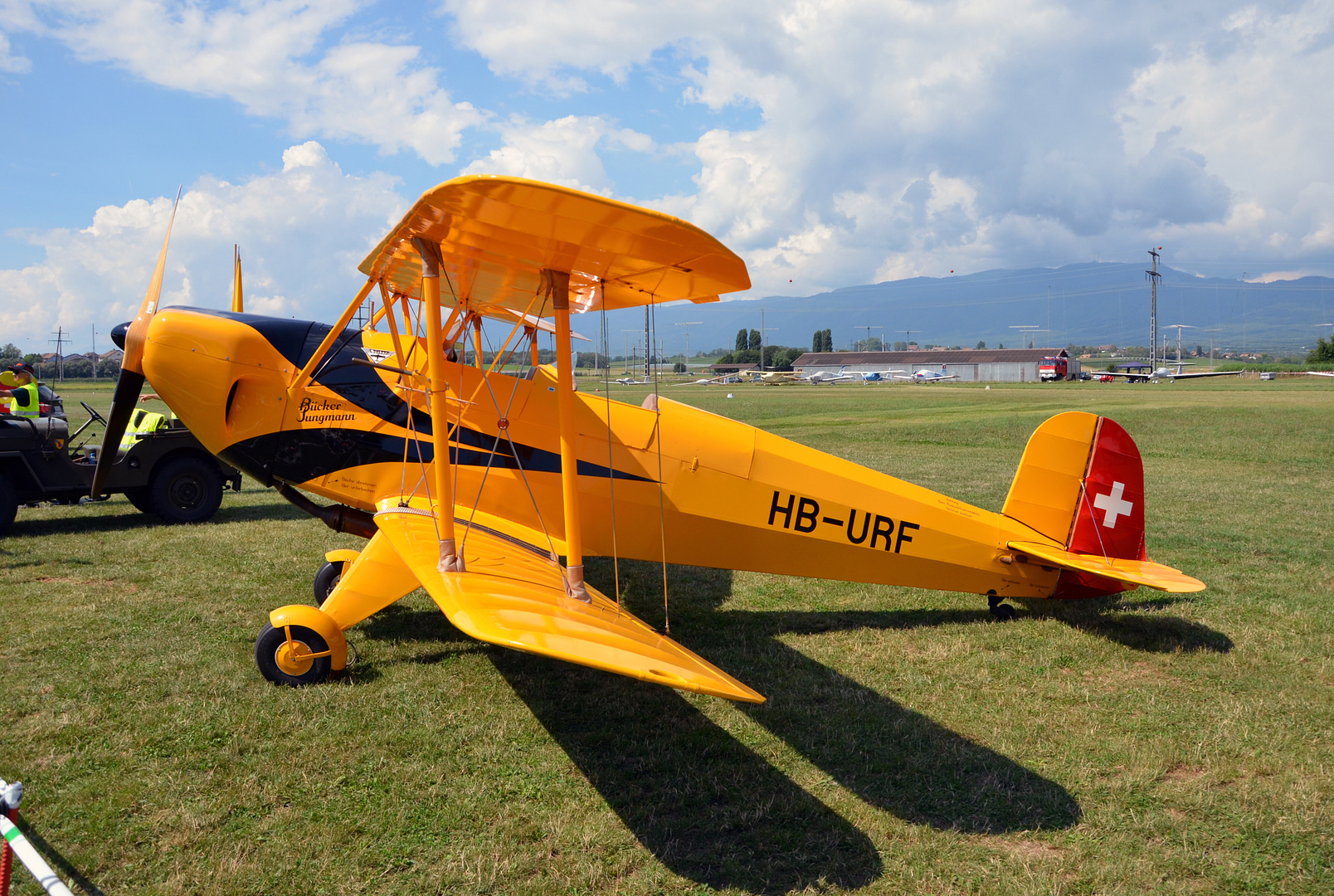
Bücker Bü 131
“Jungmann”
The little open-cockpit biplane that taught the world to fly — Germany’s classic 1930s primary trainer, licence-built on four continents and still looping over airfields nearly a century later. And this is one of the very few historic types you can still book a flight in.
Bücker Bü 131 Jungmann: the biplane that taught the world to fly
In 1932 the former German naval aviator Carl Clemens Bücker came home after more than a decade abroad. During the years when the Treaty of Versailles had all but strangled German aviation, he had gone to Sweden, where he ran the aircraft manufacturer Svenska Aero and learned his trade building military machines for a foreign air force. When he returned to Germany he set up Bücker Flugzeugbau at Berlin-Rangsdorf, and he did not come alone: he brought with him a brilliant young Swedish engineer, Anders J. Andersson, who would design almost everything the company became famous for.
Their very first product, first flown on 27 April 1934, was the Bü 131 Jungmann — German for “young man,” the beginner. It was tiny, light and beautifully proportioned: a single-bay biplane with a welded steel-tube fuselage, wooden wings, fabric covering and two open cockpits in tandem. Power came from a small inverted air-cooled inline engine, a Hirth of around 80 to 105 horsepower, mounted upside-down so the cylinders hung below the crankshaft and the student had a clean view over the nose.
It could not fly fast, and it was never meant to. What the Jungmann did supremely well was teach. Its controls were light and perfectly harmonised, it gave honest warning before a stall, and it was stressed for aerobatics so a pupil could safely be shown loops, rolls and spins. It rewarded good hands and gently exposed sloppy ones — exactly what a first aeroplane should do. Andersson had built, in effect, the perfect primary trainer, and the aviation world noticed almost at once.
As Germany rapidly rebuilt its air arm through the mid-1930s, the Jungmann became the standard primary trainer of the Luftwaffe and of the civil Deutsche Verkehrsfliegerschule flying schools. Tens of thousands of pilots took their first lessons, first solos and first spins in one. Its success also spawned a smaller, hotter single-seat sibling — the Bü 133 Jungmeister (“young master”) — which went on to dominate international aerobatic competition and cemented the Bücker name.
Then the design travelled. The Jungmann was licence-built across Europe and Asia on a scale few trainers have ever matched. Spain produced it as the CASA 1.131 in very large numbers and kept the line open into the 1960s, many re-engined with ENMA Tigre or Continental flat-fours. Japan built it as the Army Kokusai Ki-86 and the Navy Kyushu K9W Momiji. Suíça assembled it at Dornier/Doflug in Altenrhein for its own air force; Czechoslovakia continued it post-war as the Aero C-4 / C-104 e Tatra T-131; and Hungary and Yugoslavia built or flew it too.
Total production across all those lines runs into the thousands — the exact figure is genuinely uncertain and quoted very differently by almost every source, which is why any single number should be read as an estimate. During the Second World War the type stayed overwhelmingly in the training role, though individual aircraft were pressed into secondary duties: liaison and communications flying, glider-towing, and light observation. It was a teacher, not a warplane, and its documentary photographs wear the plain training markings of the era.
Most trainers are forgotten the instant their students graduate. The Jungmann was not. Its sweet handling and gentle aerobatic manners turned it into a cult classic of the vintage movement, and the sheer number built — especially the late Spanish CASAs — meant plenty survived to be restored. Today hundreds remain airworthy, from Switzerland to California to New Zealand, flown by pilots who fall in love with the same qualities that made it such a fine teacher ninety years ago.
And it is one of the very few pre-war types the public can still fly in. MiGFlug’s partner brand GoAviator offers passenger flights in a genuine open-cockpit Jungmann from Grenchen, Switzerland — you ride in the front cockpit in leather cap and goggles and choose sightseeing, aerobatics, or both. The aircraft is a Swiss Doflug-built machine from 1939; the details are below.
The company itself became a fixture of German aviation, moving to a purpose-built factory at Rangsdorf south of Berlin, where the Jungmann was joined on the line by the Jungmeister and, from 1939, the low-wing Bü 181 Bestmann monoplane trainer. For a firm that had started from almost nothing in 1932, it was a remarkable rise — built entirely on the reputation of aircraft that were a joy to fly rather than on speed or armament.
Defeat in 1945 ended German aircraft production for a decade, but by then the Jungmann had long since escaped Germany’s borders. The Spanish, Swiss, Czech and other lines kept building and flying it, and when the vintage-aircraft movement gathered pace from the 1960s onward the type was perfectly placed to be rediscovered: cheap to run by warbird standards, fully aerobatic, and available in real numbers thanks to all those licence machines. What had been a humble military teaching tool became one of the most sought-after classic biplanes in the world.
01The Bücker Bü 131 Jungmann’s two-seat layout: why it, not the Jungmeister, carries passengers today
Bücker built two famous biplanes that look almost identical to a casual eye, and they are constantly confused. The Bü 131 Jungmann is the two-seat primary trainer — student in the front cockpit, instructor behind. The Bü 133 Jungmeister (“young master”) is a smaller, more powerful single-seat aerobatic development of it. Because the Jungmeister has only one seat, it physically cannot carry a passenger — so every genuine “fly in a Bücker biplane” experience is, necessarily, a two-seat Jungmann.
GoAviator’s Grenchen aircraft is exactly that: a two-seat Bü 131 Jungmann built under licence in 1939 by Doflug (Dornier-Werke) at Altenrhein, Switzerland, carrying the Swiss military registration A-66 (works number 79). The passenger rides up front while the pilot flies from the rear seat. GoAviator’s own listing labels the machine a “Jungmann” — the two-seater — but writes the type number as “Bü 133,” which is simply an error: a Bü 133 Jungmeister could never take a passenger. What matters is that this is the two-seat Bü 131, the classic 1930s trainer this page is about.
What makes the Bücker Bü 131 Jungmann special
A featherweight built like a bridge
The Jungmann’s fuselage is a welded steel-tube frame under fabric, with fabric-covered wooden wings braced by a single set of struts and flying wires. Empty it weighs only around 390 kg. That combination — light, torsionally strong and fully stressed for aerobatics — is exactly why the type is still trusted to loop and roll after ninety years, and why so many airframes have survived to be rebuilt.
The upside-down Hirth engine
Power came from a small Hirth inverted inline-four: the HM 60R of about 80 hp in the Bü 131A, and the definitive HM 504 of about 105 hp in the Bü 131B. Mounting it inverted put the cylinders low and the propeller shaft high, giving a slim nose and an unobstructed view forward — a real advantage when a student is learning to judge a three-point landing in a taildragger.
Andersson’s magic handling
Designer Anders Andersson gave the Jungmann light, beautifully matched controls and honest stall behaviour. Pilots consistently rank it among the most delightful biplanes ever built. The same aerodynamics, shrunk to a single seat and given more power, produced the Bü 133 Jungmeister — a world-championship aerobatic star of the 1930s and proof of how good the basic design was.
02The Bücker Bü 131 Jungmann’s Hirth engine: the inverted inline-four explained
The Jungmann was built around the Hirth family of inverted, air-cooled, inline four-cylinder engines. The prototype and early Bü 131A used the Hirth HM 60R of roughly 80 hp; the definitive Bü 131B adopted the larger Hirth HM 504 of about 105 hp, which gave crisper aerobatic performance. “Inverted” means the cylinders point downward from the crankcase — a layout that keeps the propeller thrust-line high and the nose slim, improving forward view and ground clearance. It is a modest, unstressed engine that runs happily on ordinary fuel, which is part of why the type is still practical to operate. Many surviving airframes — especially the Spanish CASA 1.131s — were re-engined over the years with the Spanish ENMA Tigre or with American Continental and Lycoming flat-fours, so two “identical” Jungmanns can sound and fly noticeably differently.
03The Bücker Bü 131 Jungmann’s structure: fabric, steel tube and why it lasts
The Jungmann is a textbook example of 1930s light-aircraft construction. The fuselage is a welded chrome-molybdenum steel-tube truss, faired to shape with wooden formers and stringers and then covered in doped fabric. The wings are wooden two-spar structures, also fabric-covered, arranged as an equal-span single-bay biplane cell with N-struts and bracing wires. This makes the aircraft light and immensely repairable: a damaged tube can be cut out and re-welded, ribs can be rebuilt, and fabric can simply be renewed. It is that repairability — rather than any exotic material — that has kept so many Jungmanns flying for the better part of a century. The trade-off is maintenance: fabric ages, wood must be protected from moisture, and airframes need regular, skilled attention to stay airworthy.
04The Bücker Bü 131 Jungmann as a trainer: two open cockpits and how it taught pilots
The whole point of the Jungmann was ab-initio training — taking someone who had never flown and turning them into a pilot. Its two open cockpits sit in tandem, student in front and instructor behind, connected by a simple speaking-tube or, later, an intercom. The open layout was deliberate: it immersed the pupil in the sensations of flight and let the instructor watch head and hand movements directly. Because the aircraft was fully aerobatic yet forgiving, a syllabus could progress from straight-and-level and circuits all the way through spinning and aerobatics on the same airframe. Through the mid-1930s and into the war it was the first type flown at German flying schools, and the same qualities made it a favourite basic trainer for a dozen other air forces that bought or built it.
05The Bücker Bü 131 Jungmann’s licence variants: CASA 1.131, Ki-86, Aero C-104 and the Swiss Doflug machines
Few trainers were copied as widely as the Jungmann. Spain built it as the CASA 1.131 in large numbers and kept the line running into the 1960s, re-engining many with ENMA Tigre or, later, Continental engines — which is why a very large share of surviving “Jungmanns” are actually Spanish CASAs. Japan licence-built it as the Army Kokusai Ki-86 and the Navy Kyushu K9W Momiji (“maple leaf”). Suíça assembled it at Dornier/Doflug, Altenrhein, for the Swiss Air Force — the source of GoAviator’s aircraft. Czechoslovakia continued production after the war as the Aero C-4 / C-104 e Tatra T-131, and Hungary and Yugoslavia built or operated it as well. Because the variants differ in engine, equipment and detail fit, headline performance and production figures vary from source to source — treat any single total as an estimate rather than a hard fact.
06The Bücker Bü 131 Jungmann in the air: what pilots say it is like to fly
Pilots who fly the Jungmann tend to run out of superlatives. The controls are light and beautifully matched, the aircraft “talks” to you through the stick, and it will loop, roll and spin cleanly on modest power while remaining forgiving of a beginner. It is slow — cruising around 170 km/h — and in an open cockpit you feel every knot of it: the slipstream on your face, the smell of the engine, the horizon tipping over the top wing. That sensory honesty, not raw performance, is the whole point, and it is precisely what a modern passenger experiences on the Grenchen flight. The lineage shows, too: the single-seat Jungmeister derived from it was a world-championship aerobatic aircraft, and the Jungmann carries the same delightful DNA in a gentler, two-seat form.
07The Bücker Bü 131 Jungmann you can fly: the 1939 Swiss Doflug airframe A-66 at Grenchen
The specific aircraft MiGFlug’s partner GoAviator flies is a genuine 1939 Bü 131 Jungmann built under licence by Doflug (Dornier-Werke) at Altenrhein, Switzerland — works number 79, originally delivered to the Swiss Air Force as A-66. Switzerland operated its Doflug-built Jungmanns as primary trainers from 1936 until 1971, an extraordinary 35-year career, after which many passed straight into private and warbird hands. This machine is now a lovingly maintained warbird flown from Grenchen, with the passenger seated in the front cockpit. You can choose gentle sightseeing over the Swiss Mittelland and Jura, a full aerobatic sequence — loops, rolls, inverted flight, Immelmanns, spins — or a mix, with flights of roughly 30 or 60 minutes priced around 430–790 CHF. It is one of the only ways left to experience a pre-war Bücker biplane exactly as its first students did.
08Bücker Flugzeugbau and Anders Andersson: the company behind the Bü 131 Jungmann
The Jungmann was the making of a company that would leave a mark on aviation far larger than its size. Carl Clemens Bücker was a First World War German naval aviator who, when post-war restrictions gutted German aircraft manufacturing, moved to Sweden and built up the firm Svenska Aero. There he honed both his engineering instincts and his eye for talent — hiring the young Swedish designer Anders J. Andersson. When Bücker returned to Germany and founded Bücker Flugzeugbau in 1932, Andersson came too, and became the creative force behind the company’s aircraft. In just a few years the pair produced the Bü 131 Jungmann, the Bü 133 Jungmeister and the Bü 181 Bestmann — a trio of trainers admired for exactly the same quality: light, honest, beautifully harmonised handling. Andersson later returned to work in Sweden, but the design philosophy he brought to Rangsdorf is why a Jungmann still feels so alive in the hands today.
09Bü 131A vs Bü 131B: the Jungmann variants and the wider Bücker family
The two principal German versions differ mainly in power. The original Bü 131A used the Hirth HM 60R of about 80 hp; the definitive Bü 131B fitted the larger HM 504 of roughly 105 hp, giving livelier climb and crisper aerobatics, and it was the B that was built and copied in the greatest numbers. Beyond Germany, the licence machines form a family of their own: the Spanish CASA 1.131 (often re-engined and produced into the 1960s), the Japanese Ki-86 e K9W Momiji, the Czechoslovak Aero C-4 / C-104 e Tatra T-131, and the Swiss Doflug/Dornier-built aircraft. It is easy to confuse the Jungmann with its stablemates, so it is worth being precise: the single-seat Bü 133 Jungmeister is the aerobatic champion derived from it, while the Bü 181 Bestmann is a later low-wing monoplane trainer — a different aircraft entirely. The Jungmann proper is always the two-seat biplane.
Bücker Bü 131 Jungmann full specifications
Airframe & Performance (Bü 131B)
- Equipe
- 2 (student & instructor, tandem)
- Comprimento
- 6.62 m
- Envergadura
- 7.40 m
- Altura
- 2.25 m
- Área da asa
- ~13.5 m²
- Configuration
- Single-bay biplane, fixed tailskid/wheel gear
- Peso vazio
- ~390 kg
- Max takeoff weight
- ~680 kg
- Max speed
- ~183 km/h
- Velocidade de cruzeiro
- ~170 km/h
- velocidade de estol
- ~60 km/h
- Taxa de subida
- ~4 m/s
- Faixa
- ~650 km
- Endurance
- ~3.5 hours
- Teto de serviço
- ~3,000–4,000 m
Powerplant, Programme & Cost
- Engine (Bü 131A)
- Hirth HM 60R · ~80 hp
- Engine (Bü 131B)
- Hirth HM 504 · ~105 hp
- Configuration
- Inverted air-cooled inline-4
- Propeller
- Two-blade fixed-pitch wooden
- Manufacturer
- Bücker Flugzeugbau, Germany
- Designer
- Anders J. Andersson
- First flight
- 27 April 1934
- Built
- Thousands, incl. all licences (estimate)
- Licence variants
- CASA 1.131, Ki-86, K9W, Aero C-104, Tatra T-131
- Swiss builder
- Doflug / Dornier, Altenrhein
- Unit cost
- No open-market price (1930s military/club type)
- Cost per flight hour
- No standard figure for a vintage type
10The Bücker Bü 131 Jungmann’s operating costs: what a vintage biplane actually costs to fly
There is no meaningful “unit price” or official cost-per-flight-hour for a Bü 131. It was a 1930s military and club trainer, never sold on a modern open market, and the survivors are one-off restorations whose value depends entirely on condition, engine and provenance. In practice, running one today is the cost of a small vintage aeroplane: a modest-power engine burning ordinary avgas at a low rate, set against the real expense of maintaining a fabric-and-steel-tube airframe — recovering fabric, protecting woodwork, and keeping an ageing engine airworthy — to certified standard. Restored examples change hands for figures typical of desirable vintage biplanes rather than warbird fighters, but any precise number you see should be treated as an estimate. The clearest public price attached to the type is simply the ticket: MiGFlug’s partner GoAviator offers a passenger flight in a genuine open-cockpit Jungmann from Grenchen for roughly 430–790 CHF, depending on duration and whether you choose sightseeing or aerobatics.
Bücker Bü 131 Jungmann: ninety years in the air
Bücker comes home
Carl Clemens Bücker, back from running the Svenska Aero works in Sweden, founds Bücker Flugzeugbau near Berlin and brings Swedish designer Anders Andersson with him.
First flight
The prototype Bü 131 Jungmann flies on 27 April — a light, fully aerobatic two-seat biplane trainer powered by an inverted Hirth engine.
Luftwaffe standard trainer
The improved Bü 131B with the 105-hp Hirth HM 504 enters mass service as the primary trainer of the expanding Luftwaffe and Germany’s civil flying schools.
The Jungmeister is born
Andersson shrinks the design into the single-seat Bü 133 Jungmeister, which quickly becomes one of the outstanding aerobatic aircraft of the decade.
Switzerland builds its own
Licence assembly begins at Dornier/Doflug in Altenrhein; the Swiss Air Force adopts the Jungmann as its primary trainer, with “A-” military registrations.
Exported and copied worldwide
The type is licence-built in Spain (CASA 1.131), Japan (Ki-86 / K9W Momiji), Hungary, Czechoslovakia and Yugoslavia — thousands are produced across all lines.
Wartime service
The Jungmann remains overwhelmingly a primary trainer, with individual aircraft used for liaison, glider-towing and light observation. GoAviator’s A-66 is built at Altenrhein in 1939.
Spain keeps the line alive
CASA continues building the Jungmann as the CASA 1.131 into the 1960s, many re-engined — the reason so many survivors today are Spanish-built airframes.
End of Swiss service
Switzerland retires its military Jungmanns after 35 years of continuous use; many pass directly into private and warbird ownership.
Still flying — and bookable
Hundreds remain airworthy worldwide as beloved vintage aerobatic biplanes. MiGFlug’s partner GoAviator offers open-cockpit Jungmann flights from Grenchen, Switzerland.
From the cockpit: twelve Jungmann stories
From Sweden, with a Swede
Carl Bücker learned aircraft-building in Sweden and brought designer Anders Andersson home with him.
Read the full story
The prototype takes off
The first Jungmann flew on 27 April 1934 and impressed everyone who touched the controls.
Read the full story
“Young man” and “young master”
Jungmann means “young man”; the single-seat Jungmeister is the “young master.”
Read the full story
Where German pilots began
Through the late 1930s the Jungmann was the first aircraft most German pilots ever flew.
Read the full story
The Jungmann that never stopped
Spain built the type as the CASA 1.131 into the 1960s — so most survivors are Spanish.
Read the full story
A Bücker in the Far East
Japan licence-built the Jungmann as the Army Ki-86 and the Navy K9W Momiji.
Read the full story
Thirty-five years of Swiss service
The Swiss Air Force flew Doflug-built Jungmanns from 1936 until 1971.
Read the full story
The champion sibling
The single-seat Bü 133 Jungmeister became a 1930s world-aerobatic star.
Read the full story
Why the engine hangs upside-down
The inverted inline kept the cylinders low so the student could see over the nose.
Read the full story
The biplane pilots fall in love with
Ask anyone who has flown one: the Jungmann’s controls are close to perfect.
Read the full story
You can still fly one
MiGFlug’s partner GoAviator offers open-cockpit Jungmann flights from Grenchen.
Read the full story
Hundreds still airworthy
Ninety years on, the Jungmann remains a cornerstone of the vintage-aircraft world.
Read the full story
The Bücker Jungmann in pictures
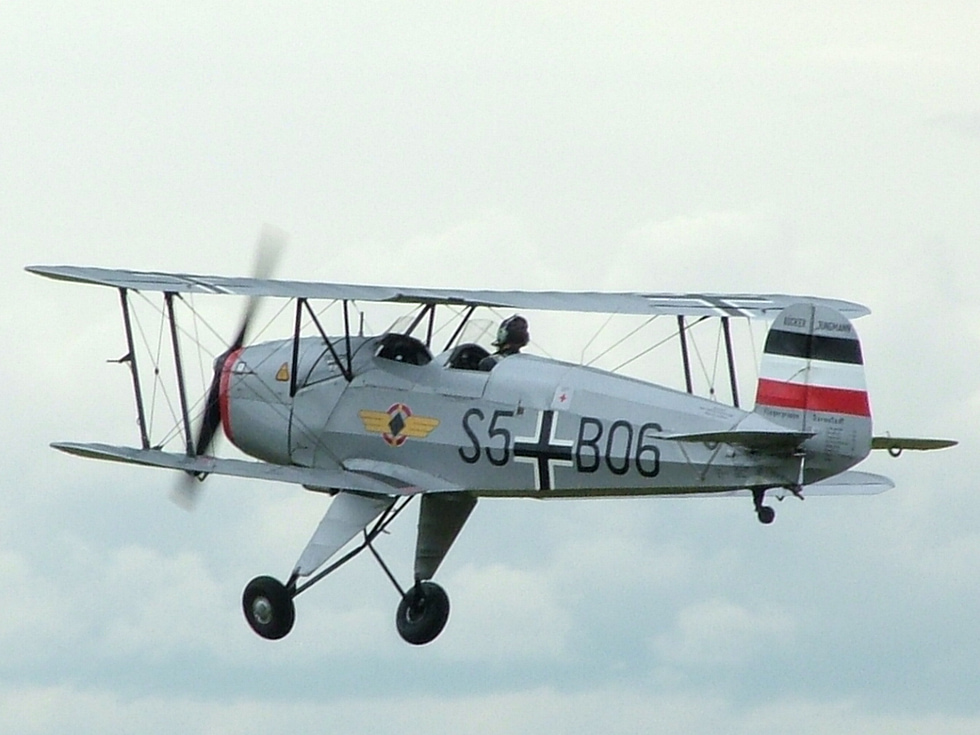
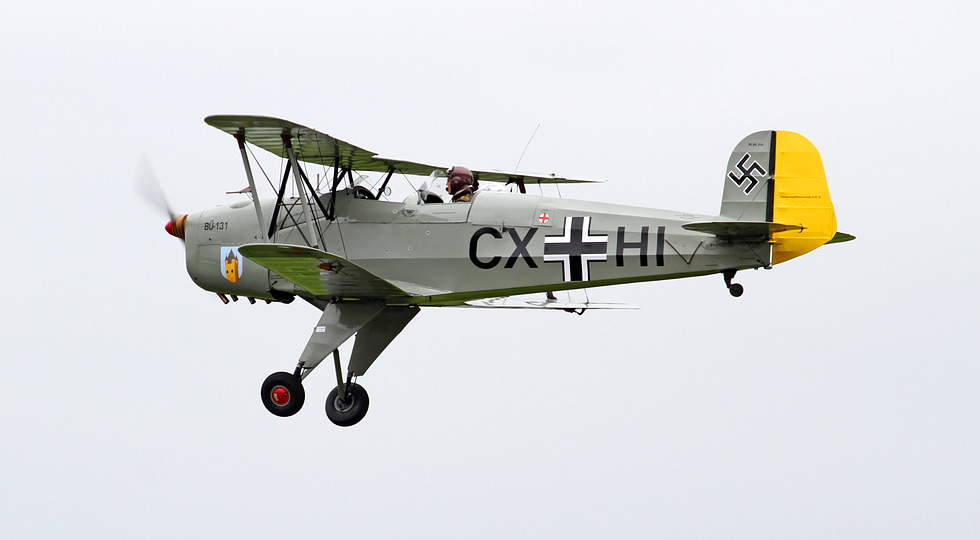
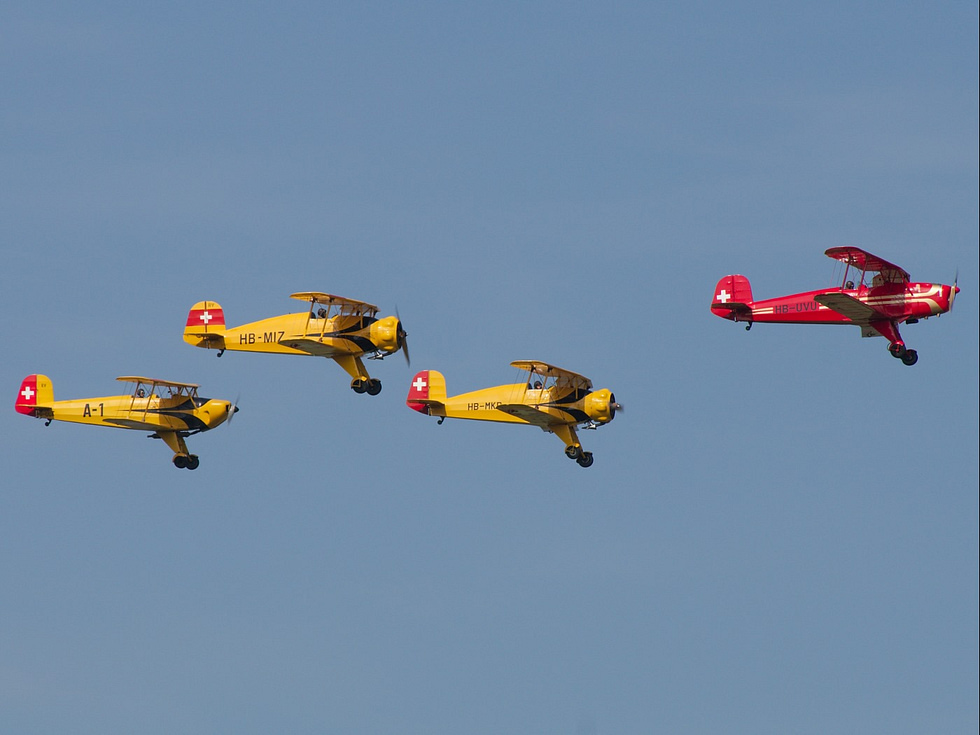
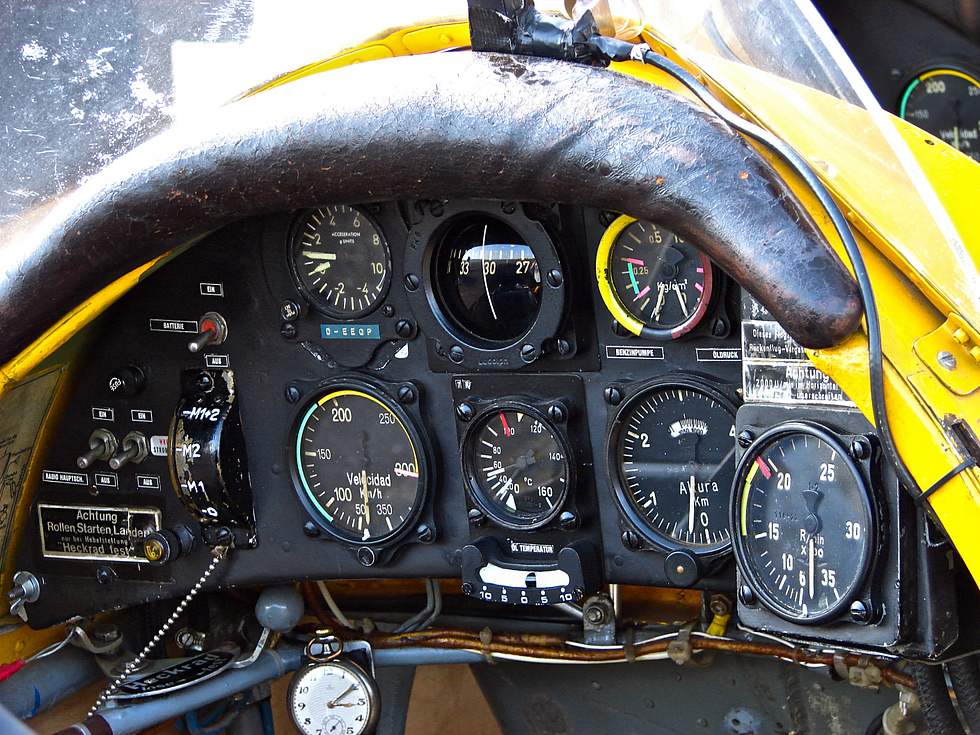
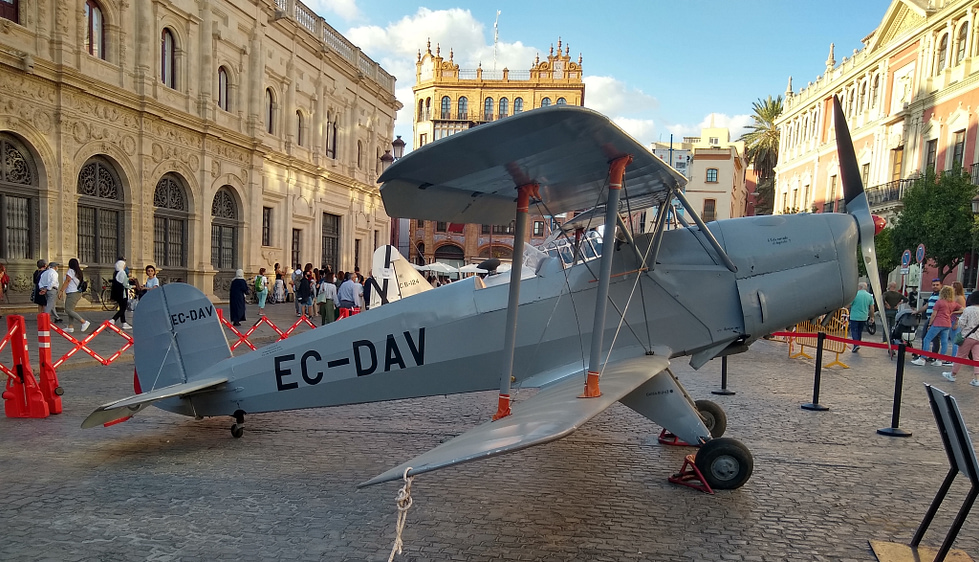
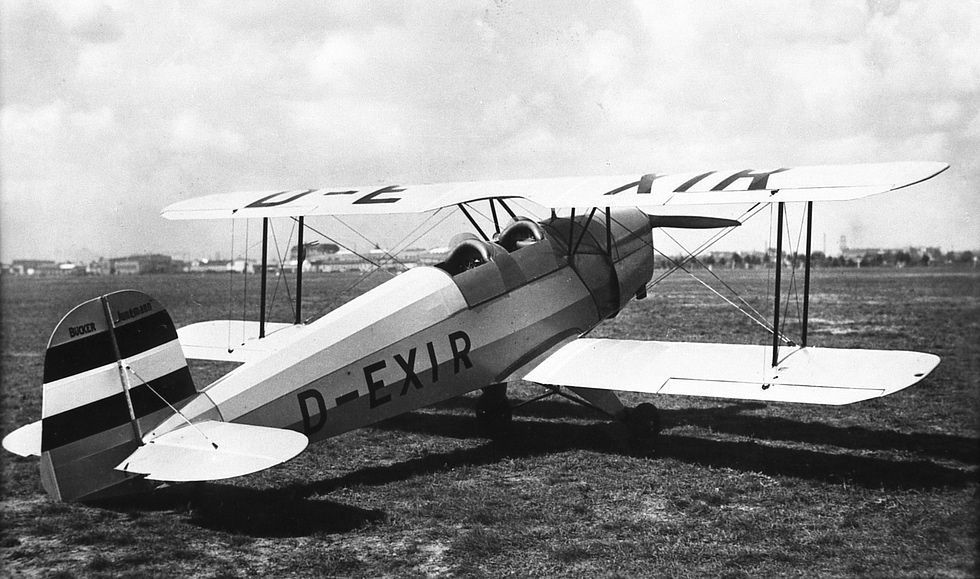
The Bücker Jungmann in motion
Flying with the Bücker 131 “Jungmann” — Pre-WW2 Trainer (channel: phil style). A pilot’s-eye flight in a restored open-cockpit Jungmann — the same slow, sensory experience GoAviator offers passengers from Grenchen.
Where the Bücker Jungmann flew
A trainer’s record: counted in pilots, not kills
The Jungmann was never a warplane, so it has no tally of air-to-air victories to define it. Its record is written instead in the one thing a trainer actually exists to produce: pilots. For the better part of four decades it turned nervous beginners into aviators, first across Germany and then, through its many licence versions, across a dozen air forces from Spain to Japan to Switzerland. Measured by how many people first learned to fly on it, few aircraft in history have a stronger claim to importance.
Its second, quieter record is one of endurance. Where most trainers are scrapped the moment a newer type arrives, the Jungmann kept going — in Spanish CASA production into the 1960s, in Swiss military service until 1971, and then in private and warbird hands ever since. Ninety years after the prototype first flew, hundreds are still airworthy and still doing loops and rolls at airshows and fly-ins around the world. That combination of huge original numbers and genuine affection is exactly why so many survived.
As a documentary type it wore the plain training markings of its era, including wartime German schemes on 1930s and 1940s airframes; this page treats those markings neutrally and historically rather than sanitising or dramatising them. The Jungmann’s legacy is not conquest but continuity — a link, unbroken, back to the very beginnings of powered flight training.
Explore more trainers, biplanes and warbirds in the MiGFlug Aircraft Museum.
Everything people ask about the Bücker Bü 131 Jungmann
Can I fly in a Bücker Bü 131 Jungmann?
What is the difference between the Bü 131 Jungmann and the Bü 133 Jungmeister?
When did the Bücker Jungmann first fly, and who designed it?
How many Bücker Jungmanns were built?
What engine does the Bücker Bü 131 Jungmann use?
What are the Jungmann’s licence-built versions?
Which exact aircraft does GoAviator fly at Grenchen?
Is the Bücker Jungmann still flying today?
Was the Bücker Jungmann ever used in combat?
Where can I see a Bücker Jungmann?
Is the Bücker Jungmann difficult to fly?
What does an open-cockpit Bücker Jungmann flight include?
Why is the Bücker Jungmann so popular with warbird pilots?
You CAN fly the Bücker Jungmann
Almost every aircraft in this encyclopedia is one you can only read about. The Jungmann is different. MiGFlug’s partner GoAviator flies a genuine 1939 open-cockpit Bücker Jungmann from Grenchen, Switzerland — you sit up front in leather cap and goggles and choose sightseeing, aerobatics, or both. Roughly 430–790 CHF depending on duration.
Continue the tour
Every fact, checked
- Smithsonian National Air and Space MuseumReference for the Bücker family of trainers and the Bü 133 Jungmeister aerobatic derivative held in the national collection.
- History of War — Bücker Bü 131 JungmannDevelopment history, the A and B variants, licence production and wartime service background.
- flugzeuginfo.net — Bü 131 technical dataDimensions, weights, engine and performance figures used for the Bü 131B specification table.
- Aviation History of SwitzerlandSwiss Doflug/Dornier licence production at Altenrhein and Swiss Air Force service from 1936 to 1971, including the “A-” registrations.
- The Aviation Geek ClubVintage-warbird coverage of the Jungmann, its handling reputation and its many licence variants.
- Warbird AlleyBackground on surviving Bücker Jungmann and CASA 1.131 warbirds and their place in the vintage-aircraft world.
- Historic & Classic Aircraft SalesMarket notes, restoration detail and history for surviving Bü 131 and CASA 1.131 airframes.
- Wikimedia CommonsImage source for the photographs used on this page; each individual credit and licence is shown in the gallery captions above.