

Fairey Firefly
The Fleet Air Arm’s Griffon-powered two-seater: a fighter, a reconnaissance aircraft and a strike machine that flew from carrier decks from the Pacific in 1945 to Korea in the 1950s.
At a Glance
Fairey Firefly: key facts
A História
The Fairey Firefly: the naval all-rounder that outlived its own war
The Fairey Firefly is one of those aircraft that resists a neat label. It was not the fastest fighter of the Second World War, nor the most glamorous, and it never became a household name like the Spitfire or the Corsair. Yet it did something few of its contemporaries managed: it took off from a pitching carrier deck as a fighter in 1943, flew reconnaissance and anti-shipping strikes across two oceans, and was still going into action over Korea nearly a decade later. Rugged, versatile and honestly rather large for a carrier aeroplane, the Firefly earned its keep as a workhorse rather than a thoroughbred.
It was designed by Fairey Aviation’s chief designer H. E. Chaplin to meet Admiralty requirements for a two-seat naval fighter-reconnaissance aircraft — a machine that could fight when it had to, but whose real value lay in the second crewman, the observer, who navigated over featureless sea, worked the radio, and later operated radar. That two-seat philosophy set the Firefly apart from single-seat naval fighters and shaped everything about it: a longer fuselage, a heavier airframe, and a role that blurred the line between fighter, scout and strike aircraft.
At its heart was the Rolls-Royce Griffon, the big-displacement stablemate of the Merlin. The Griffon gave the Firefly the power to haul its weight and its fuel over long distances, and it gave the aircraft a distinctive deep-chinned nose. Fairey paired the engine with one of its signature features: the Fairey-Youngman flap, a retractable area-increasing flap that could be set to a cruise position as well as for take-off and landing. It gave the heavy two-seater surprisingly good low-speed handling and turn performance — enough that Firefly crews occasionally found themselves able to out-manoeuvre lighter opponents at low speed, though no one pretended it was a dogfighter in the classic sense.
The prototype first flew on 22 December 1941, and the type entered Fleet Air Arm service in 1943. Its combat debut came in northern waters: Fireflies flew fighter cover and strike sorties off Norway in 1944, including operations connected with the long Royal Navy campaign against the German battleship Tirpitz. But it was in the Far East that the Firefly made its most striking early mark.
In January 1945 the aircraft of the British Pacific Fleet struck the Japanese-controlled oil refineries at Palembang, in Sumatra — Operations Meridian I and II. Fireflies were among the first Fleet Air Arm aircraft over the target, going in ahead of the strike to suppress flak, strafe defences and escort the Avengers that carried the bombs. The Palembang strikes were among the most ambitious and costly carrier operations the Royal Navy mounted in the war, and the Firefly’s part in them established its credentials as a genuine strike aircraft, not merely a scout.
Later in 1945 Fireflies ranged over the Japanese home islands themselves, flying strike, armed-reconnaissance and combat air patrol sorties as the British Pacific Fleet operated alongside the Americans. By the time the war ended, the Firefly had shown it could do a little of almost everything a carrier air group needed.
What makes the Firefly unusual is what happened next. Where many wartime types were scrapped within a year or two of victory, the Firefly entered a long and busy second career. New marks with two-stage Griffons and redesigned wings appeared; anti-submarine, night-fighter, trainer and target-tug versions followed. And when war returned to the Far East in 1950, the Firefly went back to sea.
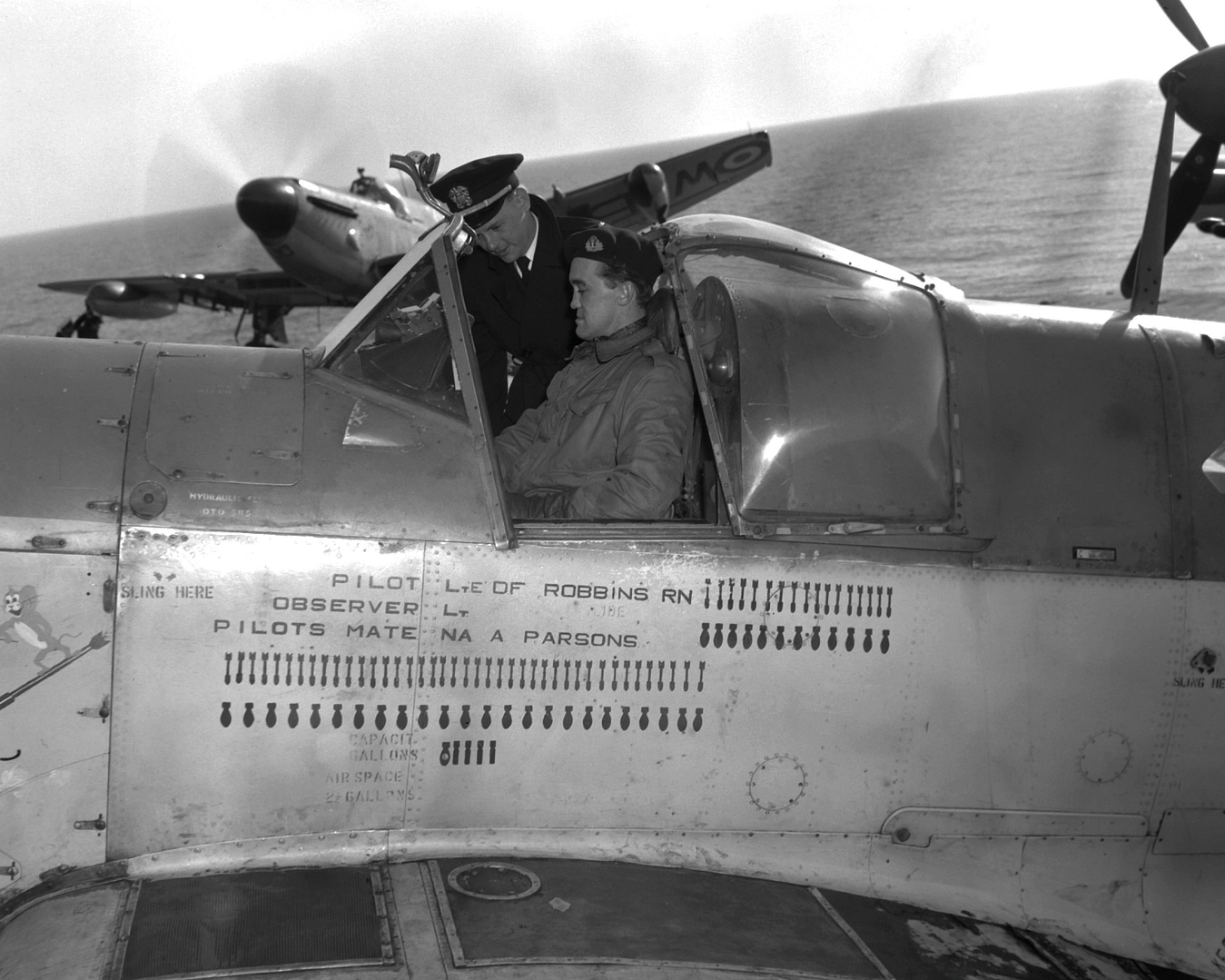
Throughout the Korean War (1950–53) Fireflies flew ground-attack, interdiction and armed-reconnaissance strikes from the light-fleet carriers of the Royal Navy and the Royal Australian Navy — HMS Ocean, Theseus and Glory, and HMAS Sydney among them. It was unglamorous, dangerous work: rockets and bombs against bridges, railways, supply dumps and troop concentrations, flown in all weathers from small decks. The Firefly did it steadily, day after day, and it is this Korean second act — rather than any single wartime dogfight — that best captures what the aeroplane was for.
It was also, by the standards of the day, a genuine export success. The Royal Australian Navy, the Royal Canadian Navy, the Royal Netherlands Navy and others operated Fireflies in front-line and training roles, while target-towing and drone variants served air arms from India to Scandinavia. Estimates of total production vary, but the figure most often quoted is in the region of 1,700 aircraft.
Today the Fairey Firefly is remembered as a naval all-rounder: not a legend, but a reliable, adaptable machine that gave the Fleet Air Arm exactly the flexibility it needed across a decade of very different wars. A handful survive in museums, and a small number have been kept or restored to airworthy condition over the years — enough that the deep growl of a Griffon-powered Firefly can still, occasionally, be heard over an airshow crowd.
To understand the Firefly is to accept that its value lay in breadth rather than brilliance. It never held a speed record or won a famous duel, but across a decade it filled almost every gap a carrier air group could have: air defence, reconnaissance, anti-shipping strike, ground attack, submarine hunting, aircrew training and even target towing. Few aircraft of any era spread themselves so widely and did each job competently.
That breadth came from deliberate choices — two seats, a big engine, clever flaps, a strong airframe — and from a willingness to keep developing the design mark by mark rather than discarding it. The story that follows traces those choices, the engineering behind them, the operations that tested them, and the survivors that still carry the Firefly’s memory forward.
01The Fairey Firefly’s design brief: what the Admiralty actually wanted+
The Firefly grew out of Admiralty thinking in the late 1930s about what a carrier fighter should be. Rather than a single-seat interceptor, the Royal Navy wanted a two-seat fighter-reconnaissance aircraft: one that could defend the fleet, but which also carried an observer to navigate over open sea and to find and shadow enemy ships. Fairey’s design, led by H. E. Chaplin, answered a series of related requirements and effectively replaced the earlier, slower Fairey Fulmar with a far more capable machine.
The decision to build around two crew and the powerful Griffon engine, rather than chasing outright single-seat performance, is the key to understanding the Firefly. It was never meant to win turning fights against land-based fighters; it was meant to be useful across the widest possible range of naval tasks. That trade-off — capability and endurance over raw agility — defined the aircraft for its whole career.
Contemporary figures should be treated as nominal: sources differ on exact specification numbers, and the requirements themselves evolved as the design matured into the aircraft that flew in December 1941.
02The Fairey Firefly versus the Fairey Fulmar: how the Fleet Air Arm’s two-seater grew up+
The Firefly is often described as the aircraft the Fulmar should have been. The Fulmar, also a Fairey two-seater, had been a useful but under-powered fleet fighter early in the war, hampered by the modest Merlin installation and a heavy airframe. The Firefly kept the two-seat concept but added the Griffon’s extra power, cannon armament in place of rifle-calibre guns, and the Fairey-Youngman flap system that transformed its low-speed handling.
The result was a machine that could actually fight as well as scout. Where the Fulmar had struggled to catch its opponents, the Firefly was fast enough and hit hard enough to matter, while retaining the endurance and second crewman that made two-seaters so valuable to the Navy.
Both aircraft illustrate a broader truth about naval aviation of the period: carriers needed flexibility more than they needed a single perfect fighter, and Fairey built its reputation supplying exactly that kind of adaptable aircraft.
Design & Engineering
How the Fairey Firefly was designed and built
Three features defined the Firefly: the Griffon engine that powered it, the Youngman flaps that tamed it at low speed, and the two-seat layout that gave it its purpose.
The Rolls-Royce Griffon heart
The big Griffon V12 gave the heavy two-seater the power to carry fuel, guns and a second crewman over long distances. Early marks used a single-stage Griffon of around 1,730 hp; later Fireflies adopted two-stage, two-speed Griffons for better high-altitude performance. The engine’s deep installation gave the aircraft its characteristic chin.
Fairey-Youngman flaps
The Firefly’s signature was its patented Youngman flap — a retractable, area-increasing flap that extended below and behind the wing. Set to a cruise position it improved lift and manoeuvrability; fully deployed it allowed slow, controlled carrier approaches. It is the main reason a large two-seater could handle so well at low speed.
Two seats, many jobs
Behind the pilot sat an observer who navigated, worked the radio and, in later marks, operated radar. That second crewman is why the Firefly could be a fighter one sortie and a reconnaissance or anti-submarine aircraft the next — a flexibility single-seat fighters simply could not match at sea.
03The Fairey Firefly’s wing, cannon and folding gear: engineering for the carrier deck+
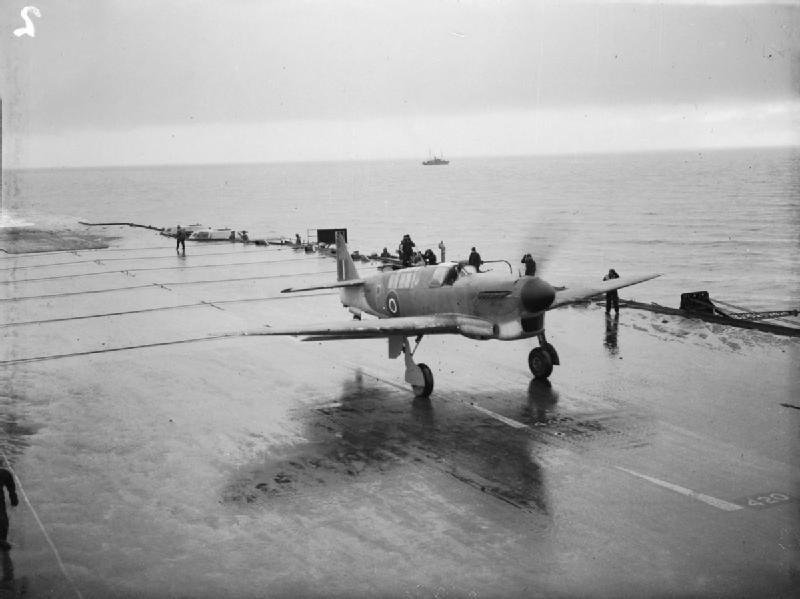
Everything about the Firefly’s structure was shaped by carrier operations. The wings folded for stowage in the cramped hangars of British carriers; the undercarriage was stressed for the hard arrested landings of deck flying; and an arrester hook was fitted for recovery. Four 20 mm Hispano cannon were mounted in the wings — a heavy, modern armament that gave the Firefly real striking power against aircraft, ships and ground targets alike.
Under the wings the aircraft could carry bombs — commonly up to two 1,000 lb bombs — or rockets, typically eight 60 lb rocket projectiles on rails. This ordnance load is what made the Firefly effective in the strike and ground-attack role that came to dominate its career, especially over Korea.
As always with a design that ran through many marks, exact fits varied: armament, radar and stores differed between the fighter, reconnaissance, night-fighter and anti-submarine versions. Treat any single specification as representative of one mark rather than the whole family.
04The Fairey Firefly’s later marks: two-stage Griffons and a redesigned airframe+
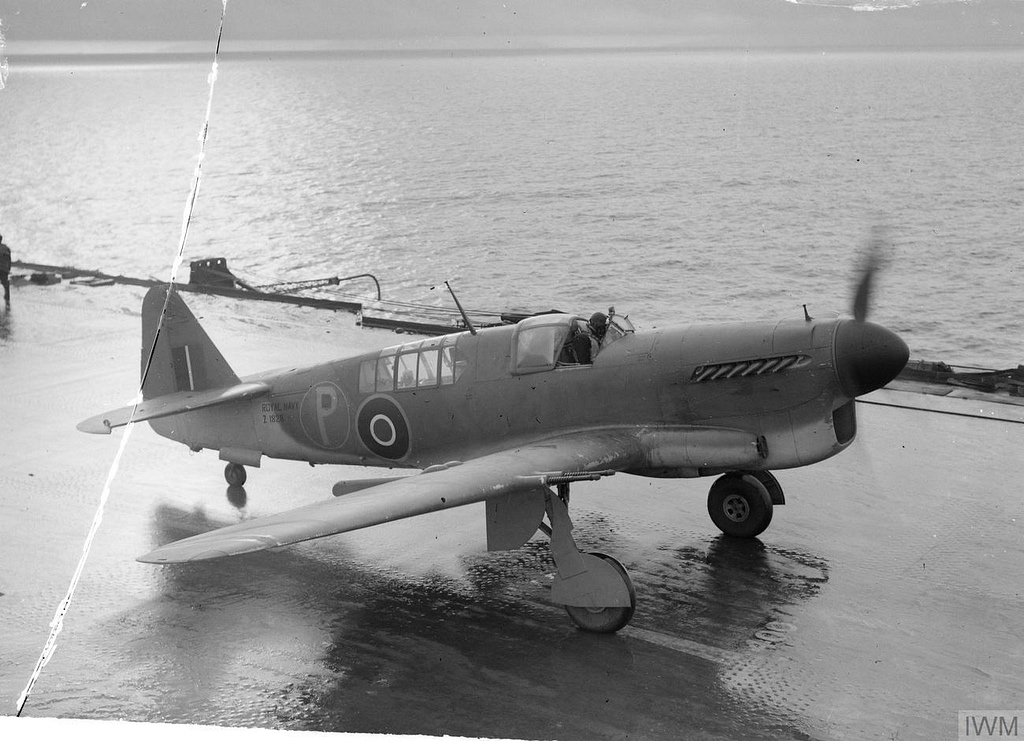
The most visible break in the Firefly’s development came with the FR.4 and the marks that followed. The FR.4 introduced a two-stage, two-speed Griffon, wing-root radiators in place of the earlier chin radiator, clipped and reshaped wings, and a taller fin. Externally it looked noticeably different from the graceful Mk I, and it performed better at altitude.
From there the family branched into anti-submarine marks (AS.5, AS.6) packed with radar and sonobuoy equipment, night-fighter versions, dual-control trainers (T.1, T.2, T.3), and finally pilotless target drones (U.8, U.9) and target-tugs. The same basic airframe was stretched to cover an extraordinary range of tasks well into the 1950s.
Because so many variants existed, published performance and weight figures scatter widely. Where this page gives numbers, they are best read as typical values for the early Mk I unless a specific later mark is named.
Full Specifications
Fairey Firefly Mk I — specifications
Representative figures for the early Firefly F.I / FR.I. Sources vary; treat performance numbers as nominal and mark-specific.
| Role | Carrier-borne fighter-reconnaissance / strike |
|---|---|
| Equipe | 2 (pilot + observer) |
| Comprimento | ~11.46 m (37 ft 7 in) |
| Envergadura | ~13.56 m (44 ft 6 in) |
| Altura | ~4.14 m (13 ft 7 in) |
| Área da asa | ~30.5 m² (328 sq ft) |
| Peso vazio | ~4,420 kg (~9,750 lb) |
| Loaded weight | ~6,360 kg (~14,000 lb) |
| Powerplant | 1 × Rolls-Royce Griffon IIB V12 |
| Power | ~1,290 kW (~1,730 hp) |
| Max speed | ~509 km/h (~316 mph) at altitude |
|---|---|
| Velocidade de cruzeiro | ~320 km/h (~200 mph) |
| Faixa | ~1,300 km (~800 mi) typical; more with drop tanks |
| Teto de serviço | ~8,500 m (~28,000 ft) |
| Armament (fixed) | 4 × 20 mm Hispano cannon |
| Stores | Up to 2 × 1,000 lb bombs or 8 × 60 lb rockets |
| First flight | 22 December 1941 |
| Introduced | 1943 (Fleet Air Arm) |
| Number built | ~1,700 (estimates vary) |
| Cost per flight hour | Not reliably recorded (WWII) |
05The Fairey Firefly’s operating costs: what a 1940s naval aircraft actually cost to run+
Honest answer: there is no reliable modern-style “cost per flight hour” figure for the Fairey Firefly, and this page does not invent one. Wartime and early post-war British naval aircraft were not accounted for the way a modern jet fleet is, and the surviving records do not support a trustworthy hourly operating cost.
What can be said is qualitative. The Firefly was a big, Griffon-engined two-seater, so it burned considerably more fuel and demanded more maintenance than a light single-seat fighter — but far less than the multi-engine strike aircraft that shared the carrier deck. Its real economy was operational: because one airframe could fight, scout, hunt submarines or tow targets, navies got a great deal of flexibility from a single type and a single training pipeline.
For the handful of Fireflies flown today by warbird operators, the running costs are those of any large piston warbird: substantial fuel burn, specialist Griffon maintenance and the ever-present challenge of spares for a type out of production since the 1950s. Precise figures are private to their owners.
Reference Data
Fairey Firefly: origins, production and service
Programme facts at a glance. Production totals in particular vary between sources; the figures below are the commonly cited ones.
| Manufacturer | Fairey Aviation Company, United Kingdom |
|---|---|
| Chief designer | H. E. Chaplin |
| Primary operator | Royal Navy Fleet Air Arm |
| Prototype first flight | 22 December 1941 |
| Service entry | 1943 |
| Combat debut | Off Norway, 1944 |
| Peak wartime action | Palembang strikes, Sumatra, January 1945 |
| Later major conflict | Korean War, 1950–53 |
| Retired (front-line RN) | Mid/late 1950s |
| Total built | ~1,700 (estimates vary) |
| Main foreign operators | Australia, Canada, Netherlands, India, Ethiopia, Sweden, Denmark, Thailand |
Powerplant & Heritage
The engine, the name and the Fairey Firefly’s place in history
06The Rolls-Royce Griffon: the engine that defined the Fairey Firefly+
The Griffon was Rolls-Royce’s larger-capacity companion to the famous Merlin, developed from the earlier “R” racing engine lineage and displacing around 37 litres. It delivered more torque and power at low and medium altitudes, which suited a heavy naval aircraft that needed to lift a full load off a short deck.
In the Firefly the Griffon evolved from the single-stage units of the early marks to the two-stage, two-speed engines of the FR.4 and later. That progression tracked the wider British effort to keep piston fighters competitive at higher altitudes as the war and the post-war years went on. The Griffon’s deep block is also why the Firefly’s nose looks so purposeful — there was simply a lot of engine to house.
The same engine family powered late-mark Spitfires and the Avro Shackleton, giving the Firefly a distinguished mechanical pedigree.
07Where the name “Firefly” comes from — and the earlier Fairey Firefly+
Confusingly, this was not the first Fairey aircraft called Firefly. In the late 1920s and 1930s Fairey had built the Firefly biplane fighter, an entirely different single-seat aircraft. The name was revived for the Second World War monoplane covered here, which shares nothing but the manufacturer and the insect.
When researching the type it is worth being careful: references to a “Fairey Firefly” from the interwar period almost always mean the earlier biplane, while the two-seat naval fighter-reconnaissance aircraft is the wartime and post-war machine. This page is entirely about the latter.
Fairey’s naming ran to nature and light — Fulmar, Firefly, Swordfish, Barracuda — a house style that gives the company’s aircraft a recognisable family feel.
08The Fairey Firefly in the story of British naval aviation+
The Firefly sits at an important hinge in Fleet Air Arm history. It bridged the gap between the improvised, sometimes obsolescent aircraft the Navy went to war with in 1939 and the capable, purpose-built naval jets of the 1950s. For roughly a decade it was one of the aircraft the Royal Navy actually relied on to do the everyday work of carrier aviation.
Its longevity also reflects a hard post-war reality: money was tight, and a versatile piston aircraft that could be updated mark by mark was more affordable than a fleet of specialised types. The Firefly’s anti-submarine and training variants in particular kept it relevant long after its fighter role had faded.
By the time it left front-line service, naval aviation had moved decisively into the jet age — but the Firefly had helped carry the Fleet Air Arm across that divide.
Variants
Every major Fairey Firefly version
A simplified family tree. Designations and totals differ between sources; the list below covers the principal marks.
| Variant | Tipo | Motor | Notas |
|---|---|---|---|
| F.I / FR.I | Fighter / fighter-recon | Single-stage Griffon | First production marks; FR.I carried radar |
| NF.II | Night fighter | Single-stage Griffon | Radar-equipped; limited production |
| FR.4 | Fighter-recon / strike | Two-stage Griffon | Redesigned wing, wing-root radiators, taller fin |
| AS.5 / AS.6 | Anti-submarine | Two-stage Griffon | Radar and sonobuoys; Korea-era strike work too |
| NF.5 | Night fighter | Two-stage Griffon | Night/all-weather variant of the later airframe |
| T.1 / T.2 / T.3 | Trainer | Griffon | Dual-control conversion and operational trainers |
| U.8 / U.9 / TT | Target drone / target-tug | Griffon | Pilotless drones and target-towing aircraft |
Notable Operations
The Fairey Firefly in action — and afterwards
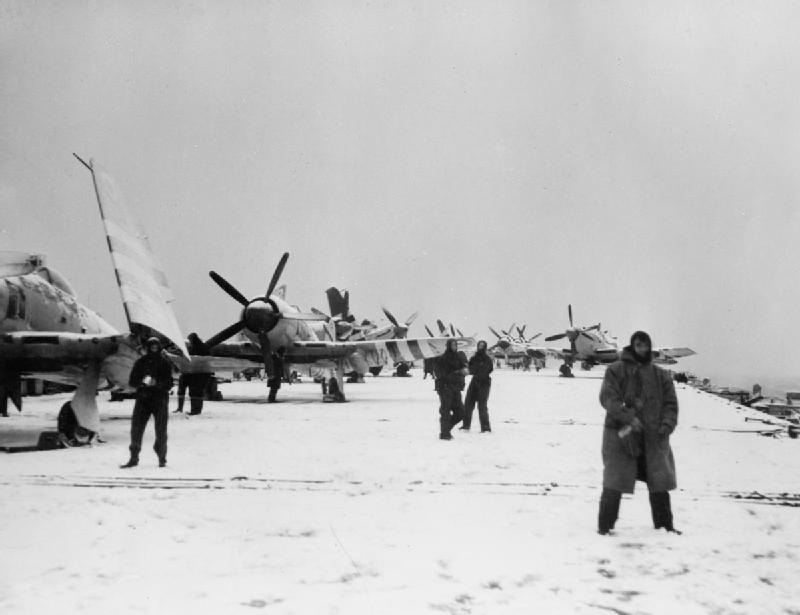
Norway, 1944. The Firefly’s first significant combat came in northern European waters, flying fighter cover and strike sorties from Royal Navy carriers off the Norwegian coast, including operations linked to the long campaign against the battleship Tirpitz.
Palembang, January 1945. In the type’s defining wartime action, Fireflies of the British Pacific Fleet spearheaded Operations Meridian I and II against the Palembang oil refineries in Sumatra — suppressing flak, strafing defences and escorting the bombers in one of the Royal Navy’s most demanding carrier strikes of the war.
Over Japan, 1945. As the British Pacific Fleet joined operations against the Japanese home islands, Fireflies flew strike, armed-reconnaissance and combat air patrol missions in the closing months of the war.
Korea, 1950–53. The Firefly’s longest and most sustained combat came after the Second World War. Flying from Commonwealth light-fleet carriers, Fireflies pounded bridges, railways, supply lines and troop positions with bombs and rockets throughout the Korean War, day after day, in the ground-attack and armed-reconnaissance role.
Anti-submarine and second-line work. Beyond the shooting wars, Fireflies spent years hunting submarines with radar and sonobuoys, training aircrew, and serving as target-tugs and pilotless drones — the quiet, essential tasks that kept the type in service into the 1950s.
In Context
The Fairey Firefly among its contemporaries
How the Firefly compares with other naval aircraft of its era. Figures are nominal and for rough comparison only.
| Aeronave | Origin | Equipe | Approx. top speed | Role emphasis |
|---|---|---|---|---|
| Fairey Firefly Mk I | Reino Unido | 2 | ~509 km/h | Fighter-recon / strike |
| Fairey Swordfish | Reino Unido | 2–3 | ~224 km/h | Torpedo / anti-submarine |
| Vought F4U Corsair | EUA | 1 | ~717 km/h | Fighter / fighter-bomber |
| Grumman Avenger | EUA | 3 | ~442 km/h | Torpedo / strike |
| Bristol Beaufighter | Reino Unido | 2 | ~515 km/h | Heavy fighter / strike |
Timeline
The Fairey Firefly: a service history
Stories & Eyewitnesses
The Fairey Firefly in the words of its war
A big aeroplane for a carrier deck
Test pilots found a heavy two-seater that flew far better than its size suggested — thanks to the Youngman flaps.
Read the full story
When the prototype first flew in December 1941, the Firefly was, by naval standards, a large aircraft. Yet the Fairey-Youngman flap system gave it low-speed manners that belied its bulk, allowing controlled approaches to a carrier deck and surprisingly tight turns for a machine of its weight.
That combination — size and load-carrying ability on one hand, docile low-speed handling on the other — is exactly what the Fleet Air Arm needed, and it shaped the aircraft’s reputation from the very start.
First blood off Norway
Fireflies flew cover and strikes in northern waters as the Navy hunted the Tirpitz.
Read the full story
The Firefly’s combat career opened in the cold, grey conditions of the Norwegian coast in 1944. Operating from Royal Navy fleet carriers, Fireflies flew fighter cover and ground-attack sorties in support of the long series of operations aimed at the German battleship Tirpitz and other targets ashore.
It was demanding flying — long over-water transits, uncertain weather and heavily defended targets — precisely the environment the two-seat, long-range Firefly had been designed for.
Spearhead at Palembang
Fireflies went in first against the Sumatran oil refineries, suppressing flak for the bombers.
Read the full story
Operations Meridian I and II, the British Pacific Fleet’s strikes on the Palembang refineries in January 1945, were among the most ambitious carrier operations the Royal Navy attempted. Fireflies were among the first aircraft over the target, going in ahead of the main strike to strafe defences, suppress anti-aircraft fire and escort the Avenger bombers.
The refineries were vital to the Japanese war effort, and the strikes — though costly — demonstrated that the Fleet Air Arm could reach out and hit strategic targets deep inland. The Firefly’s part cemented its place as a strike aircraft, not just a scout.
Over the home islands
With the British Pacific Fleet off Japan, Fireflies flew strike and reconnaissance to the war’s end.
Read the full story
In the final months of the war the British Pacific Fleet operated alongside the US Navy off Japan. Fireflies flew armed-reconnaissance, strike and combat air patrol sorties against airfields, shipping and coastal targets, adding the Firefly’s name to the roll of aircraft that saw out the Pacific war.
It was a fitting end to the type’s wartime service — and, as it turned out, only the first half of its combat career.
A second generation
Two-stage Griffons, new wings and radar kept the Firefly current after the war.
Read the full story
Rather than fading away with victory, the Firefly was steadily developed. The FR.4 brought a two-stage Griffon, redesigned wings with root radiators and a taller fin; anti-submarine marks added radar and sonobuoy gear. The result was an aircraft that looked and performed quite differently from the wartime Mk I.
This willingness to keep updating a sound basic design is a big part of why the Firefly stayed useful for so long.
Back to war in Korea
When Korea erupted, the Firefly went straight back to sea as a strike aircraft.
Read the full story
The outbreak of the Korean War in June 1950 sent Commonwealth carriers to the Yellow Sea and the Sea of Japan. Fireflies were quickly in action, flying ground-attack and armed-reconnaissance strikes against North Korean and later Chinese targets.
For an aircraft first flown in 1941, it was a remarkable return to front-line combat — and the beginning of its most sustained period of operations.
Bridges, rails and supply lines
Day after day, Fireflies attacked the infrastructure that kept the enemy fed and armed.
Read the full story
Much of the Firefly’s Korean work was interdiction: cutting bridges, cratering railways, hitting supply dumps and transport. Armed with bombs and rockets, crews flew repeated sorties in all weathers from the small decks of light-fleet carriers such as HMS Theseus, Ocean and Glory.
It was dangerous, attritional flying against a well-defended battlefield, and it showcased the Firefly’s toughness and load-carrying ability far more than any single dramatic engagement.
HMAS Sydney joins the fight
The Royal Australian Navy took its Fireflies to Korea aboard HMAS Sydney.
Read the full story
The Firefly was not only a Royal Navy aircraft. The Royal Australian Navy operated the type from HMAS Sydney off Korea, its Fireflies flying strike and armed-reconnaissance sorties alongside their British counterparts.
Australian, Canadian and other Commonwealth crews all flew the Firefly, underlining how thoroughly the type had spread through allied naval aviation.
The submarine hunters
Away from the headlines, AS-mark Fireflies patrolled for submarines with radar and sonobuoys.
Read the full story
The anti-submarine Fireflies did unglamorous but vital work, sweeping the sea with radar and dropping sonobuoys to detect submerged contacts. The second crewman, so central to the Firefly concept, came into his own in this role, managing the sensors while the pilot flew the search pattern.
This capability kept the Firefly relevant well after its days as a fighter were over.
Trainers and target-tugs
Dual-control and target-towing Fireflies served in the fleet’s second line for years.
Read the full story
As front-line duties passed to jets, many Fireflies found new life as trainers and target-tugs, and some as pilotless target drones. These second-line variants extended the type’s service life and squeezed extra value from a proven airframe.
It is a reminder that a warplane’s usefulness often outlasts its front-line career by many years.
A Commonwealth and world aircraft
Australia, Canada, the Netherlands and others flew the Firefly in front-line and training roles.
Read the full story
The Firefly served with the Royal Australian Navy, the Royal Canadian Navy and the Royal Netherlands Navy, among others, while target-towing and drone variants reached air arms as far afield as India, Ethiopia, Sweden, Denmark and Thailand.
Exact fleet sizes and dates vary by source, but the breadth of operators shows how well the type suited navies that needed a flexible, affordable carrier aircraft.
The sound of a surviving Firefly
A handful survive; a few have flown again, letting new audiences hear the Griffon growl.
Read the full story
Several Fireflies are preserved in museums around the world, and over the years a small number have been kept or returned to airworthy condition by warbird collections and naval historic flights. When one flies, the deep note of its Griffon engine is unmistakable.
These survivors are precious: reminders of an aircraft that quietly did more, across more roles and more years, than its modest fame suggests. Numbers and airworthiness change over time, so treat any “how many fly today” claim with caution.
The Fairey Firefly in Depth
The Fairey Firefly: the questions people actually ask
Longer answers to the things enthusiasts and researchers most often want to know.
09Was the Fairey Firefly a fighter or a reconnaissance aircraft?+
Both — and that is the point. The Firefly was classified as a fighter-reconnaissance aircraft, meaning it was expected to fight when needed but to spend much of its time scouting, shadowing and reporting. The presence of a dedicated observer in the second seat made the reconnaissance and navigation role practical over open ocean.
Over its career the balance shifted towards strike and anti-submarine work, but the dual identity was always there. Calling it “just a fighter” or “just a scout” misses what made the aircraft valuable to the Fleet Air Arm.
10How did the Fairey Firefly compare with single-seat naval fighters like the Corsair?+
On raw fighter performance, it did not compare favourably. Single-seat naval fighters such as the Vought F4U Corsair or the Grumman Hellcat were faster and more agile, being lighter and optimised purely for air combat. The Firefly, carrying a second crewman and built for endurance and flexibility, was never going to match them in a straight fight.
But that comparison misses the Firefly’s purpose. It offered navigation, radar operation, long endurance and a heavy strike load that single-seaters could not. Navies operated both kinds of aircraft precisely because they did different jobs.
11What were the Fairey-Youngman flaps, and why did they matter?+
The Youngman flap was a retractable, area-increasing flap mounted below and behind the wing. Unlike a simple landing flap, it could be set to an intermediate “cruise” position that improved lift and manoeuvrability in combat, as well as being fully deployed for slow carrier approaches.
For a heavy two-seater, this was transformative. It allowed the Firefly to turn and handle at low speed far better than its weight would suggest, and it made carrier landings safer. It is one of the most distinctive engineering features of the whole design.
12How important were the Fairey Firefly’s Korean War operations?+
Very. Korea was arguably the Firefly’s most significant sustained combat, not its wartime service. From 1950 to 1953 Fireflies flew thousands of ground-attack and armed-reconnaissance sorties from Commonwealth carriers, hitting the bridges, railways and supply lines that kept enemy forces in the field.
That an aircraft first flown in 1941 was still doing hard front-line work a decade later says a great deal about the soundness of the basic design and the value of its load-carrying, long-endurance layout.
13Which countries operated the Fairey Firefly?+
Britain’s Royal Navy Fleet Air Arm was the primary operator. Beyond it, the Royal Australian Navy, the Royal Canadian Navy and the Royal Netherlands Navy flew Fireflies in front-line and training roles, while target-towing, trainer and drone variants reached air arms including India, Ethiopia, Sweden, Denmark and Thailand.
Exact operator lists and dates vary between sources, and some countries used only a handful of aircraft in specialised roles. The operations map on this page shows the principal operators and combat theatres colour-coded by category.
14How many Fairey Fireflies were built?+
The most commonly cited figure is around 1,700 aircraft, but published totals vary, and different sources count prototypes, sub-variants and licence or overseas production differently. Treat any single number as approximate.
What is not in doubt is that the Firefly was built in substantial quantity across many marks over roughly a decade of production — enough to equip the Fleet Air Arm and several foreign navies and still leave aircraft for second-line and export use.
15Why is the Fairey Firefly less famous than the Spitfire or the Swordfish?+
Partly it is a matter of story. The Spitfire has the Battle of Britain; the Swordfish has Taranto and the Bismarck. The Firefly’s contribution was spread across many roles and two very different wars, without one single iconic moment to fix it in the public memory.
It is also a matter of type: multi-role naval workhorses rarely capture the imagination the way pure fighters or dramatic torpedo bombers do. But among those who study naval aviation, the Firefly is respected precisely for its quiet, sustained usefulness.
16Did the Fairey Firefly have any notable weaknesses?+
Its size and weight were the obvious trade-offs. As a two-seat, Griffon-engined aircraft it was never as fast or as nimble as single-seat fighters, which limited its value in pure air-to-air combat against modern opposition. Early marks also had the altitude limitations of a single-stage engine, addressed later with two-stage Griffons.
None of this was a design failure — it was the price of flexibility. The Firefly was optimised for the naval mission set as a whole, and it accepted lower fighter performance in exchange for range, load and versatility.
More on the Fairey Firefly
The Fairey Firefly: legacy, survivors and myths
17Are there any airworthy Fairey Fireflies today?+
Several Fireflies survive, and over the years a small number have been maintained or restored to airworthy condition by warbird operators and naval historic flights — though the exact number flying at any given time changes, and airworthy warbirds are sometimes grounded or lost. It is safest to say that a handful have flown in the airshow era rather than to quote a fixed figure.
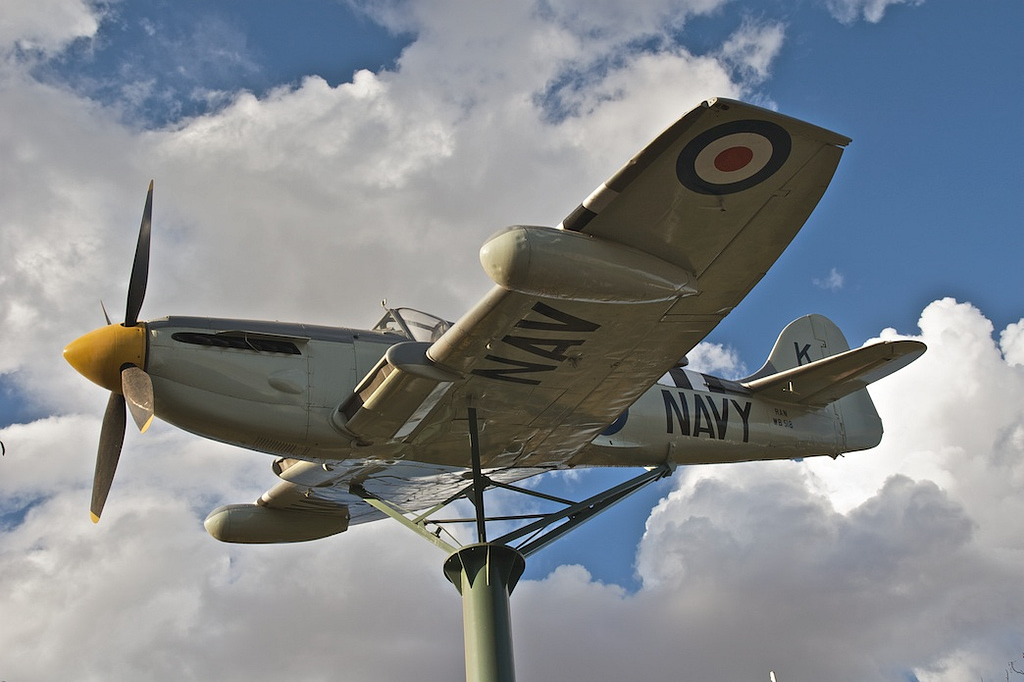
Static survivors are more numerous and can be seen in aviation museums in Britain, Australia, Canada and elsewhere. If you want to see a Firefly, a museum is by far the more reliable bet than hoping to catch one flying.
18Where can I see a preserved Fairey Firefly?+
Preserved Fireflies are held by a number of aviation and naval museums. The Fleet Air Arm Museum at Yeovilton in England is the natural home of the type, and examples also survive in Australia, Canada and elsewhere, reflecting the countries that operated it.
Because museum holdings and loans change, it is worth checking a specific museum’s current collection before travelling. The survivors that remain are important physical links to an aircraft that is otherwise fading from popular memory.
19Is it true the Fairey Firefly could out-turn single-seat fighters?+
There is truth in it, with caveats. Thanks to the Youngman flaps, the Firefly handled unusually well at low speed for its size, and there are accounts of Firefly crews using that low-speed agility to advantage. But this should not be exaggerated into a claim that the Firefly was a superior dogfighter.
Against a well-flown single-seat fighter with a speed and energy advantage, the heavier two-seater was at a disadvantage. The low-speed handling was a genuine and useful trait, not a magic ability to beat purpose-built fighters at their own game.
20How did the Fairey Firefly’s anti-submarine role work?+
The anti-submarine marks (AS.5, AS.6) carried radar to detect surfaced submarines and sonobuoys to help localise submerged contacts, with the observer managing the sensors. Armed with depth charges, bombs or rockets, they could then attack a contact once found.
This role kept the Firefly in service into the 1950s, bridging the gap until dedicated anti-submarine aircraft and helicopters took over the task. It is a good example of how the two-seat layout gave the aircraft a long and varied life.
21What replaced the Fairey Firefly in Royal Navy service?+
As naval aviation moved into the jet age, the Firefly’s roles were taken over by a new generation of aircraft. Anti-submarine and strike duties passed to types such as the Fairey Gannet and, in time, to helicopters and jets, while jet fighters replaced the fighter role.
The Firefly’s withdrawal from front-line Royal Navy service in the mid-to-late 1950s marked the end of the piston-engined two-seat fighter-reconnaissance concept it had embodied so well.
22Did the Fairey Firefly serve in any air forces other than navies?+
The Firefly was fundamentally a naval aircraft, but its second-line variants — particularly target-tugs and drones — found their way into a wider range of services, including some operated on behalf of armies and air forces for target-towing and trials work.
The details vary by country and by source, and some of these uses involved only small numbers of specialised aircraft. The core identity of the Firefly, though, remained that of a carrier-borne fleet aircraft.
Equipment & Operations
The Fairey Firefly: crew, kit and how it was flown
23What did the Fairey Firefly’s two crew members actually do?+
The pilot flew and fought the aircraft, aiming the cannon and delivering bombs or rockets. Behind him, the observer navigated — a critical job over trackless ocean — worked the radio, and in radar-equipped marks operated the radar or anti-submarine sensors.
This division of labour is the essence of the Firefly. A single pilot could not have flown the aircraft, navigated precisely over the sea and worked the sensors simultaneously; the second crewman made the full mission set possible.
24How was the Fairey Firefly armed for strike missions?+
For fixed armament the Firefly carried four 20 mm Hispano cannon in the wings — heavy hitting power for strafing and air combat. For strike work it added underwing stores: commonly up to two 1,000 lb bombs or a set of rocket projectiles, typically eight 60 lb rockets on rails.
This combination of cannon and underwing ordnance made the Firefly genuinely effective against ground and shipping targets, which is why it was so heavily used in the interdiction role over Korea.
25What was it like to operate the Fairey Firefly from a carrier?+
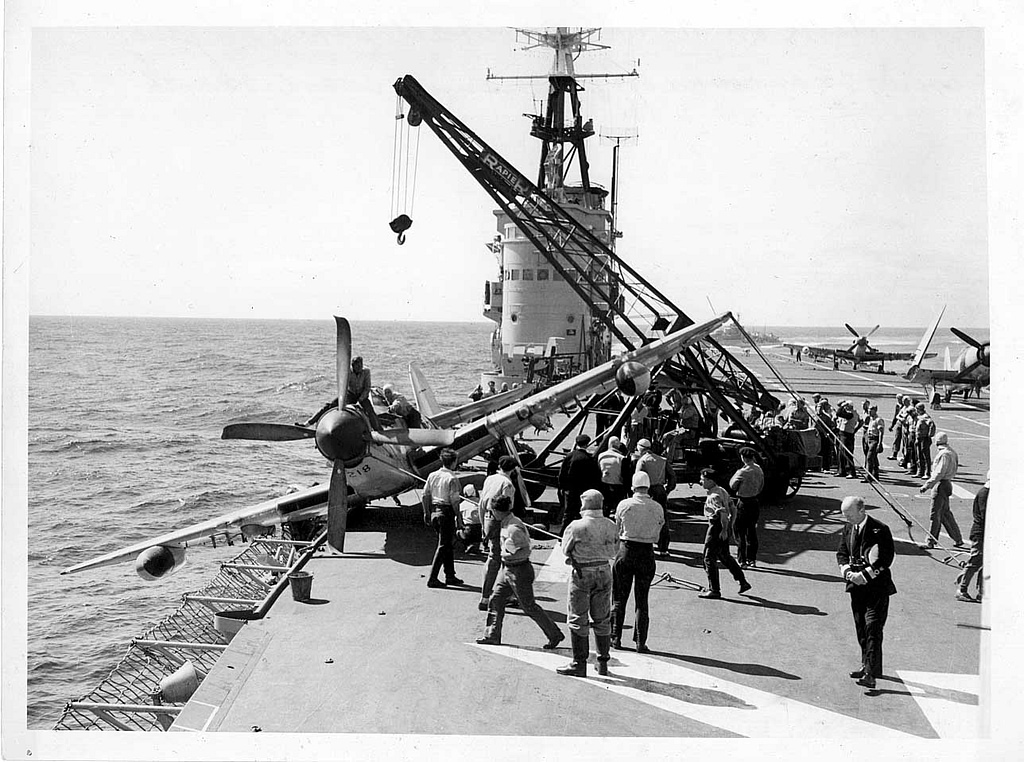
Operating any large piston aircraft from a wartime carrier deck was demanding, and the Firefly was no exception. Folding wings allowed it to be struck down into the hangar; the arrester hook and stressed undercarriage handled the violent arrested landings; and the Youngman flaps helped bring the aircraft aboard at a controllable speed.
Deck crews, catapults or free take-off runs, and the ever-present hazards of weather and pitching decks all shaped daily operations. The Firefly’s forgiving low-speed manners were a real asset in this unforgiving environment.
26Did the Fairey Firefly use radar?+
Yes, in several marks. Reconnaissance, night-fighter and anti-submarine Fireflies carried radar operated by the observer, used variously to find ships, other aircraft or surfaced submarines. Radar greatly extended the aircraft’s usefulness in poor visibility and at night.
The specific radar fits changed over time and between marks, in step with the rapid development of airborne radar during and after the war. As with other equipment, treat any single description as applying to a particular variant.
27How reliable and rugged was the Fairey Firefly?+
The Firefly earned a reputation as a sturdy, dependable aircraft — qualities that mattered enormously for sustained carrier operations far from major repair facilities. Its ruggedness was on full display over Korea, where it absorbed the punishment of repeated low-level strike sorties against defended targets.
No aircraft is without its foibles, and the Firefly had the usual maintenance demands of a big piston engine and a complex naval airframe. But its overall record is one of a tough, serviceable machine that crews could rely on.
28Could you fly the Fairey Firefly today as a passenger?+
The Firefly is a two-seat aircraft, and airworthy examples do fly at airshows — so in principle the second seat exists. In practice, flights in the surviving airworthy Fireflies are not a bookable public experience, and they are certainly not offered by MiGFlug. Any flying that happens is at the discretion of the aircraft’s owners and operators.
If you want to actually fly in a fast military aircraft yourself, MiGFlug does offer that — but in other types. See the question below, and the flights-and-prices page, for the aircraft you really can fly in.
29What is the Fairey Firefly’s lasting legacy?+
The Firefly’s legacy is the multi-role naval aircraft done right: one flexible airframe covering fighter, reconnaissance, strike, anti-submarine, training and target roles across a decade of service and two major wars. It proved how much value a navy could extract from a sound, adaptable design.
It also carried the Fleet Air Arm across the divide between the piston and jet eras, doing hard, useful work while the future was being built. That quiet contribution — versatile, dependable, long-serving — is exactly why the Firefly deserves to be remembered.
Mark by Mark
The Fairey Firefly, variant by variant and carrier by carrier
A closer look at the marks, the ships and the missions that made up the Firefly’s long career. As ever, treat specific figures as nominal and mark-dependent.
30The Fairey Firefly F.I and FR.I: the wartime first generation+
The F.I fighter and FR.I fighter-reconnaissance aircraft were the marks that took the Firefly to war. Powered by single-stage Griffons and armed with four 20 mm cannon, they equipped the first Fleet Air Arm squadrons and flew the type’s wartime operations off Norway, at Palembang and over Japan.
The FR.I added radar, carried in a pod, which extended its usefulness for reconnaissance and shipping searches. These early aircraft established the Firefly’s reputation and the basic layout — two seats, Griffon power, Youngman flaps — that every later mark inherited.
They were not the last word in performance, but they were available, capable and flexible at a time when the Fleet Air Arm badly needed a modern two-seat fighter.
31The Fairey Firefly FR.4: the great redesign+
The FR.4 was the biggest single step in the Firefly’s evolution. It replaced the single-stage Griffon with a two-stage, two-speed engine, moved the radiators from the chin into the wing roots, and reshaped the wing — including clipped tips — to suit the new installation. A taller fin balanced the changes.
The result was a noticeably different-looking and better-performing aircraft, particularly at altitude. The FR.4 and the marks that followed it carried the Firefly through the post-war years and into the Korean conflict.
It is a good illustration of how a sound basic design can be stretched and modernised rather than replaced — a recurring theme in the Firefly story.
32The Fairey Firefly AS.5 and AS.6: the submarine hunters+
The anti-submarine marks turned the Firefly into a maritime patrol aircraft. Fitted with radar and, in the AS.6, sonobuoy equipment, they let the observer search for submarines while the pilot flew the pattern and, if a contact was found, delivered the attack.
These aircraft also did straightforward strike work — the AS.5 in particular flew ground-attack sorties over Korea — showing again how blurred the lines between Firefly roles could be. One airframe, many jobs.
The anti-submarine Fireflies kept the type in front-line service into the mid-1950s, bridging the gap to purpose-built aircraft like the Fairey Gannet.
33Fairey Firefly trainers, target-tugs and drones+
Not every Firefly carried weapons. Dual-control trainer versions (T.1, T.2, T.3) taught pilots to handle the type and to use its operational equipment. Target-tug conversions towed sleeves and banners for gunnery practice, and pilotless target drones (U.8, U.9) served as flying targets for missile and gunnery trials.
These second-line variants extended the Firefly’s life well beyond its front-line career and spread it into services and countries that never used it as a combat aircraft.
They are easy to overlook, but they represent a large share of total Firefly activity in the 1950s.
34The carriers that flew the Fairey Firefly in Korea+
The Firefly’s Korean War was fought from light-fleet carriers. Royal Navy ships including HMS Triumph, Theseus, Ocean and Glory took turns on station, their Fireflies flying alongside Sea Furies in the strike role. The Royal Australian Navy’s HMAS Sydney added its own Fireflies to the effort.
These were not the huge fleet carriers of the Pacific war but smaller, austere ships, and operating from them demanded skill and stamina from crews and deck parties alike. The Firefly’s forgiving handling and rugged construction suited the task.
Rotating carriers on and off the line kept a continuous Commonwealth naval air presence over Korea for the length of the war.
35The Fairey Firefly and the British Pacific Fleet+
The British Pacific Fleet was the Royal Navy’s most powerful carrier force of the Second World War, operating alongside the US Navy in 1945. The Firefly was part of its air groups, contributing the two-seat fighter-reconnaissance and strike capability that complemented single-seat fighters like the Corsair and Hellcat.
It was in this context that the Firefly flew its most demanding wartime operations — the Palembang strikes and the sorties over Japan — as part of a large, modern, multi-carrier force projecting power across vast distances.
The experience showed the Firefly working as one element of a balanced carrier air group, which is exactly how it was meant to be used.
36The Fairey Firefly abroad: Australia, Canada and the Netherlands+
Three navies in particular made the Firefly their own. The Royal Australian Navy flew it operationally, including over Korea from HMAS Sydney; the Royal Canadian Navy operated it in fighter, anti-submarine and training roles; and the Royal Netherlands Navy used it at sea and ashore.
For these smaller naval air arms, the Firefly was an affordable way to field a capable, multi-role carrier aircraft with British support and a common training pipeline. It helped several Commonwealth and allied navies build up their post-war carrier aviation.
Fleet sizes and service dates differ between sources; the operations map on this page groups these countries under “Export & other operators”.
37The Fairey Firefly’s target-towing life in Sweden and beyond+
Some of the Firefly’s most unusual service came far from any carrier. In Sweden, the civil operator Svensk Flygtjänst flew Fireflies on target-towing contracts for the armed forces, and target-tug and drone Fireflies served other nations including India, Ethiopia, Denmark and Thailand in specialised roles.
This long tail of second-line and export use is part of why the Firefly’s total production ran to something like 1,700 aircraft and why the type stayed active into the later 1950s.
It also explains why Fireflies turn up in the histories of air arms that never used them as front-line combat aircraft.
38How the Fairey Firefly fits between the Fulmar and the Gannet+
The Firefly sits neatly in a Fairey lineage of naval aircraft. Before it came the Fulmar, the under-powered two-seat fleet fighter of the early war. After it came the Gannet, the turboprop anti-submarine aircraft that took over the maritime patrol role in the mid-1950s.
Seen this way, the Firefly is the mature middle of that story: more capable than the Fulmar, and holding the line until the Gannet and naval jets arrived. It carried the Fleet Air Arm’s two-seat naval tradition through its most demanding decade.
Understanding that lineage helps explain both what the Firefly was asked to do and why it was eventually retired.
39The Fairey Firefly’s place in the transition to jets+
The Firefly’s front-line career ended as naval aviation went jet. Jet fighters replaced piston fighters, and specialised aircraft and helicopters took over reconnaissance and anti-submarine work. The Firefly’s withdrawal marked the close of an era of piston-engined, two-seat naval multi-role aircraft.
But its contribution to that transition was real: it kept the Fleet Air Arm effective through the difficult early post-war years, when budgets were tight and the jet fleet was still being built and worked up.
By doing the everyday work reliably, the Firefly bought the time the Navy needed to modernise — a quietly important role.
Squadrons & Crews
The Fairey Firefly: squadrons, crews and the human story
Behind the airframes were the naval aircrew and deck parties who flew and maintained the Firefly. Specific unit details vary between sources and are given here in broad terms.
40The first Fairey Firefly squadrons and their carriers+
The Firefly entered service with Fleet Air Arm Naval Air Squadrons from 1943, the first units forming and working up before embarking in fleet carriers. The type is closely associated with carriers such as HMS Indefatigable, from which Fireflies flew some of their earliest operations.
Standing up a new naval squadron meant more than receiving aircraft: crews had to master deck landings, over-water navigation and the aircraft’s systems, while ground crews learned to keep the big Griffon engines running in the salt-laden environment of a carrier. Only then could a squadron be declared operational.
Exact squadron numbers, dates and embarkations are best confirmed against detailed Fleet Air Arm records, as accounts differ in the particulars.
41What it took to fly the Fairey Firefly from a carrier+
Flying the Firefly operationally demanded a particular blend of skills. The pilot had to land a heavy aircraft precisely on a small, moving deck, often in poor weather, then fight or strike once airborne. The observer had to navigate accurately over open ocean with limited aids, work the radio, and operate radar or anti-submarine equipment.
The partnership between the two crew members was central. A good pilot-observer team could find a target, attack it and get home in conditions that would have defeated a single-seat aircraft. That teamwork is one of the quiet strengths the two-seat layout brought to the Fleet Air Arm.
It is worth remembering that much of this flying was routine only in the sense that it happened every day — it was never safe or easy.
42The deck crews who kept the Fairey Firefly flying+
An aircraft carrier’s air group depends on the men who work the deck and the hangar. For the Firefly, that meant handling a large aircraft with folding wings in cramped spaces, arming it with cannon rounds, bombs and rockets, and maintaining a complex Griffon powerplant far from any workshop.
The tempo of operations off Korea, in particular, put these teams under sustained pressure, turning aircraft around for repeated strike sorties day after day. The Firefly’s reputation for ruggedness owed a great deal to the skill and endurance of these crews.
Their contribution rarely makes the headlines, but no Firefly ever flew a mission without them.
43Losses, risks and the reality of Fairey Firefly operations+
Naval flying was dangerous even without an enemy. Deck accidents, ditchings, weather and mechanical failure all took their toll, and combat added flak and ground fire — especially in the low-level strike role over Korea, where the Firefly spent so much of its later career.
The Palembang strikes of 1945 were costly, and the interdiction campaign over Korea exposed crews to intense anti-aircraft defences. These operations were not without loss, and the Firefly’s record should be read with that human cost in mind.
Specific loss figures vary by source and by operation; this page deliberately avoids quoting precise totals it cannot stand behind.
44The Fairey Firefly in the post-war reserve and training role+
As front-line squadrons re-equipped with jets, many Fireflies passed to training units and reserve formations. Here they gave new pilots and observers experience of a powerful naval aircraft, and kept skills current in the reserve.
This phase of the Firefly’s life is less dramatic than its combat service, but it was important: it made use of a proven, available aircraft at a time when the Navy was managing the expensive transition to jets.
It also means that a good many aircrew of the 1950s had Firefly time in their logbooks, spreading familiarity with the type widely through the Fleet Air Arm.
45Why enthusiasts still care about the Fairey Firefly+
For those who study naval aviation, the Firefly is a rewarding subject precisely because it resists easy summary. It touches the Pacific war, the Korean War, the anti-submarine mission, the export trade and the transition to jets — a single type that opens a window onto a whole era of carrier operations.
Its survivors, in museums and occasionally in the air, keep that history tangible. Standing beside a preserved Firefly, the sheer size of the aircraft and the depth of its Griffon nose tell you at once that this was a serious, purposeful machine.
That is the Firefly’s enduring appeal: an honest, hard-working aircraft whose story is bigger than its fame.
Photo Gallery
The Fairey Firefly in photographs
On Film
The Fairey Firefly on film
A well-researched documentary on the Firefly’s design, service and legacy from a respected military-aviation history channel.
“Fairey Firefly: The first multi-role naval strike fighter” — Armoured Archivist (~169,000 views at time of writing). A ~28-minute history of the type from prototype to Korea.
Operations Map
Where the Fairey Firefly operated
Britain designed and built it; the Fleet Air Arm took it to war across the Pacific and, later, Korea; and it was widely exported. Toggle the categories to explore. Combat markers show theatres of conflict, not the operating nation’s homeland.
Combat Record
The Fairey Firefly’s war in numbers
Indicative figures. The Firefly’s record is spread across many roles and two wars, so treat these as summary impressions rather than precise tallies.
Where to See One
Surviving Fairey Fireflies
A snapshot of where the type survives. Museum holdings and airworthiness change over time — check before you travel.
Reino Unido
The Fleet Air Arm Museum at Yeovilton is the natural home of the type, holding a preserved Firefly among its Royal Navy collection.
Australia & Canada
Both the Royal Australian Navy and Royal Canadian Navy flew the Firefly, and preserved examples survive in museums in both countries.
Airworthy survivors
Over the years a small number of Fireflies have been kept or restored to flying condition by warbird collections and naval historic flights.
Numbers, locations and airworthiness of surviving Fireflies change over time; this is a general guide rather than a definitive register.
In the End
The Fairey Firefly: how history should remember it
The Fairey Firefly was never going to be a legend in the way the Spitfire is a legend. It was too big, too versatile, too quietly competent for that. But strip away the search for glamour and you find one of the most genuinely useful aircraft the Fleet Air Arm ever operated.
It fought over Norway, spearheaded the Royal Navy’s most ambitious carrier strikes of the Pacific war at Palembang, ranged over Japan in 1945, and then — remarkably — went back to war a decade later, pounding the length of the Korean peninsula from tiny carrier decks. In between and afterwards it hunted submarines, trained aircrew and towed targets. Few aircraft of its generation did so much, for so long, across so many roles.
Honesty is the right note on which to remember the Firefly: a rugged, adaptable, long-serving naval workhorse rather than a glamorous dogfighter. That is not a lesser thing to be. It is, arguably, exactly what a navy most needs.
Questions & Answers
Fairey Firefly: your questions answered
Can I fly in a Fairey Firefly?
Not as a bookable experience — and not with MiGFlug. The Firefly is a two-seat aircraft, and a small number of airworthy examples do fly at airshows, but seats in them are at the discretion of their owners and are not offered as a public ride. MiGFlug does not operate the Fairey Firefly.
However, you can fly in several genuine military jets today. If it is the thrill of a real fast-jet flight you are after, MiGFlug offers exactly that in aircraft such as the L-39 Albatros and the MiG-29 — see migflug.com/flights-prices for the aircraft and locations currently available.
What was the Fairey Firefly used for?
It was a carrier-borne fighter-reconnaissance aircraft for the Royal Navy Fleet Air Arm, designed to fight, scout, navigate over the sea and strike ground and shipping targets. Over its career it also took on anti-submarine, night-fighter, training and target-towing roles.
What engine did the Fairey Firefly use?
The Rolls-Royce Griffon, a large-capacity V12 related to the Merlin. Early marks used a single-stage Griffon of around 1,730 hp; later marks such as the FR.4 adopted two-stage, two-speed Griffons for better high-altitude performance.
How fast was the Fairey Firefly?
The early Mk I had a top speed of roughly 509 km/h (about 316 mph), though figures vary by mark and source. It was never as fast as single-seat fighters of the day — the trade-off for carrying two crew, heavy armament and long endurance.
Did the Fairey Firefly serve in the Korean War?
Yes — extensively. Throughout the Korean War (1950–53) Fireflies flew ground-attack and armed-reconnaissance strikes from Royal Navy and Royal Australian Navy carriers, attacking bridges, railways and supply lines. Korea was arguably the type’s most sustained combat.
How many Fairey Fireflies were built, and who flew them?
Around 1,700 were built, though totals vary between sources. The Royal Navy was the main operator, joined by the Royal Australian Navy, Royal Canadian Navy, Royal Netherlands Navy and others, with target-towing and drone variants reaching India, Ethiopia, Sweden, Denmark and Thailand.
Are any Fairey Fireflies still flying?
Several survive in museums, and over the years a small number have been kept or restored to airworthy condition. The exact number flying at any moment changes, so it is safest to say a handful have flown in the airshow era rather than to quote a fixed figure.
You can’t fly the Fairey Firefly. These, you can.
The Firefly is a museum piece and, for a lucky few, an airshow performer — but the thrill of flying a real military aircraft is not out of reach. MiGFlug puts you in the cockpit of genuine ex-military jets with an experienced pilot. Here is where to start.
Fighter Jet Flights
Take the controls of a real ex-military jet with an experienced fighter pilot.
L-39 Albatroz
The classic jet trainer — aerobatics and low-level fun, in several countries.
MiG-29 Fulcrum
Ride a genuine air-superiority fighter toward the edge of space.
Related Aircraft
More from the Aircraft Museum
 Fairey SwordfishFairey’s other naval legend — the “Stringbag” torpedo biplane that crippled the Bismarck.
 Vought F4U CorsairThe single-seat naval fighter that shows what the Firefly traded away for versatility.
 Bristol BeaufighterAnother rugged British two-seat strike aircraft — heavy-hitting and multi-role.
Sources & Further Reading