
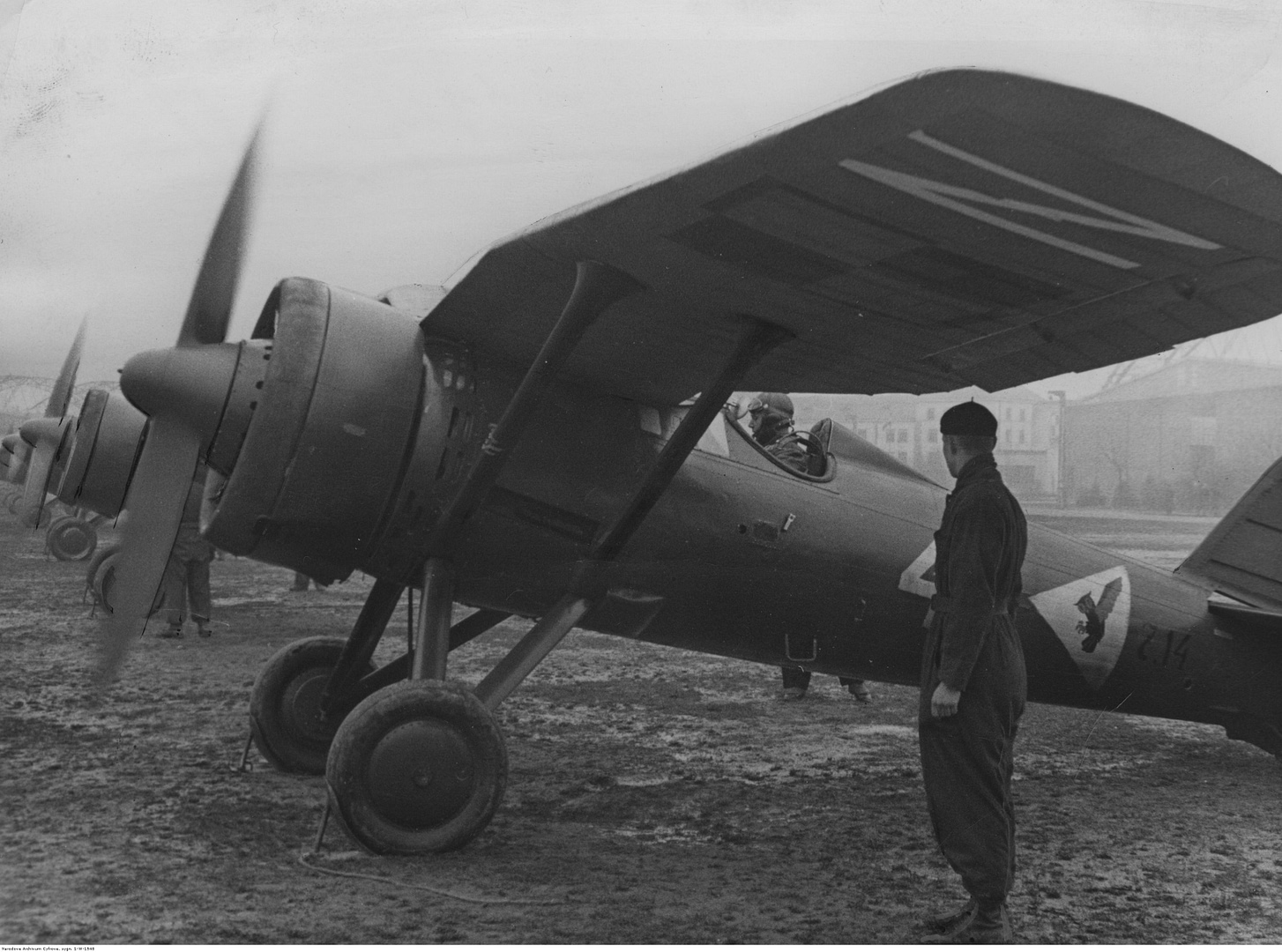
PZL P.11
Poland’s gull-winged guardian — among the most advanced fighters in the world when it appeared in the early 1930s, obsolete by 1939, yet the aircraft that carried the weight of Poland’s air defence against the Luftwaffe.
The PZL P.11: Poland’s gull-winged fighter that fought the Luftwaffe
When the PZL P.11 first flew in 1931 it was one of the most modern fighters on earth. Eight years later it was a museum piece still being asked to win a war — and it very nearly rose to the task.
The story of the PZL P.11 is really the story of how fast aviation moved between the wars. In the space of a single decade the fighter aeroplane changed more than in any comparable period before or since: the open-cockpit, fixed-undercarriage, lightly armed machines of the early 1930s gave way to the fast, cannon-armed, retractable-gear monoplanes of 1939. The P.11 sat astride that divide. It was born on the modern side of it and died, obsolete, on the old one — all without ever being substantially redesigned.
It came from the drawing board of Zygmunt Puławski, a young and brilliant Polish engineer whose name is still attached to the aircraft’s most famous feature. The high, cranked “gull” wing — thinned and bent down where it met the fuselage so the pilot could see over and under it — became known internationally as the Puławski wing or simply the “Polish wing.” It was not decoration. It gave the pilot a superb field of view, kept the wing structure light and stiff, and marked the P.11 and its P.7 predecessor out as genuinely original designs at a time when much of the world was still flying biplanes.
Puławski did not live to see his fighter reach its squadrons. He was killed in March 1931 testing an unrelated amphibian prototype, the PZL.12, months before the P.11 itself first flew. The design he left behind was carried into production by his colleagues at Państwowe Zakłady Lotnicze (PZL — the State Aviation Works) in Warsaw.
In 1934 the PZL P.11 was arguably the most advanced fighter in service anywhere in the world. By 1939 it was hopelessly outclassed — and still it fought.
When the definitive P.11c entered service in the mid-1930s it was, by common consent, one of the best fighters flying. All-metal, fast-climbing, superbly manoeuvrable and easy to see out of, it was exported interest and national pride rolled into one. Foreign observers took it seriously. Poland had, briefly, a world-class fighter industry.
The trouble was that the world did not stand still. While the P.11 went into service almost unchanged, Britain, Germany and others leapt ahead. The Messerschmitt Bf 109 and the Supermarine Spitfire — enclosed, cannon-capable, retractable-gear machines a hundred kilometres an hour faster — made the little Polish gull-wing look like what it now was: a design from another aeronautical age. Poland knew this. A successor, the PZL.50 Jastrząb, was under development, but it was slow to mature, and when war came in September 1939 the P.11c was still the backbone of the fighter force.
What happened next is the part of the story that matters most. Outnumbered and outperformed, Polish pilots flew their obsolete fighters against the most modern air force in the world — and they did not collapse. Using good ground control, dispersal, superior low-speed manoeuvrability and sheer aggression, P.11 units claimed a significant number of German aircraft in the campaign. The figures are debated to this day and should be treated as claims rather than confirmed tallies, but the essential truth is not in doubt: the P.11 was beaten by the calendar, not by its pilots.
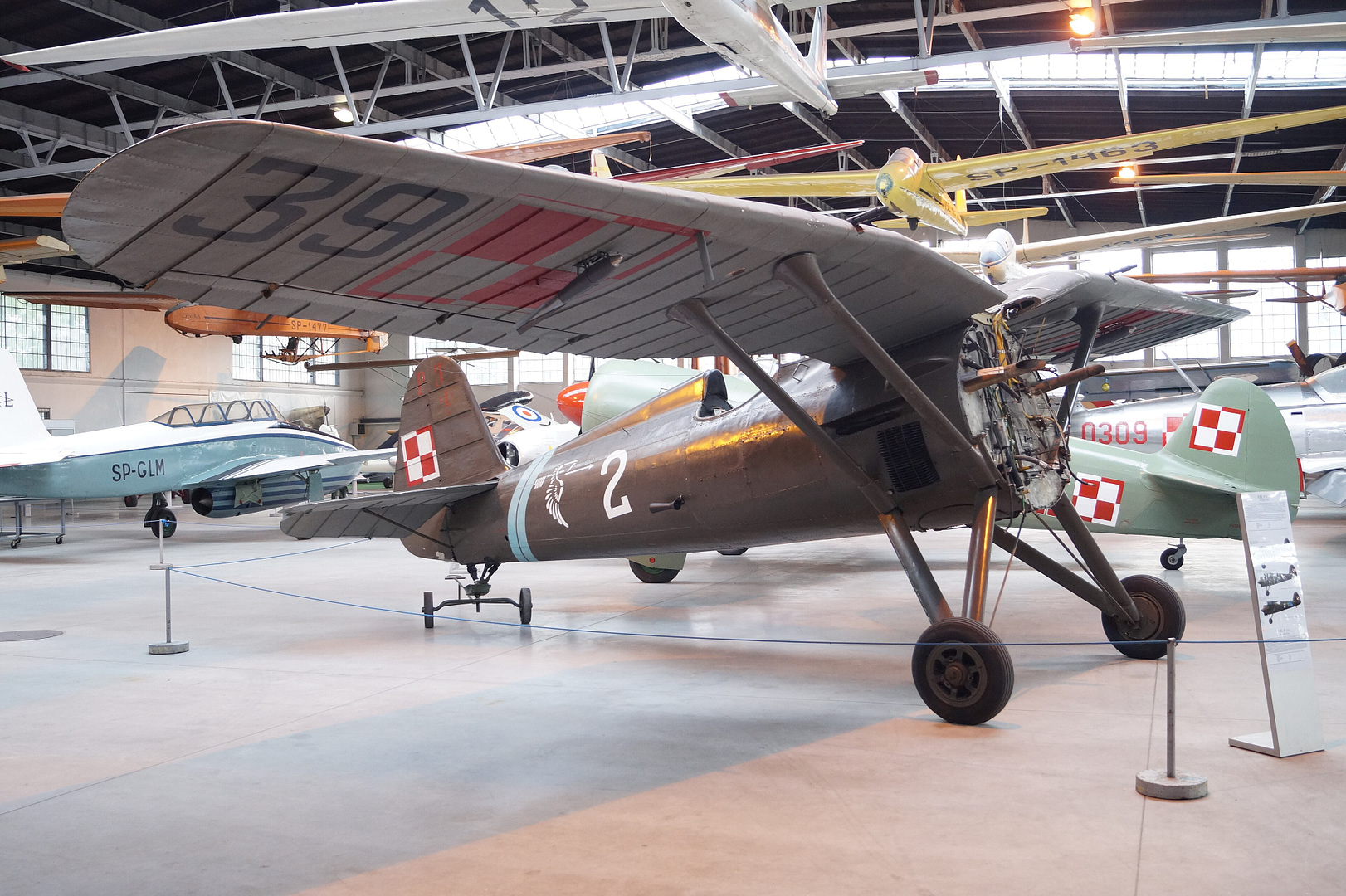
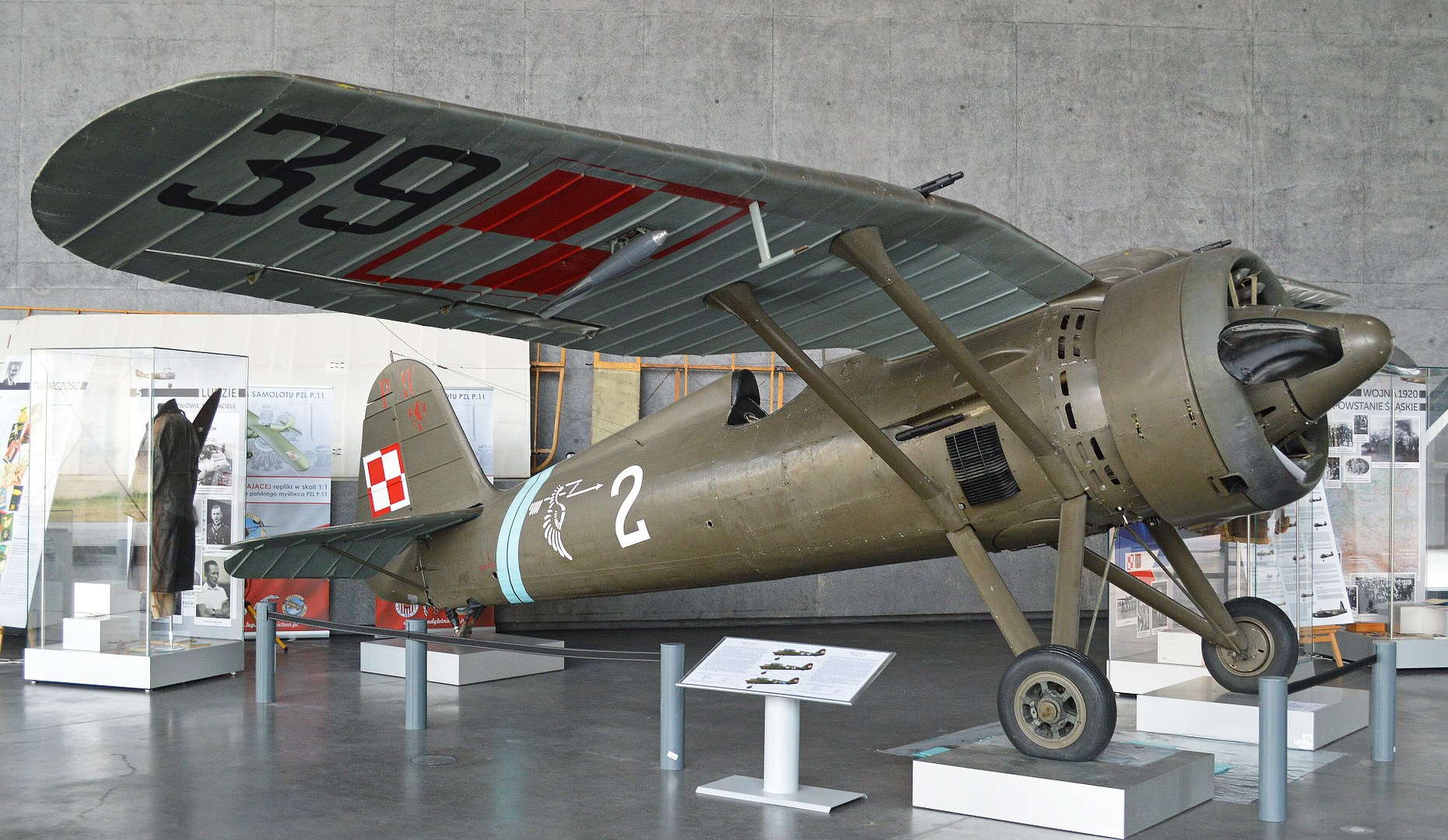
Today a single original survives — a P.11c preserved at the Polish Aviation Museum in Kraków. There is no airworthy example anywhere in the world. The gull wing that once out-turned everything in the sky now hangs in a museum, a reminder of how quickly a world-beater can become a relic, and how much courage it took to fly one anyway.
To understand how the P.11 could be both a world-beater and a relic, it helps to remember what a fighter was in 1931 and what it had become by 1939. In 1931 the cutting edge was an open cockpit, a fixed undercarriage, a radial engine of a few hundred horsepower and a pair of rifle-calibre machine guns synchronised to fire through the propeller. The P.11 had all of that, plus an all-metal structure and that inspired gull wing — it was, in every sense, a state-of-the-art machine. By 1939 the cutting edge had moved to 1,000-horsepower liquid-cooled engines, enclosed cockpits, retractable gear, cannon armament and speeds above 550 km/h. Nothing about the P.11 had changed; the definition of ‘modern’ had simply run away from it.
That is why the P.11 occupies such an unusual place in aviation history. It is neither a straightforward success story nor a cautionary tale of a bad design. It is a good aircraft that had the misfortune to be asked to fight one war too late — and whose pilots, knowing exactly how outmatched they were, flew it into that war anyway.
There is a temptation, looking back, to romanticise the P.11 as a plucky underdog and leave it there. That is too easy. The aircraft’s obsolescence in 1939 was a genuine strategic failure — the predictable result of a small country trying to keep pace with great powers in the most expensive, fastest-moving field of military technology of the age. The pilots paid for that failure with their lives. Honouring their courage means being honest about the machine they were given: it was a fine fighter that had been allowed to become a poor one, and everyone in the Polish air force knew it before the first shot was fired.
All of this makes the P.11 one of the most instructive aircraft in this museum. It is a near-perfect case study in how quickly military technology can render a design obsolete, how a smaller nation can be caught out by an arms race it cannot afford to run, and how much the skill and courage of aircrew can — and cannot — compensate for an inferior machine. The gull-wing fighter is remembered not because it won, but because of the honesty of what it represents: the right aircraft for 1934, asked to fight the wrong war in 1939, and flown with everything its pilots had.
01The PZL P.11 and the “Puławski wing”: why Poland’s fighter looked like that
The gull wing was Zygmunt Puławski’s signature and the single most recognisable thing about the P.11. In a conventional high-wing (parasol) monoplane the wing sits on struts above the fuselage in a straight line, and the thick centre-section blocks the pilot’s upward and forward view. Puławski cranked the wing downward where it joined the fuselage, thinning it to a shallow ‘M’ or gull shape, so the wing met the cockpit almost at eye level. The pilot could see over the top of the wing in the climb and under its leading edge in a turn — a real combat advantage in an era before radar-cued interceptions, when spotting the enemy first was half the battle.
The shape also had structural logic: the bend put the main spar attachment low on the fuselage and let the whole wing be built lighter and stiffer. The layout was so distinctive that it was copied and admired abroad, and the phrase ‘Polish wing’ entered the aeronautical vocabulary. It first appeared on the earlier P.6/P.7 series and reached maturity on the P.11.
02The PZL P.11’s place in history: world-beater to relic in one decade
It is easy, with hindsight, to file the P.11 under ‘obsolete 1939 fighter’ and move on. That does the aircraft an injustice. When the type was conceived and first entered service, it belonged to the leading edge of fighter design — an all-metal monoplane at a time when the RAF, the Luftwaffe’s predecessors and most other air arms still flew fabric-covered biplanes. For a few years in the mid-1930s Poland fielded, in the P.7 and P.11, front-line fighters as modern as any in the world.
The tragedy was one of timing and resources. Aircraft development in the late 1930s accelerated violently, and a country the size of Poland could not fund a fresh fighter generation every three years the way the great powers could. The P.11 was frozen in time while its rivals sprinted ahead. By September 1939 the gap was unbridgeable — not because the P.11 had got worse, but because everything else had got so much better, so fast.
03The PZL P.11 and the myth of a Polish air force ‘destroyed on the ground’
One of the most durable myths of the Second World War is that the Luftwaffe caught and destroyed the Polish air force on its airfields in the first hours of 1 September 1939. It is a tidy story, and it is wrong. In the days before the invasion, the Polish command dispersed its front-line aircraft — the P.11s included — to camouflaged secret airstrips away from the well-known peacetime bases. When German bombers struck those bases, they cratered largely empty fields.
The P.11s went up and fought from the first morning and kept fighting for the better part of two weeks, until attrition, lack of spares and the loss of their airfields to the advancing army wore them down. The Polish fighter force was not annihilated on the ground; it was ground down in the air. The distinction matters, because it is the difference between a walkover and a losing fight put up against impossible odds.
04The PZL P.11 in Polish memory: the fighter of September 1939
In Poland the P.11 is far more than a footnote in an aircraft catalogue. It is the aeroplane of September 1939 — the machine in which Polish airmen met the invasion, the type that scored the war’s first, bitterly symbolic losses and claims, and the physical embodiment of a nation that fought from the first hour despite hopeless odds. The surviving P.11c in Kraków is treated accordingly: not merely as a technical artefact, but as a relic of the opening act of the war and of the pilots who flew into it.
That memory is why the honest framing matters so much. To call the P.11 simply ‘obsolete’ and stop there misses the point; to pretend it was a match for the Bf 109 would be a different kind of disservice. The truthful account — a once-world-class fighter, overtaken by the pace of technology, flown with conspicuous courage against a far stronger enemy — is also the one that does the aircraft and its pilots the most justice.
05The PZL P.11 and the birth of the Polish fighter industry
The P.11 did not appear in a vacuum. It was the high point of a remarkable, short-lived flowering of Polish aviation in the late 1920s and early 1930s, centred on the state aviation works, PZL, in Warsaw. In the space of a few years a young industry produced a series of world-class fighter designs — the P.1, P.6, P.7 and P.11 — and equipped the Polish air force entirely with all-metal monoplanes at a time when the great powers were still flying biplanes. For a country that had regained its independence only in 1918, it was a genuine technological achievement.
What Poland could not do was sustain it. Designing a world-beating fighter is one thing; funding a fresh generation every few years, as the arms race of the late 1930s demanded, is another entirely. The same industry that gave the world the Puławski wing simply could not keep pace with the resources of Germany or Britain. The P.11 was thus both the triumph and the limit of interwar Polish aviation — brilliant, original, and ultimately overtaken.
What made the PZL P.11 advanced — and what left it behind
The P.11 got its airframe brilliantly right for 1931 and its engine and armament fatally wrong for 1939. Three features tell the whole story.
The gull wing and all-metal airframe
Puławski’s cranked high wing gave the pilot an outstanding all-round view and a light, stiff, all-metal stressed-skin structure — genuinely modern engineering in an age of wood and fabric biplanes. The P.11 was agile, strong, and forgiving to fly.
A Bristol Mercury radial — but not enough of it
Power came from a Bristol Mercury air-cooled radial, licence-built in Poland by PZL and Skoda, giving roughly 600–645 hp depending on the mark. Excellent in 1934; by 1939 it was little more than half the output of the engines in the fighters ranged against it.
Fixed gear, open cockpit, light guns
The P.11 kept a fixed, spatted undercarriage and an open cockpit, and was armed with just two — sometimes four — rifle-calibre 7.92 mm machine guns. Each feature cost speed or firepower that the newest monoplanes no longer sacrificed.
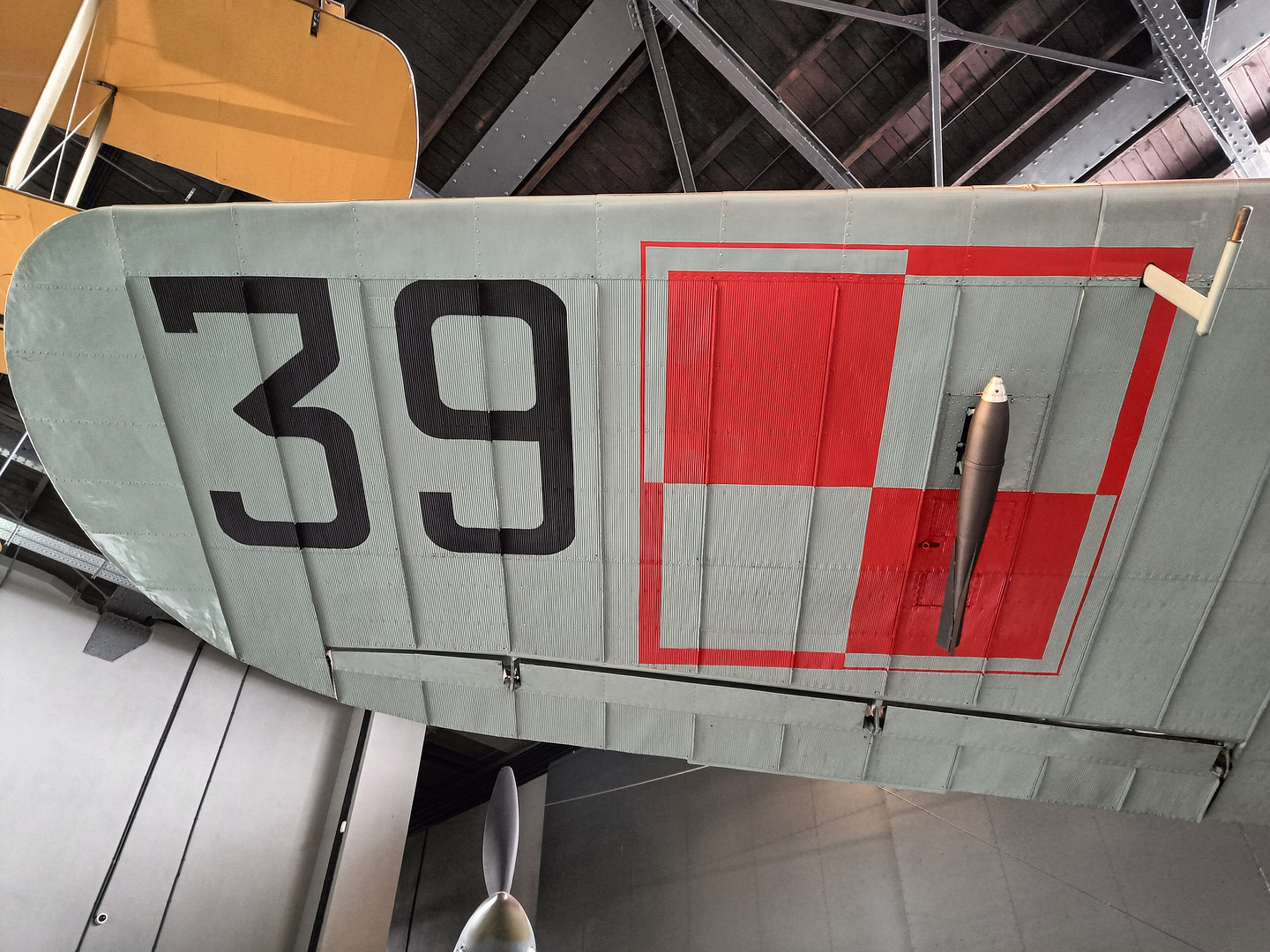
The all-metal construction deserves a word of its own. In an era when many fighters were still built of wooden frames and doped fabric, the P.11’s stressed-skin duralumin structure was genuinely advanced, giving it strength, durability and a clean finish. Pilots could dive it hard without fear of the wing failing, and the airframe stood up to rough field conditions well. The irony is that this modern structure was wrapped around an increasingly dated configuration: no amount of good metalwork could compensate for a fixed undercarriage, an open cockpit and half the horsepower of the opposition.
06The PZL P.11c versus the Messerschmitt Bf 109: an honest comparison
Placed beside the fighter it actually had to face in 1939, the P.11c’s disadvantages were stark. The Bf 109E was faster by roughly 100–150 km/h, climbed faster, dived faster, was better armed (with cannon on many variants) and had an enclosed cockpit and retractable gear. In a straight energy fight the German fighter held every card.
Where the P.11 could still compete was in the horizontal: at low speed it could out-turn the 109 comfortably, and a P.11 pilot who forced the fight into a tight, slow turning contest could get a firing solution. The Polish answer to being outperformed was tactical — use height where they had it, use the turn, use surprise, and never try to run in a straight line. It was not enough to change the outcome, but it was enough to make the Luftwaffe pay.
The honest verdict, then and now: the P.11c was a well-flown, well-handled fighter that was simply a generation behind. Its pilots closed part of that gap with skill; they could not close all of it.
07The PZL P.11’s variants: from P.11a to the Romanian P.11f and the P.11g Kobuz
For a single basic design the P.11 spawned a useful family. The initial Polish service version was the P.11a (around 50 built). The definitive Polish model was the P.11c (about 150 built from 1934), with a repositioned engine for a better view and provision for two extra wing guns on some aircraft.
Romania was the export and licence story. It ordered the Gnome-Rhône-engined P.11b (around 49) and then licence-built the P.11f at IAR (roughly 95 aircraft) with an IAR-built engine. A single improved P.11g Kobuz prototype — more powerful, with an enclosed cockpit — flew only in mid-August 1939, far too late to matter. Total production across all versions is usually given as around 325, though sources differ and the figure should be treated as approximate.
08The PZL P.11’s gull wing: the engineering legacy of Zygmunt Puławski
Zygmunt Puławski was one of the outstanding fighter designers of his generation, and the gull wing was his masterstroke. Before him, high-wing monoplane fighters forced a compromise: put the wing on top for lift and visibility, and accept that its thick roots blocked the pilot’s view and added drag. Puławski’s answer — thinning and cranking the wing down to the fuselage — solved the visibility problem and the structural problem at once, and did it with such elegance that the layout was studied and copied abroad.
He died in March 1931 at just thirty, testing an unrelated amphibian, before the P.11 had even flown. His colleagues completed his fighter, and the ‘Polish wing’ became his monument. It is fair to wonder what he might have designed next, had he lived to see the monoplane revolution he had helped to start — and whether Poland might have had a competitive 1939 fighter if it had.
09The PZL P.11 versus the Polikarpov I-16: two answers to the same problem
The P.11 and the Soviet Polikarpov I-16 entered service at almost the same time, and they represent two opposite bets on what the next fighter should be. The I-16 was a stubby, tricky, retractable-gear low-wing monoplane — fast, unforgiving and pointed squarely at the future. The P.11 was a docile, superbly visible, fixed-gear high-wing machine that prioritised handling and the pilot’s eye.
By 1939 the I-16’s bet had aged better: retractable gear and a low wing had become the template every serious fighter followed. But the comparison is not entirely one-sided. The P.11 was far easier and safer to fly, and its visibility advantage was real. Both types were obsolescent by 1941; both were flown with great courage by pilots who deserved better machines. They are a neat illustration of how much the choices of the early 1930s shaped the fighters that had to fight at the start of the war.
10Flying the PZL P.11: the open cockpit and fixed gear from the pilot’s seat
To fly a P.11 was to fly a fighter of the early 1930s in every physical sense. The cockpit was open to the slipstream behind a small windscreen, so the pilot felt the cold, the wind and the noise directly — punishing at altitude in a Polish autumn, and a world away from the enclosed, heated cockpits of the fighters that would face it. The fixed, spatted undercarriage sat permanently in the airflow, costing speed on every sortie but making the aircraft simple, rugged and forgiving on the rough grass strips it operated from.
Against those drawbacks, pilots consistently praised the P.11’s handling. It was light on the controls, honest near the stall, quick into a turn and blessed with that superb all-round view. It was, by all accounts, a genuine pleasure to fly — which only sharpens the tragedy of 1939, when a delightful aircraft was sent to do a job that delightful handling could no longer win.
11The PZL P.11c versus the P.11a: what actually changed
The two main Polish service versions look almost identical but differ in ways that mattered. The earlier P.11a carried its engine higher, which slightly obstructed the pilot’s forward view, and was armed with two machine guns. The definitive P.11c lowered the engine installation for a better sightline over the nose, strengthened the airframe, added provision for two extra wing-mounted guns on some aircraft, and could carry a small load of light bombs.
Neither change altered the fundamental equation — both were fixed-gear, open-cockpit, rifle-calibre fighters — but the P.11c was the more capable and more numerous of the two, and it was the version that bore the brunt of the September 1939 fighting. When people speak of ‘the P.11’ as Poland’s 1939 fighter, it is almost always the P.11c they mean.
12The Bristol Mercury and the PZL P.11: the engine that defined its fate
More than any other single factor, the P.11’s engine explains both its early excellence and its later obsolescence. The Bristol Mercury was a British air-cooled radial of proven reliability, and Poland secured a licence to build it domestically through PZL and Skoda — a sensible, strategically important arrangement that gave the country a modern powerplant of its own manufacture. In the early 1930s, six hundred-odd horsepower put the P.11 firmly among the best-powered fighters in the world.
But engine development, like everything else, accelerated. By the late 1930s the fighters ranged against the P.11 were being built around engines of a thousand horsepower and more, with the frontal area of a liquid-cooled inline to keep them slim and fast. The P.11 was stuck with a good engine that had simply been left behind, and its bluff radial frontage did its top speed no favours. The licence that had once been a mark of Polish self-sufficiency became, in the end, a symbol of how a single-engine choice can freeze an entire aircraft in its era.
The PZL P.11 at war: the backbone of Poland’s defence in 1939
On 1 September 1939 the P.11c was the fighter most Polish pilots flew into the largest air assault the world had yet seen. What followed was neither the walkover of German propaganda nor a miracle — it was a hard, costly, honourable fight.
It is worth setting the scene honestly. Poland began the campaign with roughly 175 fighters in front-line units, the great majority of them P.11s (with a handful of older P.7s), plus a small reserve. Against them the Luftwaffe committed thousands of modern aircraft. The Polish fighters were slower, more lightly armed and fewer — but they were not caught on the ground in the way the myth insists. Most had been dispersed to secret field airstrips before the invasion, and they went up to fight from the first morning.
The war’s very first aerial casualty was a P.11. In the pre-dawn of 1 September, Captain Mieczysław Medwecki’s P.11c was shot down near Balice — commonly cited as the first aircraft, and its pilot the first Allied airman, lost in the Second World War. Minutes later his wingman, Second Lieutenant Władysław Gnyś, is credited with downing German aircraft near Olkusz in what is often described as one of the first Allied aerial victories of the war. The details of Gnyś’s claim are genuinely disputed by historians and are best stated with care — but the symbolism is real: the first shots of the air war in the West were exchanged between a Luftwaffe bomber force and Poland’s obsolete gull-wing fighters.
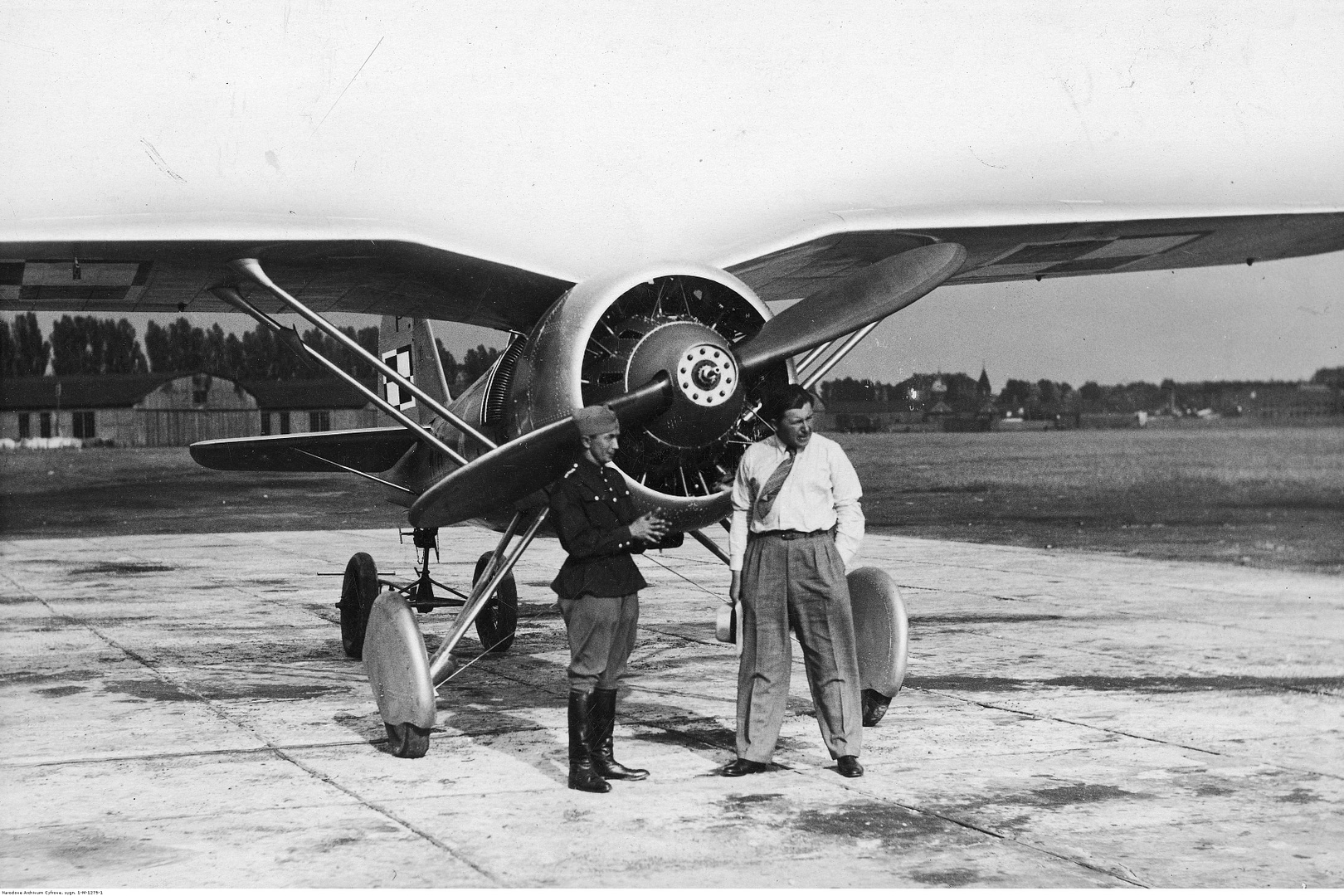
Over the days that followed, the P.11 squadrons fought across southern and central Poland and, crucially, in the defence of Warsaw, where the Pursuit Brigade contested the skies over the capital. Polish pilots exploited what they had: interception from a functioning ground-observation and control network, the P.11’s tight turn, and diving attacks from above. They shot down bombers and, occasionally, the fighters escorting them. They also died in large numbers, and their aircraft were ground down by attrition, lack of spares and the sheer pace of the German advance overrunning their airfields.
By the campaign’s end the P.11 force had been largely destroyed or dispersed. As Poland collapsed under the German and, from 17 September, Soviet invasions, around three dozen surviving P.11s were flown south to Romania, where they were interned and impressed into the Royal Romanian Air Force. Many of the pilots escaped onward to France and Britain, where P.11 veterans would fly Hurricanes and Spitfires in 1940 — taking their hard-won tactics into far more capable machines.
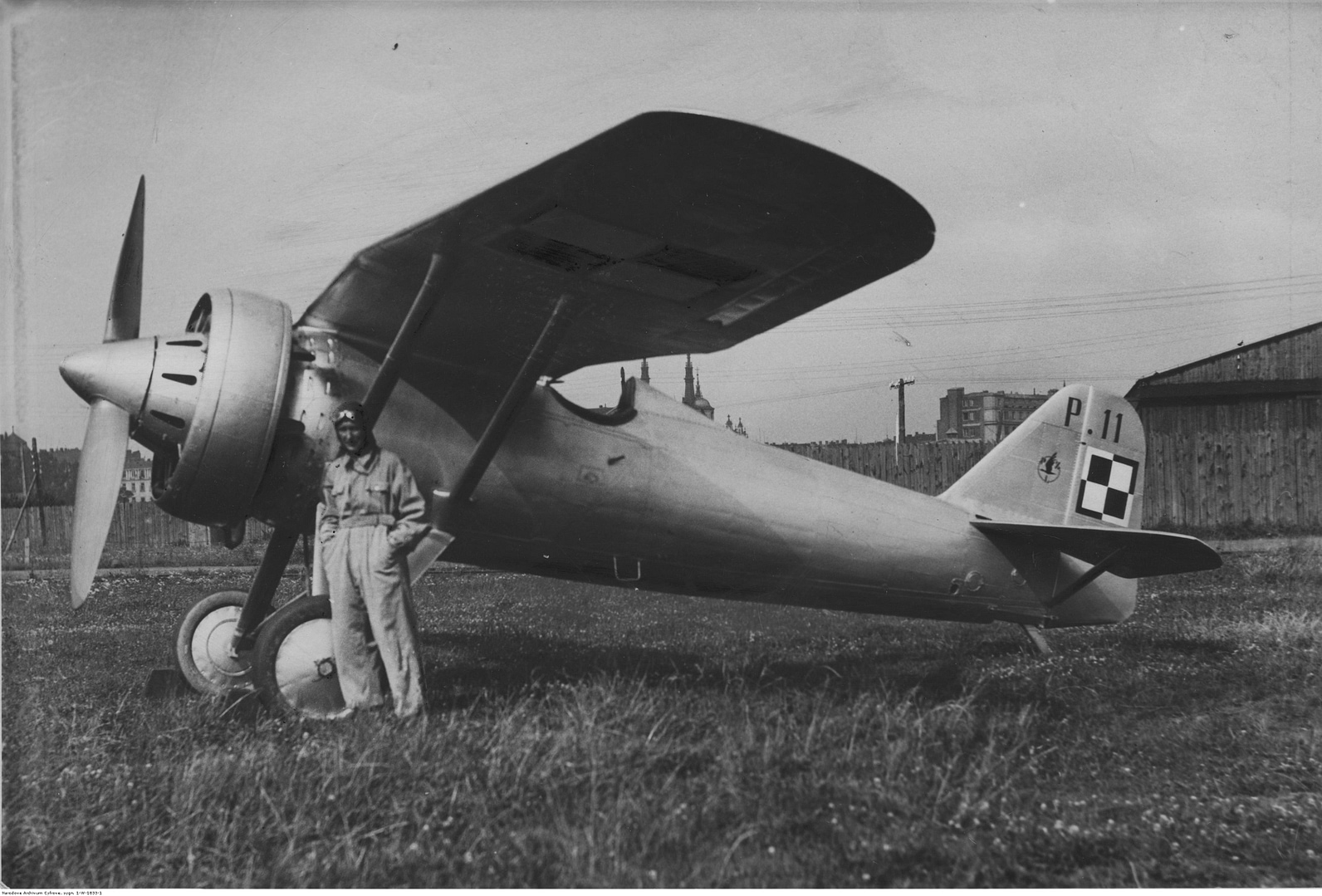
The most-quoted figure for the campaign is that P.11 units claimed on the order of 110 German aircraft destroyed for the loss of most of the Polish fighter force. That number has circulated for decades and is plausible in shape, but exact air-combat tallies from September 1939 are contested on both sides and should be read as claims, not audited totals. What is not contested is the character of the fight: a small force of outdated fighters, well led and bravely flown, made the conquest of Polish airspace a good deal more expensive than the Luftwaffe expected.
The scale of the mismatch is worth stating plainly. The Luftwaffe committed the better part of two thousand modern combat aircraft to the Polish campaign. Poland could field only a few hundred, and its fighter arm — the P.11 and a handful of older P.7s — amounted to roughly 175 machines at the front. Every one of them was slower and more lightly armed than the German fighters, and most were slower than the German bombers they were sent to catch. In that context, the story of September 1939 is not that the Polish fighters lost. It is that they inflicted anything at all.
It is also worth being precise about what the fighters could and could not affect. Poland’s defeat in 1939 was decided on the ground, by the speed and weight of the German (and later Soviet) armies, not in the air. Even a modern Polish fighter force could not have changed that outcome. What the P.11 squadrons could do — and did — was contest the sky over key points, impose losses, and deny the Luftwaffe the effortless supremacy its planners expected. Measured against that realistic yardstick rather than against victory, the P.11’s campaign reads very differently from the propaganda image of a helpless air force swept aside.
13The PZL P.11 and the first aerial victory of WWII: what Władysław Gnyś is actually credited with
Few first-day episodes are quoted more often, or more loosely. In the early morning of 1 September 1939, flying a P.11c from the Kraków wing, Second Lieutenant Władysław Gnyś is credited by Polish accounts with destroying German aircraft (usually described as two Dornier Do 17 bombers) that came down near the village of Żurada, east of Olkusz. It is frequently called one of the first Allied aerial victories of the Second World War.
Historians urge caution. Some researchers argue the Dorniers may have been damaged by anti-aircraft fire and collided, with Gnyś’s role uncertain; Polish sources point to ground witnesses who saw a Polish fighter attack immediately before the crash. The safest phrasing is that Gnyś is credited with an early — possibly the first — Allied air victory, while the exact circumstances remain debated. Separately, and less disputed, the first Allied aircraft and airman lost in the war were a P.11c and its pilot, Captain Medwecki, shot down minutes earlier.
14How many aircraft did the PZL P.11 claim in 1939 — and how reliable is the number?
The commonly cited tally is that Polish P.11 units claimed around 110 Luftwaffe aircraft in the September campaign. Some accounts push the figure higher when all Polish fighter and anti-aircraft claims are combined; German loss records for the campaign are also substantial but were compiled differently. As with almost all air-combat statistics — on every side, in every war — claims routinely exceed confirmed losses because two pilots may claim the same aircraft, damaged machines that limped home are counted as destroyed, and record-keeping in a collapsing front is imperfect.
Treat the ~110 figure as a widely repeated claim that captures the right order of magnitude rather than a precise, reconciled total. The meaningful, defensible statement is this: an obsolete fighter force inflicted real and costly losses on a vastly superior enemy before being overwhelmed.
15The PZL P.11 over Warsaw: the Pursuit Brigade’s defence of the capital
The most concentrated P.11 fighting took place over Warsaw, where the Pursuit Brigade — the massed fighter force assigned to defend the capital — flew repeatedly against German bomber formations and their escorts in the opening days of the war. Guided by a ground-observation network that fed warnings to the fighters, the brigade’s P.11s and P.7s climbed to intercept raid after raid, breaking up bomber streams and forcing the Luftwaffe to fight for the airspace over the city.
They could not hold it indefinitely. Losses mounted, replacement aircraft did not exist, and after a few days the brigade was pulled back to conserve what remained. But for those opening days the defence of Warsaw showed what a well-directed force of obsolete fighters could still do: not win, but make the enemy bleed for every mile of sky.
16From the PZL P.11 to the Hurricane: the Polish pilots who fought on in 1940
The P.11’s most important legacy was not the aircraft but the men who flew it. When Poland fell, thousands of its airmen escaped — first to Romania and the Baltic states, then to France, and finally to Britain. There, P.11 veterans converted onto Hurricanes and Spitfires and flew in the Battle of Britain, where Polish squadrons and individual pilots compiled a record out of all proportion to their numbers.
They arrived with something their British hosts initially underrated: real, recent combat experience against the Luftwaffe, and a hard-won understanding of how to fight when outnumbered. The gull-wing fighter that had been outclassed over Poland had, in a sense, trained the pilots who helped turn back the same enemy over England a year later. It is one of the quiet ironies of 1940 that some of the deadliest Hurricane pilots of the summer had learned their trade in an obsolete Polish parasol monoplane.
17The PZL P.11’s guns and tactics: making a light fighter count
With only two, sometimes four, rifle-calibre machine guns, the P.11 pilot had a narrow margin for error. There was no cannon to smash an airframe with a single hit; kills had to be earned with accurate, close-range bursts into vulnerable spots — engines, cockpits, fuel tanks. This put a premium on getting close and shooting well, and on the P.11’s two genuine advantages: its excellent visibility, which helped pilots spot and stalk their targets, and its tight turn, which let them convert an interception into a firing pass.
Polish fighter tactics in 1939 reflected these realities. Where they had warning and height, P.11 pilots preferred diving attacks that traded altitude for a brief speed advantage, fired, and climbed away rather than lingering in a fight they could not win on energy. Against unescorted bombers this worked well; against the Bf 109 it was a matter of survival as much as offence. It was not enough to change the campaign, but it was disciplined, professional flying that made the most of a bad hand.
18The PZL P.11 through German eyes: an enemy that fought harder than expected
German accounts of the Polish campaign are revealing precisely because the Luftwaffe expected so little resistance. The Polish fighter force was known to be small and outdated, and the plan assumed rapid, near-total air superiority. What German aircrew actually encountered over Poland — aggressive, well-directed P.11s that climbed to intercept, pressed home attacks on bombers and used their turn to survive against the escorts — came as an unwelcome surprise in the opening days.
None of this changed the strategic result, and it should not be overstated: the Luftwaffe won air superiority quickly and held it. But the idea, popular in later propaganda, that Polish aviation was a non-event swept aside in hours does not survive contact with the German records of losses and combats. The P.11 was beaten; it was not negligible.
PZL P.11c full specifications and cost data
Figures are broadly representative of the definitive P.11c and vary between sources and individual aircraft; contested or approximate values are marked as estimates.
| Equipe | 1 (pilot) |
|---|---|
| Motor | Bristol Mercury radial (licence-built by PZL / Skoda) |
| Power | ~600–645 hp / ~450–480 kW (variant-dependent; estimate) |
| Velocidade máxima | ~375–390 km/h (~233–242 mph) at altitude |
| Speed at sea level | ~300 km/h (~186 mph) (estimate) |
| Teto de serviço | ~8,000 m (~26,000 ft) |
| Climb | 5,000 m in ~6 min |
| Faixa | ~700 km (~435 mi) |
| Comprimento | 7.55 m (24 ft 9 in) |
|---|---|
| Envergadura | 10.72 m (35 ft 2 in) |
| Altura | 2.85 m (9 ft 4 in) |
| Área da asa | 17.9 m² |
| Peso vazio | ~1,147 kg (2,529 lb) |
| Loaded weight | ~1,630–1,800 kg (3,590–3,970 lb) (estimate) |
| Armamento | 2 × 7.92 mm wz.33 machine guns; some P.11c fitted 4 × |
| Bomb load | up to 4 × 12.5 kg bombs (P.11c) |
| Undercarriage | Fixed, spatted (non-retractable) |
| Cockpit | Open |
| First flight | August 1931 (P.11/I prototype) |
| Number built | ~325 total incl. Romanian P.11f (figures vary) |
| Unit cost | Not reliably recorded (1930s) |
| Cost per flight hour | Not applicable — no airworthy example |
| Programme cost | Not reliably recorded (1930s) |
Values marked “estimate” or shown as ranges vary between references; performance figures are for the P.11c at optimum altitude. The P.11 predates modern cost accounting, so unit and hourly costs are not reliably recorded, and no example is airworthy today.
19The PZL P.11’s operating costs: why there is no cost-per-hour figure
Unlike the modern jets elsewhere in this museum, the P.11 has no meaningful cost-per-flight-hour number, and that is not an oversight. The aircraft was built in the early-to-mid 1930s under a state aviation programme in interwar Poland; the detailed lifecycle-cost records that make hourly figures possible for post-war military aircraft simply do not exist in a comparable form, and much of Poland’s aviation documentation was lost in the war.
More to the point, there is no airworthy P.11 anywhere in the world to generate an operating cost. The single surviving original is a static museum exhibit. So while we can describe what the aircraft cost Poland strategically — scarce resources spent on a design that could not be kept current — a spreadsheet dollars-per-hour value would be invented, not recorded. We would rather leave the row honest than fabricate one.
20The PZL P.11 versus its contemporaries: where it stood in the fighter league of the 1930s
Measured against the fighters it grew up with — the Gloster Gladiator biplane, the Fiat CR.32, the early Hawker monoplanes, the Soviet Polikarpov I-16 — the P.11 was a strong, respectable performer, and clearly on the modern side of the biplane-to-monoplane divide. Against the generation that followed, it was outclassed on almost every axis of speed, protection and firepower.
The clearest way to see it: the P.11 was designed to fight the aircraft of about 1932, entered its prime around 1934, and was still front-line in 1939 — by which point its opponents were designed to a 1936–38 standard. One generation’s gap does not sound like much until you put a 380 km/h fighter in the same sky as a 550 km/h one.
21The PZL P.11’s descendants: the P.24 export family and the PZL.50 Jastrząb
The P.11 was not a dead end; it spawned two very different offspring. The first was the PZL P.24, an export derivative developed specifically for customers who could not buy the British Bristol Mercury engine used in Poland’s own aircraft. Fitted with a French Gnome-Rhône radial and often more heavily armed — sometimes with cannon — the P.24 was a genuine export success, sold to Turkey, Greece, Romania and Bulgaria, and in several respects a better-armed fighter than the P.11c that stayed home.
The second was the intended domestic successor, the PZL.50 Jastrząb (‘Hawk’), a modern low-wing monoplane with retractable gear meant to bring Poland back to the front rank. It was delayed by engine and development problems and by shifting priorities, and the war arrived before it could enter service. Poland thus went to war in 1939 with the P.11 it had, not the fighter it wanted — a gap between ambition and industrial reality that the September campaign exposed with brutal clarity.
22Reading the PZL P.11’s numbers: why the sources disagree
Anyone comparing references on the P.11 will quickly notice that the figures wander. Top speed is variously quoted between about 375 and 390 km/h; engine power between roughly 500 and 645 hp; production totals anywhere from around 300 to over 350; and combat claims for 1939 across a wide band. This is normal for an interwar aircraft, and there are good reasons for it.
Different sources quote different variants and engine marks; performance figures depend heavily on altitude, weight and whether the extra wing guns were fitted; production totals differ depending on whether Romanian licence-built aircraft and prototypes are counted; and 1939 combat figures are genuinely contested between Polish and German records. Throughout this page we have used representative ranges and flagged the softer numbers as estimates rather than pretending to a false precision the evidence does not support.
The PZL P.11: from world-beater to last stand
The Puławski wing takes shape. Engineer Zygmunt Puławski develops his gull-wing all-metal fighters at PZL — the P.6 and P.7 — establishing the layout the P.11 will refine.
The P.7 enters service. Poland becomes one of the first air forces in the world equipped entirely with all-metal monoplane fighters, ahead of Britain, France and Germany — a brief, genuine technological lead.
Puławski is killed. The designer dies testing the unrelated PZL.12 amphibian prototype, months before his fighter’s first flight. His colleagues carry the P.11 into production.
First flight. The prototype PZL P.11/I takes to the air — a modern, all-metal, gull-wing monoplane at a time when most air forces still fly biplanes.
The P.11c enters service. Poland fields one of the most advanced fighters in the world; about 150 P.11c are built through 1936.
Romania builds the P.11 under licence. IAR begins production of the P.11f (following the imported P.11b), the type’s principal export and licence story.
Overtaken. The Bf 109, Spitfire and Hurricane render the P.11 obsolescent. Poland’s intended successor, the PZL.50 Jastrząb, is delayed.
Too late. The improved P.11g ‘Kobuz’ prototype — more powerful, enclosed cockpit — flies just two weeks before the war. It never reaches the squadrons.
War. A P.11c (Capt. Medwecki) becomes the first Allied aircraft lost in WWII; moments later Lt Gnyś is credited with an early Allied aerial victory.
The defence of Warsaw. The Pursuit Brigade’s P.11s and P.7s fight repeated actions over the capital, breaking up German bomber raids before losses force them to withdraw.
The second front. The Soviet invasion from the east seals Poland’s fate; surviving P.11s are ordered south as organised resistance collapses.
The defence. P.11c units form the backbone of Poland’s fighter defence, claiming on the order of 110 German aircraft (a contested figure) before being overwhelmed; ~36 are flown to Romania.
The pilots fight on. Many P.11 veterans escape to France and Britain, flying Hurricanes and Spitfires in the Battle of Britain and beyond.
One survivor. A single original P.11c is preserved at the Polish Aviation Museum in Kraków. No P.11 is airworthy.
The PZL P.11 in twelve stories
The designer, the pilots, the first shots of the air war and the single survivor — the human history behind Poland’s gull-wing fighter.
Zygmunt Puławski
The gull wing that made the P.11 famous was the work of a designer who never saw it fight. Zygmunt Puławski was killed in March 1931 testing an unrelated amphibian prototype, aged just thirty, with his best work still on the drawing boards he left behind. His colleagues completed the fighter, and the ‘Polish wing’ became his lasting monument in the history of flight.
The first loss of the war
In the dark before dawn on 1 September 1939, Captain Mieczysław Medwecki’s P.11c was shot down near Balice — widely recorded as the first aircraft, and its pilot the first Allied airman, lost in the Second World War. It was a grim distinction for a fighter that had once been among the best in the world: the war’s opening casualty was a Polish gull-wing already a generation out of date.
Credited to Gnyś
Minutes later his wingman, Second Lieutenant Władysław Gnyś, is credited with downing German aircraft near Olkusz — often called one of the first Allied air victories of WWII. Historians debate the exact circumstances, and the claim is best stated with care, but the symbolism endures: within an hour of the invasion, an obsolete Polish fighter had already struck back.
Seeing first
Pilots prized the Puławski wing for one reason above all: visibility. Set almost at eye level and cranked down out of the line of sight, it let a P.11 pilot see over the top of the wing in the climb and under its leading edge in a turn. In an age before radar-guided interception, spotting the enemy first was half the battle — and the P.11 was built to do exactly that.
Out-turning the 109
A P.11 could not run from a Bf 109, so its pilots did the opposite: they turned. At low speed the gull-wing fighter could out-circle the faster German machine, and a disciplined pilot who dragged the fight into a tight, slow turning contest could still bring his guns to bear. It was a way of surviving against a superior enemy, and occasionally of beating one.
Not caught on the ground
The myth says the Luftwaffe destroyed the Polish air force in its hangars on day one. It didn’t. Most P.11s had been quietly moved to camouflaged field strips before the invasion, so the bombs that cratered the peacetime bases fell on empty fields. The Polish fighters rose to fight from the first morning and kept fighting for the better part of two weeks.
The Pursuit Brigade
The P.11s of the Pursuit Brigade contested the skies over the Polish capital, climbing again and again against waves of German bombers and their escorts. Fed warnings by a ground-observation network, they broke up raids and made the Luftwaffe fight for the air over Warsaw — until losses and the lack of any replacements forced them back.
Slower and lighter
The P.11 gave away roughly 100–150 km/h to the fighters it faced and carried a fraction of their firepower — rifle-calibre machine guns against cannon. Every victory it won was won from a position of technical disadvantage, by pilots who knew precisely how outmatched their machines were and flew them into the fight regardless.
Flight to Romania
As Poland fell under the German and, from 17 September, Soviet invasions, around three dozen surviving P.11s were flown south and interned in Romania, where they were absorbed into the Royal Romanian Air Force. Many of their pilots did not stop there — they escaped onward, through the Balkans and France, toward Britain.
The licence operator
Romania was the P.11’s one true export and licence success, importing the Gnome-Rhône-engined P.11b and building around 95 P.11f at IAR — the same industrial base that produced the later, related and more heavily armed PZL P.24 export family sold across the Balkans and to Turkey.
The Jastrząb that wasn’t
Poland knew the P.11 was ageing and designed the PZL.50 Jastrząb to replace it — a modern low-wing monoplane with retractable gear. But the programme ran late on engines and priorities, and war arrived before a competitive Polish fighter could reach the squadrons. Poland fought 1939 with the aircraft it had, not the one it wanted.
One aircraft, Kraków
Of the hundreds built across Poland and Romania, exactly one original remains: a P.11c at the Polish Aviation Museum in Kraków. There is no airworthy example anywhere in the world. To stand in front of it is to stand in front of the last of its kind — the fighter of September 1939, preserved.
The PZL P.11 in photographs
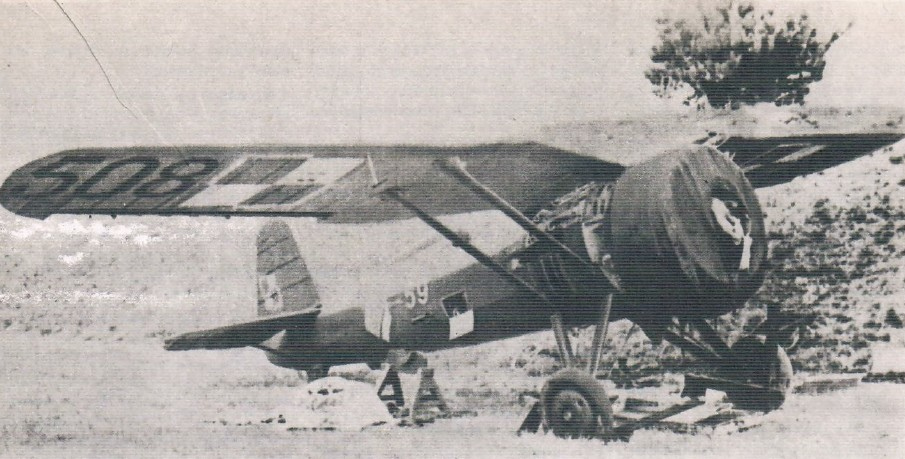
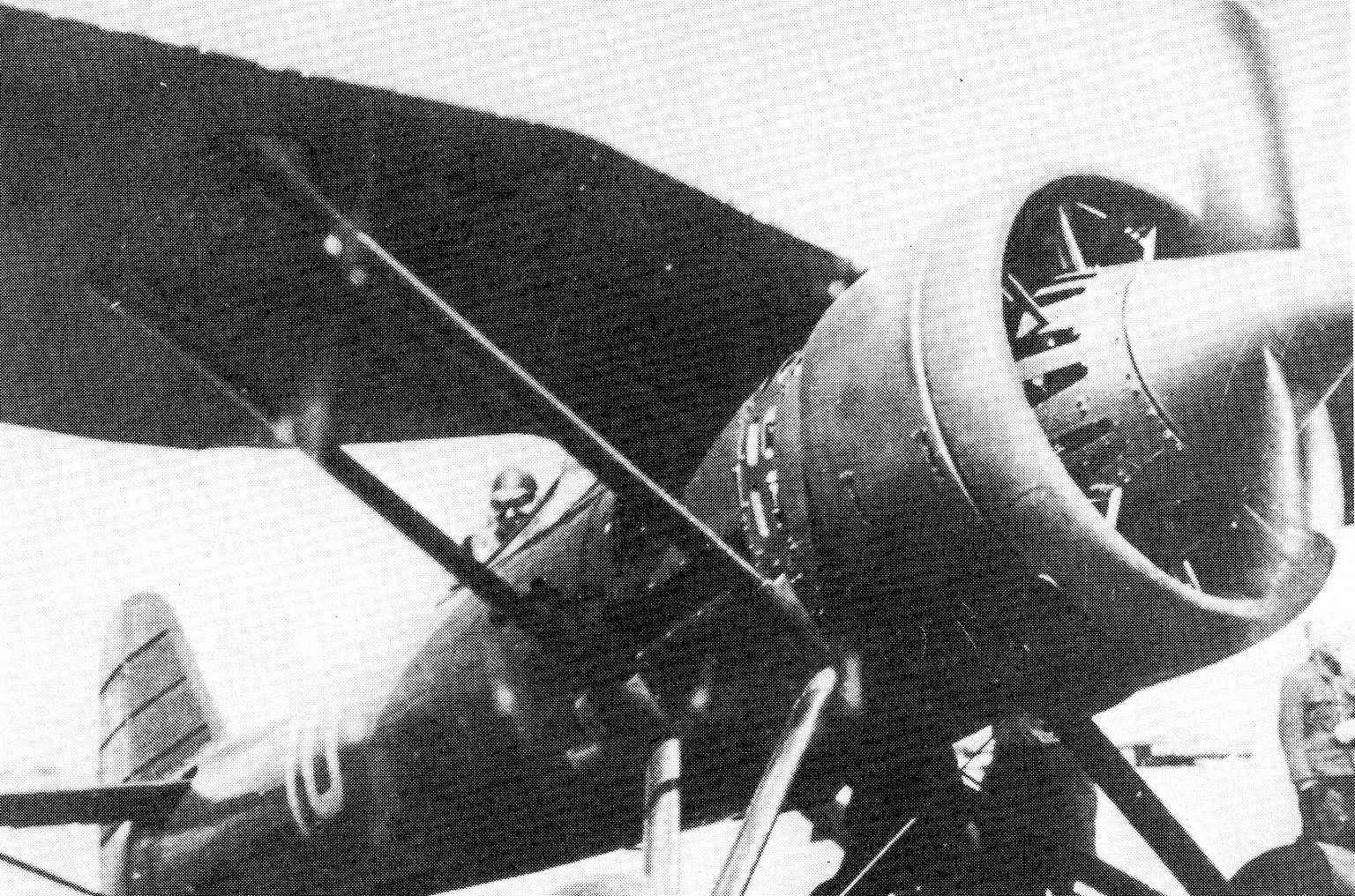
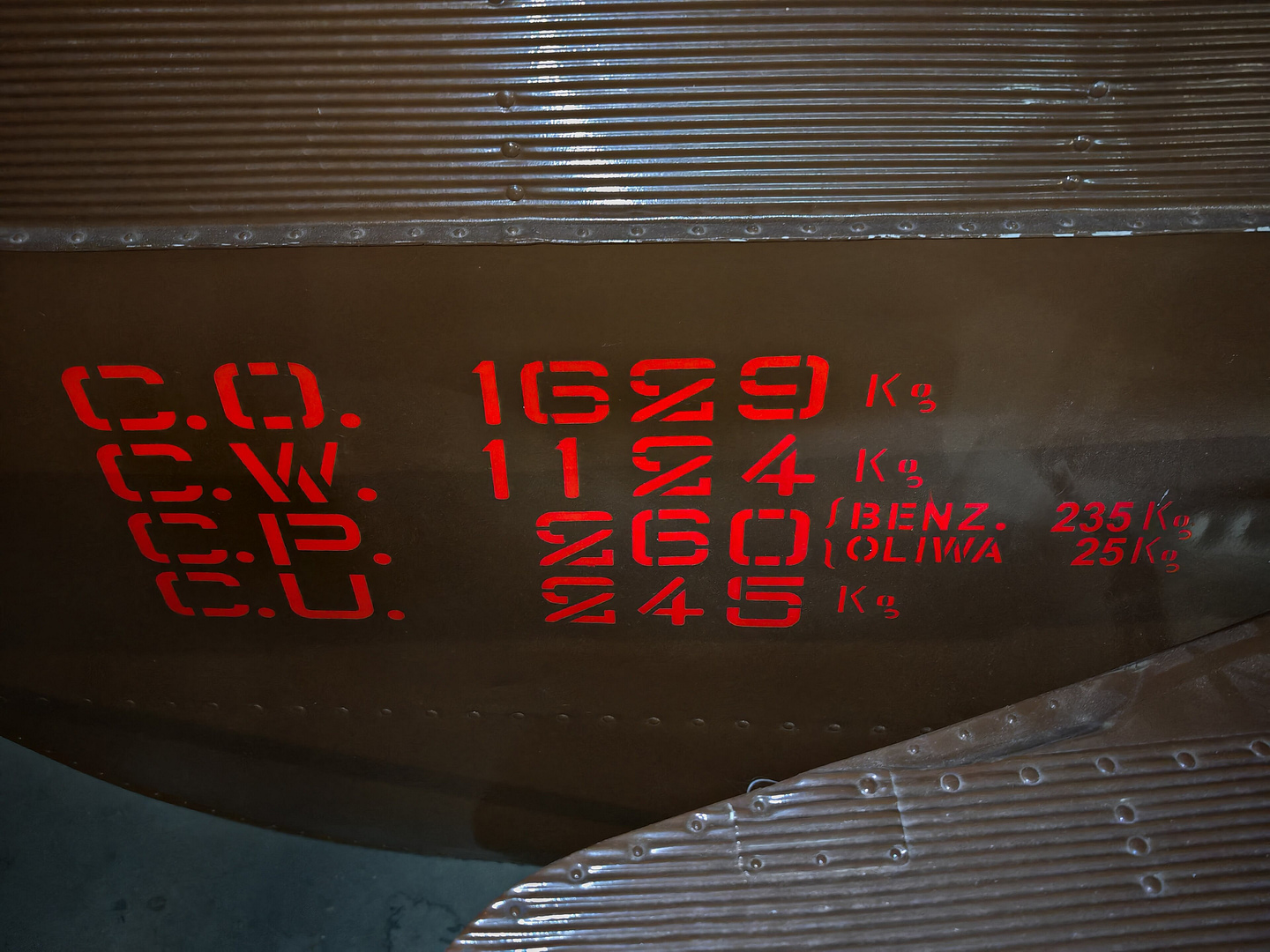
Period images from the 1930s and the sole surviving P.11c at the Polish Aviation Museum in Kraków. Every photo is credited and licensed; scroll for more.
The PZL P.11 on film: how an obsolete fighter fought the Luftwaffe
A concise, well-sourced history of the P.11 and its September 1939 campaign.
“P.11 — How Poland Became a Thorn in Germany’s Side” by AllthingsWW2 (~54,000 views). An established WWII-history channel’s account of the aircraft and its 1939 fight.
Where the PZL P.11 flew: origin, the 1939 war, export and the last survivor
The P.11 had a focused footprint: designed and built in Poland, thrown into the 1939 defensive war over Polish soil, exported and licence-built in Romania (with the related P.24 family reaching further), and surviving today in a single museum. Toggle the categories to explore.
The PZL P.11 by the numbers: September 1939
Air-combat tallies from September 1939 are disputed on all sides and are given here as claims, not audited totals. The defensible summary: a small, obsolete fighter force inflicted real and costly losses on a far superior enemy before being overwhelmed.
PZL P.11: your questions answered
Can I fly in a PZL P.11?
No. Only one original PZL P.11 survives — a static P.11c at the Polish Aviation Museum in Kraków — and there is no airworthy or bookable example anywhere in the world. A flying reproduction has occasionally been reported, but nothing is available to fly in. MiGFlug does not offer P.11 flights.
However, you can fly in genuine military jets today. MiGFlug arranges flights in aircraft such as the L-39 Albatros, the MiG-29 Fulcrum, the Hawker Hunter and the F-104 Starfighter. See migflug.com/flights-prices for what is currently bookable.
Why is the PZL P.11’s wing shaped like a gull?
The cranked, high ‘gull’ wing was designed by Zygmunt Puławski and is known as the Puławski or ‘Polish’ wing. Bending the wing down where it met the fuselage put it near the pilot’s eye level and out of his line of sight, giving excellent visibility over and under the wing — a real advantage for spotting the enemy first — while keeping the all-metal structure light and stiff.
Was the PZL P.11 really one of the best fighters in the world?
Yes — for a few years. When it entered service around 1934 the all-metal, gull-wing P.11 was among the most modern and capable fighters anywhere, at a time when most air forces still flew biplanes. That standing did not last: fighter design accelerated so fast in the late 1930s that the P.11 was overtaken within a few years.
Why was the PZL P.11 obsolete by 1939?
Because everything else got much better, very fast. By 1939 the P.11 faced fighters like the Messerschmitt Bf 109 that were roughly 100–150 km/h faster, more heavily armed (often with cannon), and fitted with enclosed cockpits and retractable undercarriages. The P.11 kept its fixed gear, open cockpit and rifle-calibre machine guns. It had been frozen in time while its rivals advanced a generation.
How many German aircraft did PZL P.11 pilots shoot down in 1939?
The most commonly cited figure is around 110 German aircraft claimed by P.11 units during the September 1939 campaign, for the loss of most of the Polish fighter force. These are claims, not reconciled totals — air-combat figures from 1939 are disputed on all sides — but they capture the right order of magnitude: an outdated fighter force made the conquest of Polish airspace genuinely costly.
Did a PZL P.11 score the first aerial victory of World War II?
It is often said so, with care needed. Lt Władysław Gnyś, flying a P.11c on 1 September 1939, is credited with downing German aircraft near Olkusz in what is frequently called one of the first Allied air victories of the war — though historians debate the exact circumstances. Separately, and less disputed: the first Allied aircraft and airman lost in WWII were a P.11c and its pilot, Capt. Mieczysław Medwecki, shot down minutes earlier.
What engine did the PZL P.11 use?
A Bristol Mercury air-cooled radial, licence-built in Poland by PZL and Skoda, producing roughly 600–645 hp depending on the mark. The Romanian P.11f used an IAR-built engine. It was a good engine for the early 1930s but, by 1939, delivered barely more than half the power of its opponents’ engines.
How was the PZL P.11 armed?
Lightly, by 1939 standards: two 7.92 mm wz.33 machine guns as standard, with a further two wing-mounted guns fitted to some P.11c aircraft (four in total). It could also carry a small load of light bombs. Against opponents carrying cannon, this rifle-calibre armament was a serious handicap.
Did the PZL P.11 have retractable landing gear?
No. The P.11 had a fixed, spatted undercarriage and an open cockpit — both features that marked it as a design of the early 1930s and both of which cost speed compared with the retractable-gear, enclosed monoplanes it faced in 1939.
How many PZL P.11s were built?
Around 325 in total across all versions, though sources differ and the figure should be treated as approximate. That includes roughly 50 P.11a and about 150 P.11c for Poland, plus the Romanian P.11b (~49 imported) and P.11f (~95 licence-built by IAR).
Did other countries use the PZL P.11?
Yes — principally Romania, which imported the P.11b and licence-built the P.11f, and which later absorbed around three dozen Polish P.11s flown south when Poland fell in 1939. The related and more successful PZL P.24 export derivative — developed from the P.11 for markets that could not buy the British-engined original — was sold to countries including Turkey, Greece and Bulgaria.
Are there any surviving PZL P.11s?
Just one original: a P.11c on display at the Polish Aviation Museum (Muzeum Lotnictwa Polskiego) in Kraków. No P.11 is airworthy. A flying reproduction project has been reported from time to time, but no genuine or replica P.11 is available to fly in.
What replaced the PZL P.11?
Poland intended the PZL.50 Jastrząb to succeed it, and flew an improved P.11g ‘Kobuz’ prototype in August 1939, but neither reached the squadrons before the invasion. In practice the P.11’s successors were the Hurricanes and Spitfires that its surviving pilots flew after escaping to France and Britain.
How fast was the PZL P.11 compared with the Messerschmitt Bf 109?
Not fast enough. A P.11c topped out at roughly 375–390 km/h at altitude; the Bf 109E that opposed it in 1939 could exceed 550 km/h. That gap of around 150 km/h meant the P.11 could never dictate a fight on its own terms — it could not catch what it chased, nor outrun what chased it. Its only edge was the tight, low-speed turn, and Polish pilots used it for all it was worth.
Who was Zygmunt Puławski?
Zygmunt Puławski was the Polish aeronautical engineer who designed the gull-wing fighters that made PZL famous, including the P.7 and P.11. His cranked high wing — the ‘Puławski’ or ‘Polish’ wing — gave outstanding pilot visibility and a light, stiff structure, and was admired and imitated internationally. He was killed in March 1931, aged just 30, while testing an unrelated amphibian prototype, before the P.11 first flew.
Did the PZL P.11 see any service after the 1939 campaign?
Yes, in a limited way. Around three dozen P.11s flown to Romania in 1939 were impressed into the Royal Romanian Air Force, and Romania’s own licence-built P.11f soldiered on in second-line, training and border-patrol roles into the early war years, by which time the type was thoroughly obsolete. No P.11 played any significant front-line combat role after September 1939.
What is the difference between the PZL P.7, P.11 and P.24?
They are a single family. The P.7 was the earlier gull-wing fighter that established the layout; the P.11 was its refined, more powerful successor and Poland’s main 1939 fighter; and the P.24 was an export derivative of the P.11, re-engined with a French Gnome-Rhône radial (because the P.11’s British Bristol engine could not be exported freely) and often more heavily armed. Poland flew the P.7 and P.11; the P.24 was sold abroad to Turkey, Greece, Romania and Bulgaria.
Where can I see a PZL P.11 today?
At the Polish Aviation Museum (Muzeum Lotnictwa Polskiego) in Kraków, Poland, which holds the world’s only surviving original PZL P.11c. It is a static exhibit; there is no airworthy P.11 anywhere. If it is the experience of flying a genuine fighter you are after rather than the specific aircraft, MiGFlug can arrange flights in real military jets — see migflug.com/flights-prices.
Fly a real fighter with MiGFlug
The PZL P.11 lives only in a museum. But the thrill its pilots knew — a real fighter, real speed, real manoeuvres — is still bookable today.
Explore more from the Aircraft Museum
PZL P.11: sources & further reading