
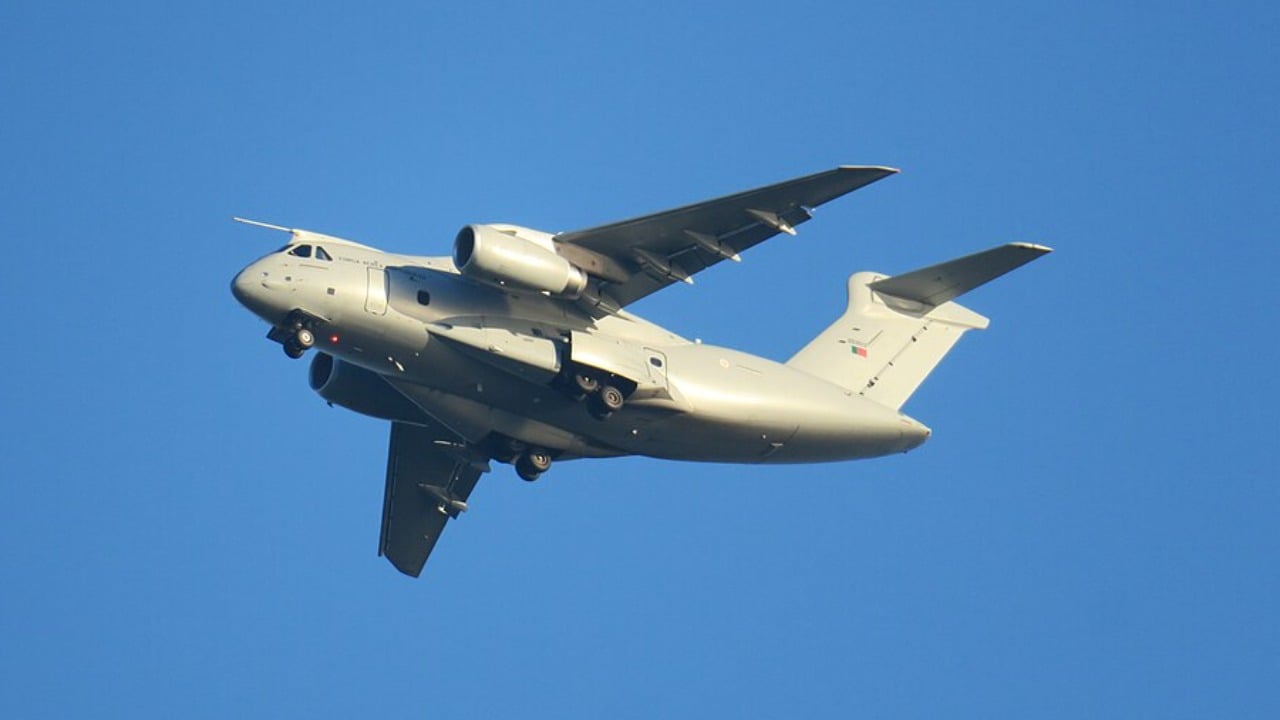
Athens signed the paperwork on Monday, and with it the Hellenic Air Force finally got an answer to a question it had been dodging for most of a decade: what replaces the Hercules?
The answer is Brazilian, routed through Lisbon. Greece has ordered three Embraer KC-390 Millennium multi-role transports, with options on three more, in a government-to-government deal in which Portugal buys the aircraft from Embraer and sells them on. The first is due in 2027. Portugal’s Council of Ministers cleared just under €590 million before tax in October to make it work, every euro of it Greek money.
It is a small order by the standards of Greek rearmament, and a significant one by the standards of European airlift. It gives Greece a transport fleet that is not falling apart, and it gives the Hellenic Air Force something it has never owned: its own aerial tanker.
Kurzinfo
Flugzeug: Embraer KC-390 Millennium
Befehl: three firm, options for three more
Unterzeichnet: 2 November 2026, Athens
Route: government-to-government through Portugal
Value: just under €590 million before tax, funded by Greece
Erste Lieferung: 2027
Ersetzt: Hellenic Air Force C-130B and C-130H Hercules
Nutzlast: up to 26 tonnes; up to 19 tonnes air-dropped
Motoren: two IAE V2500-E5 turbofans
Tanker fit: two wing hose-and-drogue pods, up to 1,500 litres a minute
A Brazilian Airlifter With a Portuguese Passport
The mechanics of this deal matter more than the headline number, because they explain how a country gets an aircraft in 2027 that it only decided to buy in 2026. Greece is not buying from Embraer. It is buying from Portugal, which already operates the type and which holds options on a further batch of production slots at Embraer’s Brazilian plant. Three of those slots have been handed to Athens.
That is a genuinely short delivery timeline for a military transport, and Embraer has not said which airframes are involved or whether an aircraft earmarked for somebody else has been reassigned. What is clear is that without Lisbon in the middle, Greece would be waiting years rather than months.
The money breaks down roughly as follows: about €533 million plus VAT for the three aircraft and an initial logistics support package from Embraer and its Portuguese arm, and a further €57 million for electronic warfare equipment, crew and technician training, sustainment, technical assistance in Greece, and programme management. Greek crews are expected to start converting at Beja Air Base in Portugal, where the Portuguese Air Force flies its own fleet.
Embraer’s own footage of the KC-390 working from unprepared desert strips, the capability Greece is buying into.
What Greece Is Actually Replacing
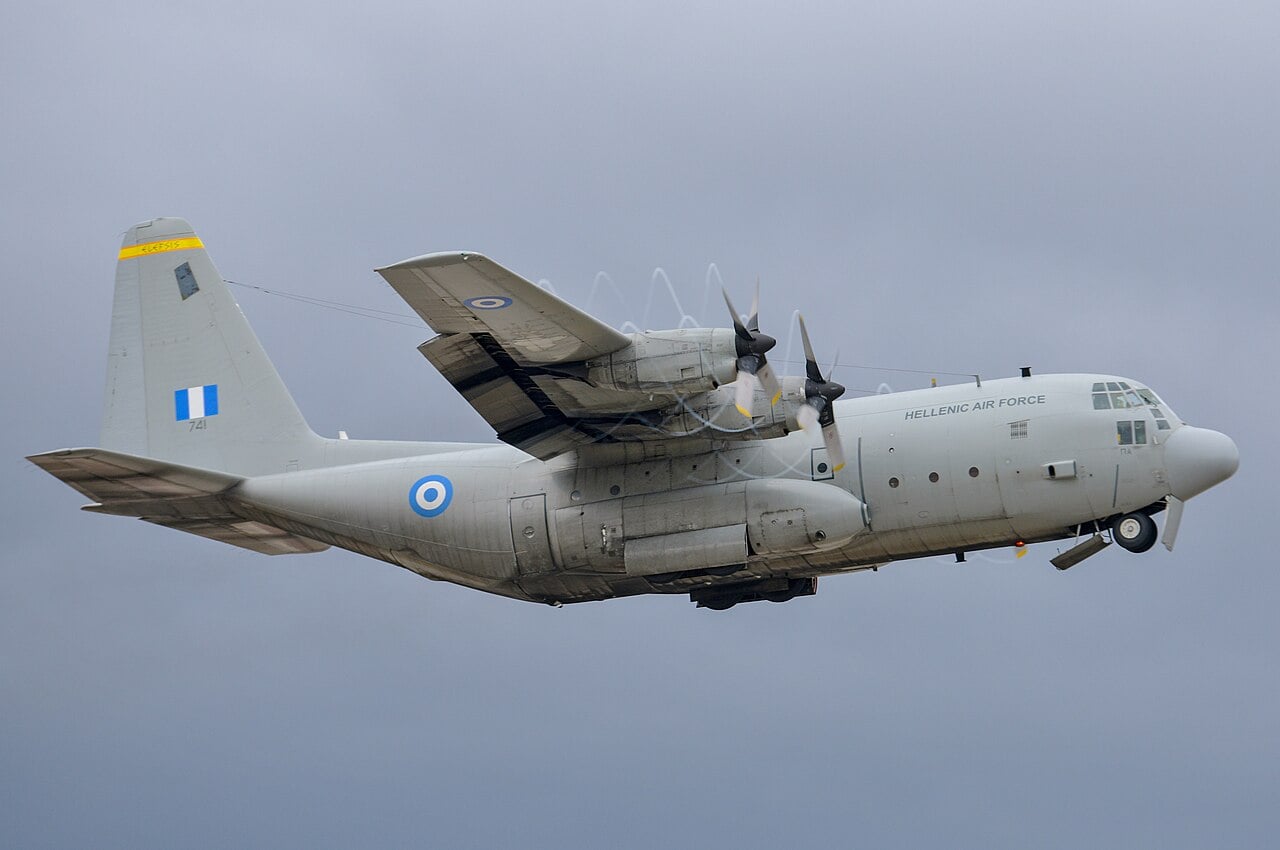
The Hellenic Air Force has been flying C-130 Hercules since 1975, and over the years took delivery of close to twenty of them in C-130B and C-130H form. The survivors are now between forty-five and fifty years old, and they show it: fatigue inspections, corrosion treatment, lengthening depot visits and a thinning supply of parts for an airframe generation the rest of the world is retiring.
How thin it got is the part Greeks will remember. Defence Minister Nikos Dendias told parliament in November 2025 that five Hercules were serviceable, and that this was an improvement, because the fleet had at one point been down to a single flyable aircraft. Independent reporting through 2025 and 2026 puts availability somewhere between four and seven airframes. For a country whose territory is a few hundred inhabited islands and whose standing commitments include Cyprus, that is not an airlift fleet. It is an airlift problem.
Greece looked at the obvious fixes and rejected them. Retired American C-130s were offered and turned down, because the refurbishment bill exceeded what the airframes would have been worth afterwards. New-build C-130J Super Hercules were studied and lost. The KC-390 carries 26 tonnes, more than even the stretched C-130J-30, and it does it on two turbofans rather than four turboprops.
The Tanker Half, and the F-16 Question
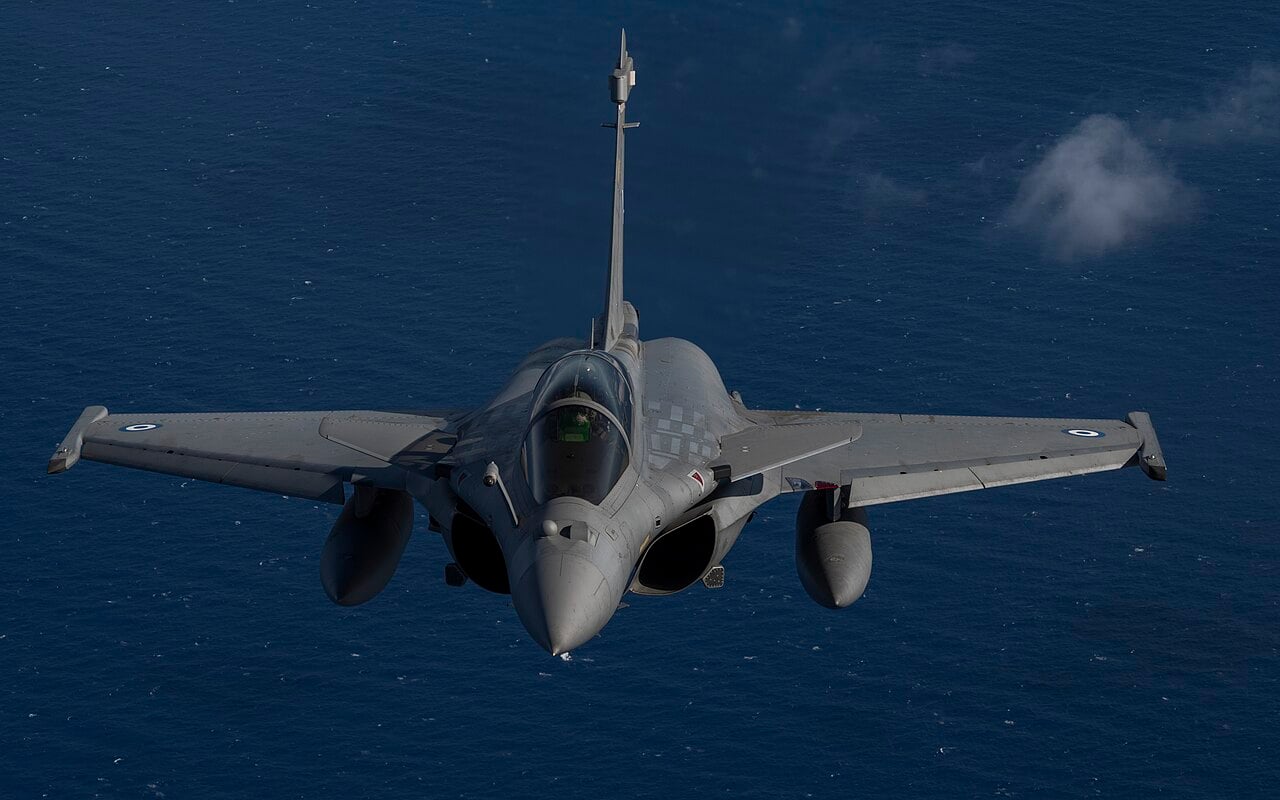
The letters in front of the designation are the interesting part. Greece is buying the KC-390, the tanker-capable configuration, which carries two removable hose-and-drogue pods under the wings. Embraer publishes a transfer rate of up to 1,500 litres a minute, drawn from an internal fuel load of around 35 tonnes, at receiver speeds between 120 and 300 knots and altitudes from 2,000 to 32,000 feet. The Hellenic Air Force has never had that. Until now, Greek fighters needing fuel in the air have needed somebody else’s tanker.
A hose and drogue works with a probe, which is why the first beneficiaries are the Rafale und die Mirage 2000. Dendias has indicated that the F-16 would follow roughly a year later, and that is where the story gets less tidy. The F-16 is a boom receiver: it takes fuel through a receptacle behind the cockpit, not a probe, and no amount of drogue will help it. Embraer is developing a boom for the KC-390, and has a memorandum of understanding with Northrop Grumman on an autonomous version, but no boom-equipped KC-390 is in service with anyone today.
So the honest version is this: Greece gets organic tanking for its Dassault fleet from the outset, and the F-16 part depends on hardware that is still a development programme. Nobody has published a contract for a Greek boom. Treat the one-year figure as a ministerial intention rather than a delivery date.
Seventh in Europe, Sixth in NATO
Embraer counts Greece as the seventh European customer for the type, after Portugal, Hungary, the Netherlands, Austria, the Czech Republic and Sweden. Six of those seven are NATO members, Austria being the neutral exception, which is why the same announcement is also being read in Brasilia as a sixth alliance sale. Outside Europe the list runs Brazil, South Korea, the United Arab Emirates, Uzbekistan and Colombia. The Brazilian Air Force, the launch customer, has ordered nineteen.
For a European observer the pattern is hard to miss. A Brazilian airframe, assembled with a large Portuguese industrial content, has quietly become the default replacement for the Hercules across a continent that spent two decades arguing about the A400M. Each sale makes the next one easier, because the support network, the training pipeline and the spares pool all thicken.
Greece intends to take its share of that. Embraer and Hellenic Aerospace Industry signed a maintenance and support agreement earlier in 2026, and Greek reporting puts domestic participation at no less than a quarter of the programme. Airframe and engine work is meant to move to HAI rather than stay abroad, which is the part of any procurement that outlives the aircraft.
What the deal does not do is solve everything. Greece still flies eight C-27J Spartans, which are due an upgrade of their own, and three airlifters is a thin fleet for a country with Greece’s geography. The option for three more exists precisely because everyone involved knows it. Athens has bought itself a fleet that works. Whether it has bought enough of one is a question for the next defence budget.
A walk through what the C-390 Millennium is and why it keeps winning Hercules replacement competitions.
Sources: The Aviationist, AeroTime, Aviacionline, Air Data News, Defence Industry Europe, Army Recognition, Embraer.

0 Comments