
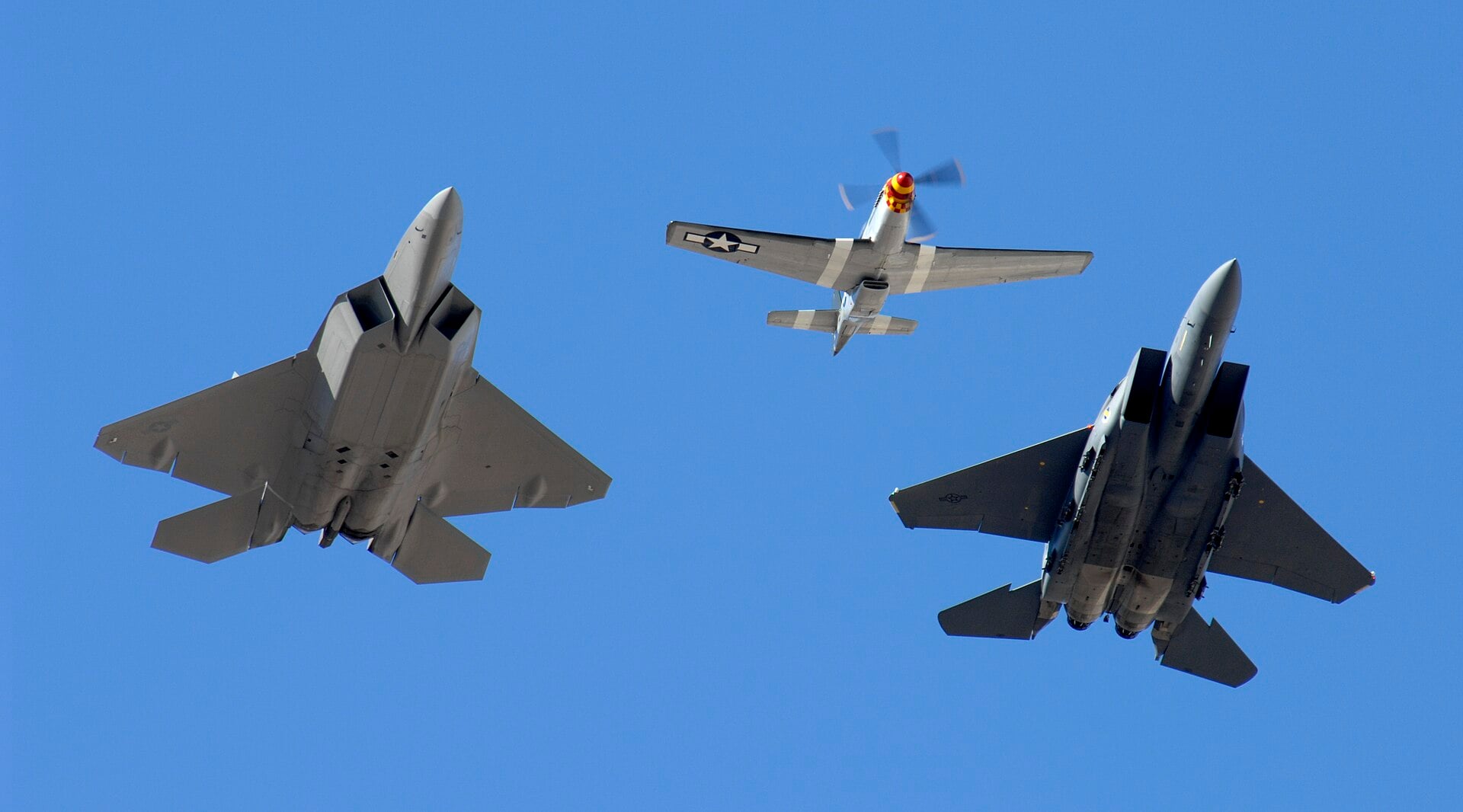
A P-51 Mustang pulls up off the crowd line at an American air show, rolls inverted at the top of the climb, and the Merlin rearranges something in your chest. Somewhere in that cockpit is a certificate. It is not the certificate a Cessna carries.
A Cessna 172 holds a standard airworthiness certificate, FAA Form 8100-2, and it holds it because the aeroplane conforms to a type certificate the FAA approved decades ago. A Mustang conforms to nothing the FAA ever approved. North American built it for the Army Air Forces, to a military contract and military specifications, and no civil type certificate was ever issued for it. Strictly speaking, there is no legal standard for the aircraft to meet.
So the Mustang flies on a special airworthiness certificate, FAA Form 8130-7, in the experimental category. Written on the face of it is a single word that does all the work: exhibition. Understand that word and you understand how several thousand former military aircraft stay legal in American skies — and why the paragraph of the regulation that sounds like it was written for them is the one they cannot use.
Quick Facts: the experimental exhibition certificate
The regulation: 14 CFR 21.191(d), one of twelve experimental purposes
What it covers: air shows, motion picture and television productions, maintaining exhibition proficiency, and flying to and from those events
The certificate: FAA Form 8130-7, Special Airworthiness Certificate — not the Form 8100-2 a type-certificated aeroplane carries
Durata: unlimited, unless the FAA establishes a specific period for good cause (14 CFR 21.181(a)(5))
The application: 14 CFR 21.193, submitted as a program letter naming events, dates and routes
Operating rules: 14 CFR 91.319 — purpose-limited, day VFR unless authorised, no densely populated areas unless authorised
Il trucco: no passenger may be carried during the display itself unless essential to the flight
An experimental certificate is really twelve certificates
Section 21.191 of 14 CFR opens with a sentence that is easy to skim past: “Experimental airworthiness certificates are issued for the following experimental purposes.” Then it lists twelve of them, lettered (a) through (l). Research and development. Showing compliance with regulations. Crew training. Air racing. Market surveys. Amateur-built aircraft. Light-sport aircraft in three flavours. And exhibition.
This is the part most people miss. There is no such thing as “an experimental certificate” in the abstract. There is a certificate issued for a named purpose, and 14 CFR 91.319(a)(1) makes the point bluntly: no person may operate an aircraft holding an experimental airworthiness certificate “for other than the purpose for which the certificate was issued.” A warbird certificated for exhibition that goes air racing is not a warbird bending a rule. It is an aircraft being operated outside its certificate.
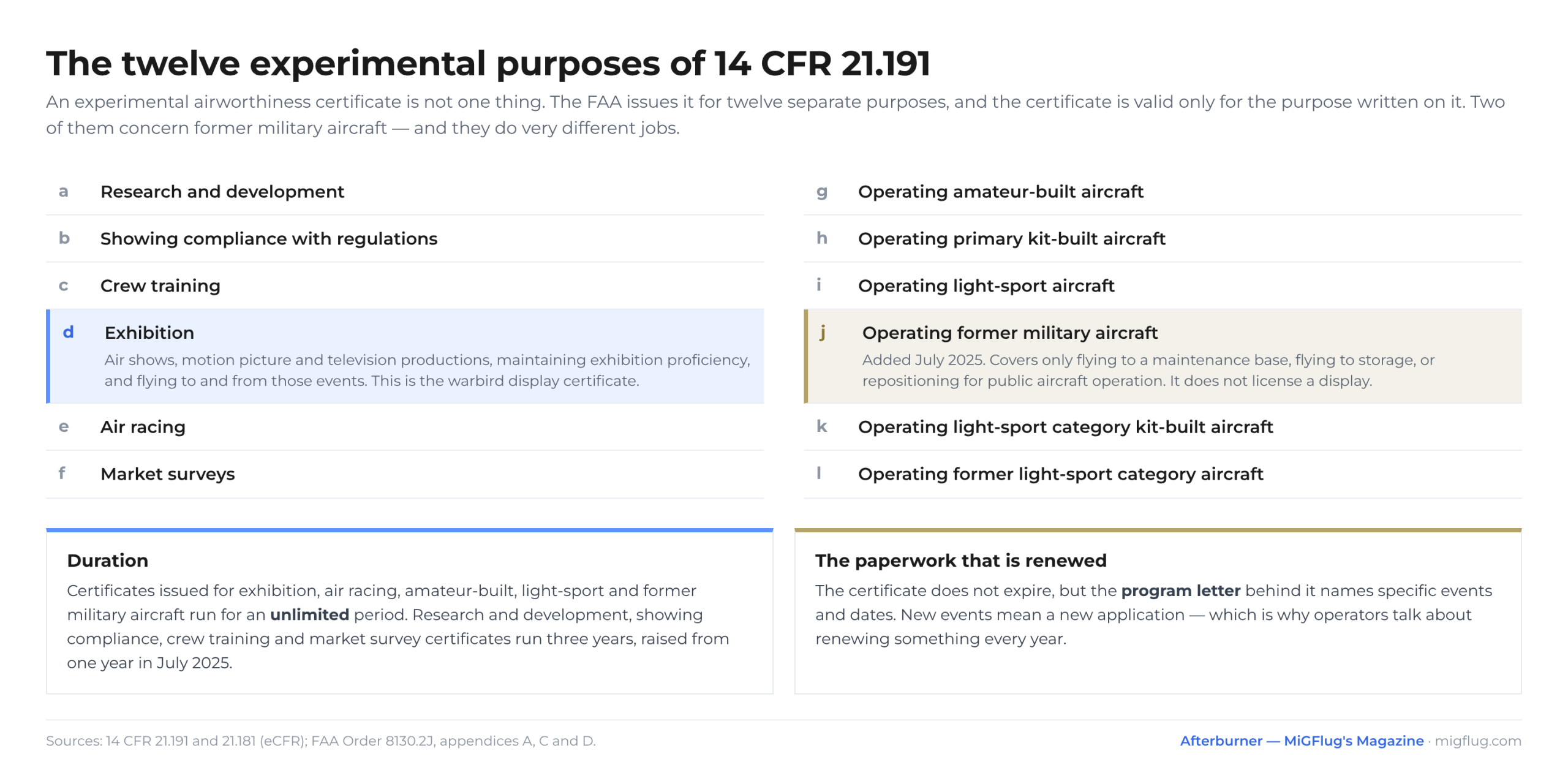
Paragraph (d) reads, in full: “Exhibition. Exhibiting the aircraft’s flight capabilities, performance, or unusual characteristics at air shows, motion picture, television, and similar productions, and the maintenance of exhibition flight proficiency, including (for persons exhibiting aircraft) flying to and from such air shows and productions.”
Forty-four words. That sentence is the legal foundation of the entire American warbird movement — every Fortezza volante B-17 on the summer circuit, every T-33 Stella Cadente in a civilian paint scheme, every MiG-15 Fagot that someone imported and put back in the air. Note what it includes almost as an afterthought: maintaining proficiency, and the transit flights. Without those two clauses a display pilot could legally fly only the display itself, which would be the least safe arrangement imaginable.
Paragraph (j) is not the warbird paragraph
On 24 July 2025 the FAA published its Modernization of Special Airworthiness Certification rule — MOSAIC, Amendment 21-109, at 90 FR 35207 — and rewrote large parts of Part 21. Among the changes, 21.191 gained three new paragraphs. One of them is headed “Operating former military aircraft.”
If you were going to guess which paragraph licenses a Mustang at Oshkosh, you would guess that one. You would be wrong, and the regulation says so in detail. Paragraph (j) applies to an aircraft that is not unmanned, that was manufactured by, purchased by, modified by, or on the registry of the US Armed Forces or a foreign military — and then restricts what you may actually do with it to three things: flying to a base where repairs, alterations or maintenance are to be performed, plus check flights afterwards; flying to a point of storage; and repositioning the aircraft for operation as a public aircraft.
Ferry, park, hand over. Not one of the three is a display. Paragraph (j) is a logistics certificate for aircraft in transition, and an operator who wants to fly a former military aircraft in front of a crowd still applies under paragraph (d), exactly as they did before July 2025.
AOPA’s explainer on the MOSAIC rule is a useful tour of what else changed in special airworthiness certification last year, most of it aimed at the light-sport world rather than the warbird one.
The thing that expires is not the certificate
Ask around a warbird ramp and someone will tell you the exhibition certificate has to be renewed every year. Ask the regulation and you get the opposite answer.
That matches 14 CFR 21.181(a)(5), which lists exhibition alongside air racing, amateur-built, kit-built, light-sport and former military aircraft as unlimited in duration. The three-year clock that MOSAIC introduced — raised from one year — applies to research and development, showing compliance, crew training and market survey certificates. Exhibition is not among them.
So why does everyone talk about renewing? Because of the document behind the certificate. Section 21.193 requires an applicant to submit the experimental purpose, enough information to describe the operation, the estimated time or number of flights, the areas over which flights will be conducted, enough data to identify the aircraft, three-view drawings or photographs unless the aircraft is previously type certificated without appreciable external change, and anything else the FAA finds necessary to safeguard the general public.
The paper that carries all of that is the program letter, and Order 8130.2J is specific about what an exhibition program letter should contain: event names and dates for the events at which the aircraft will be exhibited, proposed routes of flight to and from those events, and for proficiency and maintenance flights, the estimated number of flight hours and the intended area and airports. The order’s own guidance adds that to add new projects, the applicant should submit a new application.
Which is the whole answer. The certificate does not expire. The list of air shows you named in 2025 does. Both halves of the hangar folklore are half right.
One owner filmed the process of moving his aircraft into the experimental exhibition category, program letter and all. It is not a glamorous film, and that is rather the point.
You may not carry a passenger during the display
Here is the clause that surprises people who have never read their own operating limitations. The FAA publishes a standard set of limitations for each experimental purpose in Appendix D of Order 8130.2J, and the one attached to paragraph (d) aircraft reads:
The same limitation then gives back what it just took: persons may be carried during flights to and from any event, or during proficiency and currency flying, limited to the design seating capacity of the aircraft and subject to the regulatory prohibition on compensation. A two-seat warbird can carry someone to the show and home again. During the eight minutes in front of the crowd, the back seat stays empty unless the person in it is essential to the flight.
The rest of 91.319 is in the same spirit. Day VFR only, unless the Administrator specifically authorises otherwise. No flight over a densely populated area or in a congested airway, unless the operating limitations say otherwise — which, for a display operator, is exactly what those limitations are negotiated to permit, inside an agreed box over an agreed airfield. And every person carried must be advised of the experimental nature of the aircraft, which is a sentence worth reading twice before you climb into a seventy-year-old jet.
So how is a warbird ride legal at all?
If the exhibition certificate bars passengers during a display, and 91.319(a)(2) bars carrying persons for compensation or hire in operations that would require an air carrier or commercial operator certificate under Part 119, then on the face of it nobody can sell a seat in a B-17. And a B-17 can never hold a Part 119 certificate, because the certificate the aircraft itself holds is not a standard one.
The FAA’s answer is not a rule. It is an exemption, granted operator by operator, and it has a name: the Living History Flight Experience.
FAA Notice N 8900.604, effective 22 November 2021, is the guidance inspectors use to oversee the operators who hold one. It describes the exemptions as permitting carriage of persons for compensation in aircraft holding limited or experimental category airworthiness certificates, for what it calls historically significant, former military aircraft providing short in-flight experiences. Then it draws the boundary with unusual precision:
Read that carefully, because it is the whole shape of the thing. The exemption does not loosen the operating limitations. It does not turn the aircraft into an airliner. It lifts exactly one bar — the one that says you may not operate contrary to the aircraft’s operating limitations when money changes hands — and leaves every other restriction standing. The notice says so again in its own words: regulatory relief extends only to those regulations specifically identified in each individual exemption.
The notice also records why it exists. It replaced earlier guidance after a fatal B-17 accident in 2019, and it obliged every FAA office overseeing an LHFE holder to survey that holder before the end of 2021. The underlying policy, including which aircraft the agency generally considers eligible, was published on 21 July 2015 at 80 FR 43012. The history is worth knowing: the FAA imposed a moratorium on new exemptions of this kind in 2011, and the 2015 policy is what reopened the door under conditions.
What all this looks like from the passenger seat
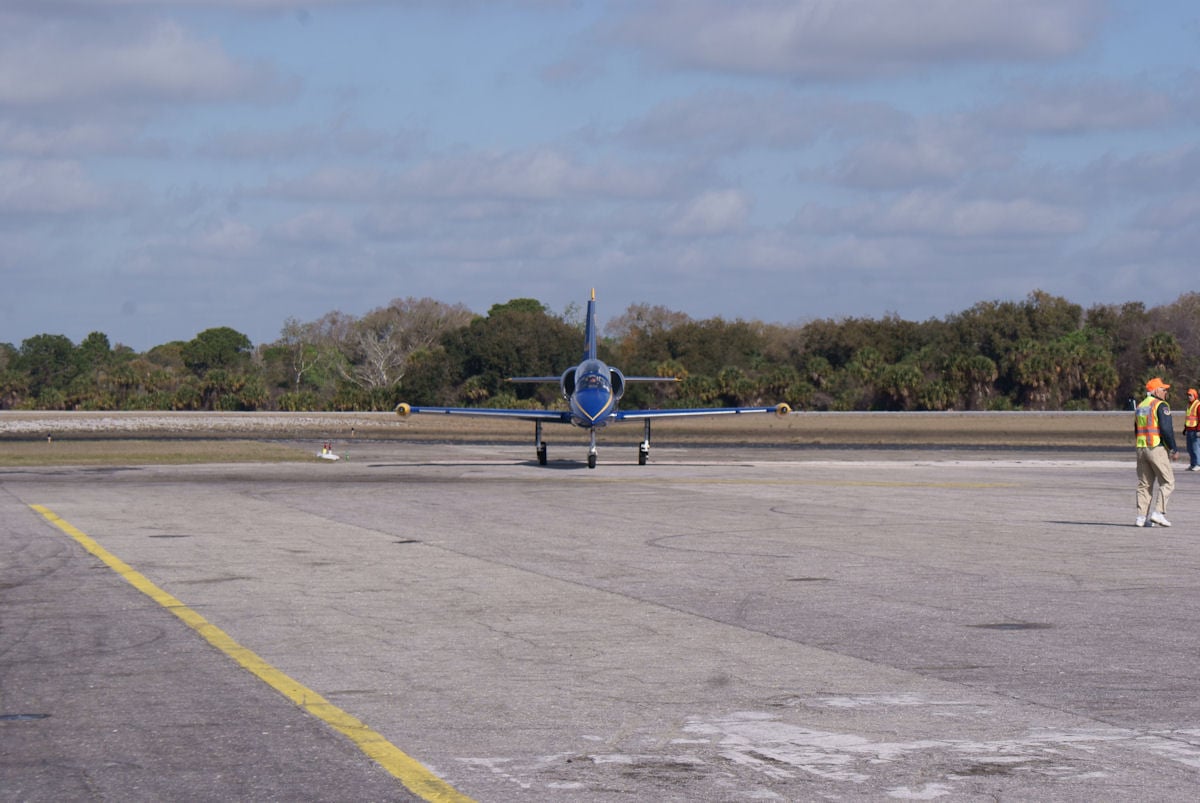
Walk a warbird ramp in Florida and the paperwork is invisible, which is the point. What you see is a Czechoslovak jet trainer with a civil registration on the tail, a canopy up, and a queue. What is holding the whole arrangement together is a certificate issued for a purpose, a set of operating limitations tailored to that aircraft, and — the moment somebody pays — a separate grant of relief with its own conditions attached.
That pattern is not unique to the United States. Europe reaches the same place by a different route, through a permit to fly whose flight conditions are approved before the permit is issued, which is the subject of our companion piece on special flight permits and permits to fly. What is distinctively American is the elegance of the trick: rather than inventing a warbird category, the FAA took a certificate designed for test aircraft, attached a purpose to it, and let an entire preservation movement grow up inside the gap.
For anyone whose curiosity runs past the regulation and into the hangar bill, this walkthrough of what an L-39 actually costs to own in the United States is a sobering companion piece.
The paradox is worth keeping hold of. A Mustang at an American air show is not an uncertificated aeroplane flying on goodwill. It holds a certificate — a real one, issued by the FAA, with operating limitations that are part of the certificate and must be carried in the aircraft. It simply holds a certificate issued for a purpose rather than against a standard. And the purpose, written into Part 21 decades ago and barely touched since, is to be looked at.
Sources: 14 CFR 21.181, 21.191, 21.193 and 91.319 (eCFR, current as of October 2026); FAA Order 8130.2J, Airworthiness Certification of Aircraft, 21 July 2017, appendices A, C and D and chapter 12; FAA Notice N 8900.604, Living History Flight Experience, effective 22 November 2021; FAA final rule, Modernization of Special Airworthiness Certification, Amendment 21-109, 90 FR 35205, 24 July 2025; FAA policy on Living History Flight Experience exemptions, 80 FR 43012, 21 July 2015.



0 Comments