
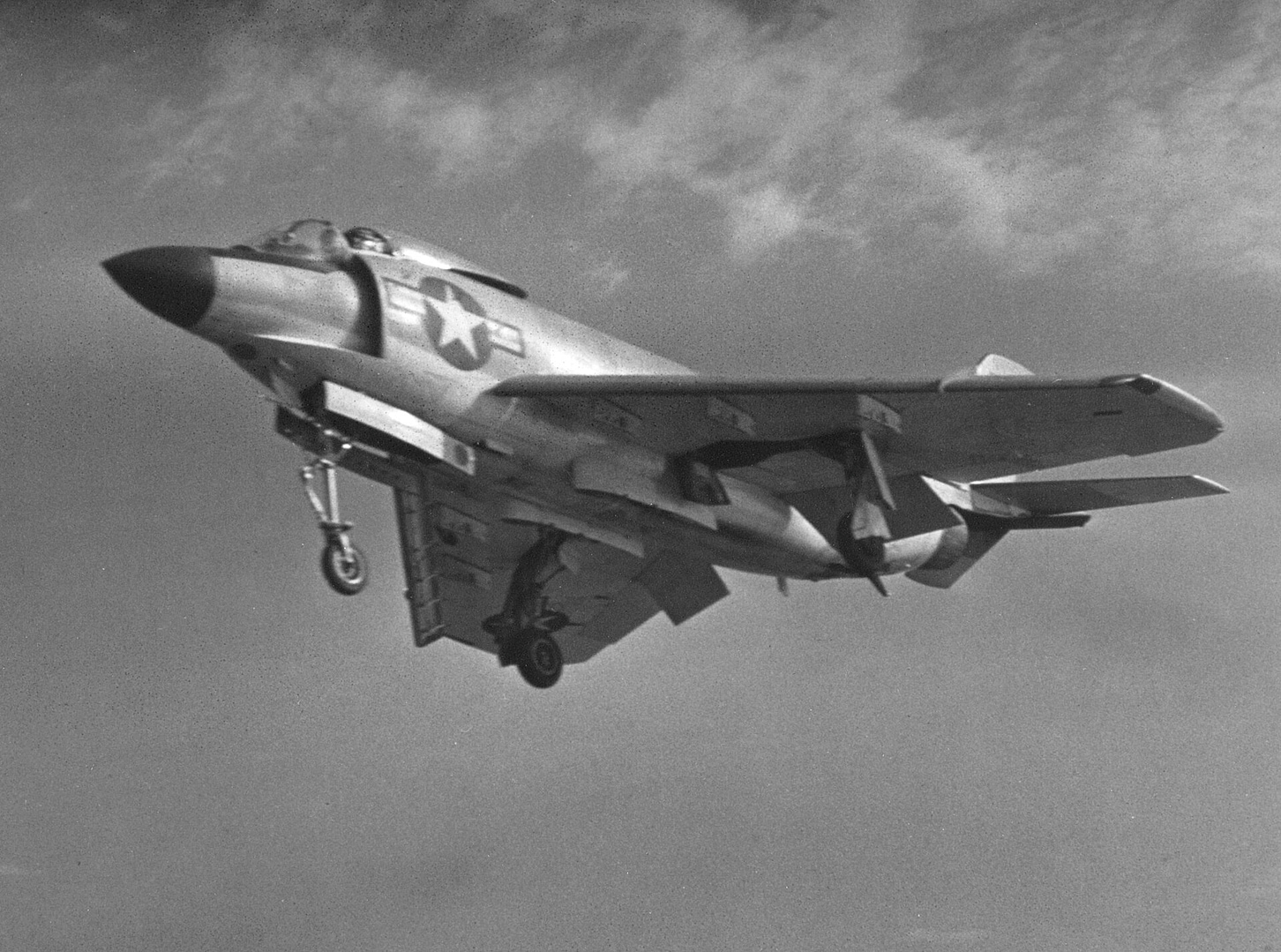
McDonnell F3H Demon
The US Navy’s swept-wing, all-weather missile interceptor — nearly killed in the cradle by a disastrous engine, reborn with a new one, and the direct design ancestor of the immortal F-4 Phantom II.
The interceptor its engine nearly killed
By the end of the Korean War the US Navy knew its straight-winged jets were falling behind. In 1949 it had already asked McDonnell Aircraft for a fast, swept-wing carrier fighter, and the St Louis firm answered with the F3H Demon — a sleek, single-engine interceptor with a 35° swept wing that first flew on 7 August 1951. On paper it was exactly what the fleet needed. In practice it was about to become one of naval aviation’s great cautionary tales.
The Demon had been designed around the Westinghouse J40, an engine the Navy expected to power a whole generation of aircraft. The J40 was a catastrophe: it never came close to its promised thrust and was chronically unreliable. The early F3H-1N Demons that flew on it suffered a string of crashes — roughly six aircraft and four pilots lost, eight of thirty-five airframes wrecked in major accidents — and the type was grounded. Some Demons were barged, not flown, to shore stations; the whole first production batch was written off. The fiasco helped trigger Congressional scrutiny of Navy engine procurement.
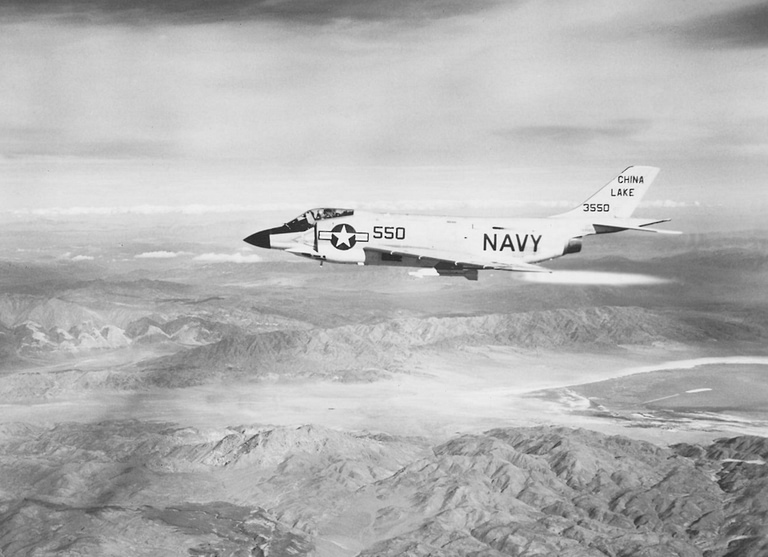
What saved the Demon was a new heart. McDonnell reworked the airframe around the Allison J71, and the re-engined F3H-2 reached the fleet in March 1956. It became the Navy’s standard carrier-based all-weather interceptor, one of the service’s first fighters built to fight primarily with guided missiles — the AIM-7 Sparrow and AIM-9 Sidewinder — alongside day fighters like the F-8 Crusader. Subsonic and single-engined, it was overtaken quickly and retired in 1964. But its real legacy was already flying: the F-4 Phantom II was conceived as an advanced development of the Demon.
01The McDonnell F3H Demon’s origins: a swept-wing carrier interceptor built around a doomed engine
The Demon grew out of a 1949 US Navy requirement for a high-performance, swept-wing carrier fighter to succeed McDonnell’s own straight-winged F2H Banshee. The company delivered an aerodynamically clean, single-engine interceptor with a 35° swept wing fitted with leading-edge slats and trailing-edge flaps for carrier work. The XF3H-1 first flew on 7 August 1951 with McDonnell test pilot Robert Edholm at the controls.
The fatal decision was propulsion. The Navy directed that the Demon be built around the Westinghouse J40, a turbojet still in development and backed heavily by the service. When the J40 failed to deliver, the whole programme — a sound airframe — was dragged to the edge of cancellation before the switch to the Allison J71 rescued it. The Demon is a textbook case of a good aircraft nearly undone by an engine chosen for it.
What makes it special
A swept-wing, all-weather carrier interceptor
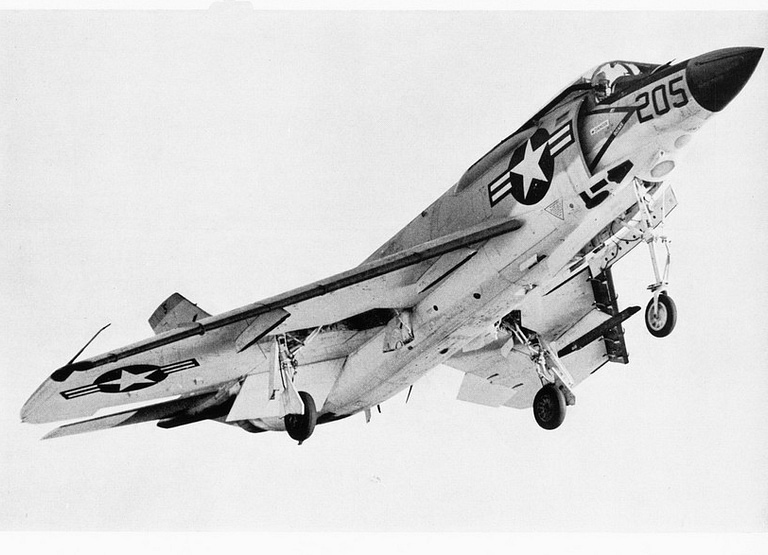
The Demon paired a 35° swept wing — the same sweep as the F9F Cougar — with leading-edge slats, trailing-edge flaps and a nose radar for genuine all-weather interception from a carrier deck. It gave the Navy a modern, radar-equipped interceptor to stand air-defence alert at sea, a clear generation beyond the straight-winged Banshees and Panthers it replaced.
The engine that nearly ended it — and the one that saved it
Designed around the Westinghouse J40, the Demon was crippled when that engine failed to deliver its promised thrust and proved deadly unreliable. McDonnell re-engined the airframe with the Allison J71-A-2 (~14,400 lb with afterburner — some 3,000 lb more than the J40 ever gave), which required a longer fuselage and bigger intakes. The J71 turned a death-trap into a workable fleet interceptor.
Built to fight with guided missiles
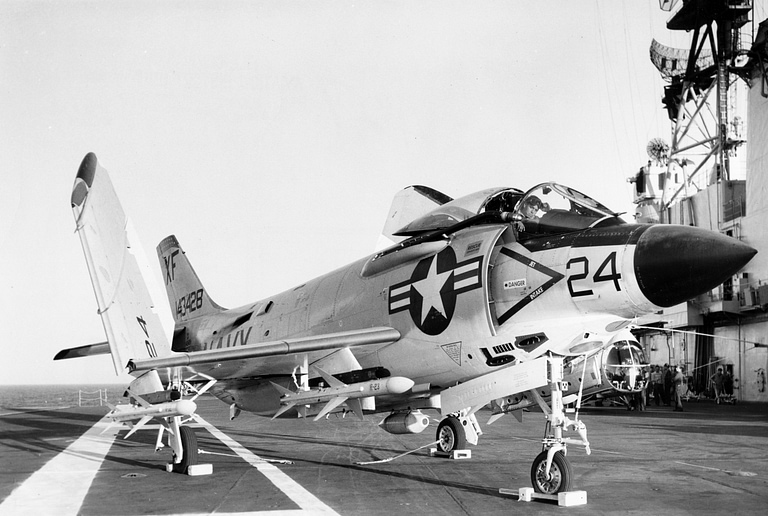
The Demon was among the first US Navy fighters designed to fight primarily with missiles. The F3H-2M carried the radar-guided AAM-N-2 / AIM-7 Sparrow, and the type also carried the AIM-9 Sidewinder, backed by four 20 mm cannon. It pointed straight at the missile-armed, all-weather interception doctrine the F-4 Phantom II would perfect.
02The F3H Demon’s engine saga: the Westinghouse J40 that never delivered
Like several early-1950s Navy jets — including the F7U Cutlass — the Demon was designed around the Westinghouse J40, an engine the Navy expected to standardise across a generation of aircraft. It proved chronically underpowered and unreliable, one of the great engine fiascos of the era. On the J40, early F3H-1N Demons suffered repeated flame-outs and accidents; roughly six aircraft and four pilots were lost and the type was grounded, with the entire first production batch effectively written off. The programme survived only by re-engining with Pratt-era rival Allison’s J71 — a rescue that cost time, money and a black eye for Navy procurement.
03The F3H Demon’s legacy: how it fathered the F-4 Phantom II
The Demon’s greatest achievement was not what it did but what it led to. McDonnell used everything it learned building an all-weather, missile-armed carrier interceptor to design its successor. The F-4 Phantom II began life as an advanced development of the Demon — the aircraft the Demon “wanted to be” but could not, held back by a single engine and limited power. Where the Demon had one J71 and was firmly subsonic, the Phantom used two mighty General Electric J79s for reliability and Mach-2 speed. In a real sense the Phantom is a twin-engined, supercharged Demon — and it became the defining Western fighter of the Cold War.
Full specifications
Figures are for the production F3H-2 (redesignated F-3B in 1962) with the Allison J71 engine. Sources differ slightly on a few values — these are the most commonly cited; contested figures are flagged.
Airframe & Performance
- צוות
- 1
- מֶשֶׁך
- ~17.96 m (58 ft 11 in)
- מוּטַת כְּנָפַים
- ~10.77 m (35 ft 4 in)
- גוֹבַה
- ~4.45 m (14 ft 7 in)
- Wing sweep
- 35°
- משקל ריק
- ~10,040 kg (22,133 lb)
- Max takeoff weight
- ~15,377 kg (33,900 lb)
- Max speed
- ~Mach 0.95 · ~716 mph (1,152 km/h)
- תקרת השירות
- ~13,000 m (~42,000 ft; some sources ~35,000 ft)
Propulsion, Armament & Cost
- מָנוֹעַ
- 1 × Allison J71-A-2 turbojet
- Thrust
- ~14,400 lb (~64 kN) with afterburner
- הְתחַמְשׁוּת
- 4 × 20 mm cannon + AIM-7 Sparrow / AIM-9 Sidewinder
- לָנוּעַ
- ~1,900 km (~1,180 mi)
- First flight
- 7 August 1951 (XF3H-1)
- Number built
- 519
- Unit cost
- Not reliably documented
- Cost per flight hour
- No reliable public figure
04The F3H Demon’s operating costs: why no reliable figure exists
The Demon was a mid-1950s US Navy programme retired in 1964, long before the era of published life-cycle cost data, and no consistent period flyaway unit price appears in the open record. Any precise dollar figure attached to the type today should be treated as an estimate rather than a sourced number. There is likewise no reliable cost-per-flight-hour figure for the F3H in open sources — unsurprising for an aircraft that left service more than sixty years ago.
From great hope to Phantom’s father
Requirement issued
The US Navy asks McDonnell for a swept-wing carrier interceptor to succeed the straight-winged F2H Banshee.
First flight
The XF3H-1 prototype flies on 7 August with test pilot Robert Edholm, built around the Westinghouse J40 engine.
The J40 disaster
Early F3H-1N Demons crash repeatedly on the failing J40; roughly six aircraft and four pilots are lost and the type is grounded.
Re-engined with the J71
McDonnell reworks the airframe around the Allison J71; the first J71-powered Demon flies, saving the programme.
Enters service
The F3H-2 joins the fleet in March, first with squadron VF-14, as the Navy’s all-weather carrier interceptor.
The missile interceptor
The F3H-2M carries the radar-guided Sparrow, making the Demon one of the Navy’s first missile-armed all-weather fighters.
Redesignated F-3
Under the new tri-service system the F3H-2 becomes the F-3B; the type is already being overtaken by faster jets.
Retirement
The last squadron, VF-161, trades its Demons for F-4 Phantom IIs in September — the successor the Demon had sired.
Twelve Demon stories
The Banshee’s swept-wing successor
McDonnell built the Demon to replace its own straight-winged F2H Banshee.
Read the full story
The engine that never showed up
The Demon was built around the Westinghouse J40 — which failed.
Read the full story
Six aircraft, four pilots
The J40-powered F3H-1N Demons crashed so often the type was grounded.
Read the full story
A new heart for the Demon
Re-engining with the Allison J71 turned a failure into a fleet fighter.
Read the full story
A fighter built for missiles
The Demon was among the first US Navy fighters designed to fight with guided missiles.
Read the full story
The father of the Phantom
The F-4 Phantom II began as an advanced development of the Demon.
Read the full story
Just “the Demon”
Unlike many Navy jets, the F3H wore its official name without irony.
Read the full story
The all-weather watch
The Demon stood carrier air-defence alert through the tense late 1950s.
Read the full story
One engine, one risk
The Demon’s single-engine layout made every flame-out a crisis.
Read the full story
Subsonic but capable
The Demon never went supersonic in level flight, but it was a solid gun-and-missile platform.
Read the full story
More than five hundred built
Despite its rocky start, 519 Demons were produced.
Read the full story
Where the Demons rest
Only a handful of Demons survive, in US museums.
Read the full story
The Demon in pictures
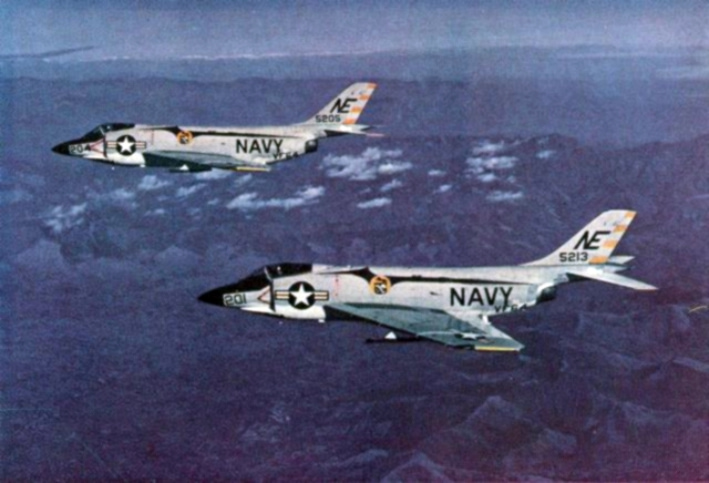
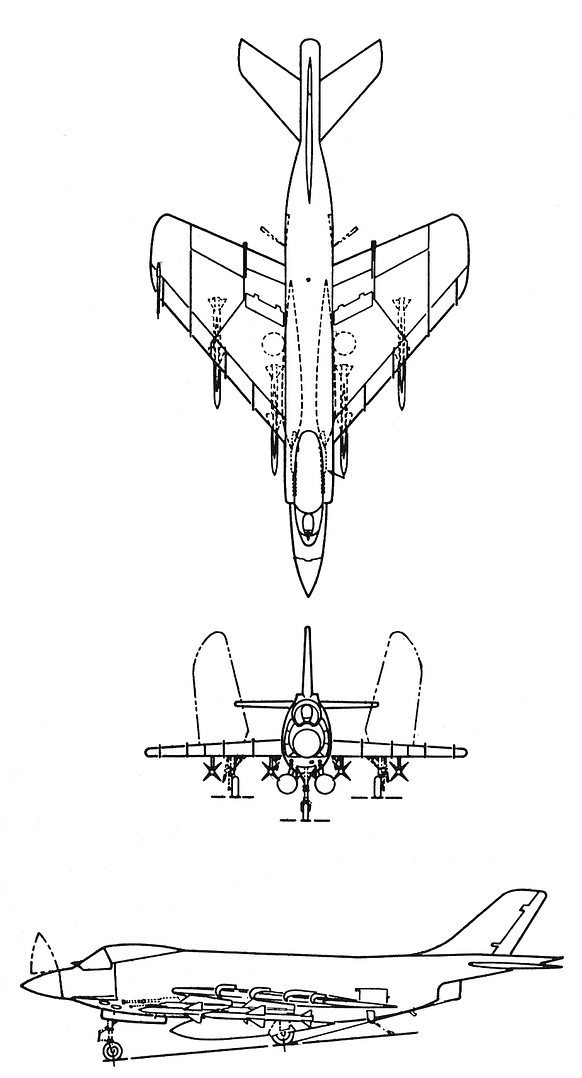
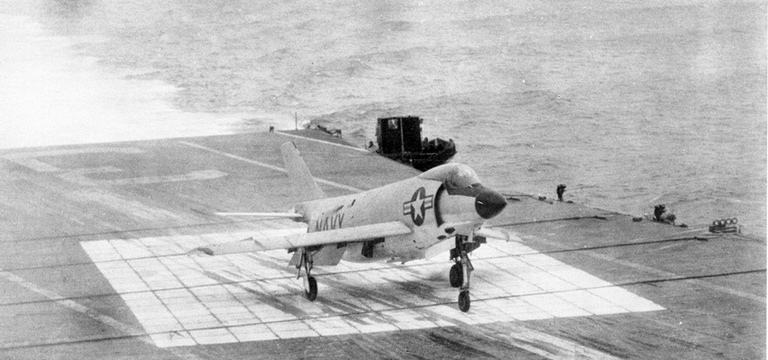
The Demon in motion
A curated video feature for the McDonnell F3H Demon is coming soon. In the meantime, explore the photo gallery above and the operator map below.
Where the Demon flew
Where the record stands
The Demon has no confirmed air-to-air combat record. It was built to intercept high-altitude bombers and stood carrier air-defence alert through the tense late 1950s and early 1960s, but the war it was designed for never came, and it was retired before Vietnam. Its legacy is not written in kills but in doctrine — the missile-armed, all-weather interception it pioneered — and in the aircraft it fathered, the F-4 Phantom II.
Compare the combat record of every military aircraft. Figures as of July 2026.
Everything people ask about the F3H Demon
Can I fly in an F3H Demon?
Why did the F3H Demon have such a bad reputation?
Is the F3H Demon related to the F-4 Phantom II?
Was the F3H Demon supersonic?
What weapons did the F3H Demon carry?
Where can I see an F3H Demon today?
You can’t fly the Demon.
These, you can.
Some legends only live in museums — others are fuelled and waiting. MiGFlug has put civilians in real military jet cockpits since 2004.
 Fly the L-39 AlbatrosThe world’s most-flown jet trainer — aerobatics included
 Fly the F-104 Starfighter“The missile with a man in it”
 Fly the MiG-21The Cold War’s most-produced jet
 טסו על ה-T-33 Shooting StarAmerica’s first jet trainer
 Fly the DH VampireA piece of early jet history
 Fly the S.211Agile Italian jet trainer
 Fly the MB-326The classic Aermacchi jet
 Fly the MiG-15The Soviet legend of the Korean War
Continue the tour
Every fact, checked
- National Naval Aviation Museum — F3H DemonOfficial Navy museum page: role, engine problems, production and the F-4 Phantom lineage.
- Vintage Aviation News — The Forgotten Ancestor of the PhantomDetailed account of the J40 losses, the J71 rescue, armament and Phantom connection.
- Pima Air & Space Museum — McDonnell F3H-2Museum specification sheet and service summary for the production Demon.
- The Armory Life — F3H DemonNarrative on the J40 fiasco, the 35-degree wing, the J71 switch and Sparrow armament.
- War History Online — Doomed Before It Entered ServiceFeature on the Demon’s troubled development and the engine that nearly killed it.
- Joe Baugher — McDonnell F3H DemonDetailed reference for variants, specifications, engine types and service dates.
- Military Factory — McDonnell F3H DemonCross-checked specification tables and production breakdown.
- Historical Marker Database — F3H-2N DemonConcise service and armament summary from a museum historical marker.