
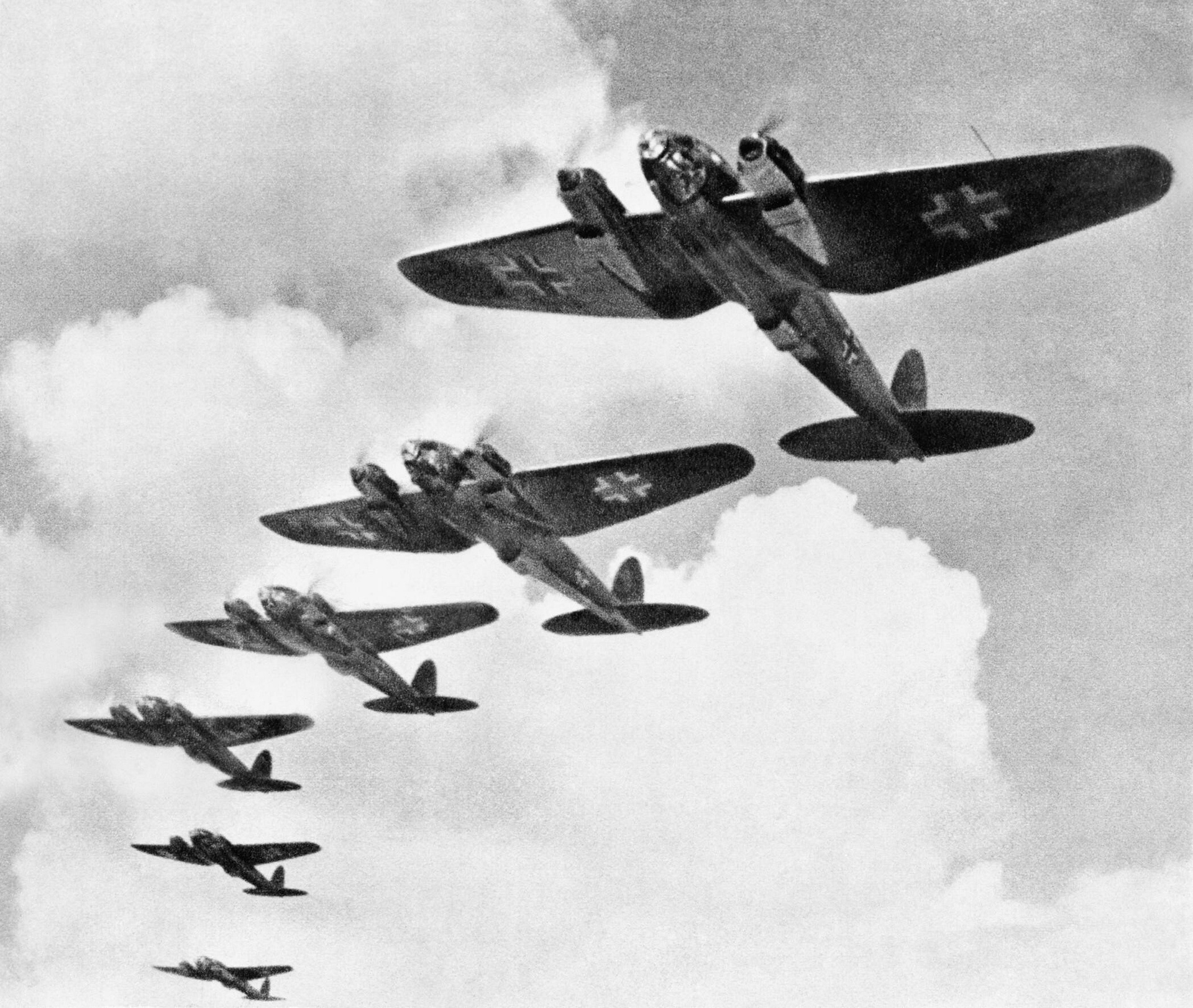
Heinkel He 111
One of the most recognisable aircraft of the Second World War — a medium bomber with a fully-glazed “greenhouse” nose that began life disguised as an airliner, formed the backbone of the Luftwaffe’s bomber arm, and was still being built under licence in Spain decades after 1945.
The Heinkel He 111: the airliner that was always a bomber
When the Heinkel He 111 was unveiled in 1935, Germany presented it to the world as a fast ten-passenger airliner for the state airline Lufthansa. It was nothing of the sort. Designed by the brothers Siegfried and Walter Günter at Ernst Heinkel’s works at Rostock-Marienehe, the aircraft was conceived from the start with a bomber in mind — a way to build combat aircraft while the Treaty of Versailles still formally barred Germany from having an air force. A handful did fly brief commercial routes; the great majority became bombers as soon as the Luftwaffe was openly rearming.
The type was blooded in the Spanish Civil War, where He 111B bombers of the German Condor Legion flew for the Nationalist side from 1937. They were fast enough that opposing fighters rarely caught them, and losses were low — a result that led German planners to a conclusion that would later prove costly: that a fast bomber needed little defensive armament. The definitive versions that followed — the He 111P and the mass-produced He 111H — adopted the aircraft’s signature feature: a smoothly rounded, fully-glazed and slightly asymmetric nose in place of the earlier stepped cockpit, giving the bombardier and pilot an almost uninterrupted forward view.
By 1939 the He 111 was the mainstay of the Luftwaffe bomber force, leading the air campaigns over Poland, France and the Low Countries. Then came the Battle of Britain וה- Blitz. Against Spitfires and Hurricanes the earlier lesson was exposed as an illusion: the He 111 carried a modest bomb load of around two tonnes, cruised slower than the fighters hunting it, and defended itself with hand-aimed rifle-calibre machine guns. Daylight losses mounted until the type was pushed largely into night bombing. Yet the airframe proved endlessly adaptable — serving as a torpedo bomber against Arctic convoys, a transport during the Stalingrad airlift, a tug for heavy gliders (the twin-fuselage He 111Z), and even an airborne launch platform for V-1 flying bombs. Around 6,500 were built before production ended in 1944, and the story did not end there: Spain built the type under licence as the CASA 2.111, some flying into the 1970s and later standing in for their German ancestors on film.
01The He 111’s “greenhouse” nose: why the Heinkel bomber looked the way it did
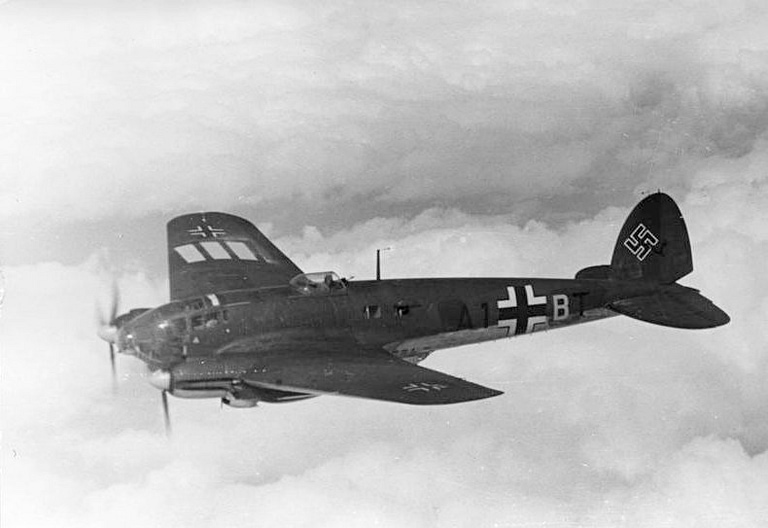
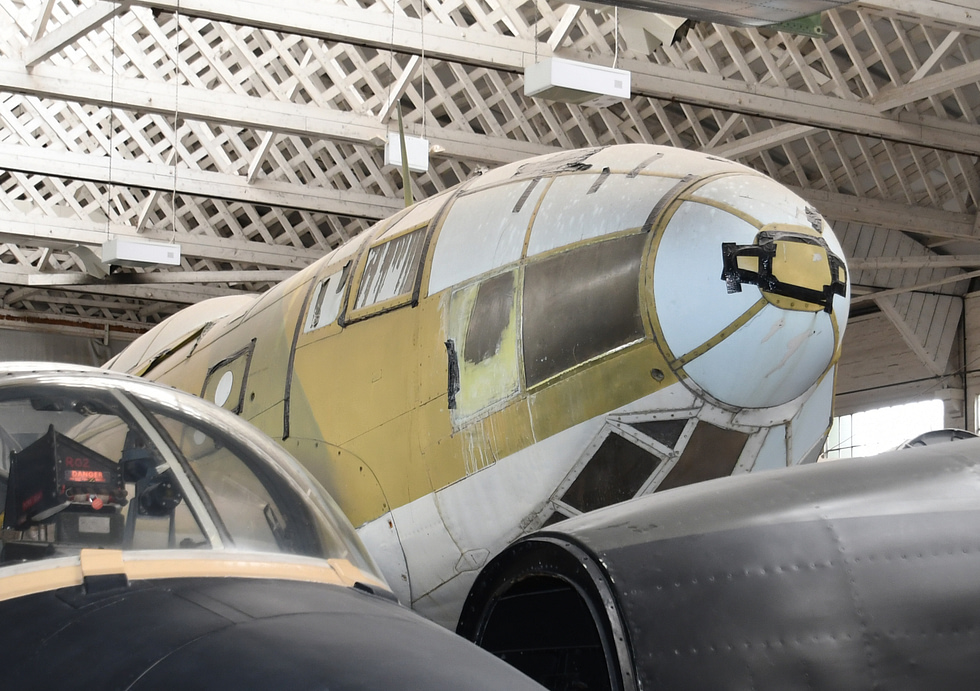
Early He 111 variants (the B and E models used in Spain) had a conventional stepped cockpit with a separate windscreen. From the He 111P of 1938–39, Heinkel replaced it with a fully-glazed, aerodynamically smooth nose that blended straight into the fuselage — the feature that makes the aircraft instantly recognisable. To give the pilot a forward view over the glazing, the design was slightly asymmetric: the pilot sat offset to port, and for take-off and landing he could raise his seat so his head projected through a sliding hatch in the roof. The bombardier lay prone in the nose, and a chin-mounted gondola beneath carried a rearward-firing gun. It was elegant, but it also concentrated the crew in a fragile glass shell — and did little to solve the aircraft’s real weakness, its light defensive armament.
What makes the He 111 special
The fully-glazed asymmetric nose
From the He 111P onward the aircraft wore a smooth, fully-glazed “greenhouse” nose with no separate windscreen step. The layout was deliberately asymmetric — the pilot sat offset to port and could raise his seat to see over the glazing on take-off and landing. The clean nose improved the airflow and gave the bombardier an exceptional view, at the cost of housing the crew in an exposed glass shell.
Twin Jumo power — and a bomber’s hard limits
The definitive He 111H was carried by two Junkers Jumo 211 inverted-V12 engines of around 1,300–1,350 hp each, for roughly 440 km/h. Bombs were stowed nose-up in internal vertical cells or on external racks, to about 2,000 kg. Speed and load were only ever moderate, and the type’s hand-aimed, rifle-calibre defensive guns left it dangerously exposed to modern fighters in daylight.
Longevity and the CASA 2.111 licence
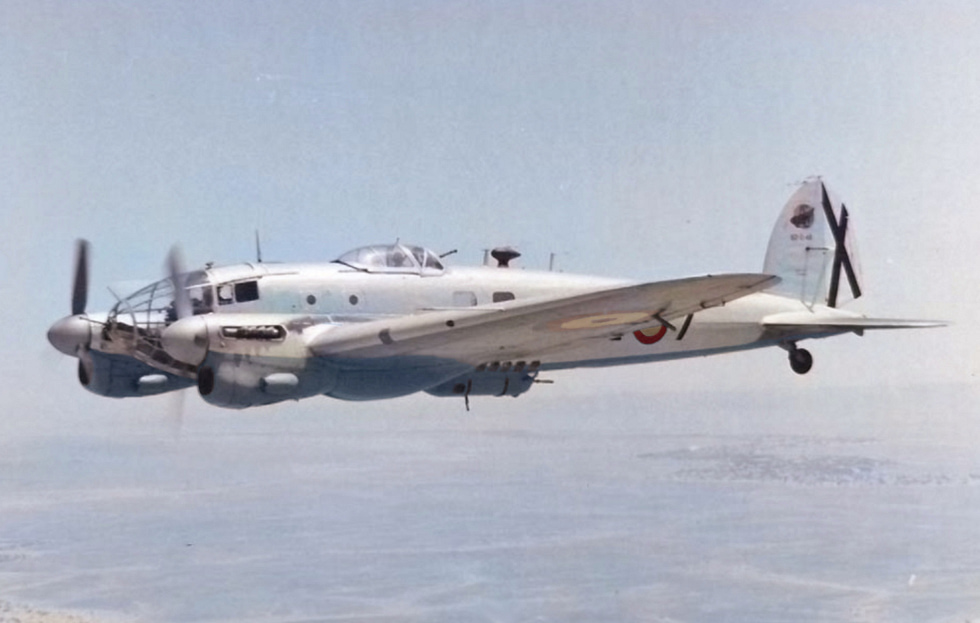
Obsolescent by 1943, the He 111 nonetheless outlived the Third Reich. Spain built it under licence as the CASA 2.111, initially with Jumo engines and later re-engined with British Rolls-Royce Merlin units. Spanish examples flew on into the early 1970s, and several later appeared on screen — most famously standing in for Luftwaffe He 111s in the 1969 film Battle of Britain.
02The He 111 in the Battle of Britain: why the Heinkel bomber was so vulnerable
The He 111’s combat record in Spain had convinced the Luftwaffe that a fast bomber needed only light defensive armament. Over Britain in 1940 that judgement failed. The Heinkel was slower than the RAF fighters intercepting it, its bomb load of roughly two tonnes was modest for a strategic campaign, and its defence rested on a handful of hand-aimed 7.92 mm MG 15 machine guns that could not hold off eight-gun Spitfires and Hurricanes. Crews welded on extra guns and up-gunned later variants with 13 mm weapons, but the fundamental problem remained. Daylight losses grew heavy enough that the He 111 — like much of the German bomber arm — was shifted to the night raids of the Blitz, where darkness, not armament, was its protection.
03The He 111’s second life: torpedoes, transports, gliders and the He 111Z Zwilling
As a front-line bomber the He 111 was fading by 1943, but the airframe was endlessly reworked. The He 111H-6 carried two torpedoes and attacked Allied shipping, including the Arctic convoys to the Soviet Union. During the encirclement at Stalingrad in the winter of 1942–43 He 111s were pressed into service as transports, suffering heavy losses. The strangest offshoot was the He 111Z “Zwilling” (“Twin”): two He 111H-6 fuselages joined by a new centre wing carrying a fifth engine, built as a tug for the enormous Me 321 Gigant glider. Twelve were made. Late in the war, He 111H-22s even air-launched V-1 flying bombs against England.
Full He 111 specifications
Figures are for the mass-produced He 111H-6; values varied across the many variants.
Airframe & Performance
- צוות
- 5 (pilot, bombardier, gunners, radio operator)
- מֶשֶׁך
- ~16.4 m
- מוּטַת כְּנָפַים
- ~22.6 m
- גוֹבַה
- ~4.0 m
- Max takeoff weight
- ~14,000 kg
- Max speed
- ~440 km/h at altitude
- מהירות שיוט
- ~370 km/h
- תקרת השירות
- ~6,500 m
- לָנוּעַ
- ~2,300 km with bomb load
- Bomb load
- up to ~2,000 kg
Propulsion & Systems
- Engines
- 2 × Junkers Jumo 211 (inverted V-12)
- Power (each)
- ~1,300–1,350 hp
- Defensive armament
- up to ~7 × MG 15 (7.92 mm) / later MG 131 (13 mm)
- Offensive load
- bombs in vertical cells or external racks; torpedoes on H-6
- First flight
- 24 February 1935
- Built
- ~6,500 (all variants, to 1944)
- Unit cost
- No reliable public figure
- Cost per flight hour
- No reliable public figure
04The He 111’s cost: why no reliable price figure exists
The He 111 was a state-directed wartime product, built in the tens of thousands of man-hours by a war economy rather than sold on an open market, so a firm flyaway unit price and a credible cost-per-flight-hour simply do not exist in the public record. Any precise figure attached to it should be treated as an estimate. What is well documented is the scale: around 6,500 aircraft across a decade of production, and, remarkably, a licence-built afterlife in Spain (the CASA 2.111) that kept the design in service and in the air long after the German original had been retired.
From airliner disguise to Spanish afterlife
First flight
The He 111 V1 prototype flies on 24 February at Rostock-Marienehe, publicly presented as a fast airliner while designed for bombing.
Combat debut in Spain
He 111B bombers of the Condor Legion fly for the Nationalists in the Spanish Civil War; low losses wrongly reassure planners about defensive armament.
Invasion of Poland
The He 111 spearheads the Luftwaffe bombing campaign as the opening act of the Second World War in Europe.
Battle of Britain & the Blitz
A mainstay of the bomber force, the He 111 suffers heavy daylight losses to RAF fighters and is switched to night raids on British cities.
New roles at sea and in the air
The He 111H-6 attacks Allied shipping as a torpedo bomber, while the twin-fuselage He 111Z is built to tow the Me 321 Gigant glider.
The Stalingrad airlift
He 111s are pressed into service as transports to supply the encircled Sixth Army, taking severe losses in the winter skies.
Air-launched V-1s · production ends
He 111H-22s launch V-1 flying bombs at England; German production of the type winds down after roughly 6,500 built.
The CASA 2.111 in Spain
Spain builds the He 111 under licence, later re-engined with Rolls-Royce Merlins; examples fly on until 1973 and appear in the 1969 film Battle of Britain.
From history: twelve He 111 stories
An airliner that was really a bomber
Germany unveiled the He 111 as a Lufthansa airliner while designing it for war.
Read the full story
The false lesson of the Condor Legion
In Spain the He 111 outran enemy fighters — teaching the wrong lesson about defence.
Read the full story
The greenhouse nose
The He 111’s smoothly glazed, asymmetric nose is one of aviation’s most recognisable shapes.
Read the full story
The opening campaign
The He 111 led the Luftwaffe bombing that opened the Second World War in Europe.
Read the full story
Exposed in daylight
Over Britain the Heinkel met fighters it could neither outrun nor fight off.
Read the full story
Retreat into the dark
Unable to survive by day, the He 111 became a night bomber over British cities.
Read the full story
Torpedoes against the convoys
The He 111H-6 became a torpedo bomber, striking Allied shipping in the Arctic and Mediterranean.
Read the full story
The He 111Z Zwilling
Two He 111 fuselages were joined into one five-engined aircraft to tow a giant glider.
Read the full story
Bomber turned transport
At Stalingrad the He 111 flew supply missions into an encircled army, at heavy cost.
Read the full story
Launching the V-1
Late in the war He 111s carried V-1 flying bombs aloft and launched them at England.
Read the full story
The CASA 2.111
Spain built the He 111 under licence and flew it, Merlin-engined, into the 1970s.
Read the full story
A second career in film
Spanish-built He 111s stood in for Luftwaffe bombers in the 1969 film Battle of Britain.
Read the full story
The He 111 in pictures
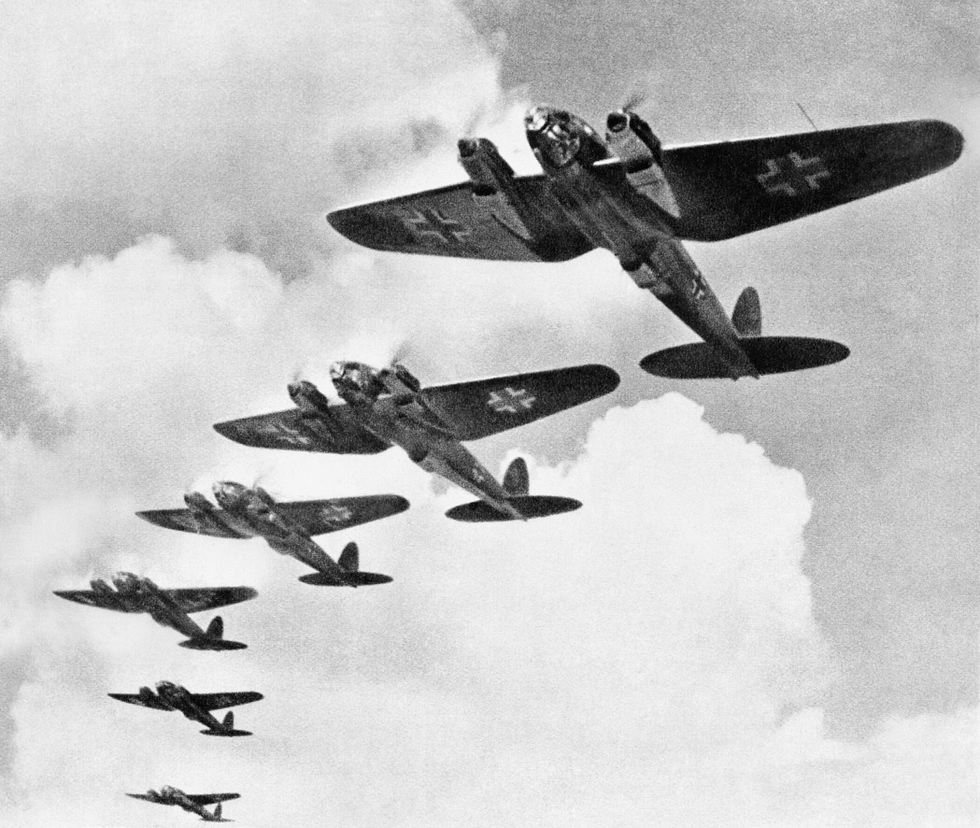
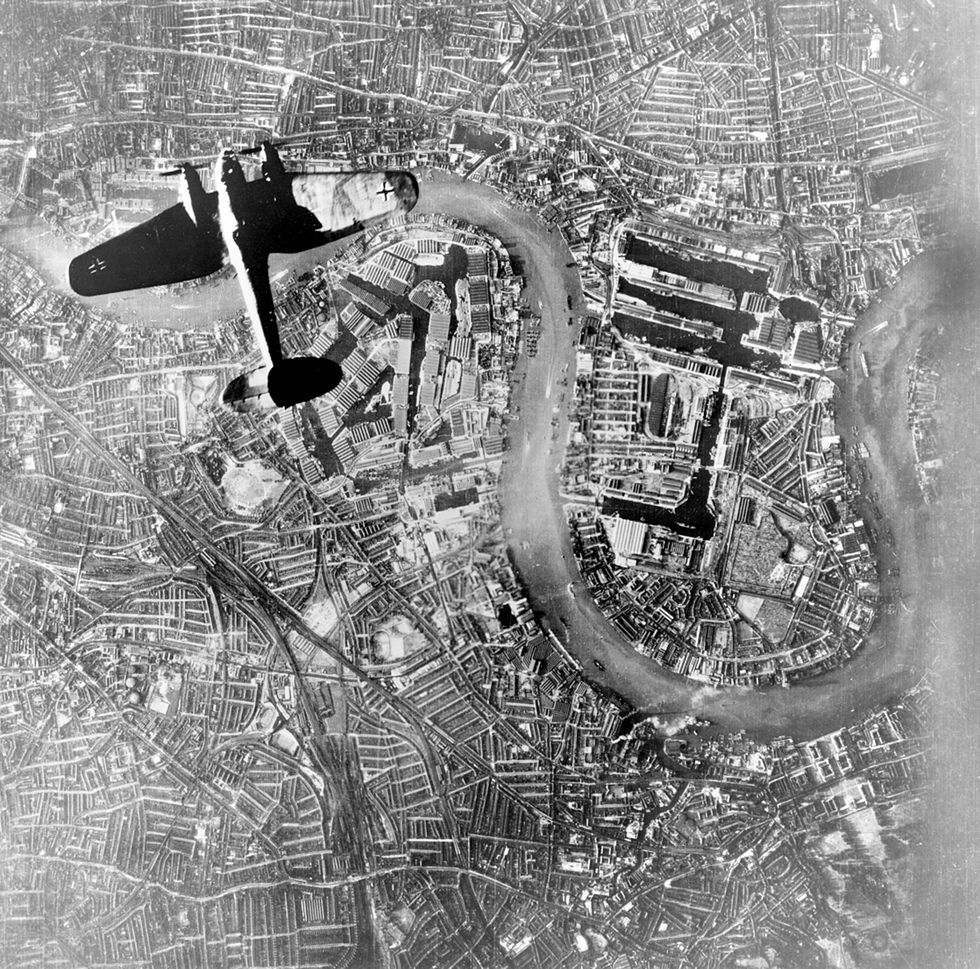
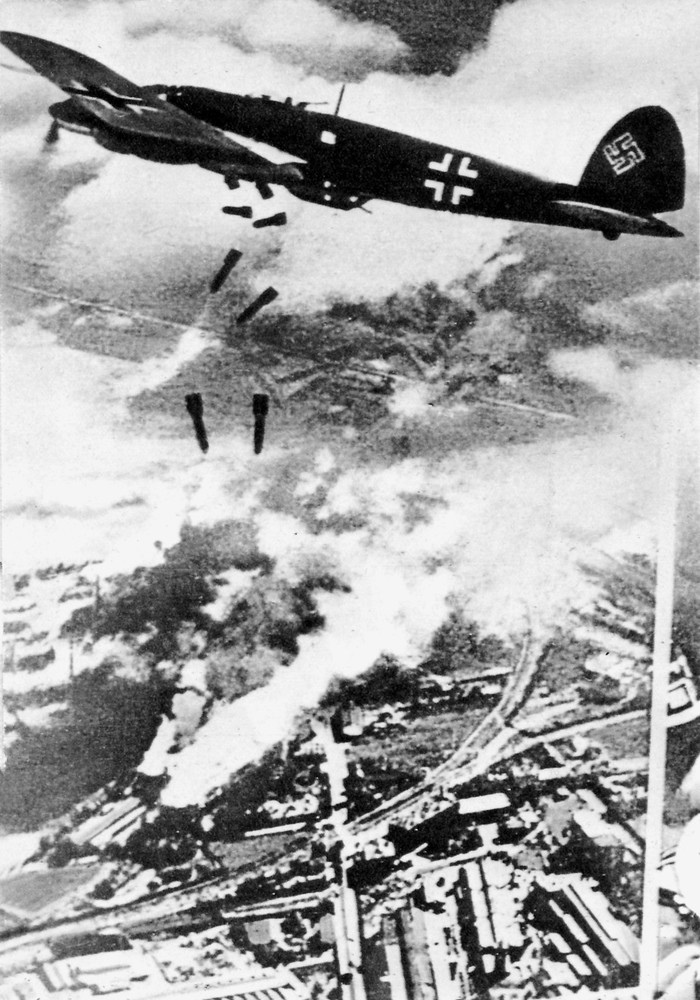
The He 111 in motion
Video coming soon — a curated documentary on the Heinkel He 111 will be added to this exhibit shortly.
Where the He 111 flew and served
The record that defines the He 111
The He 111 was a workhorse, not a world-beater. Its story is one of early dominance followed by growing vulnerability — effective while it faced weak opposition or flew by night, but exposed and out-classed against modern fighters in daylight. Its true legacy is its extraordinary adaptability and its remarkable longevity.
Compare the combat record of other military aircraft. Figures as of July 2026 and, where contested, hedged.
Everything people ask about the He 111
Can I fly in a He 111?
Why does the He 111 have that glass “greenhouse” nose?
Was the He 111 a good bomber?
How many He 111 were built?
What is the CASA 2.111?
Did the He 111 fight in the Battle of Britain?
Are any He 111 still flying?
What was the He 111Z?
You can’t fly the He 111.
These, you can.
Some legends only live in museums — others are fuelled and waiting. MiGFlug has put civilians in real military jet cockpits since 2004.
 Fly the L-39 AlbatrosThe world’s most-flown jet trainer — aerobatics included
 Fly the F-104 Starfighter“The missile with a man in it”
 Fly the MiG-21The Cold War’s most-produced jet
 טסו על ה-T-33 Shooting StarAmerica’s first jet trainer
 Fly the DH VampireA piece of early jet history
 Fly the S.211Agile Italian jet trainer
 Fly the MB-326The classic Aermacchi jet
 Fly the MiG-15The Soviet legend of the Korean War
Continue the tour
Every fact, checked
- World History Encyclopedia — Heinkel He 111Overview of the aircraft’s airliner origins, Spanish debut and wartime service.
- History of War — He 111 combat recordSpanish Civil War use and the scale of Battle of Britain losses.
- Imperial War MuseumsBlitz context and the He 111 over British cities in 1940–41.
- Royal Air Force MuseumReference for the He 111’s design, role and preserved airframes.
- Oryx — Türkiye’s He 111 bombersDetail on Turkey’s ~24 Heinkels ordered in 1937 and retired in 1945.
- Military Factory — He 111Specifications and the family of variants across the type’s career.
- The Aviation Geek ClubHe 111Z Zwilling, torpedo-bomber and V-1 air-launch history.
- The National WWII MuseumContext on the Luftwaffe bomber arm and the strategic air war.