
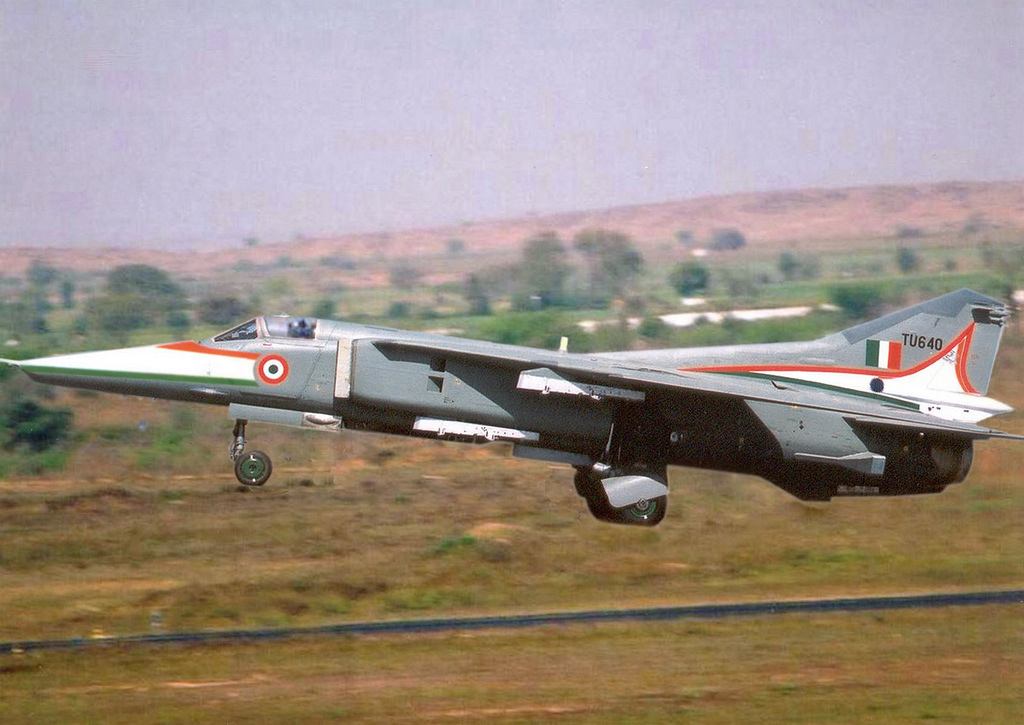
Mikoyan-Gurevich MiG-27
“Flogger”
The Soviet Union’s dedicated ground-attack Flogger — the swing-wing MiG-23 fighter rebuilt for the low-level strike mission, with an armoured ‘ducknose’ cockpit, fixed simplified intakes and a savage six-barrel 30 mm cannon. Not to be confused with its MiG-23 parent, the air-superiority fighter.
The Flogger that traded the dogfight for the mud
The MiG-27 is often confused with the MiG-23 it grew from — but the two aircraft did very different jobs. The MiG-23 was a swing-wing air-superiority fighter, built around a big radar to intercept other aircraft. The MiG-27 was a dedicated ground-attack aircraft: the same variable-geometry planform, but re-engineered from the nose back to put bombs and cannon fire onto targets on the ground, at low level, in daylight.
That change is written all over the airframe. Mikoyan-Gurevich replaced the MiG-23’s pointed radar nose with a sharply down-sloping, armoured “ducknose” — Soviet crews called it the Utkonos (platypus) or Krokodil — that gave the pilot a far better view over the nose for aiming, and swapped the radar for a laser rangefinder and attack avionics. The complex variable intakes and long exhaust nozzle of the fighter, tuned for high-Mach interception, were replaced with fixed, simplified intakes optimised for the transonic low-level regime where a strike aircraft actually works. Heavier landing gear let it operate from rough forward airfields.
Development ran through the MiG-23B/BN fighter-bomber line of the early 1970s; the definitive dedicated version — distinct enough that NATO gave it its own designation and the Soviets renumbered it the MiG-27 — entered series production and reached Soviet service in 1975. India licence-built its own version through Hindustan Aeronautics as the “Bahadur” (Valiant), and it was India that flew the type longest, retiring the last examples only in December 2019.
01MiG-23 versus MiG-27: telling the two Floggers apart
Both aircraft share the NATO reporting name “Flogger” and the same swing-wing layout, which is why they are so often mixed up. The simplest distinction is the job: the MiG-23 is a fighter — interceptor and air-superiority aircraft — with a radar in a pointed nose. The MiG-27 is a ground-attack aircraft, with no interception radar, a stepped-down armoured nose for visibility, and a cannon and bomb load built for hitting the ground.
Visually, look at the nose and the intakes. The MiG-27 has the flat, sloping “ducknose” and plain fixed air intakes; the MiG-23 has a conical radome and variable intake ramps with prominent boundary-layer splitter plates. The MiG-23BN fighter-bomber sits between the two: it uses the MiG-27-style attack nose but keeps the MiG-23’s variable intakes and, usually, its twin-barrel gun. On MiGFlug the MiG-23 has its own separate exhibit.
What makes the MiG-27 special
A swing wing tuned for low-level strike
The MiG-27 kept the MiG-23’s variable-geometry wing, with sweep selectable at roughly 16°, 45° and 72°. On a fighter that range is about balancing takeoff, cruise and supersonic dash; on the MiG-27 it was used to steady the aircraft as a weapons platform — wings spread for lift over a rough strip and slow, accurate weapons passes, wings swept back to punch through the dense, bumpy air of a high-speed run at treetop height. It was optimised for the strike mission, not the turning fight.
The GSh-6-30: a cannon that fought its own airframe
Under the belly sat the GSh-6-30, a six-barrel 30 mm Gatling-type cannon firing at around 5,000 rounds per minute. It was ferociously effective — and almost too powerful for the jet carrying it. The recoil, widely cited at several tonnes, could crack fuel tanks, knock out avionics, tear landing-gear doors and reliably shake the landing lights out of their mountings. Long bursts were banned; pilots fired in short taps to spare the airframe.
Armoured ‘ducknose’ cockpit & rough-field toughness
Flying low over a battlefield means taking small-arms and light flak, so the MiG-27’s cockpit was wrapped in armour plate and its down-sloping nose gave the pilot the forward view a bomb-aimer needs. Reinforced, heavy-duty landing gear and low-pressure tyres let it work from short, semi-prepared forward airfields close to the front — the rugged, unglamorous end of tactical air power.
02The GSh-6-30 cannon: recoil that could break the jet
The MiG-27 dropped the MiG-23’s twin-barrel 23 mm gun for the enormous GSh-6-30, mounted in a fairing under the fuselage with a few hundred rounds. At full rate it threw 30 mm shells fast enough to shred vehicles and light armour. But the same power worked against the aircraft: test and service reports describe the whole airframe shaking violently under fire, with recoil forces heavy enough to crack fuel tanks, disable instruments and dislodge equipment. Test pilot V. N. Kondaurov recorded that the aircraft shuddered and seemed to slow under the gun’s recoil. Firing was restricted to short bursts of a second or two, and the gun became one of the type’s defining — and most troublesome — features.
03Fixed intakes and the R-29B: engineering for low, not high
The MiG-23 fighter used variable intake ramps and a variable exhaust nozzle so its engine could feed a Mach-2-plus interception. A strike aircraft spends its life low and transonic, where all that complexity is dead weight and extra maintenance. So the MiG-27 was given simplified fixed intakes and a shorter fixed nozzle, matched to the Tumansky R-29B-300 turbojet optimised for low-altitude thrust. Top speed fell — roughly Mach 1.7 at height rather than the fighter’s Mach 2.3—plus — but the aircraft was lighter, cheaper, tougher and better suited to the job it was actually built for.
Full specifications — MiG-27M/K
Airframe & Performance
- צוות
- 1
- מֶשֶׁך
- ~17.1 m (17.08 m)
- Wingspan (spread)
- ~13.8 m (13.97 m)
- Wingspan (swept)
- ~7.8 m (7.78 m)
- גוֹבַה
- ~5.0 m
- Max takeoff weight
- ~20,300 kg (up to ~20,670 kg)
- Max speed
- ~Mach 1.7 at altitude · ~1,350 km/h at sea level
- תקרת השירות
- ~14,000 m
- Combat range
- ~540–780 km (mission-dependent)
Propulsion & Armament
- מָנוֹעַ
- 1 × Tumansky R-29B-300 turbojet
- Thrust
- ~112.8 kN with afterburner (~78.5 kN dry)
- Cannon
- 1 × GSh-6-30 30 mm six-barrel (~260–300 rounds)
- Ordnance
- up to ~4,000 kg on 7 hardpoints
- Guided weapons
- Kh-23/Kh-29 missiles, laser- & TV-guided bombs (M/K); R-60 AAMs
- First flight
- early 1970s (MiG-23BM line)
- Entered service
- 1975
- Built
- ~1,075 incl. Indian licence
- Unit cost
- No reliable open figure
04The MiG-27’s cost: a Soviet product with no open price
Like most Soviet combat aircraft, the MiG-27 was a state product built for the Warsaw Pact and allied air forces, never sold on an open dollar market, so no reliable flyaway unit price exists in the public record. The clearest hard numbers come from later second-hand deals: Sri Lanka is reported to have paid on the order of US$1.75 million for remanufactured airframes around 2000, with a later batch costing considerably more. There is no credible public cost-per-flight-hour figure for the type, and any precise dollar amount attached to a MiG-27 should be read as an estimate, not a sourced fact.
From fighter derivative to Cold-War bomb-truck
The MiG-23 fighter flies
Mikoyan-Gurevich’s swing-wing MiG-23 interceptor first flies, giving the Soviets a variable-geometry airframe to adapt for other roles.
The attack nose appears
The MiG-23B/BN fighter-bomber introduces the armoured, down-sloping “ducknose” and dedicated ground-attack avionics.
The dedicated Flogger takes shape
The MiG-23BM adds fixed simplified intakes and the GSh-6-30 cannon — the aircraft the Soviets renumber the MiG-27.
Enters Soviet service
The MiG-27 reaches Soviet Frontal Aviation as a dedicated low-level strike aircraft, eventually equipping many fighter-bomber regiments.
India builds the ‘Bahadur’
Hindustan Aeronautics licence-produces the MiG-27ML in India as the “Bahadur” (Valiant), the export success the type never found elsewhere.
Afghanistan
Soviet MiG-27s fly close air support late in the Soviet-Afghan War, limited by a high minimum altitude imposed by the MANPADS threat.
Kargil War
Indian MiG-27s fly ground-attack sorties over the Himalayas; one is lost to an engine flameout while firing rockets, its pilot captured and later returned.
The Floggers retire
Russia withdraws its MiG-27s from frontline use in 1993; Sri Lanka flies them through its civil war, and India retires the last examples in December 2019.
Twelve MiG-27 stories
Two Floggers, one name
The MiG-27 and MiG-23 share a NATO name and a wing — but not a job.
Read the full story
The platypus nose
Soviet crews nicknamed the MiG-27’s flat armoured nose the Utkonos — platypus.
Read the full story
The gun that shook the jet
The GSh-6-30 was so violent that firing it could crack the aircraft’s own tanks.
Read the full story
Simpler on purpose
The MiG-27 threw away the fighter’s variable intakes because a strike jet does not need them.
Read the full story
Why the wings still moved
A strike aircraft rarely dogfights, so the MiG-27 used its swing wing differently.
Read the full story
The Bahadur
India licence-built its own MiG-27 and flew the type longer than anyone.
Read the full story
Held high by the MANPADS threat
In Afghanistan the MiG-27 was kept above the altitude where its accuracy mattered most.
Read the full story
Nachiketa over the Himalayas
An Indian MiG-27 was lost in the 1999 Kargil War when its engine failed during a rocket attack.
Read the full story
No. 12 Squadron
Sri Lanka bought refurbished MiG-27s to fly ground attack in its long civil war.
Read the full story
From D to K
The MiG-27 family ran from the basic bomb-truck to a laser-toting precision striker.
Read the full story
Flogger, Frogfoot, Fitter
The MiG-27 was one of three Soviet strike aircraft that overlapped in service.
Read the full story
The end of the dedicated Flogger
By 2023 every air force had retired the MiG-27; none was replaced in kind.
Read the full story
The MiG-27 in pictures
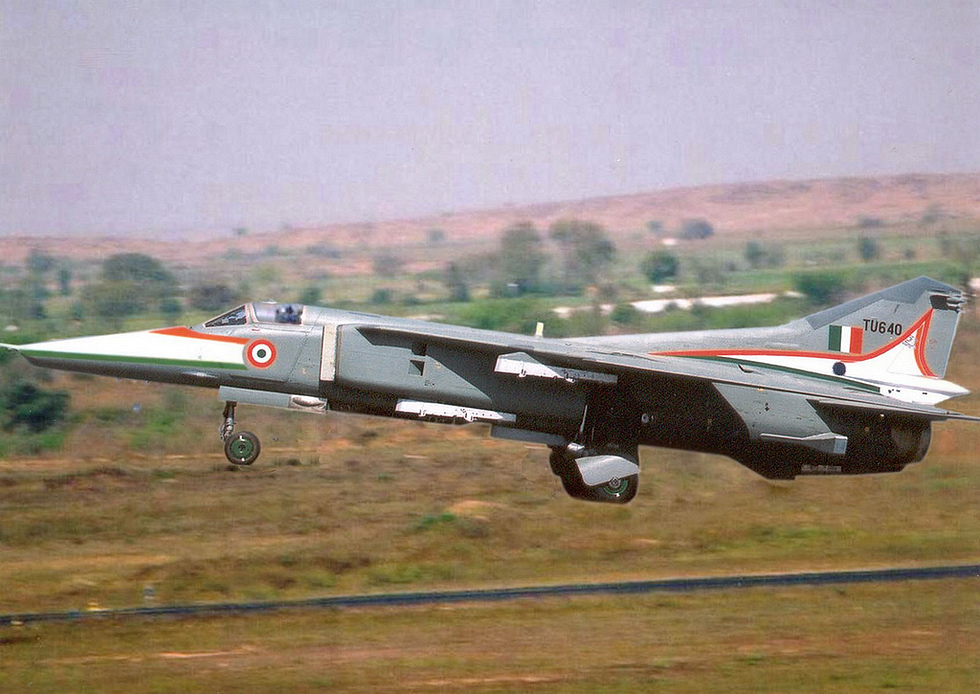
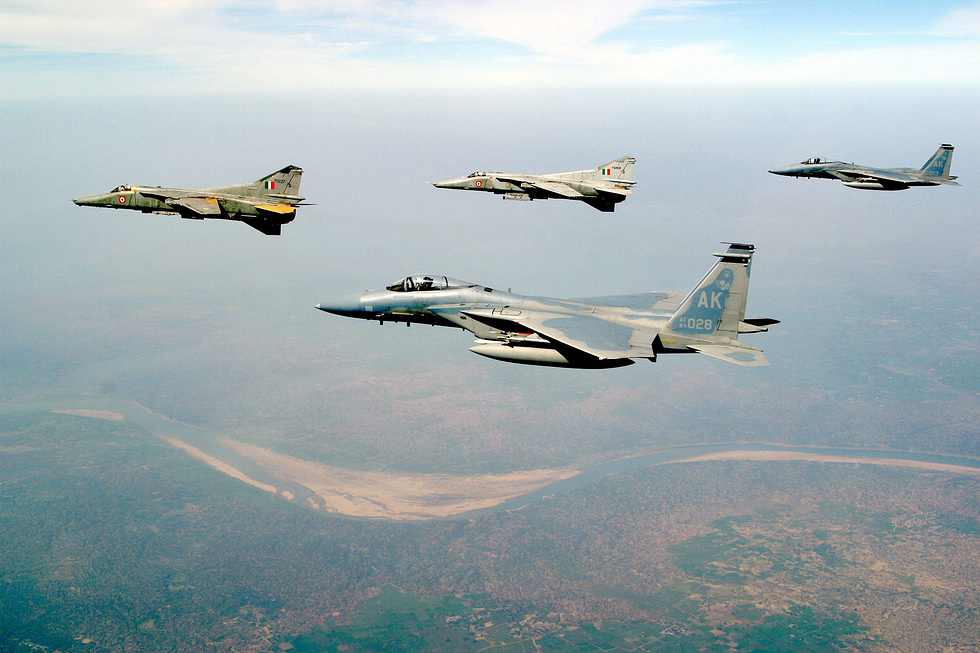
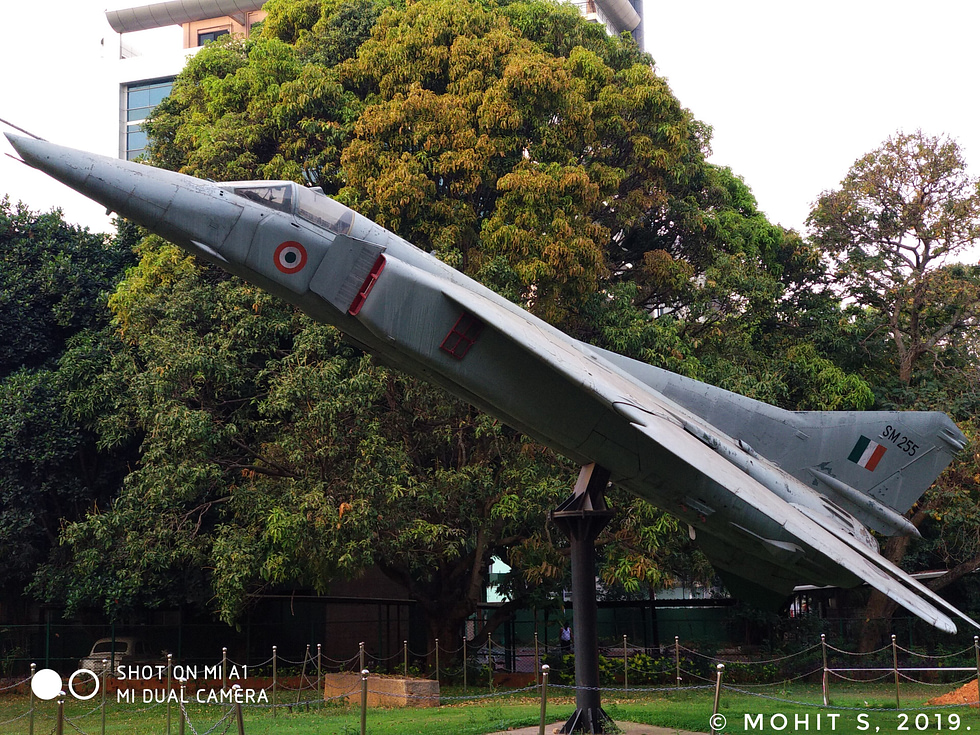
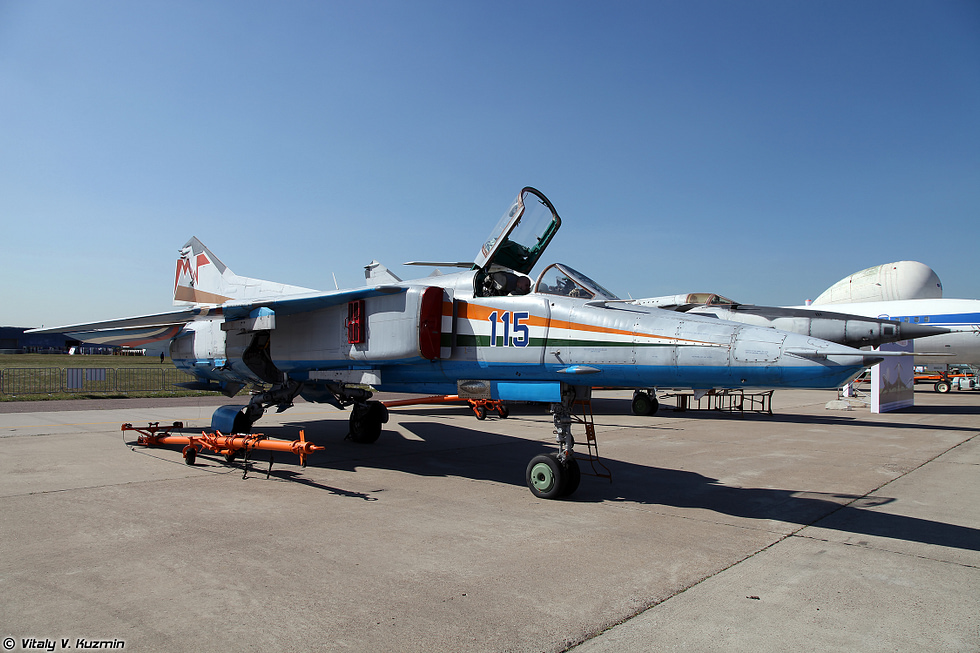
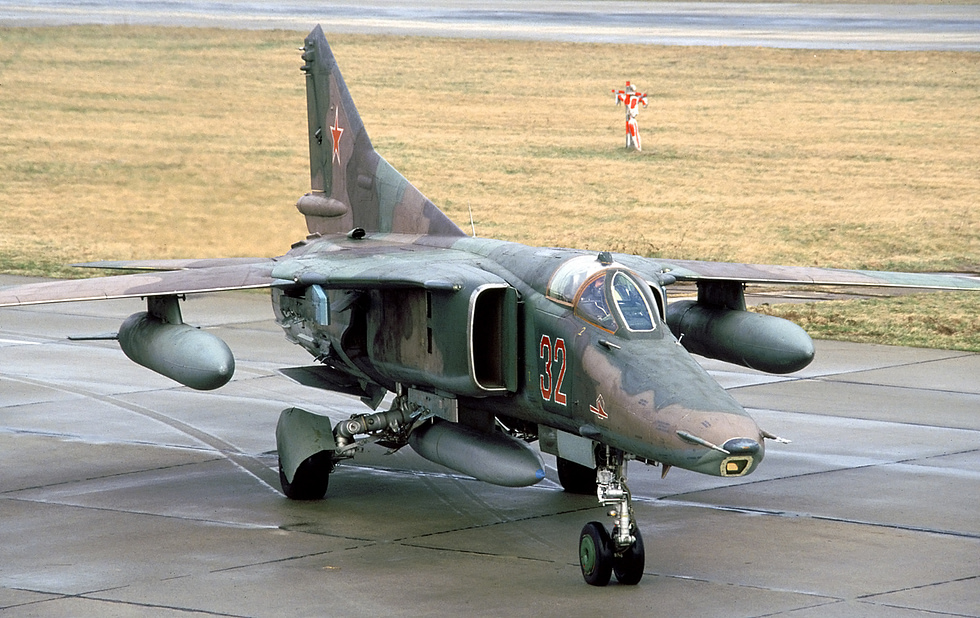
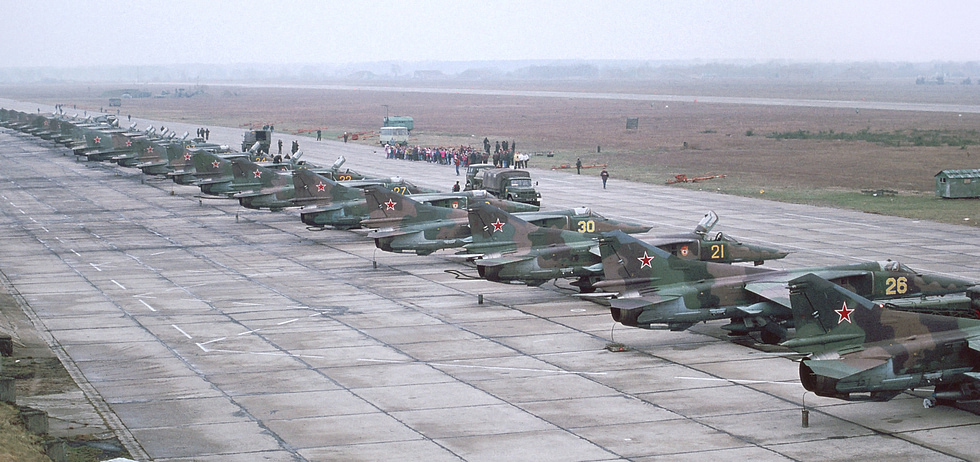
The MiG-27 in motion
A curated MiG-27 video feature is coming soon. In the meantime, explore the photo gallery and timeline above for a closer look at the Flogger, its ducknose and its swing wing.
Where the MiG-27 flew
The score that defines it
The MiG-27 was a ground-attack aircraft, so its combat history is measured in strike sorties, not air-to-air kills. It flew close air support in the Soviet-Afghan War, in India’s 1999 Kargil War and in Sri Lanka’s civil war. Precise sortie and loss figures are contested and vary by source; the record below is given factually and without endorsement of any side in these conflicts.
Compare the combat record of every military aircraft. Figures as of July 2026.
Everything people ask about the MiG-27
Can I fly in a MiG-27?
What is the difference between the MiG-27 and the MiG-23?
Why was the MiG-27’s cannon a problem?
How fast is the MiG-27?
What was the Indian “Bahadur”?
Did the MiG-27 fight in Afghanistan?
Is the MiG-27 still in service?
You can’t fly the MiG-27.
These, you can.
Some legends only live in museums — others are fuelled and waiting. MiGFlug has put civilians in real military jet cockpits since 2004.
 Fly the L-39 AlbatrosThe world’s most-flown jet trainer — aerobatics included
 Fly the F-104 Starfighter“The missile with a man in it”
 Fly the MiG-21The Cold War’s most-produced jet
 טסו על ה-T-33 Shooting StarAmerica’s first jet trainer
 Fly the DH VampireA piece of early jet history
 Fly the S.211Agile Italian jet trainer
 Fly the MB-326The classic Aermacchi jet
 Fly the MiG-15The Soviet legend of the Korean War
Continue the tour
Every fact, checked
- Fly a Jet Fighter — The MiG-27 Flogger, from Moscow to KabulDevelopment from the MiG-23, the ducknose and fixed intakes, the cannon and combat use.
- The National Interest — the GSh-6-30 cannonThe gun’s rate of fire and the recoil damage to tanks, avionics and landing lights.
- Military Factory — Mikoyan MiG-27Specifications, variants and production cross-check.
- Airforce Technology — MiG-27 FloggerAirframe, engine and weapons-system reference.
- AeroCorner — Mikoyan-Gurevich MiG-27Dimensions, weights and performance figures.
- Republic World — Kargil War air assetsThe Indian MiG-27 in the 1999 Kargil campaign.
- The National Interest — India retires the “Valiant”The Bahadur’s Indian service and 2019 retirement.
- Sri Lanka Air Force — official siteReference for Sri Lankan air-operations context.