
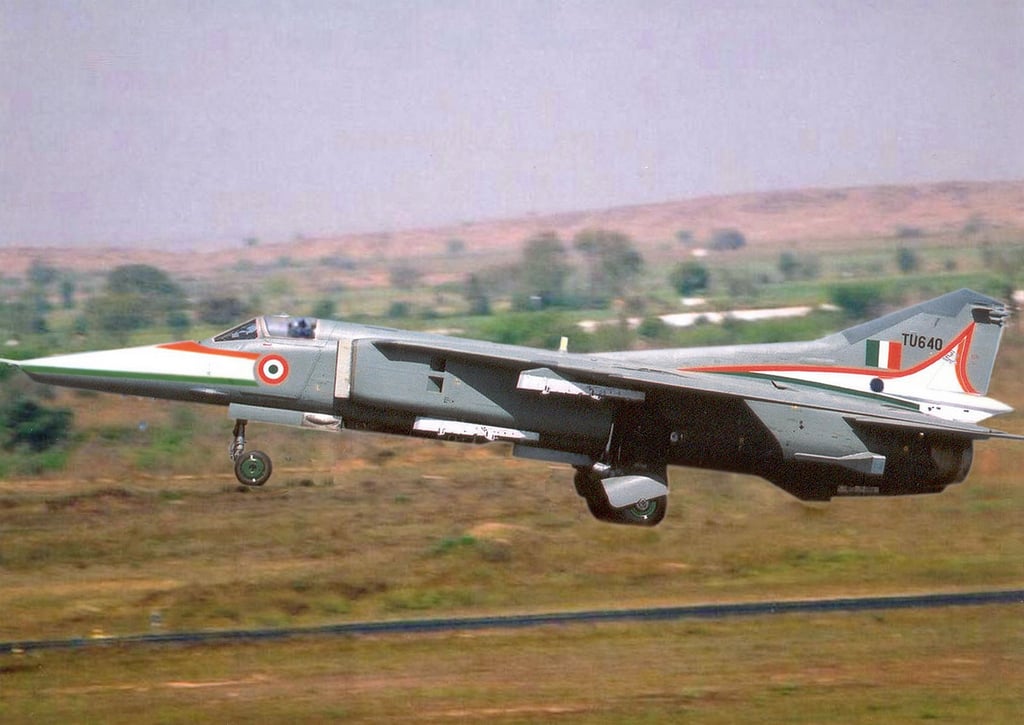
Mikoyan-Gurevich MiG-27
“Flogger”
The Soviet Union’s dedicated ground-attack Flogger — the swing-wing MiG-23 fighter rebuilt for the low-level strike mission, with an armoured ‘ducknose’ cockpit, fixed simplified intakes and a savage six-barrel 30 mm cannon. Not to be confused with its MiG-23 parent, the air-superiority fighter.
The Flogger that traded the dogfight for the mud
The MiG-27 is often confused with the MiG-23 it grew from — but the two aircraft did very different jobs. The MiG-23 was a swing-wing air-superiority fighter, built around a big radar to intercept other aircraft. The MiG-27 was a dedicated ground-attack aircraft: the same variable-geometry planform, but re-engineered from the nose back to put bombs and cannon fire onto targets on the ground, at low level, in daylight.
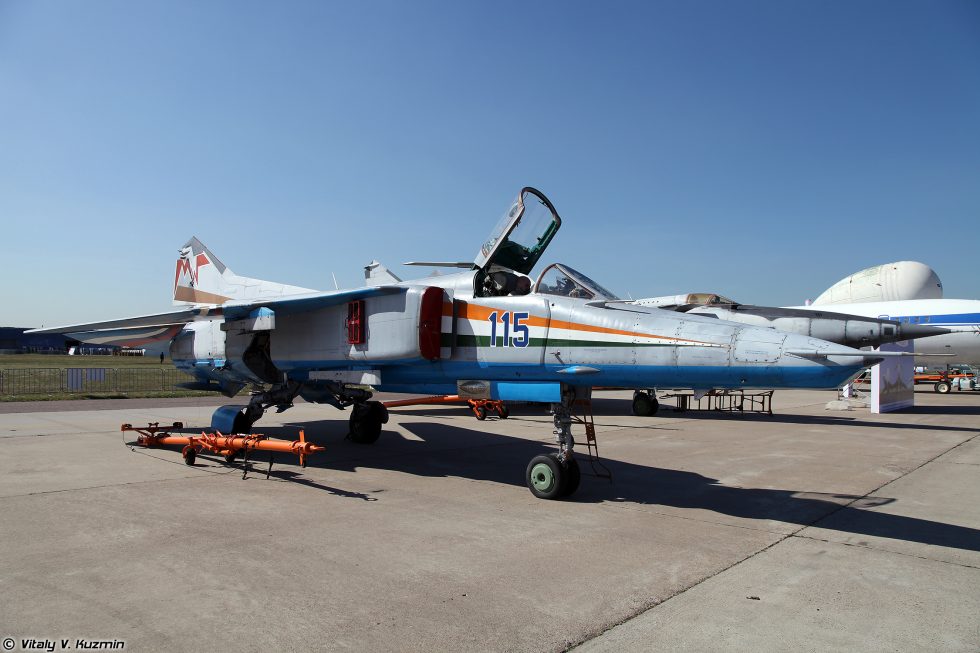
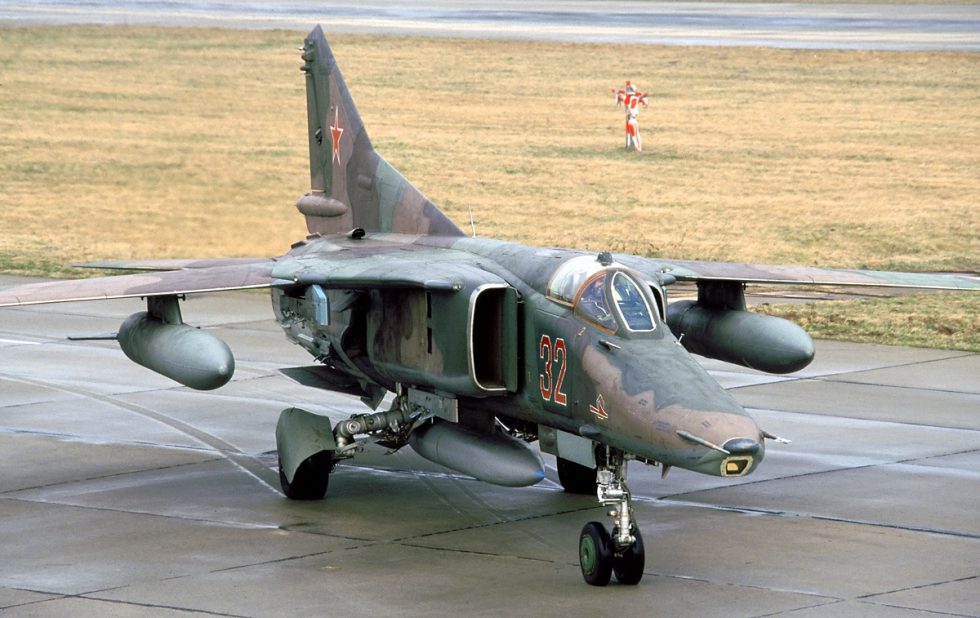
That change is written all over the airframe. Mikoyan-Gurevich replaced the MiG-23’s pointed radar nose with a sharply down-sloping, armoured “ducknose” — Soviet crews called it the Utkonos (platypus) or Krokodil — that gave the pilot a far better view over the nose for aiming, and swapped the radar for a laser rangefinder and attack avionics. The complex variable intakes and long exhaust nozzle of the fighter, tuned for high-Mach interception, were replaced with fixed, simplified intakes optimised for the transonic low-level regime where a strike aircraft actually works. Heavier landing gear let it operate from rough forward airfields.
Development ran through the MiG-23B/BN fighter-bomber line of the early 1970s; the definitive dedicated version — distinct enough that NATO gave it its own designation and the Soviets renumbered it the MiG-27 — entered series production and reached Soviet service in 1975. India licence-built its own version through Hindustan Aeronautics as the “Bahadur” (Valiant), and it was India that flew the type longest, retiring the last examples only in December 2019.
01MiG-23 versus MiG-27: telling the two Floggers apart
Both aircraft share the NATO reporting name “Flogger” and the same swing-wing layout, which is why they are so often mixed up. The simplest distinction is the job: the MiG-23 is a fighter — interceptor and air-superiority aircraft — with a radar in a pointed nose. The MiG-27 is a ground-attack aircraft, with no interception radar, a stepped-down armoured nose for visibility, and a cannon and bomb load built for hitting the ground.
Visually, look at the nose and the intakes. The MiG-27 has the flat, sloping “ducknose” and plain fixed air intakes; the MiG-23 has a conical radome and variable intake ramps with prominent boundary-layer splitter plates. The MiG-23BN fighter-bomber sits between the two: it uses the MiG-27-style attack nose but keeps the MiG-23’s variable intakes and, usually, its twin-barrel gun. On MiGFlug the MiG-23 has its own separate exhibit.
What makes the MiG-27 special
A swing wing tuned for low-level strike
The MiG-27 kept the MiG-23’s variable-geometry wing, with sweep selectable at roughly 16°, 45° and 72°. On a fighter that range is about balancing takeoff, cruise and supersonic dash; on the MiG-27 it was used to steady the aircraft as a weapons platform — wings spread for lift over a rough strip and slow, accurate weapons passes, wings swept back to punch through the dense, bumpy air of a high-speed run at treetop height. It was optimised for the strike mission, not the turning fight.
The GSh-6-30: a cannon that fought its own airframe
Under the belly sat the GSh-6-30, a six-barrel 30 mm Gatling-type cannon firing at around 5,000 rounds per minute. It was ferociously effective — and almost too powerful for the jet carrying it. The recoil, widely cited at several tonnes, could crack fuel tanks, knock out avionics, tear landing-gear doors and reliably shake the landing lights out of their mountings. Long bursts were banned; pilots fired in short taps to spare the airframe.
Armoured ‘ducknose’ cockpit & rough-field toughness
Flying low over a battlefield means taking small-arms and light flak, so the MiG-27’s cockpit was wrapped in armour plate and its down-sloping nose gave the pilot the forward view a bomb-aimer needs. Reinforced, heavy-duty landing gear and low-pressure tyres let it work from short, semi-prepared forward airfields close to the front — the rugged, unglamorous end of tactical air power.
02The GSh-6-30 cannon: recoil that could break the jet
The MiG-27 dropped the MiG-23’s twin-barrel 23 mm gun for the enormous GSh-6-30, mounted in a fairing under the fuselage with a few hundred rounds. At full rate it threw 30 mm shells fast enough to shred vehicles and light armour. But the same power worked against the aircraft: test and service reports describe the whole airframe shaking violently under fire, with recoil forces heavy enough to crack fuel tanks, disable instruments and dislodge equipment. Test pilot V. N. Kondaurov recorded that the aircraft shuddered and seemed to slow under the gun’s recoil. Firing was restricted to short bursts of a second or two, and the gun became one of the type’s defining — and most troublesome — features.
03Fixed intakes and the R-29B: engineering for low, not high
The MiG-23 fighter used variable intake ramps and a variable exhaust nozzle so its engine could feed a Mach-2-plus interception. A strike aircraft spends its life low and transonic, where all that complexity is dead weight and extra maintenance. So the MiG-27 was given simplified fixed intakes and a shorter fixed nozzle, matched to the Tumansky R-29B-300 turbojet optimised for low-altitude thrust. Top speed fell — roughly Mach 1.7 at height rather than the fighter’s Mach 2.3—plus — but the aircraft was lighter, cheaper, tougher and better suited to the job it was actually built for.
Full specifications — MiG-27M/K
Baseline note: the figures below describe the first production Mikoyan MiG-27 — factory designation izdeliye 32-25, originally allotted the in-house number MiG-23BM, NATO reporting name Flogger-D — built at the Irkutsk plant from 1973 to 1977 with the Khachaturov/Tumansky R-29B-300 turbojet. That mark is the right baseline because it is the one that introduced every feature which makes the MiG-27 a different aeroplane from the MiG-23: the fixed simplified intakes, the shortened simplified nozzle, the armoured cockpit, the sloped radarless nose and the six-barrel GSh-6-30 cannon. Everything after it — the K, the D, the M, the Indian machines — changed the avionics and the weapons clearance, not the airframe. Deltas for the MiG-27K (Flogger-J2), the rebuilt MiG-27D, the MiG-27M (Flogger-J) and the Indian licence-built MiG-27L/ML Bahadur are given in grey. One boundary before anything else. The MiG-27 is a dedicated ground-attack derivative of the Mikoyan-Gurevich MiG-23, and the MiG-23 is a separate aircraft with its own page. They share a variable-geometry wing, a fuselage cross-section and a family resemblance, and they share nothing else that matters. The MiG-23 is an interceptor with a Sapfir radar in a pointed radome, fully variable two-dimensional intake ramps and a long variable-area afterburner nozzle, built to catch aeroplanes at height. The MiG-27 threw all three away. Its intakes are fixed plates with no moving ramps, its nozzle is a short two-position unit optimised for low-level subsonic thrust, its nose is a downward-sloping unglazed "ducknose" — Russian crews called it utkonos, the platypus, or Krokodil Gena after the cartoon crocodile — containing a laser ranger and marked-target seeker instead of radar, and its cockpit sits inside bolted-on steel armour. It also carries a gun no MiG-23 ever carried. The intermediate MiG-23B and the widely exported MiG-23BN are attack MiG-23s and belong to that page, not this one; the split in NATO nomenclature follows the same line, Flogger-D, -J and -J2 being MiG-27s and Flogger-F and -H being attack MiG-23s. Five cautions about the numbers. First, the powerplant: a widely reproduced English-language specification box names a Tumansky R-40-B-300 afterburning turbofan, and both halves of that are wrong. No R-40-B-300 exists; the engine is the R-29B-300, the low-level-optimised member of the R-29 family designed under Khachaturov at the Tumansky (Soyuz) bureau, and it is a turbojet, not a turbofan. The thrust figures printed beside the wrong name are nevertheless the correct ones. Second, airvectors gives 122 kN (12,500 kgf) in afterburner; that is the fighter R-29-300 of the MiG-23M, not the R-29B-300 of the MiG-27, which is rated at 112.8 kN (11,500 kgf). The two are routinely conflated. Third, the wing loading of 605 kg/m² that circulates in tables is the maximum take-off weight divided by the fully swept wing area; over the spread wing at a normal take-off weight the figure is about 485 kg/m², and quoting the first without saying so makes the aeroplane sound worse than it was. Fourth, the published mark-by-mark production totals do not sum to the ~1,127 sometimes quoted for "all MiG-27 variants": about 360 MiG-27s, about 197 MiG-27Ks and about 162 Soviet MiG-27Ms is roughly 719 new-build Soviet airframes, the ~300 MiG-27Ds being conversions of aircraft already counted, so the higher total almost certainly folds in MiG-23BNs that are not MiG-27s at all. Fifth, internal fuel is the least trustworthy number on this page and is flagged as such below.
Dimensions & weights
- Crew
- 1 — one pilot with no radar, flying a single-seat strike aeroplane at low level over defended ground while managing a laser ranger, a bombing computer, a weapons panel and a gun that shook the airframe hard enough to break things. There was no MiG-27 two-seater: conversion training was done on the MiG-23UB, a MiG-23 trainer, which meant every MiG-27 pilot’s first flight in the type was solo
- Length overall
- 17.08 m (56 ft 0 in) including the nose probe on the figure most commonly published. Airvectors gives 17.14 m (56 ft 3 in) for the same aeroplane; the 6 cm is measurement convention, not a different aircraft. The MiG-27 is very slightly shorter than a radar-nosed MiG-23 because the ducknose is a blunter, stubbier structure than the Sapfir radome
- Wingspan, spread
- 13.97 m (45 ft 10 in) with the wings at the 16° minimum-sweep position used for take-off, landing and loiter
- Wingspan, swept
- 7.78 m (25 ft 6 in) at 72°. A few tables round this to 26 ft. The 6.2 m of span that disappears between the two settings is the whole point of the variable geometry, and on a strike aircraft it bought a genuinely useful combination: short field performance spread, and a smooth, fast, low-drag ride down low swept
- Wing sweep positions
- 16°, 45° and 72° — three detented settings selected manually by the pilot, not a scheduled automatic system. The MiG-23 used the same three angles for cruise, combat and high-speed dash; on the MiG-27 the middle setting became the normal attack position and the fully swept setting was rarely needed, because a MiG-27 with bombs was not going anywhere near its clean limiting Mach number
- Height
- 5.00 m (16 ft 5 in) on the undercarriage, with the large ventral fin folded. That fin has to fold sideways before the aircraft can be landed, and it is one of the more conspicuous inheritances from the MiG-23
- Wing area
- 37.35 m² spread (402 sq ft); 34.16 m² (368 sq ft) fully swept. The variable-geometry glove means the "wing area" of this aeroplane is not a single number, and comparisons that pick whichever value flatters the argument are common
- Empty weight
- 11,908 kg (26,252 lb). The MiG-27 is heavier empty than a MiG-23BN despite the 300 kg saved by deleting the variable intake ramps and shortening the nozzle, because the armour, the strengthened undercarriage, the heavier pylons and the gun and its 260-round magazine put the weight straight back on and then some
- Normal take-off weight
- 18,100 kg (39,904 lb) with full internal fuel and a moderate stores load; some compilations give a gross weight of 20,300 kg (44,750 lb), which is a heavy operational load rather than a normal one
- Maximum take-off weight
- 20,670 kg (45,570 lb). The gap between 18,100 kg and 20,670 kg is about 2,570 kg, which is well short of the 4,000 kg the pylons are rated for — in other words the maximum external load and full internal fuel are mutually exclusive, as they are on almost every tactical aircraft of the generation, and the MiG-27’s quoted 4,000 kg is a structural rating rather than a mission load
- Internal fuel
- ~4,560 litres (~1,205 US gal), roughly 3,700 kg, in fuselage tanks and the integral tankage of the fixed wing gloves, on the figure most often published. Sources disagree badly here — values from about 4,250 to about 5,400 litres are in print, some of them evidently including external tanks and some of them borrowed wholesale from MiG-23 marks with different tankage. Treat any precise internal-fuel figure for the MiG-27 with suspicion, this one included
- External fuel
- 3 × 790-litre drop tanks (3 × 209 US gal) — one on the ventral centreline and one under each fixed glove. For ferry flights two more could be hung on the swivelling outer wing pylons, which then had to be locked and the wings left at 16° sweep, so a five-tank MiG-27 was a subsonic straight-line transit aircraft and nothing else. That is how the 2,500 km ferry range is achieved
- Hardpoints
- 7 — one ventral centreline, four on the fuselage (two forward under the intake ducts and two aft), and two under the fixed wing gloves. The two swivelling pylons on the moving outer wing panels are usually excluded from the count because they were cleared only for fuel tanks and, with the wings swept, are unusable; counts of nine appear in some references for exactly this reason
- Maximum external load
- ~4,000 kg (~8,818 lb) — a real advance over the MiG-23BN’s 3,000 kg, and the direct result of the strengthened pylons and undercarriage. A typical Afghan war load was rather less: four FAB-500s and a centreline tank is about 2,800 kg of stores, and that was a heavy day
Performance
- Maximum speed, altitude
- 1,885 km/h (1,171 mph / 1,018 kn) at 8,000 m, clean. The MiG-23 from which this airframe derives will do about 2,500 km/h; the MiG-27 gives up roughly a quarter of its top speed to the fixed intakes, and gave it up deliberately, because a fighter-bomber that spends its life below a thousand metres has no use for Mach 2 and every use for the 300 kg and the maintenance hours the variable ramps cost
- Maximum Mach number
- Mach 1.77 at altitude — usually rounded to Mach 1.7, and hard-limited by the fixed intake geometry rather than by thrust or structure. With a combat load it is academic: a laden MiG-27 was a high-subsonic aeroplane and its pilots flew it as one
- Maximum speed, sea level
- 1,350 km/h (839 mph), about Mach 1.09 clean — supersonic on the deck, which is the number the R-29B-300 and the short nozzle were chosen to produce. This is the performance that actually mattered, and by it the MiG-27 was one of the fastest low-level strike aircraft of its day
- Service ceiling
- 14,000 m (45,900 ft). Airvectors quotes 15,600 m (51,200 ft), which is probably a clean and light figure. Either way it is a good deal less than a MiG-23’s, and it never mattered until Afghanistan, where the MANPADS threat pushed the aircraft up to a mandatory 5,000 m floor and turned a low-level precision attacker into a mediocre medium-level bomber. Soviet MiG-27s saw combat in one war only, and late: the 134th Fighter-Bomber Regiment arrived at Shindand in October 1988 after intensive work-up in Kazakhstan and left on 4 February 1989, weeks before the withdrawal ended. In four months it bombed convoys and troop concentrations, scattered mines with cluster munitions and flew night attacks — and, held above the missile envelope, was judged of limited effectiveness. The aeroplane the Soviet Union spent fifteen years building for close support of a ground offensive in Europe got one short tour in the wrong war
- Rate of climb
- 200 m/s (39,400 ft/min) initial, clean. That is interceptor-grade climb and a reminder of the ancestry — underneath the armour and the gun this is a MiG-23 airframe with a big single turbojet
- Combat radius
- ~540 km (~336 mi / ~292 nmi) on a low-low-low profile with a moderate bomb load and drop tanks; a hi-lo-hi profile stretches it towards 780 km. Compared with the Su-7 it replaced in the fighter-bomber regiments this is a transformation — roughly double the reach with roughly double the load — and it is the single strongest argument for the whole variable-geometry exercise
- Combat range
- 780 km (485 mi / 421 nmi) as usually published; some sources present the same 780 km as a radius on a favourable profile rather than a range, and the ambiguity is never resolved in the English literature. Aviastar gives 1,600 km with maximum payload and 2,110 km with maximum fuel for the MiG-27D, which are yet another pair of definitions again
- Ferry range
- 2,500 km (1,553 mi / 1,350 nmi) with the full external tank fit, wings locked at minimum sweep, no ordnance. This is a transit figure and describes no operational mission
- Wing loading
- 605 kg/m² (124 lb/sq ft) at maximum take-off weight over the fully swept wing — the number that appears in most tables, and a genuinely punishing one. At a normal take-off weight over the spread wing it falls to about 485 kg/m² (99 lb/sq ft). Both are true; neither should be quoted without saying which is which
- Thrust-to-weight ratio
- 0.62 at gross weight in full afterburner. Around 0.96 at a light weight with the tanks nearly dry. The MiG-27 was never short of thrust; it was short of wing
- Load factor limit
- +7 g clean, and considerably less with a full external load — the swing-wing pivot boxes and the pylons, not the pilot, set the limit. The airframe was cleared for hard, fast, low manoeuvring rather than for sustained turning, which suited a doctrine of single high-speed passes at a pre-briefed target
Propulsion & systems
- Engine
- 1 × Khachaturov/Tumansky R-29B-300 afterburning turbojet — the low-altitude-optimised member of the R-29 family, distinguished from the fighter R-29-300 of the MiG-23M by a re-rated compressor and a much shorter two-position nozzle. Sources that name a "R-40-B-300", or call it a turbofan, are simply in error; sources that give it 122 kN in afterburner have picked up the fighter engine’s figure
- Thrust, dry
- 78.5 kN (17,600 lbf / 8,000 kgf) military power
- Thrust, afterburning
- 112.8 kN (25,400 lbf / 11,500 kgf). The R-29 was thirsty, heavy and famously hard on its hot section, and in Indian service its reliability became the defining problem of the whole programme. India lost roughly a dozen MiG-27s between 2001 and 2010 alone, most of them blamed on engine defects; a fatal crash near Siliguri on 16 February 2010 grounded the entire fleet of over 150 aircraft for inspection, and further engine-related losses forced repeated groundings afterwards. Russian specialists working on the engine from 2003 cut the rate but never fixed it. The Indian press took to calling the aircraft a "flying coffin", and it is worth being exact about that label: it belongs first and most famously to the MiG-21, which India lost in the hundreds, and was extended to the MiG-27 and to Soviet-origin types generally rather than coined for it. The MiG-27’s own record was bad, but it was never the MiG-21’s
- Air intakes
- Fixed, simplified side intakes — the defining external difference from a MiG-23. The MiG-23’s multi-shock variable ramps and their hydraulics and control system were deleted entirely and replaced by a small fixed splitter plate. The saving was about 300 kg together with the nozzle change, plus a very large reduction in maintenance; the price was the loss of roughly 600 km/h of top speed. For the mission, an excellent trade
- Exhaust nozzle
- Shortened two-position afterburner nozzle — the MiG-23’s long fully variable nozzle was replaced by a stubby unit with essentially two settings, dry and reheat, matched to subsonic low-level operation. It is the second recognition feature: a MiG-27’s tailpipe visibly stops short of where a MiG-23’s ends
- Nose and sensors
- Radarless sloping "ducknose" — no radar of any kind. The baseline MiG-27 carried the PrNK-23 nav-attack system with a Fon laser rangefinder behind a small optical window, plus a Sokol-23S bombing computer. The pilot got a markedly better view forward and down over the nose than any MiG-23 pilot, which on a strike aeroplane is worth more than a radar it could not have used at fifty metres anyway
- Nav-attack, later marks
- The MiG-27K carried the Kaira-23 combined laser designator and television seeker in a much enlarged nose bay with a ventral window, driven by an Orbita-20 digital computer — the first Soviet tactical aircraft able to designate for its own laser-guided bombs and to fly TV-guided Kh-29T, and the equal of an early Pave Tack fit. The MiG-27M and the rebuilt MiG-27D made do with the cheaper Klen-PM laser rangefinder-designator in the PrNK-23M suite: laser-guided weapons yes, television-guided weapons no. The Indian MiG-27ML was built to a further-downgraded M standard, and the later Indian MiG-27UPG rebuild fitted a new mission computer, a Western head-up display, a radar warning receiver and a countermeasures dispenser
- Self-defence and countermeasures
- SPO-10 Sirena-3 radar warning receiver on early aircraft, SPO-15 Beryoza on later ones, with chaff and flare dispensers in the rear fuselage and an SPS-141/142 Siren jamming pod carried externally when needed. Afghanistan showed that the flare fit was inadequate against Stinger and it was progressively enlarged — the fleet acquired conspicuous dorsal and rear-fuselage dispenser blisters
- Cockpit protection
- Bolted steel armour plates on both cockpit sides plus an armoured windscreen and armour under the cockpit floor, carried over from the MiG-23B and thickened. Published thicknesses vary and none is authoritative in the open literature, but the protection was designed against small-arms and light anti-aircraft fire rather than against missiles, and it worked: MiG-27s absorbed a good deal of ground fire in Afghanistan and over Sri Lanka and brought their pilots home
- Undercarriage
- Strengthened tricycle gear with low-pressure tyres and bulged main-gear doors and wing-glove fairings to house the fatter wheels — the aircraft was meant to work from semi-prepared and unpaved strips close behind the front. A brake parachute in a tailcone container is standard. The nose gear doors turned out to be one of the parts the gun destroyed
- Ejection seat
- KM-1M zero-speed, low-altitude seat — not a true zero-zero seat by later standards, requiring some forward speed for a safe recovery near the ground. Flight Lieutenant Nachiketa ejected from a MiG-27 over Batalik in 1999 and survived with back injuries he still carries; that is a fair summary of the seat
- Production
- ~360 MiG-27 at Irkutsk 1973–1977, plus about 197 MiG-27K, about 162 Soviet MiG-27M and roughly 300 MiG-27D rebuilds of existing MiG-27s, and 150 to 165 MiG-27L/ML assembled and progressively manufactured by HAL at Nasik in India between 1986 and 1996. New-build Soviet airframes therefore total roughly 719 and the grand total including India is roughly 880; totals of 1,075 or 1,127 quoted elsewhere are almost certainly counting MiG-23BNs as well. Indian sources give 165 and Frawley and Thorn’s International Directory of Military Aircraft 1996/97 gives 150 for HAL production; the discrepancy is probably whether kit-built early airframes are counted twice
04The MiG-27’s cost: a Soviet product with no open price
Like most Soviet combat aircraft, the MiG-27 was a state product built for the Warsaw Pact and allied air forces, never sold on an open dollar market, so no reliable flyaway unit price exists in the public record. The clearest hard numbers come from later second-hand deals: Sri Lanka is reported to have paid on the order of US$1.75 million for remanufactured airframes around 2000, with a later batch costing considerably more. There is no credible public cost-per-flight-hour figure for the type, and any precise dollar amount attached to a MiG-27 should be read as an estimate, not a sourced fact.
Armament & payload
The MiG-27 was built around a cannon so violent it damaged the aeroplane carrying it
Every Soviet fighter-bomber of the era carried a gun. The MiG-27 carried the GSh-6-30A, a six-barrel 30 mm rotary cannon adapted from the naval AO-18 of the AK-630 close-in weapon system, mounted in a ventral fairing under the forward fuselage and canted to help absorb its recoil. It fires a 390 g projectile from the 30×165 mm cartridge at a nominal 4,000 to 5,000 rounds per minute, with 260 rounds in the magazine, and the recoil is about 5.5 tonnes — roughly half the aircraft’s afterburning thrust, applied in pulses, through a fuselage frame. Nothing else in the Soviet inventory hit ground targets like it, and nothing else punished its own airframe like it either.
The damage is documented rather than anecdotal, and the list is remarkable: fatigue cracks in fuel tanks, radio and avionics failures, landing lights broken so reliably that ground crews removed them before gunnery sorties, cracked gunsight reflectors, damaged nose undercarriage doors implicated in at least three crash landings, instrument panels shaken loose in flight and, in the worst recorded cases, canopies departing the aircraft. Burst length was restricted to roughly thirty rounds — under half a second — because of barrel heating and the risk of rounds cooking off in the chamber, and the service rate of fire was cut from 5,000 to about 4,000 rounds per minute. The fragmentation pattern of the impacting shells was itself lethal out to about 200 metres from the point of impact, which is to say that a MiG-27 pressing a gun attack too close could be hit by its own ammunition.
Away from the gun the MiG-27 was a competent and, in its final marks, a genuinely modern strike aircraft: 4,000 kg across seven pylons, a laser designator that worked, and on the MiG-27K a television channel that let one pilot find, designate and kill a point target without help. What it never had was a radar, so it never had a beyond-visual-range air-to-air capability, and its missiles were short-range infrared rounds carried purely to keep an interceptor honest on the way home. Clearances differed sharply by mark and by operator: the MiG-27K could employ the full television- and laser-guided range, the M and D were limited to laser weapons, the Indian MiG-27ML was delivered with a reduced guided-weapon fit that the MiG-27UPG rebuild only partly restored, and Sri Lanka’s ex-Ukrainian aircraft appear to have been used almost entirely with unguided bombs and rockets.
Gun
- 1 × GSh-6-30A six-barrel 30 mm rotary cannon, 260 rounds, in a canted ventral fairing under the forward fuselage — the defining MiG-27 feature and the one thing no MiG-23 ever carried
- Nominal 5,000 rounds per minute, reduced in service to about 4,000; bursts limited to roughly 30 rounds against barrel heating and cook-off
- Recoil about 5.5 tonnes (~54 kN); documented consequences include cracked fuel tanks, avionics and radio failures, shattered landing lights, cracked gunsight glass, nose-gear door damage tied to at least three crash landings and, in extreme cases, instrument panels and canopies coming loose
- Shell fragments from impacts were dangerous to about 200 m, including to the firing aircraft
- Supplementary gun armament came in pods: up to two SPPU-22-01 pods each with a twin-barrel GSh-23L on a mount that could be depressed to fire ahead of and below the aircraft during a pass
Air-to-air
- R-3S and R-13M (NATO AA-2 Atoll) infrared missiles on the glove pylons on early aircraft
- R-60 and R-60M (NATO AA-8 Aphid) short-range infrared missiles, the standard fit from the late 1970s, usually two on the glove stations
- Strictly self-defence. With no radar there was no radar-guided missile capability of any kind, and no MiG-27 is credited with an air-to-air kill
- Indian MiG-27MLs routinely flew Kargil sorties with R-60s aboard against a real Pakistani fighter threat that never materialised over the target areas
Air-to-surface guided
- Kh-23M (NATO AS-7 Kerry) radio-command missile, steered by the pilot with a thumb controller using the Delta-NG guidance pod — effective in theory, extremely demanding in practice
- Kh-25ML (AS-10 Karen) semi-active laser missile, guided by the aircraft’s own Klen or Kaira designator
- Kh-29L and, on the MiG-27K only, Kh-29T (AS-14 Kedge) — a 660 kg weapon with a 320 kg warhead, laser- or television-guided, for bridges and hardened structures
- Kh-27PS and Kh-25MP (AS-12 Kegler) anti-radiation missiles with the Vyuga targeting pod, for defence suppression
- KAB-500L laser-guided and KAB-500Kr television-guided bombs, and the S-25L laser-guided heavy rocket — the KAB-500Kr and Kh-29T were MiG-27K weapons, since only the Kaira system had a television channel
Bombs
- FAB-250 and FAB-500 general-purpose bombs, up to eight FAB-500s in the maximum load; FAB-500ShN retarded bombs for very low release
- RBK-250 and RBK-500 cluster bombs, heavily used in Afghanistan for scattering mines and attacking convoys and troop concentrations
- ZB-500 incendiary tanks and ODAB-series fuel-air bombs
- One tactical nuclear store on the centreline — an RN-40-class free-fall weapon — which is why Soviet MiG-27 regiments practised the loft delivery relentlessly and why the type was counted as a theatre nuclear delivery system
- Indian aircraft in the Kargil war delivered mostly 500 kg iron bombs; the aircraft had no precision capability there, and the laser-guided work was done by Mirage 2000s
Rockets
- UB-32 pods, 32 × 57 mm S-5 rockets each — the standard Soviet area-suppression round
- B-8M1 pods, 20 × 80 mm S-8 rockets each, the heavier and far more effective successor; 80 mm rockets were what Nachiketa’s MiG-27 had just fired over Batalik on 27 May 1999
- S-24B 240 mm heavy rockets carried singly on the pylons, a favourite in Afghanistan for attacking caves and fortified compounds from a safe stand-off
- S-25 250 mm rockets in single tubes, and their laser-guided S-25L development
Pods & other stores
- Three — and for ferry flights five — 790-litre drop tanks; the ventral tank was carried on almost every operational sortie
- Delta-NG command-guidance pod for the Kh-23M, and the Vyuga emitter-location pod for anti-radiation missiles
- SPS-141 and SPS-142 Siren active jamming pods; chaff and flare dispensers were internal and were repeatedly enlarged after Afghanistan
- SPPU-22-01 traversable gun pods, and on some aircraft KMGU submunition dispensers for mine-scattering
- Not carried: no buddy refuelling store, no targeting pod in the Western sense — the MiG-27’s designator was built into the nose — and no reconnaissance pod fit worth the name, that role belonging to the MiG-25RB
Three typical loadouts
- Afghanistan, medium-level bombing, 1988–89
- 4 × FAB-500 or RBK-500 cluster bombs on the fuselage and glove pylons, 1 × 790-litre ventral tank, 2 × R-60M, full gun magazine. Flown above a mandatory 5,000 m floor imposed by the Stinger threat, which destroyed the accuracy the aircraft had been built for and reduced a precision-capable strike fighter to dropping iron from height at convoys and troop concentrations.
- MiG-27K precision strike, Soviet doctrine
- 2 × Kh-29L or 2 × KAB-500L, 1 × 790-litre ventral tank, 2 × R-60M, Kaira-23 designating from the aircraft itself. This is the MiG-27 at its best and the reason the K is the mark worth remembering: one pilot, one pass, one bridge, with no buddy designator and no second seat.
- Indian MiG-27ML, Kargil close support, May–July 1999
- 2 × B-8M1 rocket pods with 80 mm S-8s or 2 × 500 kg bombs, 260 rounds for the GSh-6-30A, 2 × R-60M, ventral tank. Flown against bunkers and sangars at target elevations of 4,000 to 5,500 m, where thin air flattened weapon trajectories, lengthened every recovery and left almost no margin for an engine that quit. On 27 May 1999 one did. Flight Lieutenant K. Nachiketa of No. 9 Squadron, flying a MiG-27ML over the Batalik sector, had just fired his 80 mm rockets and guns when the R-29 flamed out; a relight failed and he ejected into Pakistani-held ground, fired his service pistol until it was empty and was taken prisoner, being released on 3 June. The IAF attributed the loss to engine failure, Pakistan claimed a shoulder-fired missile, and the disagreement has never been settled. What happened next is not disputed: Squadron Leader Ajay Ahuja, sent up in a MiG-21 to find the crash site and guide a rescue helicopter to it, was shot down by a Stinger over the same ground, ejected alive and was killed on the ground, his body returned with gunshot wounds. A day later an Mi-17 was brought down by Stingers with all four crew. India withdrew helicopters from offensive work and handed the precision task to laser-armed Mirage 2000s.
Sourcing caveat: Soviet-era weapon clearances are known mark by mark from Russian technical literature but were never published as a single authoritative list, and the loadouts above are representative rather than doctrinal. The gun damage catalogue is drawn from Russian service accounts reproduced in the English literature; the individual items — cracked tanks, broken landing lights, failed avionics, nose-gear door damage — are consistently reported, but no source gives loss figures attributable to gun firing, and claims that the GSh-6-30 "regularly destroyed aircraft" go beyond what is documented. Ammunition capacity is given as 260 rounds in Russian sources and as 300 in several English compilations; 260 is the better attested.
Variants
Four Soviet marks, one Indian licence line, and a family tree that has to be pruned back to the MiG-23 first
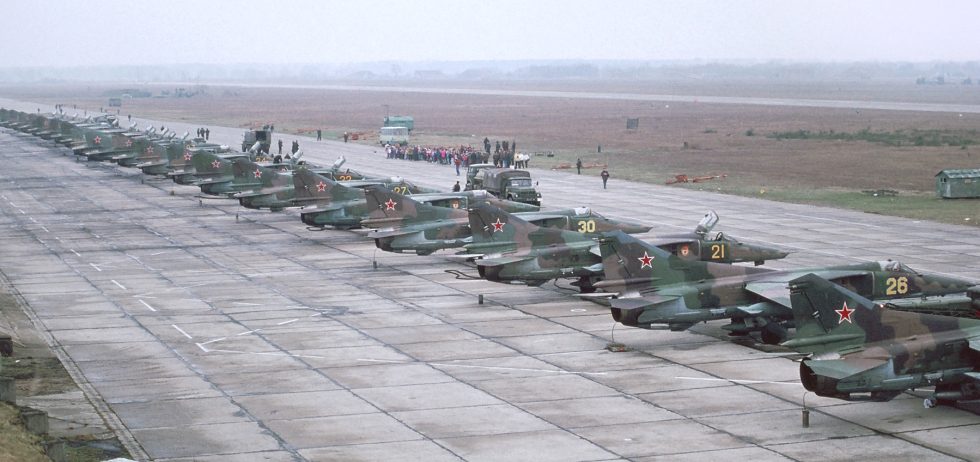
The MiG-27 story starts with an admission of failure. The MiG-23BN, a MiG-23 with a bombing nose and a twin-barrel cannon, was not good enough at attack to justify itself, and the Mikoyan bureau responded by taking the compromise apart: delete the variable intakes and the variable nozzle the fighter needed and the bomber did not, spend the saved weight on armour, gear and pylons, and fit a cannon of unreasonable power. The result entered VVS service in 1975 and eventually equipped 22 of the 40 Soviet fighter-bomber regiments.
Because the family is confusing, keep two rules in mind. First, anything with a MiG-23 designation is a MiG-23 and belongs to that aircraft’s page, including the MiG-23B and MiG-23BN attack marks and the MiG-23UB trainer on which every MiG-27 pilot converted. Second, the MiG-27 was originally designated MiG-23BM in the factory and is still occasionally listed that way; it is the same aeroplane as the MiG-27, renamed in 1975 precisely to mark the break.
- MiG-23B (1970–1971, 24 built)
- The first attack MiG-23, flown in August 1970: sloping radarless nose, armoured cockpit, Lyulka AL-21F-3 engine. Production stopped almost at once because the AL-21 was needed for the Su-24 and could not be exported. Still a MiG-23.
- MiG-23BN (1973–1985, ~624 built) Flogger-F/H
- The AL-21 swapped for the R-29B-300 and the twin 23 mm GSh-23L retained. Widely exported to India, Iraq, Syria, Libya, Egypt, Algeria and Cuba, and the aircraft that saw most of the family’s export combat. A MiG-23, not a MiG-27, and the two are endlessly confused.
- MiG-27 (izdeliye 32-25, ex-MiG-23BM; 1973–1977, ~360 built) Flogger-D
- The break: fixed intakes, shortened nozzle, strengthened undercarriage and pylons for 4,000 kg, PrNK-23 nav-attack with a Fon laser ranger, and the GSh-6-30A. Roughly 300 kg lighter in structure and 600 km/h slower than a MiG-23, and far better at the job.
- MiG-27K (izdeliye 32-26; ~197 built, late 1970s to mid-1980s) Flogger-J2
- The best of them. The Kaira-23 laser designator and television seeker in an enlarged nose with a ventral window, an Orbita-20 digital computer, and clearance for the whole guided arsenal including Kh-29T and KAB-500Kr. Expensive enough that a cheaper parallel mark was ordered before it finished production.
- MiG-27M (izdeliye 32-29; ~162–200 built, 1978–1983) Flogger-J
- The affordable K: PrNK-23M with the Klen-PM laser rangefinder-designator instead of Kaira, so laser-guided weapons but no television channel, plus improved electronic countermeasures. Sources give either about 162 or about 200 Soviet-built examples; the higher figure may include Indian kit aircraft.
- MiG-27D (izdeliye 32-27; ~300–305 conversions, 1982–1989) Flogger-J
- Existing MiG-27s rebuilt to approximately MiG-27M standard with the Klen-PM and the M’s weapons clearance. Not new aircraft — a fact that wrecks most published production arithmetic for the type, since the D airframes are counted twice.
- MiG-27L / MiG-27ML "Bahadur" (HAL Nasik, 1986–1996, 150–165 built)
- India’s licence-built MiG-27M, named Bahadur, "the valiant". First Indian-assembled aircraft flew on 11 January 1986; the first 50 came from Irkutsk subassemblies and local content rose steadily thereafter. Delivered with a reduced avionics fit relative to Soviet MiG-27Ms.
- MiG-27UPG (HAL upgrade, from the mid-2000s, ~40 aircraft)
- The Indian mid-life rebuild: new mission computer and databus, a modern head-up display and multi-function displays, a radar warning receiver, a countermeasures dispenser and restored precision-weapon capability. It made a genuinely useful aircraft of the Bahadur, and it could do nothing about the R-29.
- Sri Lankan MiG-27M (ex-Ukrainian, from 2000; roughly 10–14 acquired in batches)
- Refurbished ex-Soviet airframes bought from Ukraine, the first four in May 2000 at a reported 1.75 million US dollars each, with further batches in 2006–2007 to replace crash and combat losses. They gave the Sri Lanka Air Force its first real dedicated ground-attack aircraft since the Pucáras and were worked hard through Eelam Wars III and IV against LTTE positions in the north and east, flying close support and interdiction with unguided bombs and rockets. The record around them is grim on every side: a Ukrainian pilot killed in August 2000, one aircraft destroyed on the ground in the LTTE raid on Katunayake on 24 July 2001 that wrecked thirteen aircraft in all, a loss at sea in June 2004, a training accident in 2012, and a long-running corruption inquiry into the 2006 purchase. No. 12 Squadron was shut down in early 2019.
Closing note on the type’s end and what survives. No air force flies the MiG-27 today. Russia began withdrawing the type from 1 July 1993, barely eighteen years after it entered service, as post-Soviet force cuts fell hardest on the fighter-bomber regiments; Belarusian and Ukrainian airframes were scrapped or reduced to instructional use, and Ukraine’s last were formally gone by 2023. India, the largest and longest user, retired its last MiG-27UPGs on 27 December 2019 at Jodhpur, when No. 29 Squadron "Scorpios" flew the type for the final time and was number-plated. Sri Lanka shut down No. 12 Squadron in early 2019, its surviving MiG-23/27 airframes already unserviceable. Kazakhstan kept a dozen MiG-27Ms the longest; they were withdrawn in 2023 and sold in April 2024 as part of a batch of 81 obsolete Soviet-era aircraft auctioned for about 2.26 million US dollars, reportedly to a United States buyer for spares. Survivors are therefore museum pieces and gate guardians rather than flyers: original airframes exist in some numbers in Russian, Indian, Ukrainian and Sri Lankan collections, and there are no reproductions and no civil-registered airworthy examples anywhere. Nobody has ever restored a MiG-27 to flight, and the combination of the R-29’s reputation and the GSh-6-30’s legacy suggests nobody will.
From fighter derivative to Cold-War bomb-truck
The MiG-23 fighter flies
Mikoyan-Gurevich’s swing-wing MiG-23 interceptor first flies, giving the Soviets a variable-geometry airframe to adapt for other roles.
The attack nose appears
The MiG-23B/BN fighter-bomber introduces the armoured, down-sloping “ducknose” and dedicated ground-attack avionics.
The dedicated Flogger takes shape
The MiG-23BM adds fixed simplified intakes and the GSh-6-30 cannon — the aircraft the Soviets renumber the MiG-27.
Enters Soviet service
The MiG-27 reaches Soviet Frontal Aviation as a dedicated low-level strike aircraft, eventually equipping many fighter-bomber regiments.
India builds the ‘Bahadur’
Hindustan Aeronautics licence-produces the MiG-27ML in India as the “Bahadur” (Valiant), the export success the type never found elsewhere.
Afghanistan
Soviet MiG-27s fly close air support late in the Soviet-Afghan War, limited by a high minimum altitude imposed by the MANPADS threat.
Kargil War
Indian MiG-27s fly ground-attack sorties over the Himalayas; one is lost to an engine flameout while firing rockets, its pilot captured and later returned.
The Floggers retire
Russia withdraws its MiG-27s from frontline use in 1993; Sri Lanka flies them through its civil war, and India retires the last examples in December 2019.
Twelve MiG-27 stories
Two Floggers, one name
The MiG-27 and MiG-23 share a NATO name and a wing — but not a job.
Read the full story
The platypus nose
Soviet crews nicknamed the MiG-27’s flat armoured nose the Utkonos — platypus.
Read the full story
The gun that shook the jet
The GSh-6-30 was so violent that firing it could crack the aircraft’s own tanks.
Read the full story
Simpler on purpose
The MiG-27 threw away the fighter’s variable intakes because a strike jet does not need them.
Read the full story
Why the wings still moved
A strike aircraft rarely dogfights, so the MiG-27 used its swing wing differently.
Read the full story
The Bahadur
India licence-built its own MiG-27 and flew the type longer than anyone.
Read the full story
Held high by the MANPADS threat
In Afghanistan the MiG-27 was kept above the altitude where its accuracy mattered most.
Read the full story
Nachiketa over the Himalayas
An Indian MiG-27 was lost in the 1999 Kargil War when its engine failed during a rocket attack.
Read the full story
No. 12 Squadron
Sri Lanka bought refurbished MiG-27s to fly ground attack in its long civil war.
Read the full story
From D to K
The MiG-27 family ran from the basic bomb-truck to a laser-toting precision striker.
Read the full story
Flogger, Frogfoot, Fitter
The MiG-27 was one of three Soviet strike aircraft that overlapped in service.
Read the full story
The end of the dedicated Flogger
By 2023 every air force had retired the MiG-27; none was replaced in kind.
Read the full story
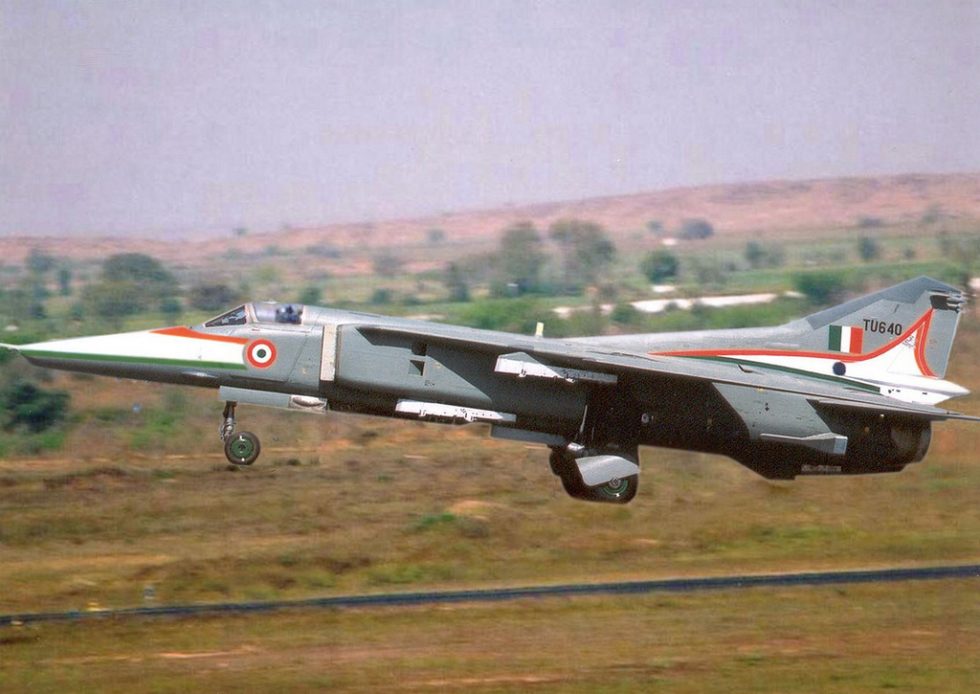
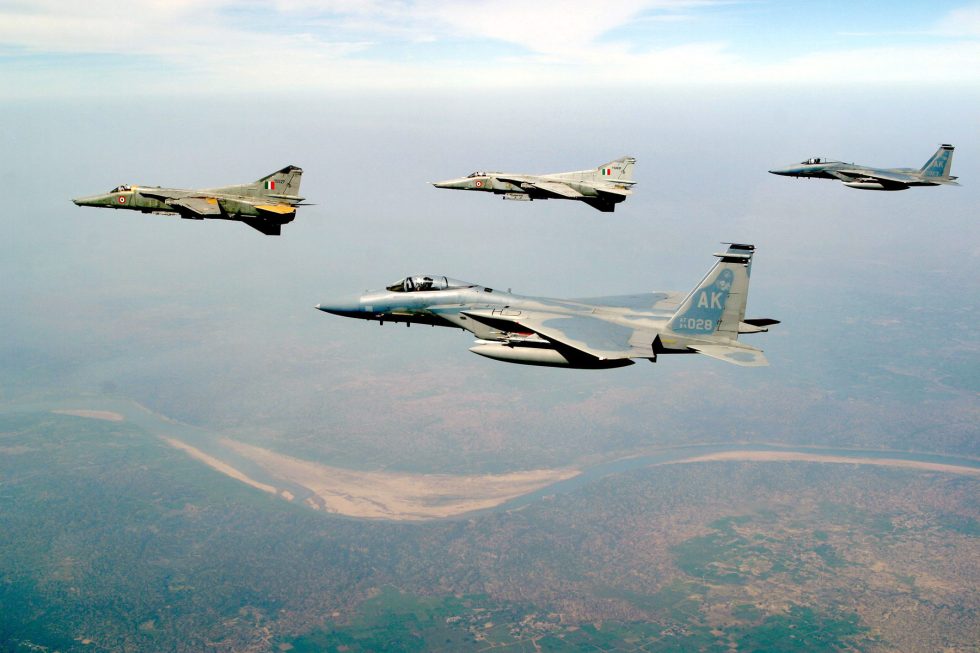
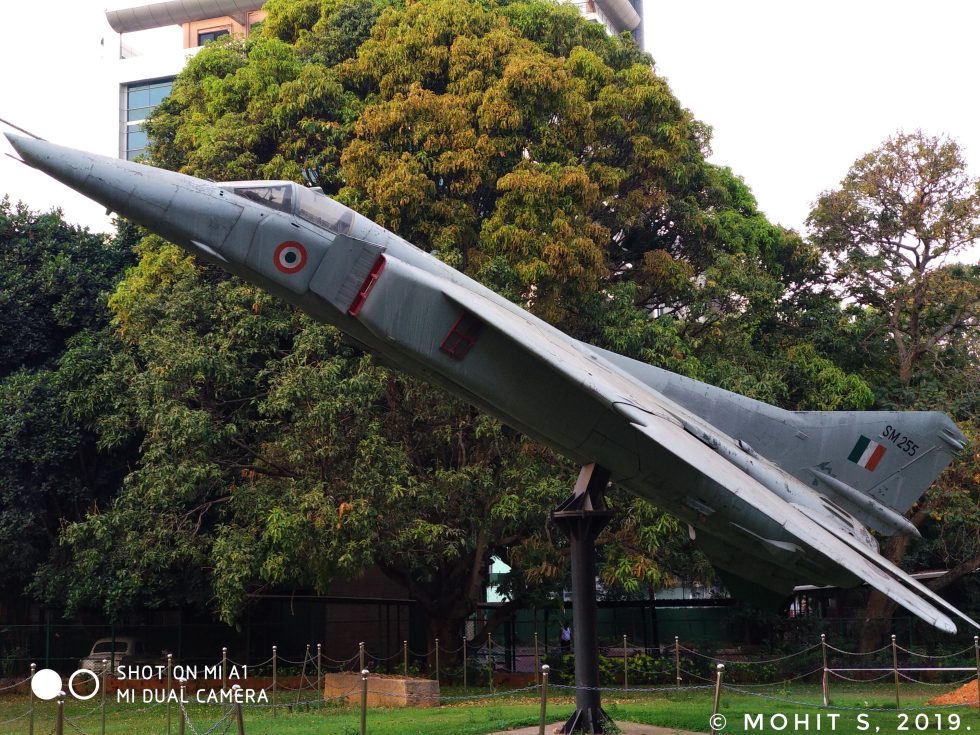
The MiG-27 in pictures
The MiG-27 in motion
A curated MiG-27 video feature is coming soon. In the meantime, explore the photo gallery and timeline above for a closer look at the Flogger, its ducknose and its swing wing.
Where the MiG-27 flew
The score that defines it
The MiG-27 was a ground-attack aircraft, so its combat history is measured in strike sorties, not air-to-air kills. It flew close air support in the Soviet-Afghan War, in India’s 1999 Kargil War and in Sri Lanka’s civil war. Precise sortie and loss figures are contested and vary by source; the record below is given factually and without endorsement of any side in these conflicts.
Compare the combat record of every military aircraft. Figures as of July 2026.
Everything people ask about the MiG-27
Can I fly in a MiG-27?
What is the difference between the MiG-27 and the MiG-23?
Why was the MiG-27’s cannon a problem?
How fast is the MiG-27?
What was the Indian “Bahadur”?
Did the MiG-27 fight in Afghanistan?
Is the MiG-27 still in service?
You can’t fly the MiG-27.
These, you can.
Some legends only live in museums — others are fuelled and waiting. MiGFlug has put civilians in real military jet cockpits since 2004.
 Fly the L-39 AlbatrosThe world’s most-flown jet trainer — aerobatics included
 Fly the F-104 Starfighter“The missile with a man in it”
 Fly the MiG-21The Cold War’s most-produced jet
 Fly the T-33 Shooting StarAmerica’s first jet trainer
 Fly the DH VampireA piece of early jet history
 Fly the S.211Agile Italian jet trainer
 Fly the MB-326The classic Aermacchi jet
 Fly the MiG-15The Soviet legend of the Korean War
Continue the tour
Every fact, checked
- Fly a Jet Fighter — The MiG-27 Flogger, from Moscow to KabulDevelopment from the MiG-23, the ducknose and fixed intakes, the cannon and combat use.
- The National Interest — the GSh-6-30 cannonThe gun’s rate of fire and the recoil damage to tanks, avionics and landing lights.
- Military Factory — Mikoyan MiG-27Specifications, variants and production cross-check.
- Airforce Technology — MiG-27 FloggerAirframe, engine and weapons-system reference.
- AeroCorner — Mikoyan-Gurevich MiG-27Dimensions, weights and performance figures.
- Republic World — Kargil War air assetsThe Indian MiG-27 in the 1999 Kargil campaign.
- The National Interest — India retires the “Valiant”The Bahadur’s Indian service and 2019 retirement.
- Sri Lanka Air Force — official siteReference for Sri Lankan air-operations context.