
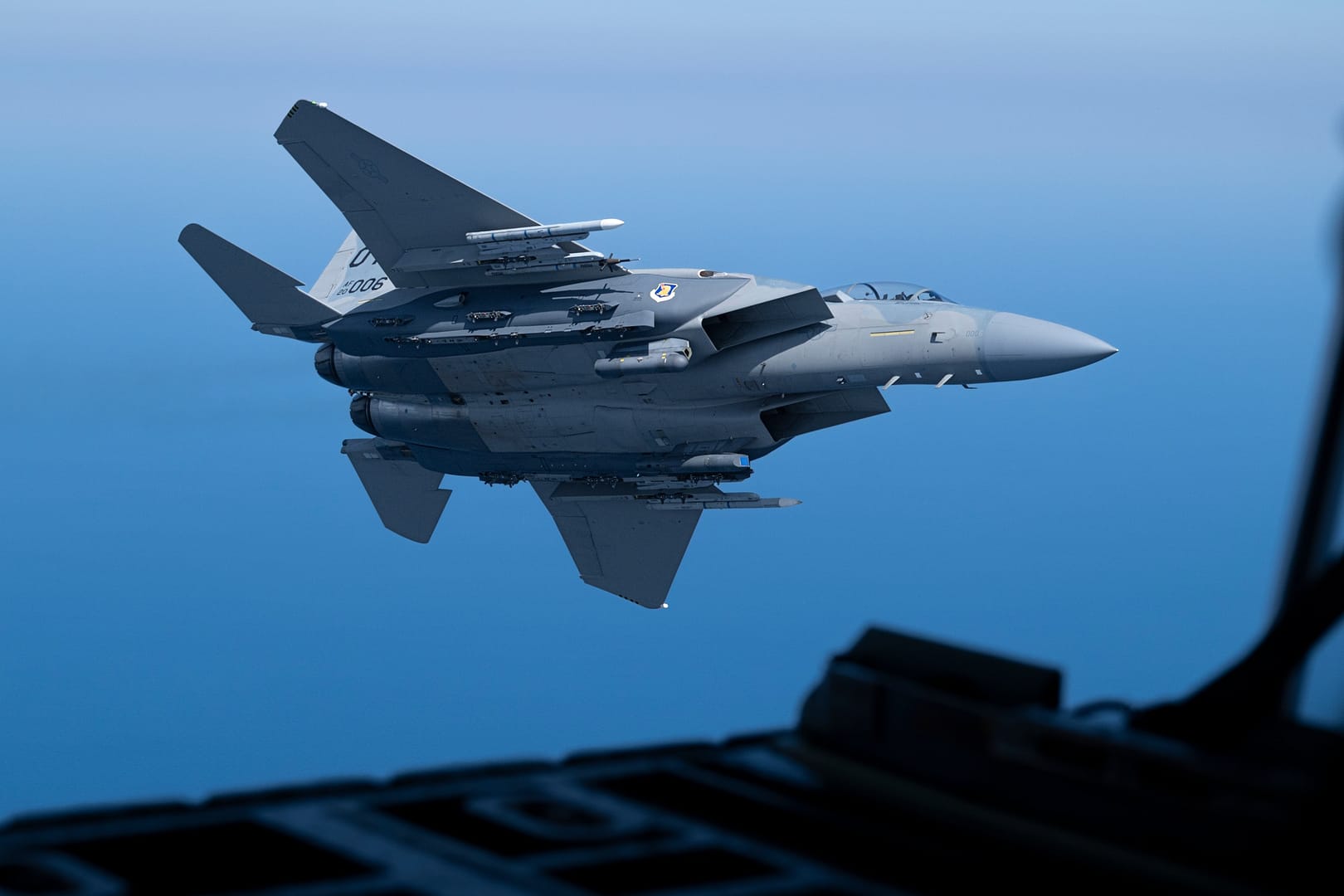
For a decade the U.S. Air Force kept trying to bury the F-15. The plan was to buy a token batch of new Eagles, then let the production line die quietly while everything went to stealth. The Eagle was the past. The F-35 and the secret sixth-generation jet were the future.
Then the service did something almost nobody saw coming. In its fiscal 2027 budget, unveiled at the Pentagon on April 21, 2026, the Air Force announced it now wants 267 Boeing F-15EX Eagle II fighters — more than double the 129 it had previously planned, and roughly triple the low-water mark of 98 jets it floated just a couple of years ago. A fighter the brass spent years trying to mothball is suddenly one of its biggest procurement bets of the decade.
So why does the “boring old Eagle” matter again? Because the math of a great-power fight changed — and the unglamorous things the F-15EX does better than anything else in the inventory turned out to be exactly what the Air Force is short on.
Quick Facts: Boeing F-15EX Eagle II
- New planned fleet: 267 aircraft (FY2027 budget request), up from 129
- Earlier low point: the buy had been cut as far as 98 jets
- Builder: Boeing, St. Louis, Missouri (ex-McDonnell Douglas line)
- Engines: two General Electric F110-GE-129 afterburning turbofans
- Radar: Raytheon AN/APG-82(V)1 AESA
- Air-to-air load: up to 12 missiles in an air-superiority fit
- First delivery: EX1 to Eglin AFB, March 11, 2021 (test fleet)
- First operational unit: 142nd Wing, Oregon Air National Guard (2024)
From the chopping block to the centrepiece
To appreciate how strange this is, rewind the tape. The Air Force originally talked about 144 F-15EXs. In the fiscal 2023 request that fell to 104. By fiscal 2025 it had slid to 98 — barely enough to re-wing a couple of Air National Guard units flying tired F-15C/D Eagles. The Eagle II looked like a stopgap with an expiry date stamped on it.
The 2027 number rewrites that story completely. At 267 jets the F-15EX is no longer a niche replacement for old air-defence Eagles. It is now slated to start recapitalising the F-15E Strike Eagle fleet as well, which keeps Boeing’s St. Louis line hot for years. Analysts have called it one of the most significant tactical-fighter procurement reversals in decades — a sharp break from the “divest to invest” doctrine that dominated Pentagon budgets for most of the 2010s.
More money, fewer hard choices
For years the Air Force was stuck in a brutal trade: keep ageing jets flying, or fund the new ones — never both. The 2027 budget’s answer was blunt. More money. The department’s top line jumps roughly 25 percent, procurement climbs about 30 percent, and suddenly the service can afford two hot fighter lines at once: the F-15EX and the F-35.
It’s worth being precise here, because the budget story is easy to garble. The F-35A buy is actually rising in 2027 — the Air Force is asking for 38 of them, up from just 24 in the lean 2026 request — even as it commits to far more Eagles down the road. The deep F-35 cut was last year’s news; this year the theme is “buy everything,” bankrolled by a spending surge. The sixth-generation Boeing F-47, meanwhile, is the budget’s darling, with more than $5 billion requested for development in 2027 alone.
Even the A-10 Warthog — the jet the Air Force has tried to kill for years — got a reprieve, with some squadrons now extended toward 2030 to preserve combat power while production ramps. The through-line is the same: in a tougher world, the Pentagon decided it could not afford to throw airframes away.


Why the Eagle suddenly matters
Stealth wins the opening night of a war. But wars are not one night long, and a stealth fighter can only carry so many missiles inside its body before its radar-evading shape fills up. That is where the Eagle earns its keep. The F-15EX is the inventory’s missile truck — in an air-superiority fit it can haul up to a dozen air-to-air missiles, far more than a stealth jet flying clean. When the shooting is constant and the targets are many, magazine depth is everything.
There is a homeland-defence angle, too. Patrolling the skies over the continental United States and the approaches to North America is a numbers game, not a stealth game. You need lots of fast jets with big radars and long legs that can sit on alert and intercept anything from a wandering airliner to a cruise missile. The Eagle, with its enormous AN/APG-82 AESA radar and brute payload, is tailor-made for it — and it frees up scarce F-22s and F-35s for the missions only they can fly.
That last point matters more every year. The F-22 Raptor fleet is small and ageing, and the F-47 is still years from squadron service. The Air Force needs capacity now, from a jet that already exists and is rolling off a line in Missouri. The Eagle II is not exciting in the way a stealth jet is. It is exciting in the way a reliable answer to an urgent problem is.
A 1970s shape, a 2020s brain
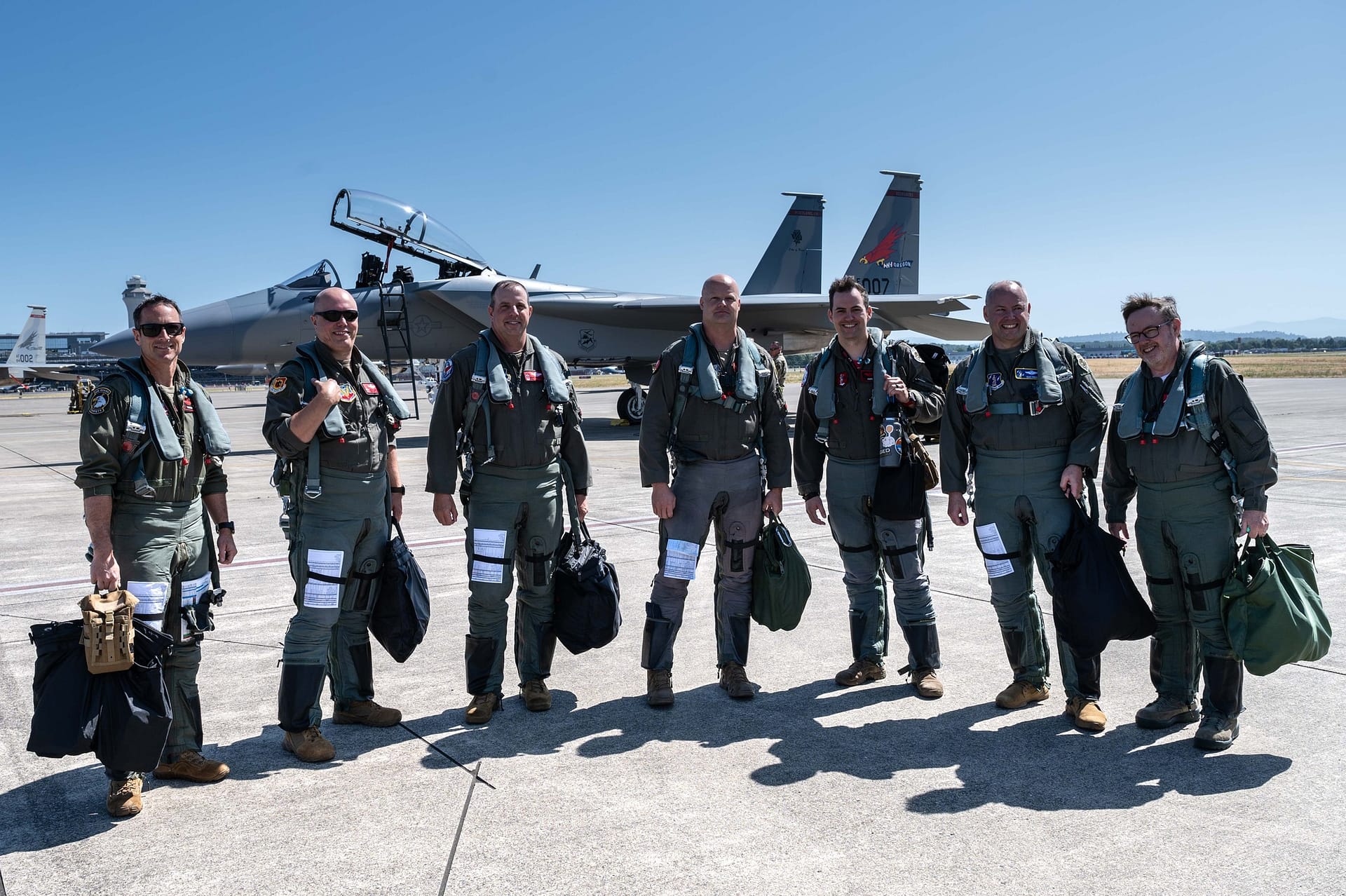
The Eagle II looks almost exactly like the F-15 that first flew in the early 1970s — same big twin tails, same broad shoulders. Under the skin it is a different animal. Two General Electric F110-GE-129 engines, a fully digital fly-by-wire flight control system, an all-glass cockpit, modern mission computers, and that APG-82 radar make it the most capable Eagle ever built. It is fast, it is tough, and it carries a war’s worth of weapons.
The first F-15EX, EX1, touched down at Eglin Air Force Base in Florida on March 11, 2021 for testing. The first operational jets went not to an active-duty wing but to the Oregon Air National Guard’s 142nd Wing in 2024 — a rare case of the Guard getting brand-new fighters before the regulars. California’s 144th Fighter Wing and other units are in line behind them.
None of that is glamorous. But the Air Force just bet 267 airframes that unglamorous and available beats flashy and years away. For a jet that was supposed to be retired into history, the Eagle is having a remarkable second act.
Boeing footage of an F-15EX Eagle II delivery flight — the kind of jet the Air Force now wants 267 of.
Sources: Breaking Defense; Air & Space Forces Magazine; Army Recognition; The War Zone; U.S. Air Force / DVIDS; Boeing.
Related Questions
What is the F-15EX Eagle II?
The F-15EX Eagle II is the latest version of Boeing's F-15 Eagle: a twin-engine fighter with modern radar, a digital cockpit and the ability to carry a very large weapons load. Built in St. Louis on the former McDonnell Douglas line, it is designed to fly alongside stealth jets as a heavily armed "missile truck".
How many F-15EX is the US Air Force buying?
In its fiscal 2027 budget, unveiled on April 21, 2026, the U.S. Air Force said it now wants 267 F-15EX Eagle II fighters — more than double the 129 previously planned, and roughly triple the low point of 98 jets floated a couple of years earlier.
How many missiles can the F-15EX carry?
In an air-superiority fit the F-15EX can carry up to twelve air-to-air missiles, more than a stealth fighter whose weapons must fit inside internal bays. This large external load is a key reason the Air Force values it alongside the F-35 and future stealth fighters.
Who builds the F-15EX?
The F-15EX is built by Boeing in St. Louis, Missouri, on the line inherited from McDonnell Douglas. It is powered by two General Electric F110-GE-129 engines and fitted with the Raytheon AN/APG-82(V)1 active electronically scanned array (AESA) radar.
Why is the Air Force buying more F-15EX?
The F-15EX does unglamorous but essential jobs — homeland defence, carrying large or heavy weapons, and quickly adding numbers — that stealth jets cannot do as cheaply. As planning shifted toward possible great-power conflict, those strengths made the Eagle a centrepiece again, much like Israel's order of new F-15 Eagles.

0 Comments