
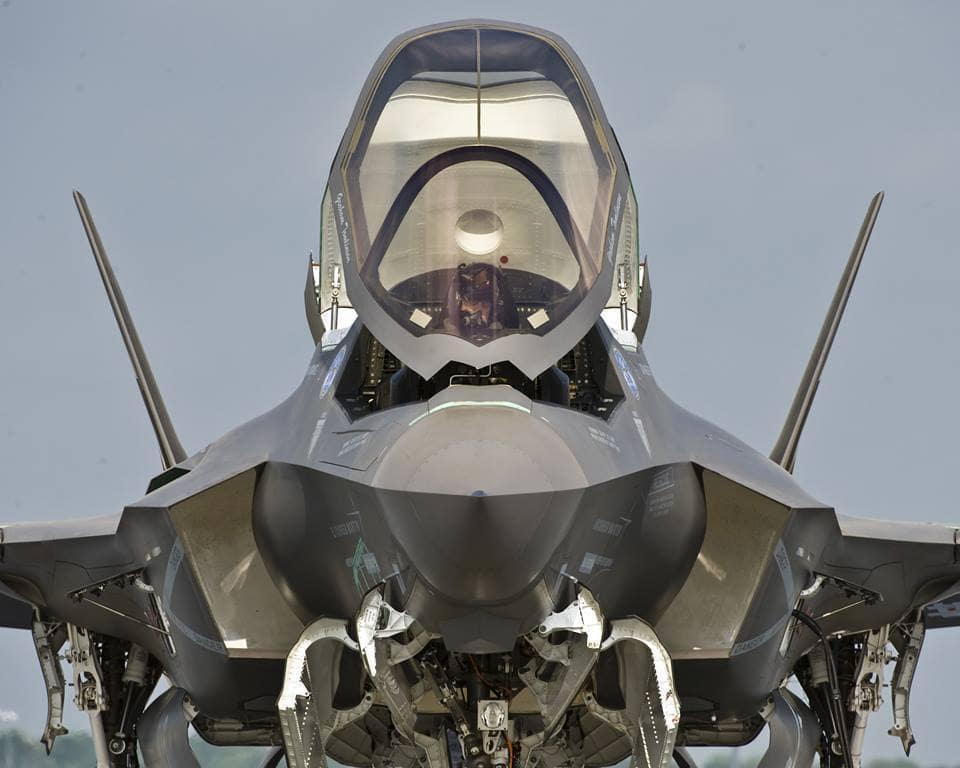
Boeing promotes F-35C Exit Strategy
We have repeatedly covered the 5th-generation topic, asking whether these jets will be the last manned fighters before being replaced by UAVs. Articles about the topic can be found here (cost), here (UAVS vs jet fighters) or here (comparison of 5th generation fighter jets of different nations - the US, Russia and China. We have also covered the launch of two Chinese 5th gen fighters, which came by many as a surprise. Now - what is also quite surprising, is that the richest of these 3 "5th gen nations" is not getting the programs under control - it seems very likely that the programs just gets another cut. Boeing, the world’s largest aviation company, is offering an exit strategy to its competitor’s product, the F-35C Lightning II, developed and produced by Lockheed Martin. Lockheed Martin itself is one of the world's largest defense contractors, and the US top defense contractor in 2008 and 2009. This is a clash of two industry giants. It is also a fight between generation 4+, promoted by Beoing subsidiary Boeing Defense, Space & Security (BDS) vs. the very latest in technology, the 5th generation Lockheed Martin F-35C Lightning II.Attack on F-35 cost and technology
Boeing officials started promoting F/A-18 Super Hornets and EA-18G Growler to the Navy at 2003 Paris Le Bourget Air Show - as a hedge against the Joint Strike Fighter program, the most expensive military acquisition program in US history. But the attack is not only about exploding cost of the JSF program: Recently, Boeing has gone a step further and questioned whether the F-35's stealth technology is still effective against the latest air defense systems being developed in Russia as well as in China. At the recent Navy League's annual conference, Boeing officials held a presentation that questioned the so called "perishability of stealth". Boeing also said the F-35 is not as effective against the wide spectrum of air defense systems as the F-Growler.Electronic warfare more important?
Even though the Navy officially stays committed to the JSF program, it has ordered 22 more Growlers recently. These are so called airborne electronic attack platforms, based on the F/A-18 platform. Boeing thinks that the Growler must be included in future strike packages in order to protect fifth generation fighters and other assets from air defense systems. Defense analyst Loren Thompson explained that...the presence of a Growler nearby a stealthy aircraft such as an F-22 or F-35 could alert an enemy that planes are nearby. Although it is a jamming aircraft, the Growler is not stealthy. Knowing that the Growler is present, you would have to assume other aircraft are also nearby - so it could tip off the enemy as to the presence of other aircraft.Thompson further criticized the decisions made so far:
If a jamming aircraft is needed to support stealthy planes like the F-22 or the F-35, then why isn't the Marine Corps or the Air Force developing a next-generation jamming aircraft? They seem to think that what they are getting in the F-35 will be survivable on its own.The development of a next generation jamming aircraft will take a lot of time. And the F/A-18 production will probably stop as early as 2019 of there are no follow-up orders coming. It will be interesting to see what comes next.
Related Questions
Why are fifth-generation fighter jets so expensive?
Fifth-generation fighters are costly because they combine stealth, advanced sensors, sensor fusion, networking and powerful engines, all requiring enormous research, development and testing. Low-observable manufacturing is exacting, software is vast and complex, and small production numbers spread fixed costs over fewer aircraft. The result is programmes whose development and lifetime costs can run into the hundreds of billions or even trillions.
What is a fifth-generation fighter jet?
A fifth-generation fighter is the most advanced class of combat aircraft, defined by stealth, sensor fusion that merges data into a single picture for the pilot, advanced networked avionics and often supersonic cruise. Examples include the American F-22 and F-35, Russia's Su-57 and China's J-20. They are designed to detect and strike first while remaining hard to find.
Will drones replace manned fighter jets?
Many analysts expect uncrewed aircraft to take on more combat roles, and air forces are already developing "loyal wingman" drones to fly alongside fighters. Whether drones fully replace manned jets remains debated, since human judgement and flexibility are still valued. For now the trend is teaming, as seen with Europe's new combat drones.
How much does the F-35 program cost?
The F-35 Joint Strike Fighter programme is projected to cost well over one trillion dollars across its lifetime, counting development, procurement and decades of operation and maintenance for thousands of aircraft. That staggering figure has made it the most expensive weapons programme in history and a frequent focus of debate over whether fifth-generation fighters are affordable.
Which countries build fifth-generation fighter jets?
Only a few nations have fielded fifth-generation fighters: the United States with the F-22 and F-35, Russia with the Su-57, and China with the J-20. Several others are pursuing them, and China in particular has invested heavily, as described in Chengdu's stealth-fighter building boom.
0 Comments