

The first big order of Farnborough 2026 landed before most of the stands had finished setting up. Riyadh Air, the Saudi carrier that flew its first paying passenger barely three weeks ago, spent Monday morning committing to 34 more widebody aircraft across both Boeing and Airbus.
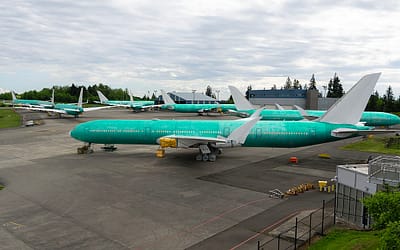
The headline number is 28 Dreamliners. The more interesting detail is what kind. Twenty of those 28 have been switched from the 787-9 to the stretched 787-10 — roughly fifty more seats per aircraft, on an airline that has been flying commercially for less than a month.
That is either enormous confidence or enormous pressure. Riyadh Air has promised to serve more than 100 destinations by 2030.
Quick Facts
| Announced | 20 July 2026, opening day of the Farnborough International Airshow |
| Boeing | 28 787 Dreamliners firmed up by exercising options from the airline’s 2023 order, including a previously unidentified purchase of 11 |
| The switch | 20 of those 28 converted from 787-9 to the larger 787-10 |
| Airbus | Six more A350-1000s firmed, taking Riyadh Air’s commitment to 31 of the type |
| In service now | Six 787-9s delivered, serving six cities |
| Owner | Saudi Arabia’s Public Investment Fund. The airline was launched in March 2023 |
| Target | More than 100 destinations by 2030, part of the Kingdom’s Vision 2030 programme |
What actually changed
It is worth being precise, because the round numbers flying around the show are misleading. Riyadh Air did not walk into Farnborough and order 28 brand-new aeroplanes. It exercised options it already held from its original 2023 Dreamliner deal and converted most of them upward to the bigger variant.
Boeing says that once the remaining 17 aircraft in that arrangement are finalised, Riyadh Air's firm 787 count will reach 67. That is a conditional statement about the future, not a number the airline holds today.
The 787-10 is the stretch of the family: about fifty more seats than the 787-9, and Boeing claims a 25 percent cut in fuel use and emissions against the aircraft it typically replaces. The trade is range. The -10 does not fly as far as the -9, which means it is a machine for dense, established, high-demand routes rather than for opening thin new ones at the edge of the map.

Both manufacturers, same morning
The Airbus half of the day was smaller but strategically neat. Six more A350-1000s were firmed, lifting Riyadh Air's commitment to 31 aircraft out of a 2025 arrangement covering up to 50. It will be the first Saudi operator of the type.
Splitting a widebody fleet between the 787 and the A350 is not the cheapest way to run an airline — two type ratings, two spares chains, two maintenance ecosystems. It is, however, an effective way to keep both manufacturers competing for your business, and a startup with sovereign-fund backing can afford the overhead in a way most carriers cannot.
For Airbus, the A350 family stood at 1,595 firm orders from 68 customers at the end of June. For Boeing, a Dreamliner order from a launch-phase carrier with a state balance sheet behind it is exactly the kind of news the company has wanted for several years.
The gap between the plan and the aeroplanes
Six cities today. More than a hundred by 2030. That is the number worth watching, and aircraft are the easy part of it — slots, crews, maintenance capacity and traffic rights are all harder to order at an airshow.
Still, the direction is unambiguous. An airline that has existed commercially for weeks has just told both of the world's aircraft manufacturers that it intends to need considerably bigger aeroplanes than it originally asked for.
A rundown of the Riyadh Air order from day one of Farnborough.
Sources: Boeing, Airbus, Simple Flying, AeroTime, FlightGlobal.
0 Comments