

Skunk Works and FalconWorks are the two most secretive advanced-projects shops in Western aerospace. Lockheed Martin's built the U-2, the SR-71 and the F-117. BAE Systems' is the British equivalent, the place where the awkward, classified and interesting work goes.
They do not usually build things together. On Monday at Farnborough they showed what happened when they did, and it is about 400 pounds, shaped vaguely like a cruise missile, and designed to fly into the teeth of an air-defence network so that something more expensive does not have to.
It is called Blizzard.
Quick Facts
| What it is | A modular, multi-mission uncrewed air system — an autonomous collaborative platform, in the jargon |
| Built by | BAE Systems’ FalconWorks and Lockheed Martin’s Skunk Works, jointly, with UK and US content |
| Unveiled | 20 July 2026, opening day of the Farnborough International Airshow |
| Weight | Roughly 400 lb (about 181 kg) |
| Mission | Stand-in jamming, decoying and suppression of enemy air defences |
| Launch options | Air drop from a fast jet, palletised release from a transport such as the A400M, plus ground and maritime launch |
| Status | Captive-carry trials complete. Flight testing expected in 2027, with production readiness targeted for 2027–28 |
| Origin | The partnership was announced at DSEI in London in September 2025; the design was shown then, unnamed |
Small, cheap, and expected not to come back
Blizzard is not a loyal wingman. It is important to say that clearly, because the term is being applied to almost everything with a propeller and an autopilot at this show. At 400 pounds it is a fraction of the size of a collaborative combat aircraft like the F-35's prospective robot escorts.
It belongs to a different family: the air-launched effect. Something you carry, release, and spend. Its job is to fly into contested airspace and confuse, decoy or jam the radars and missile batteries waiting there — a role that has historically required a crewed aircraft to go and do it in person, at considerable risk.
Anthony Gregory, BAE's FalconWorks business development and strategy director, described the intent in plain terms on the show's opening day: Blizzard exists to let other systems do their jobs.
Gregory also called the development “truly a joint design effort” — not a case of one company subcontracting to the other, but shared engineering across the Atlantic. Given how jealously both organisations normally guard their work, that is the genuinely unusual part of the announcement.
Launched from almost anything
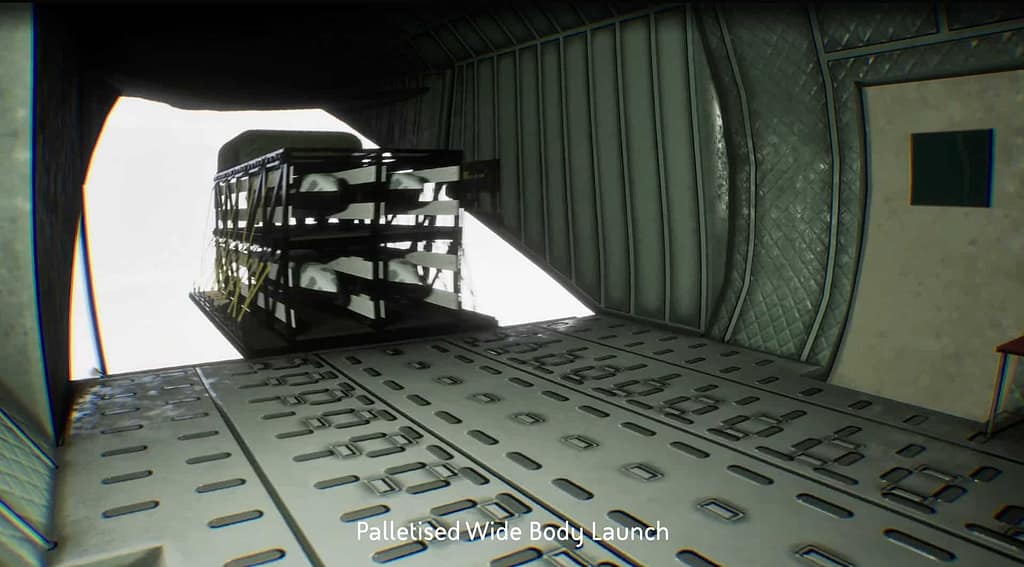
The launch flexibility is the design's other selling point. Air drop from a fast jet is the obvious option, and Janes reports Typhoon and F-35 have been discussed as carriers — though that detail comes from a single outlet and neither company has confirmed a carriage clearance. The more striking option is the transport aircraft: pallets rolled out of the back of an A400M-class airlifter, turning a cargo plane into a mass-launch platform.
Ground and maritime launch are also on the list. The pattern is familiar from Ukraine, where the cheapest and most effective systems have tended to be the ones that do not care what they are fired from.
Blizzard's stated lineage on the American side runs to Skunk Works' Common Multi-Mission Truck family, a set of low-cost expendable airframes built around exactly this logic. On the British side it complements StormShroud, the RAF's existing uncrewed stand-in jammer.
What is actually new
The collaboration itself is not the news — that was announced in September 2025, when Dave Holmes, who runs FalconWorks, set out what the two companies were trying to achieve.
What Farnborough added is the name, a physical article on a stand, a weight class, and a timeline. Aviation Week reports captive-carry trials are complete and flight testing follows in 2027; Janes describes the trials as having included release as well, and puts production readiness at the end of 2027. Those accounts do not quite agree, and neither company has published a definitive schedule.
No military designation exists. No customer has been named. For now Blizzard is a product with a brand, a mock-up and two very secretive parents — which, in this corner of the industry, is usually how things start.
A walk-through of the Blizzard reveal and what the two companies have said about it.
Sources: Aviation Week, Janes, The Aviationist, BAE Systems, FlightGlobal.
0 Comments