
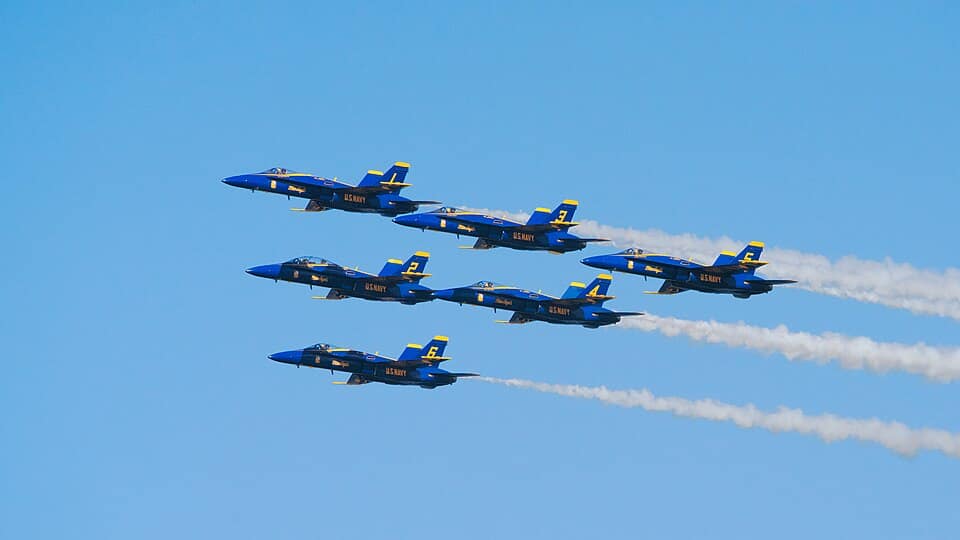
Aircraft Boeing F/A-18E/F Super Hornet (transitioned from legacy Hornets in 2021)
Founded 1946 — celebrating their 80th anniversary in 2026
Shows Cancelled NAS El Centro (March 14) and NAS Lemoore (March 21–22)
Reason Increased security measures at military installations due to the Iran war
Fat Albert Status C-130J Super Hercules grounded in the UK for wing box replacement since November 2025
Upcoming (Uncertain) Cocoa Beach (Apr 11–12), NAS Kingsville (Apr 18–19), Vidalia, GA (Apr 25–26)

Every spring, millions of Americans tilt their heads skyward and watch six Navy jets scream past in formation so tight the wingtips nearly touch. It's one of the great free spectacles in the country — and in 2026, it might not happen.
The Blue Angels have been grounded. The Navy's elite flight demonstration squadron — founded in 1946, celebrating its 80th anniversary this year — has already cancelled at least two shows and warned that the rest of the season is in jeopardy. The reason isn't mechanical. It isn't weather. It's war.
As Operation Epic Fury intensifies over Iran, military installations across the United States have shifted to heightened security postures. Airshows require open bases, open gates, and hundreds of thousands of civilian spectators pouring onto active military facilities. In the current threat environment, that's a combination the Navy isn't willing to risk.
Two Down, More at Risk
The first cancellation came on March 4, when the Blue Angels pulled out of their planned appearance at Naval Air Facility El Centro in California, scheduled for March 14. A week later, the show at NAS Lemoore on March 21–22 was also scrapped. Both cancellations came just weeks after the team received its annual performance certification — the green light that normally signals the start of a full airshow season.
The Navy cited "increased security measures and evolving force protection requirements" at military installations. Translation: with American forces in active combat against Iran, the Pentagon doesn't want to divert security resources to manage airshow crowds, and it doesn't want soft targets at the gates of operational air bases.
As of early April, shows at Cocoa Beach, Florida (April 11–12), NAS Kingsville, Texas (April 18–19), and Vidalia, Georgia (April 25–26) remain on the schedule — but all dates carry the same caveat: subject to change as the Navy reallocates resources. Nobody at Pensacola is promising anything right now.

Fat Albert Stuck Across the Atlantic
The airshow disruption would be painful even if the full team were available. But it's worse than that. Fat Albert — the Blue Angels' iconic C-130J Super Hercules transport — isn't even in the country.
The aircraft has been in the United Kingdom since November, undergoing replacement of its integral centre wing box — a massive structural overhaul that the Marines describe as essentially rebuilding the spine of the airplane. The C-130J was originally acquired from the Royal Air Force in 2019 and joined the Blue Angels in 2020. Fat Albert typically opens every show with a thundering 15-minute solo demonstration that includes a short-field takeoff, steep tactical approaches, and low-level passes. Without it, even the shows that do go ahead will feel incomplete.
The Blue Angels have included a C-130 in their shows since 1970. A generation of airshow fans has never seen a Blue Angels performance without the big turboprop warming up the crowd before the jets arrive. In 2026, they might have to get used to it.

An Anniversary Without a Party
The timing is particularly bitter. 2026 marks the Blue Angels' 80th anniversary. The squadron was established on April 24, 1946 — just eight months after the end of World War II — when Admiral Chester Nimitz ordered the Navy to form a flight demonstration team to keep the public interested in naval aviation. The original team flew Grumman F6F Hellcats. Eight decades later, their successors fly Boeing F/A-18E/F Super Hornets at speeds north of 700 mph, performing manoeuvres at 7.5G that push the limits of human endurance.
Between 1946 and 2025, the Blue Angels performed for an estimated half a billion spectators. They are, by any measure, the most effective recruiting tool the U.S. Navy has ever built. After every show, the team's PR tent gets mobbed by teenagers wanting to know how to become a naval aviator. For many of them, the Blue Angels show is the moment aviation stops being a poster on the wall and becomes a plan.
Whether those teenagers get their show this year depends on something happening 6,000 miles away. If the war in Iran de-escalates, the gates may open. If it doesn't, the Blue Angels' 80th anniversary season could be the quietest in the squadron's history. The jets are ready. The pilots are ready. The war just has other plans.
Sources: Flying Magazine, Aero-News Network, U.S. Navy
Related Questions
Who are the Blue Angels?
The Blue Angels are the U.S. Navy's Flight Demonstration Squadron, founded in 1946 and one of the world's oldest aerobatic teams. Based at NAS Pensacola, they fly precision formation shows at airshows across America, drawing millions of spectators each year. In 2026 they mark their 80th anniversary.
What aircraft do the Blue Angels fly?
The Blue Angels fly the Boeing F/A-18E/F Super Hornet, having transitioned from the smaller legacy Hornets in 2021. It is the same carrier-based strike fighter used by frontline Navy squadrons — the kind of jet flown in demanding missions like night carrier landings.
Why were the 2026 Blue Angels shows cancelled?
The Blue Angels cancelled shows at NAS El Centro and NAS Lemoore in March 2026 because of heightened security at military bases during the war with Iran. Airshows need open bases and large civilian crowds — a combination the Navy would not risk while U.S. forces were in active combat, the same pressure that pulled the F-22 demo team from airshows.
What is Fat Albert?
Fat Albert is the Blue Angels' C-130J Super Hercules transport, which opens each show with a roughly 15-minute solo of short-field takeoffs and low passes. Acquired from the Royal Air Force in 2019, it has been grounded in the UK since November 2025 for a centre wing box replacement.
How close do the Blue Angels fly to each other?
In their signature diamond formation, Blue Angels jets fly with wingtips only about 18 inches apart, flown by hand without computer assistance. That precision is what makes the team one of aviation's great free spectacles.
What is the difference between the Super Hornet and the legacy Hornet?
The Boeing F/A-18E/F Super Hornet is larger and more powerful than the original F/A-18 legacy Hornet, with greater range, payload and thrust. The Blue Angels adopted it in 2021 to match the aircraft flown by today's carrier air wings.
0 Comments