
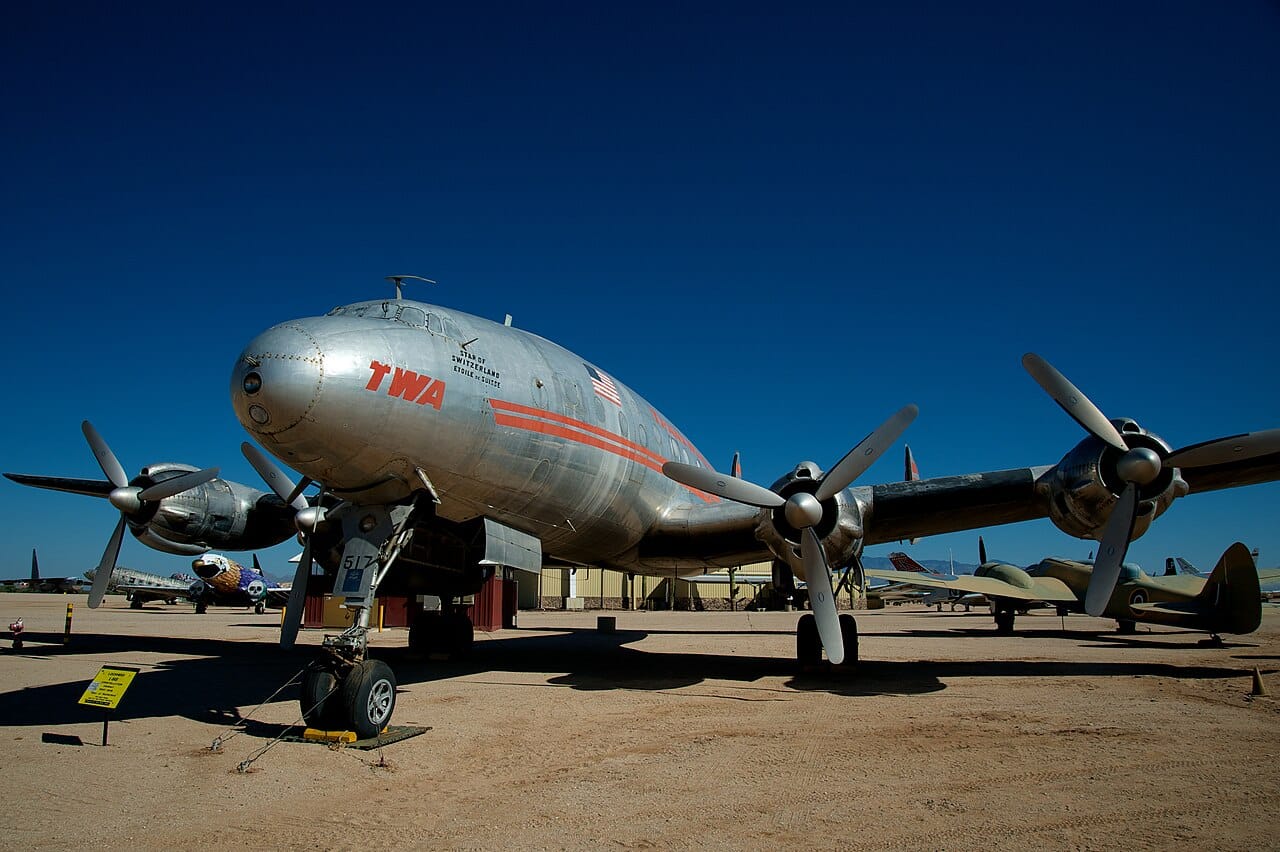
It is just before dawn on 17 April 1944, and a sleek, triple-tailed airliner is rolling down the runway at Lockheed’s Burbank field. In the left seat, hands on the controls, sits one of the most famous men in America: Howard Hughes — aviator, tycoon, and the secret force behind this aeroplane. Beside him is Jack Frye, the president of TWA. Their plan for the day is simple and audacious: fly clear across the United States to Washington, D.C., faster than anyone ever has.
Six hours and fifty-seven minutes later, they touch down at National Airport. They have just flown coast to coast in under seven hours in a propeller airliner — a feat that leaves the aviation world stunned. The aircraft is the Lockheed Constellation, and it is about to change what air travel means.
QUICK FACTS
Aircraft: Lockheed Constellation — four-engine, triple-tailed propliner
Nickname: “Connie”
First flight: 9 January 1943 (as the military C-69)
Driving force: Howard Hughes and TWA, who shaped the design
Party trick: A pressurised cabin that let it cruise above the weather
Record run: Burbank to Washington in under 7 hours, 17 April 1944
An airliner shaped like a dolphin
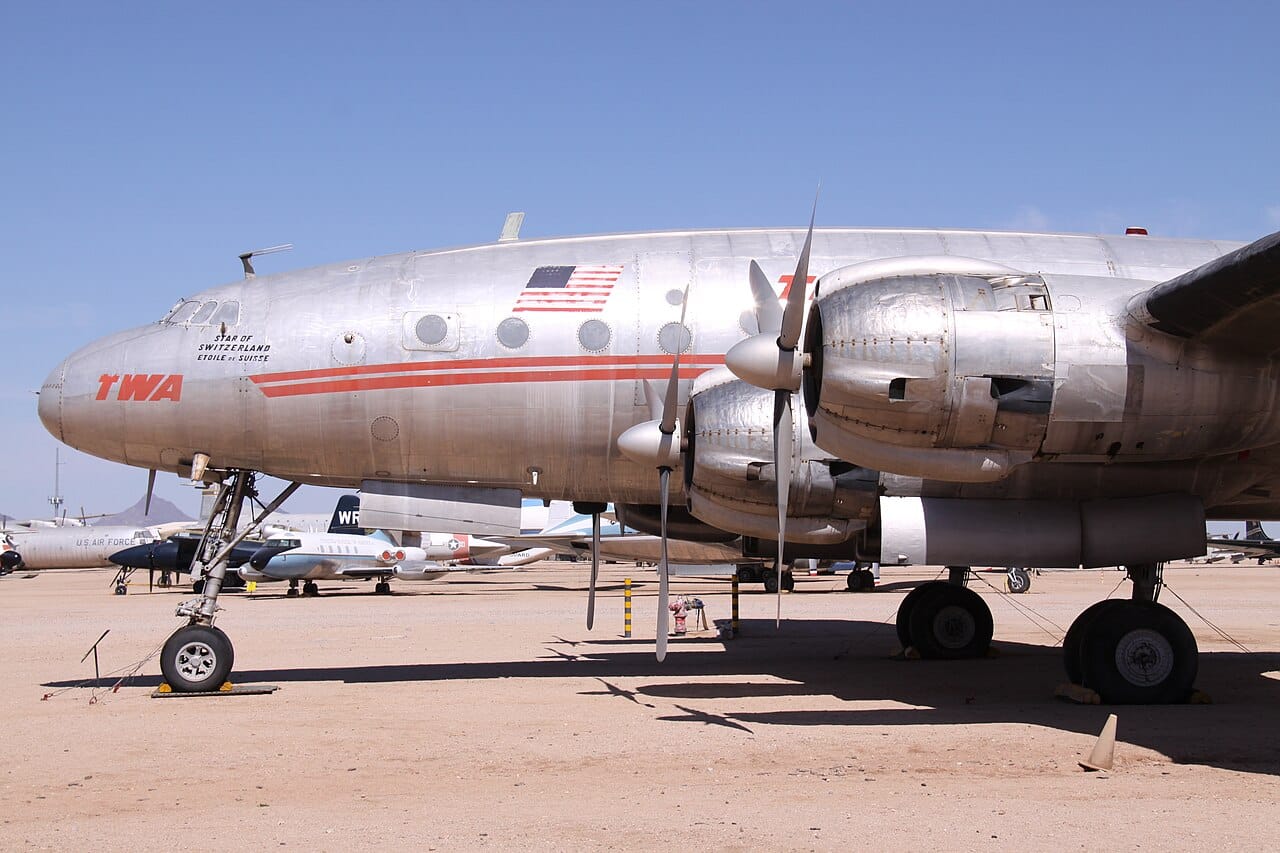
Look at a Constellation and you understand why pilots and passengers fell in love. Where other airliners were straight aluminium tubes, the “Connie” had a gracefully curved fuselage that rose and fell like a dolphin’s back, set off by three tail fins instead of one. It is still routinely voted one of the most beautiful aircraft ever built.
The triple tail was not just for looks. A single fin tall enough to do the job would not have fit inside TWA’s existing hangars — so Lockheed split the tail area into three shorter fins to keep the height down. Beauty, in this case, came from a practical problem.
The real magic was invisible
The Constellation’s genuine breakthrough was something passengers could feel but not see: a pressurised cabin. Earlier airliners had to fly low, bumping through the weather where their passengers got airsick. The Connie could climb above 20,000 feet, over the worst of the turbulence, and cruise there in smooth air at more than 300 miles per hour.
Because it first flew in 1943, the early Constellations were pressed into military service as C-69 transports. But the design had been driven all along by Howard Hughes and TWA for one purpose: fast, comfortable, long-range airline travel. The moment the war ended, the Connie was ready to deliver it.
After 1945 the Constellation did exactly that. TWA and Pan Am put it on transatlantic routes, shrinking the ocean to an overnight hop. Stretched into the Super Constellation and the elegant Starliner, it became the flagship of the propeller age — and in military form, the radar-laden EC-121, it even served as one of the world’s first airborne early-warning aircraft.
The story of the Lockheed Constellation — from Kelly Johnson’s drawing board to the flagship of the propeller age.
The jet age, and a long goodbye
The Connie’s reign was glorious but short. Within a decade the Boeing 707 and the jet age made every piston airliner obsolete almost overnight. Yet the Constellation never lost its hold on people’s imaginations. A precious few still exist, and one airworthy Super Constellation still flies today, its four big radial engines filling the sky with a sound no jet can match.
That dawn dash across America in 1944 was the moment the world glimpsed the future of travel. It arrived wrapped in the most beautiful shape ever to carry passengers — and we have been chasing that elegance ever since.
Sources: This Day in Aviation; HistoryNet; Airline History Museum; Wikipedia.
Related Questions
What was the Lockheed Constellation?
The Lockheed Constellation, nicknamed the “Connie,” was a four-engine propeller airliner of the 1940s and 1950s. Famous for its curved fuselage and triple tail, it was one of the first airliners with a pressurised cabin, letting it fly fast and high above the weather across oceans.
Why does the Lockheed Constellation have three tails?
The Constellation has three tail fins because a single fin tall enough to do the job would not have fit inside the airline hangars of the day. Splitting the tail into three shorter fins kept the aircraft’s height down — a practical fix that became its signature look.
When did the Lockheed Constellation first fly?
The Constellation first flew on 9 January 1943. Because of the Second World War, the early aircraft entered service as military C-69 transports before going on to become one of the great airliners of the postwar era.
What made the Constellation special?
Its pressurised cabin was the breakthrough. Earlier airliners had to fly low through rough weather, but the Constellation could cruise above 20,000 feet in smooth air at more than 300 mph — making long-distance flight faster and far more comfortable.
Are any Lockheed Constellations still flying?
Very few Constellations survive, but at least one airworthy Super Constellation still flies today, preserved by enthusiasts. Its four large radial engines produce a distinctive sound that no modern jet can replicate.
0 Kommentare