

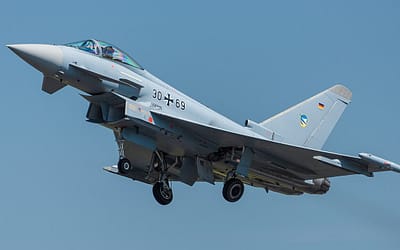
A German fighter pilot sits in the cockpit of a Eurofighter Typhoon, but she's not alone. Alongside her wingman—a sleek, autonomous drone packed with sensors and weapons—executes maneuvers no human could withstand. This isn't science fiction. Germany is racing toward this reality, with an operational deadline of 2029 and two heavyweight contenders vying for the contract.
The Bundeswehr's loyal wingman program represents a fundamental shift in air combat doctrine. Instead of fighters operating solo or in traditional formations, unmanned combat air vehicles (UCAVs) would fly alongside crewed aircraft, acting as scouts, decoys, and additional weapons platforms. The drones must think faster than humans, survive communications blackouts, and return even when separated from their mother ship.
Two Contenders, One Prize
Boeing's MQ-28A Ghost Bat emerged from Australian innovation labs as a purpose-built loyal wingman platform. Recently, it proved its mettle in tests controlled directly from an E-7 Wedgetail airborne command aircraft—a demonstration of the seamless integration Germany demands. The Ghost Bat combines survivability with firepower, designed from the ground up to operate in contested airspace where traditional drones would falter.
Its rival, the Kratos XQ-58A Valkyrie, brings a different pedigree. Airbus Defense and Space partnered with Kratos to pitch this jet-powered hunter to the Luftwaffe. The Valkyrie's sleek profile and long-range capabilities make it an enticing alternative—a platform that doesn't just escort fighters but extends their reach across entire battlespaces.
Why 2029 Matters
That target date isn't arbitrary. Europe watches its security landscape shift by the month. Germany needs a force multiplier that works now—or soon. The loyal wingman concept addresses a harsh reality: crewed fighters are expensive, irreplaceable assets. Losses matter politically. Drones can absorb risks human pilots cannot.
Autonomous return capability seals the deal. These drones must navigate home even without GPS or comms—a technical hurdle that separates viable weapons from costly prototypes. The drone that masters this challenge will reshape how the Luftwaffe projects power.
A Global Trend, German Ambition
Germany isn't alone in this race. The U.S. Air Force's Collaborative Combat Aircraft (CCA) program pursues similar goals with even greater funding. France, the UK, and others watch these trials with sharp interest. Whoever cracks the loyal wingman problem first gains a generational advantage in air warfare.
The concept promises to rewrite air combat playbooks. A flight of two Eurofighters with loyal wingman drones becomes, effectively, four platforms operating in perfect coordination. Fighters can focus on engagement while drones handle suppression and evasion. Survivability increases. Lethality multiplies. Doctrine transforms.
The Road Ahead
Both contenders bring proven technology to the table. The Ghost Bat's recent Wedgetail tests demonstrated real-world integration. The Valkyrie's jet power offers speed and altitude performance that traditional rotorcraft cannot match. Germany faces a genuine choice between proven concepts and raw capability.
What happens next unfolds across the next three years. Flight tests will intensify. Trials will stress systems to breaking points. Requirements will evolve. By 2029, the Luftwaffe expects to field the first operational loyal wingman squadron—a force that rewrites the rules of engagement.
This isn't just procurement. It's a bet on the future of air combat itself. The drone that wins Germany's contract will carry more than equipment into the sky—it will carry the weight of a new era in military aviation.
Sources: The War Zone; DroneXL; Boeing
Verwandte Fragen
What is a 'loyal wingman' drone?
A loyal wingman is an uncrewed combat air vehicle (UCAV) that flies alongside a crewed fighter as a scout, decoy, and extra weapons platform. It must perform high-g maneuvers no human could survive, operate through communications blackouts, and return home autonomously even without GPS — multiplying a pilot's reach while keeping the human out of the highest-risk roles.
What is Germany's loyal wingman program?
Germany's Bundeswehr aims to field loyal wingman drones alongside its Eurofighter Typhoons by an operational deadline of 2029. The program reflects a shift in air-combat doctrine: instead of fighters flying solo, autonomous drones would accompany them as scouts and additional shooters, effectively turning a two-Eurofighter flight into four coordinated platforms.
What is the Boeing MQ-28A Ghost Bat?
The Boeing MQ-28A Ghost Bat is a purpose-built loyal wingman drone developed in Australia and one of the contenders for Germany's program. Designed to fly with crewed fighters, it has been tested in controlled team operations and is among the most mature uncrewed combat aircraft competing for European contracts.
Why do air forces want drones to fly alongside fighters?
Crewed fighters are expensive and politically costly to lose, while drones can absorb risks human pilots cannot. Pairing them lets fighters focus on engagement while wingman drones handle scouting and suppression. The decisive technical hurdle is autonomous return — navigating home without GPS or communications — which separates a deployable weapon from a costly prototype.
What is the US Collaborative Combat Aircraft program?
The US Air Force's Collaborative Combat Aircraft (CCA) program pursues the same loyal-wingman concept as Germany's effort but with far greater funding. France, the UK, Japan and others run parallel trials tied to next-generation fighter programs. Whoever first solves reliable autonomous teaming gains a generational advantage in air warfare.
When will Germany field its loyal wingman drones?
Germany has set an operational deadline of 2029, with two contenders — including Boeing's MQ-28A Ghost Bat — competing for the contract. Meeting that date depends on proving the drones can survive communications blackouts and return autonomously, the capabilities that distinguish a deployable weapon from a demonstrator.
0 Kommentare