
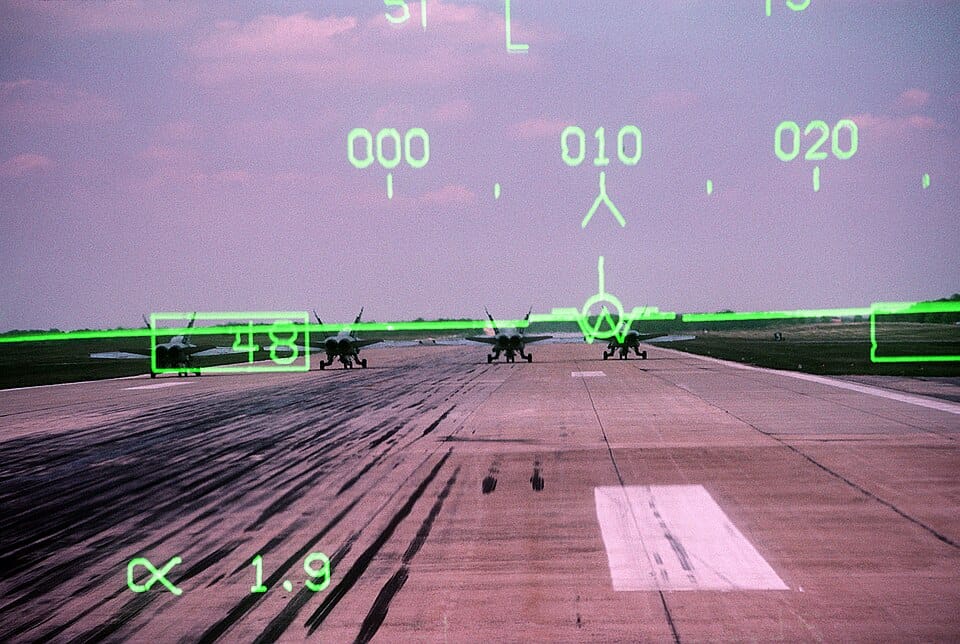
Kurzinfo: Head-Up-Display
- Erfindung: Reflektorvisiere (Zweiter Weltkrieg) entwickelten sich in den 1960er Jahren zu echten HUDs (Head-up-Displays).
- Erstes funktionsfähiges HUD: Seeräuber S.2 (Royal Navy, 1965)
- So funktioniert es: Kollimiertes Licht, das auf ein Kombinationsglas im Unendlichen projiziert wird
- Angezeigte Schlüsseldaten: Fluggeschwindigkeit, Flughöhe, Kurs, Anstellwinkel, Waffenzielanzeige, Flugbahnmarkierung
- Moderner Standard: Wide-angle holographic HUDs (F-16, F/A-18, Typhoon, Rafale)
- Zivile Adoption: Boeing 787, Airbus A350, Dassault Falcon-Serie
Vom Visier zum Glascockpit
The HUD's ancestor is the reflector gunsight — the illuminated reticle that replaced iron sights on fighter aircraft during the Second World War. The British Mk II gyroscopic gunsight, fitted to Spitfires and Hurricanes from 1943, projected a ring-and-dot aiming point onto a tilted glass plate, allowing the pilot to aim without aligning two separate sights. It was primitive, but the principle — overlay critical information on the outside world — was already established. The leap from gunsight to true head-up display came in the early 1960s, when the Royal Navy needed a way to help Buccaneer strike pilots fly low-level attack profiles at night and in bad weather without constantly cross-checking between the windscreen and the instrument panel. The solution was a collimated projection system that focused symbology at optical infinity, so the pilot's eyes could read the display and scan the outside world simultaneously without refocusing.Was der Pilot sieht
Ein modernes HUD in einem Kampfflugzeug zeigt eine sorgfältig ausgewählte Symbolik. Die Flugbahnmarkierung – ein kleiner Kreis mit Flügeln – zeigt die tatsächliche Flugrichtung an, nicht die Richtung, in die die Flugzeugnase zeigt. Fluggeschwindigkeit und Flughöhe werden digital angezeigt. Ein Kursband verläuft am oberen Rand. Die Anstellwinkelanzeige warnt vor einem drohenden Strömungsabriss. Bei Waffenauswahl erscheint ein Pfeil, ein Fadenkreuz oder ein Steuersignal, um den Piloten zum Ziel zu führen. Die Genialität des Systems liegt in dem, was es nicht anzeigt. Ein HUD, das alle vom Flugcomputer verfügbaren Parameter anzeigt, würde den Piloten überfordern. Die Kunst des HUD-Designs besteht in der Informationspriorisierung – es werden nur die Informationen angezeigt, die der Pilot für den jeweiligen Flugmodus benötigt. Im Luft-Luft-Modus ändert sich die Symbolik und zeigt Radarerfassung, Flugbahn des Flugkörpers und Zielmarkierung an. Im Luft-Boden-Modus werden Sturzflugwinkel, Waffenauslösesignal und Aufschlagpunkt angezeigt.Die zivile Revolution
Head-up-Displays (HUDs) wurden in den 1990er-Jahren von Kampfflugzeugen auf Verkehrsflugzeuge übertragen, zunächst als Nischenlösung für Anflüge bei eingeschränkter Sicht. Fluggesellschaften, die nebelanfällige Flughäfen wie San Francisco und London Heathrow anflogen, stellten fest, dass mit HUDs ausgestattete Flugzeuge auch unter Bedingungen landen konnten, die alle anderen zur Landung zwangen – insbesondere Kategorie-IIIb-Anflüge mit einer Sichtweite von unter 200 Metern auf der Landebahn. Boeing führte das HUD als Standardausrüstung für den 787 Dreamliner ein, Airbus folgte mit dem A350. Heute bietet jeder große Hersteller von Verkehrsflugzeugen ein HUD als Option an. Die Technologie ist prinzipiell identisch mit der Version für Kampfflugzeuge – kollimierte Symbole, die auf Unendlich fokussiert sind –, aber die Anzeigeinhalte sind auf die Anflug- und Landephase und nicht auf den Kampfeinsatz zugeschnitten.Was als Nächstes kommt: Helmmontierte Displays
The HUD's successor is already here. Helmet-mounted display systems — the F-35's integrated helmet, the Typhoon's Striker II, the Gripen's Cobra — project flight and weapons data directly onto the pilot's visor, allowing them to aim missiles and see tactical information regardless of where they look. The HUD, by definition, only works when the pilot looks forward through the combiner glass. The helmet display works at every angle. But the HUD is not dead. It remains the primary flight reference on every frontline fighter except the F-35, which controversially eliminated it entirely. Pilots who have flown both systems often prefer the HUD for its optical clarity and the sheer reliability of a display that has no moving parts, no helmet fit issues, and no latency. Like the analogue clock in a glass cockpit, the HUD endures because simplicity has a value that no amount of technology can replace.Quellen: BAE Systems, Elbit Systems, Boeing, "Fighter Pilot" von Col. James Broughton, "Boyd" von Robert Coram, Wikipedia
Verwandte Fragen
Was ist ein Head-up-Display (HUD) in einem Flugzeug?
Ein Head-up-Display projiziert Flug- und Waffeninformationen auf eine transparente Kombinierscheibe vor dem Piloten. Die Anzeige ist auf optisches Unendlich fokussiert, sodass die Augen die Daten erfassen und gleichzeitig die Umgebung scannen können, ohne neu fokussieren zu müssen. Angezeigt werden Fluggeschwindigkeit, Flughöhe, Kurs, Anstellwinkel und das Zielsystem der Waffe, sodass der Pilot den Blick aus dem Cockpit richten kann.
Wer hat das Head-up-Display erfunden?
Das HUD entwickelte sich aus den Reflektorvisieren des Zweiten Weltkriegs, wie beispielsweise dem britischen Kreiselvisier Mk II, das ab 1943 in Spitfires und Hurricanes eingebaut wurde. Das erste wirklich einsatzfähige Head-up-Display erschien 1965 auf der Blackburn Buccaneer S.2 der Royal Navy und wurde entwickelt, um Kampfpiloten bei Tiefflugangriffen in der Nacht und bei schlechtem Wetter zu unterstützen.
Wie funktioniert ein Head-up-Display?
Ein HUD nutzt kollimiertes Licht, das auf eine Kombinationsscheibe projiziert wird, sodass die Symbole im Unendlichen scharf abgebildet werden. Da sowohl das Bild als auch die entfernte Umgebung scharf sind, muss der Pilot seine Augen nicht zwischen Instrumenten und der Außenwelt neu fokussieren. Dadurch kann ein Kampfpilot eine Bedrohung verfolgen und gleichzeitig Fluggeschwindigkeit, Flughöhe und die Zielanzeige ablesen.
Welche Informationen zeigt das HUD eines Kampfflugzeugs an?
Das HUD eines Kampfflugzeugs zeigt Fluggeschwindigkeit und Flughöhe digital an, einen Kursstreifen am oberen Rand, eine Warnung vor Strömungsabriss durch einen Anstellwinkelbereich und eine Flugbahnmarkierung. Bei Waffenauswahl werden ein Pfeil, ein Fadenkreuz oder ein Steuersignal hinzugefügt. Die Symbolik ändert sich je nach Flugmodus: Im Luftkampf werden Radarerfassung und Flugbahn der Rakete angezeigt, im Luftkampf Sturzflugwinkel und Auswurfhinweise.
Verwenden Verkehrsflugzeuge Head-up-Displays?
Ja. Head-up-Displays (HUDs) wurden in den 1990er-Jahren von Kampfflugzeugen auf Verkehrsflugzeuge übertragen, zunächst als Nischenlösung für Anflüge bei schlechter Sicht. Mit HUDs ausgestattete Flugzeuge konnten sicher im Nebel landen, der andere Flugzeuge an Flughäfen wie San Francisco und London Heathrow am Boden hielt. Moderne Verkehrsflugzeuge wie die Boeing 787 bieten Head-up-Displays, und die Technologie ist in der kommerziellen Luftfahrt weit verbreitet.
Worin besteht der Unterschied zwischen einem Head-up-Display (HUD) und einem am Helm montierten Display?
Ein HUD ist ein fest installiertes Display, das auf die Windschutzscheibe projiziert wird und daher nur Daten anzeigt, wenn der Pilot nach vorne blickt. Ein am Helm montiertes Display projiziert Symbole auf das Visier des Piloten, egal wohin er schaut. Moderne Kampfflugzeuge wie die Die katarische F-15QA mit ihrem JHMCS II Helmvisiersystem Ein Pilot soll Ziele allein durch Anschauen auswählen können.
Wie hat sich die Cockpit-Technologie von Kampfflugzeugen im Laufe der Zeit entwickelt?
Die Cockpit-Technologie entwickelte sich von mechanischen Instrumenten und Reflektionsvisieren über kollimierte Head-up-Displays bis hin zu modernen Glascockpits mit großen Multifunktionsbildschirmen. Jeder dieser Fortschritte verkürzte die Zeit, die Piloten im Cockpit verbringen. Diese Entwicklung spiegelt die umfassendere Geschichte von … wider. Generationen von Kampfflugzeugen, wo Avionik und Sensorfusion zunehmend die Leistungsfähigkeit eines Jets bestimmen.
Ähnliche Beiträge
0 Kommentare