
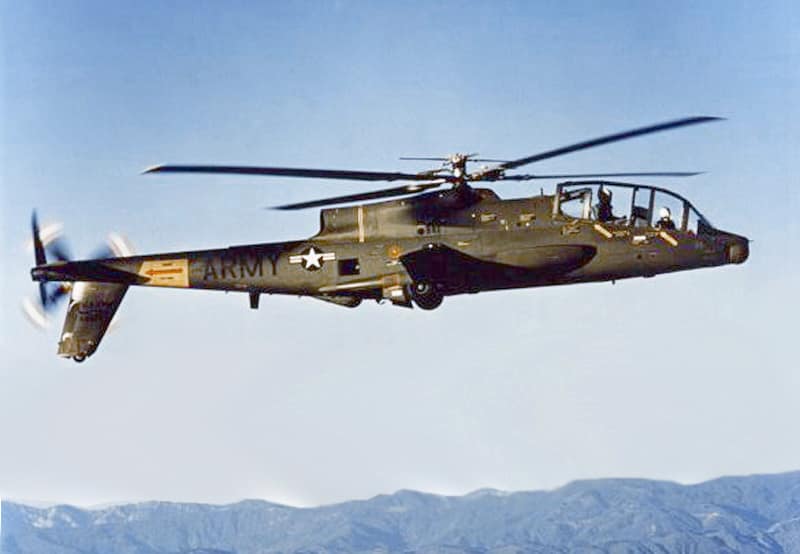
At an airshow in December 1967, the Lockheed AH-56 Cheyenne did something helicopters were not supposed to do. It bowed. Landing on its two forward wheels, it dipped its nose to the crowd, then gently set its tail down and taxied away. The trick was the pusher propeller on its tail, and it hinted at just how radical this machine really was.
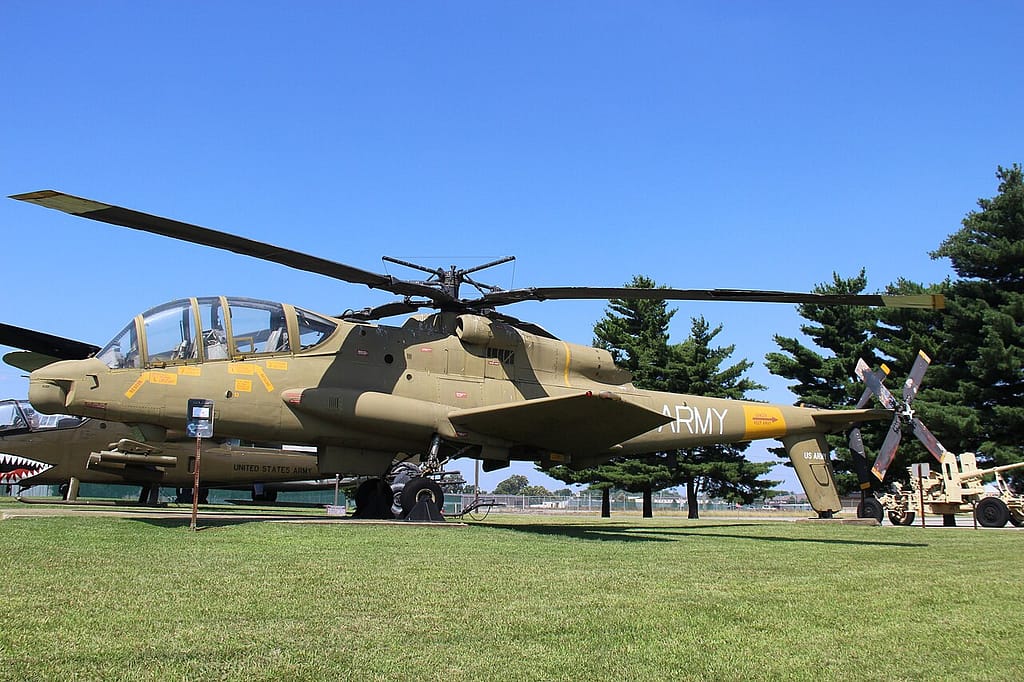
Born from the Army's Advanced Aerial Fire Support System program, the Cheyenne was a compound helicopter: a rigid four-blade main rotor for lift, stub wings to offload it at speed, and a pusher prop at the back to shove it forward. At high speed the wings and propeller took the strain, and the rotor carried only a fraction of the lift. It could out-run anything else with a rotor.
Kurzinfo
| Typ | Compound attack helicopter prototype |
| Erster Flug | 21 September 1967 |
| Kraftwerk | 1 x General Electric T64 turboshaft (up to 4,275 shp) |
| Rotoren | 4-blade rigid main, 4-blade tail, 3-blade pusher prop |
| Höchstgeschwindigkeit | 244 mph level; 282 mph in a dive |
| Anzahl gebaut | 10 prototypes |
| Schicksal | Cancelled 9 August 1972; never entered service |
Fast, deadly, and complicated
The two-man crew sat in tandem, the gunner up front in a seat that physically rotated to follow the belly turret's 30 mm cannon, the pilot behind with a helmet sight. It could carry TOW anti-tank missiles and rocket pods, and in its final form it screamed to 244 mph in level flight and 282 mph in a dive, numbers a conventional gunship could only dream of.
But brilliance had a price. The rigid rotor was prone to a vibration the engineers called half-P hop. In March 1969 that gremlin turned lethal: the rotor on prototype three struck the fuselage and the aircraft crashed, killing test pilot David A. Beil.
Killed by rivals and time
A second airframe was later destroyed in a wind-tunnel accident. The Army cancelled the production contract in May 1969, kept development alive, then watched the Air Force wage a turf war over who should fly close air support at all.
By 1972 the simpler AH-1 Cobra was already proven in Vietnam with the TOW missile, and the Army wanted a twin-engine, more survivable machine. On 9 August 1972 the Cheyenne was cancelled for good, after just ten prototypes.
The irony stings. Weeks later the Army launched the program that produced the AH-64 Apache, and decades later Sikorsky's rigid-rotor speedsters would chase the very numbers the Cheyenne hit in 1967. It was not a bad helicopter. It was simply too soon.
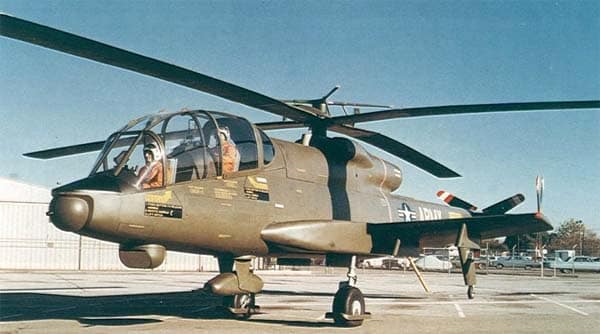
The rise and fall of the attack helicopter that arrived twenty years early:
Sources: Vintage Aviation News; Wikipedia; U.S. Army.
0 Kommentare