
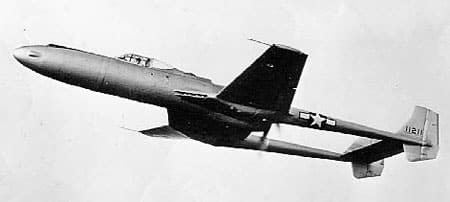
It had a propeller at the back, a nose that tilted up to lob its cannon shells, and a seat that dropped its pilot out through the belly in an emergency so he would not be chopped to pieces by his own engine. It was nearly as long as a DC-3. And it was a fighter.
Meet the Vultee XP-54 “Swoose Goose” — the biggest, strangest single-engine fighter the United States flew in the Second World War, and one that never fired a shot in anger.
Kurzinfo
| Flugzeug | Vultee XP-54 “Swoose Goose” |
| Typ | Single-seat twin-boom pusher fighter prototype |
| Erster Flug | January 15, 1943 (test pilot Frank Davis) |
| Motor | Lycoming XH-2470, ~2,300 hp, driving a pusher propeller |
| Armament (planned) | Two 37 mm cannon and two .50-cal machine guns |
| Gebaut | Two prototypes; program cancelled |
Born from a call for the radical
In February 1940, the U.S. Army issued “Request for Data R-40C,” inviting manufacturers to throw out the rulebook and propose genuinely radical fighters. Three of the strangest designs in American history came out of it: the Curtiss XP-55 Ascender, the Northrop XP-56 Black Bullet, and the winner of the competition — Vultee’s XP-54.
Vultee’s answer was enormous. The XP-54 had a wingspan of nearly 54 feet and a length of 54 feet 9 inches — only ten feet shorter than a DC-3 airliner — and at maximum weight it tipped the scales at more than 19,000 pounds, over half again the weight of a fully loaded P-51 Mustang. It was, and remains, the largest and heaviest single-engine American warplane to fly during the war.
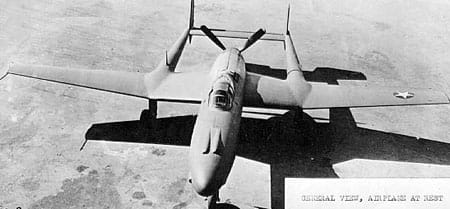
The layout borrowed from the best. Twin tail booms like the P-51 Mustang’s bigger cousin the P-38 Lightning, an inverted gull wing like the Corsair, and a pusher engine mounted behind the cockpit spinning a propeller between the booms. On paper, with its intended 1,850-horsepower Pratt & Whitney engine and contra-rotating propellers, it was supposed to hit 446 mph.
A cockpit full of clever ideas
The XP-54 bristled with firsts. Because the propeller spun directly behind the pilot, climbing out over the side in an emergency would have been suicidal — so the seat doubled as an elevator. The pilot lowered it electrically to board from the ground, rode it up into the pressurized cockpit, and, if he had to bail out, the seat fired him downward, clear of the whirling blades. It was among the first American fighters designed with a downward ejection system.
Then there was the nose. The two 37 mm cannon fired slow, arcing shells, so Vultee designed the entire nose section to pivot upward a few degrees to “lob” rounds at a target while the machine guns stayed level. It was ingenious — and wildly complicated.
Betrayed by its engine
The trouble, as so often, was power. The Pratt & Whitney engine it was designed around was cancelled, forcing Vultee to fit a heavier Lycoming XH-2470 driving a single four-bladed propeller. Frank Davis made the 31-minute maiden flight on January 15, 1943, at Muroc Dry Lake in California. But with its substitute engine the big fighter managed only about 403 mph, climbed slowly, and had a range of just 500 miles.
Two aircraft were built. The first flew 86 times before being ferried to Ohio for limited testing; the second, left in bare metal, reportedly flew only once. The guns were never fired in the air. By then, jet engines were arriving, and the case for a slow, heavy, fantastically complex piston fighter had evaporated.
Eine großartige Sackgasse
The Swoose Goose — named after a wartime song about a creature that was half swan, half goose — is a monument to a moment when American industry could afford to chase almost any idea, however outlandish. It solved problems no one quite had yet, and by the time it flew, the world had moved on. Ugly, oversized and unlucky, it remains one of the most fascinating what-ifs in fighter history.
Sources: Defense Media Network (Robert F. Dorr), U.S. Air Force Test Center, military factory records, Wikipedia.
0 Kommentare