
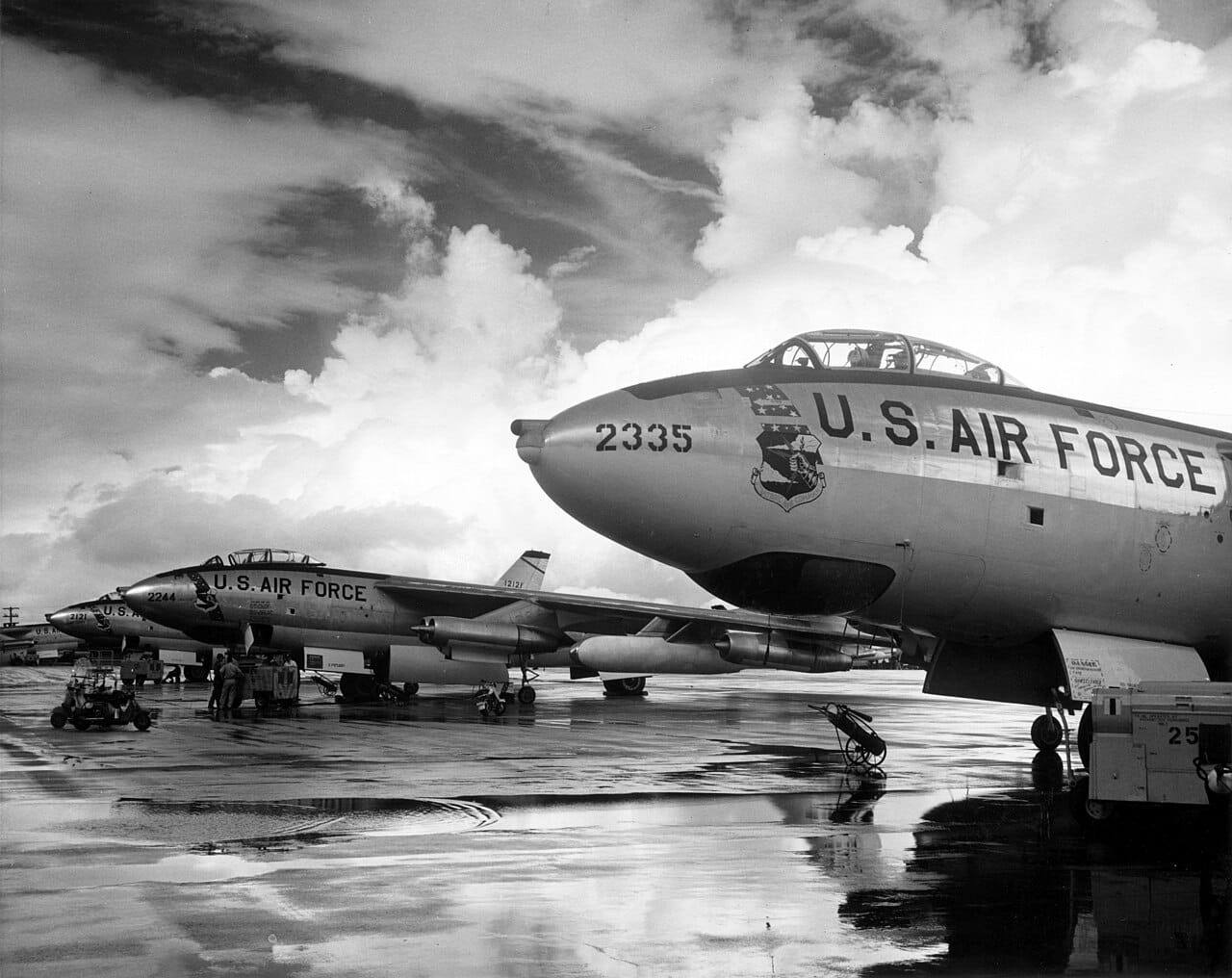
Look out of an airliner window at the swept wing and the engines slung beneath it in neat pods, and you are looking at an idea that was born on a bomber. The B-47 Stratojet never dropped a bomb in anger, yet it may be the most influential jet aircraft ever built.
When it first flew, on 17 December 1947 — 44 years to the day after the Wright brothers — it looked like nothing else in the sky: a slender, drooping, 35-degree swept wing carrying six jet engines, so radical that even the men who flew it did not grasp what they had started.
Datos rápidos
- Aeronave: Boeing B-47 Stratojet
- Primer vuelo: 17 December 1947 — 44 years to the day after the Wright brothers
- Disposición: swept wing plus six podded jet engines — the template for the jet age
- Quirks: bicycle landing gear, rocket-assisted takeoff, twin braking parachutes
- Role: backbone of Strategic Air Command’s early nuclear deterrent
- Construido: 2,032, by Boeing, Douglas and Lockheed
- Legado: its shape led to the KC-135, the 707 and nearly every jetliner since
A wing borrowed from the enemy
Boeing’s breakthrough came when its chief aerodynamicist, George Schairer, studied captured German research on swept wings and insisted the idea be applied to the new bomber. The result was transformational. Instead of a straight-winged jet that would buffet as it neared the speed of sound, the B-47 could cruise at nearly 600 mph — faster than most contemporary fighters — while carrying a nuclear load across intercontinental distances with air-to-air refuelling.
Beautiful, and a handful
The clean design created its own problems. The thin, flexible wing was too slim to hold fuel or landing gear, so Boeing gave the B-47 a “bicycle” undercarriage — two main wheels in tandem under the fuselage, with little outrigger wheels in the inboard engine pods. That meant the aircraft could neither rotate for takeoff nor flare for landing; it flew on and off the runway flat.
Heavy and, on early engines, underpowered, a loaded Stratojet often needed rockets to get airborne, firing a rack of assisted-takeoff bottles during its roll in a thunderous cloud of smoke. Coming home, jet engines of the day spooled up so slowly that pilots streamed a drogue parachute in the pattern just to keep the engines spinning fast enough for a possible go-around, then a big ribbon chute to stop the long, clean airframe on the runway.
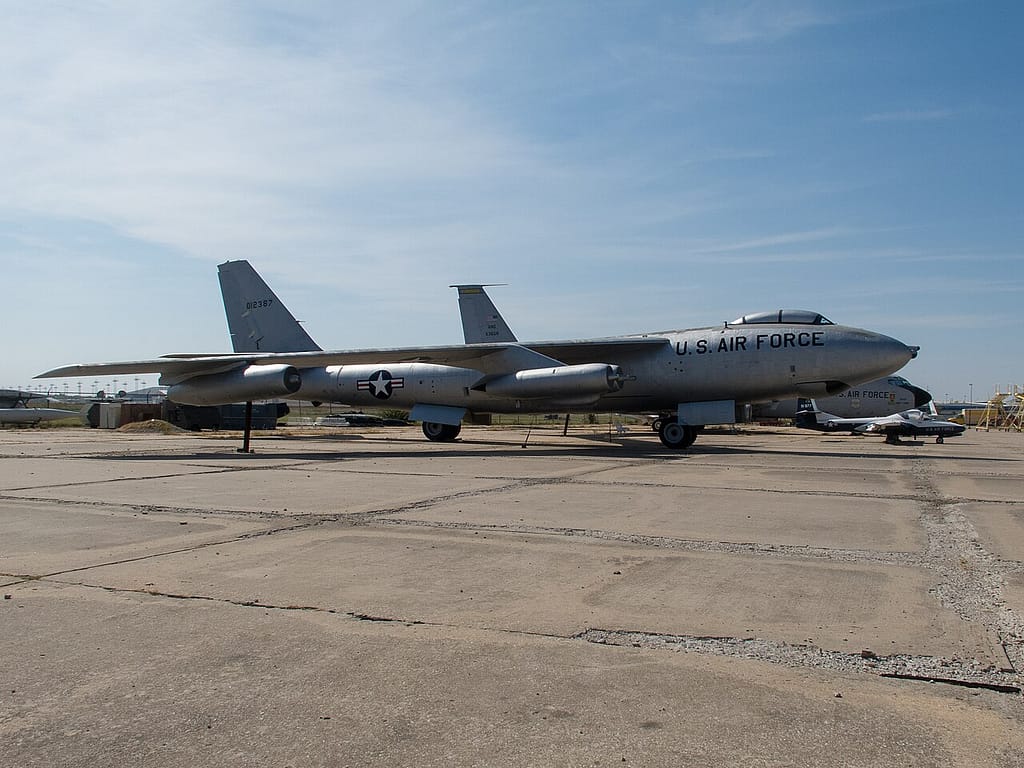
Flying it taught engineers lessons that outlived it. The B-47’s tendency to weave — “Dutch roll” — produced the yaw damper now fitted to airliners; its pitch-up problem was cured with tiny vortex generators, the little vanes you can still spot on the wings of almost every high-speed jet today.
The sight nobody forgot
At its 1958 peak, Strategic Air Command fielded well over 1,300 B-47 bombers, and General Curtis LeMay used them to make Soviet planners’ lives impossible. A whole wing launching at once became one of the great spectacles of the early Cold War.
The shape of everything that followed
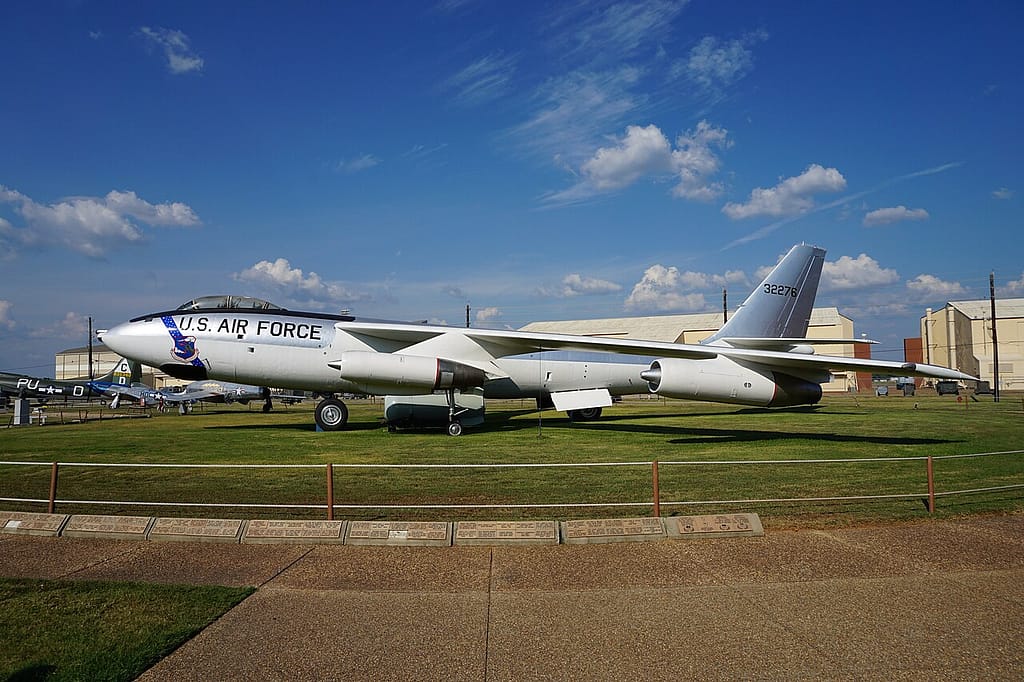
Metal fatigue eventually caught up with the type — a spate of wing failures in 1958 forced a costly fleet-wide fix — and missiles and the B-52 pushed it into retirement by 1966. But the B-47’s real legacy was its silhouette. Its cylindrical fuselage, swept wing and podded engines flowed straight into the KC-135 tanker and the Boeing 367-80, which became the 707 and, after it, the 727, 737 and every Boeing jet down to the 777. Rivals copied the formula too, from the Douglas DC-8 to the Convair jets and, eventually, Airbus. Around 2,032 were built — and the shape they pioneered carries billions of passengers a year.
Sources: Air & Space Forces Magazine (Walter J. Boyne); Plane & Pilot; Wikipedia.
0 Comentarios