
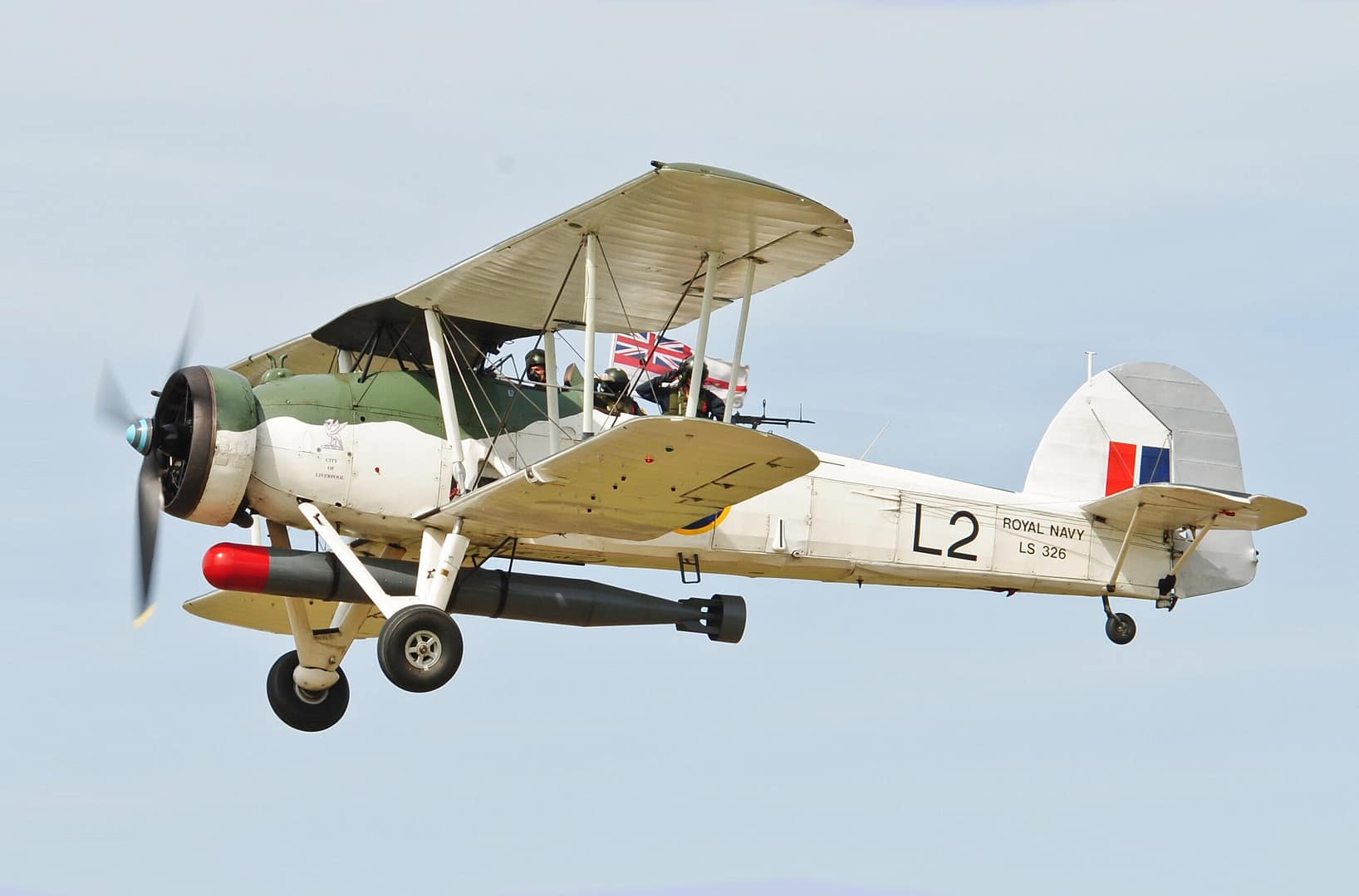
On the night of 11 November 1940, twenty-one Fairey Swordfish biplanes — fabric-covered, open-cockpit torpedo bombers with a top speed of 139 miles per hour — attacked the Italian fleet at anchor in Taranto harbour. When they were done, three battleships were sinking, the balance of naval power in the Mediterranean had shifted permanently, and a Japanese naval attaché in Rome was taking very careful notes.
We have written before about the Swordfish's extraordinary career, including its role in the hunt for the Bismarck. But Taranto deserves its own telling — because it was not just a battle. It was the moment that proved aircraft could destroy a battle fleet in its own harbour, and it changed the course of the Second World War.
The Problem: Six Battleships Behind Steel Nets
By late 1940, the Italian Regia Marina maintained a powerful fleet at Taranto, the main naval base on the heel of Italy's boot. Six battleships — including the brand-new Littorio and Vittorio Veneto — sat at anchor in the Mar Grande, protected by anti-torpedo nets, barrage balloons, and shore-based anti-aircraft batteries. As long as this fleet existed, the Royal Navy could not control the central Mediterranean, and Malta — Britain's unsinkable aircraft carrier — was slowly being starved.
Admiral Andrew Cunningham, commanding the Mediterranean Fleet from HMS Warspite, had been planning a carrier strike on Taranto since the previous summer. The plan was audacious: launch Swordfish torpedo bombers from HMS Illustrious at night, fly them 170 miles across open water, and attack the most heavily defended naval base in the Mediterranean with aircraft that would have looked old-fashioned in 1930.
The Attack: Two Waves, Ninety Minutes
The first wave of twelve Swordfish launched at 20:57. The second wave of nine followed an hour later. Each torpedo-armed aircraft carried a single 18-inch torpedo modified to run in the shallow waters of the harbour — a technical innovation that the Japanese would later replicate at Pearl Harbor.
The attack was a masterpiece of coordination. While torpedo aircraft came in low over the harbour at 30 feet — threading between the cables of barrage balloons in the dark — other Swordfish dropped flares to illuminate targets and bombs to suppress the anti-aircraft batteries. The Italian defenders, caught completely off guard by a night air attack (a feat considered impossible by most naval doctrine of the time), responded with a furious but disorganised barrage.
In ninety minutes, the Swordfish put three torpedoes into Littorio, one into Caio Duilio, and one into Conte di Cavour. Littorio settled on the bottom with her decks awash. Duilio was beached to prevent sinking. Conte di Cavour sank and was never returned to service. A cruiser and a destroyer were also damaged. Two Swordfish were lost — both to anti-aircraft fire. Two of the four crew members survived as prisoners of war.
The Aftermath: Half a Fleet Gone in One Night
In a single night, twenty-one biplanes had achieved what the entire Royal Navy surface fleet could not: they had neutralised half the Italian battle line. The surviving Italian ships were withdrawn to Naples, 300 miles further from the contested waters of the central Mediterranean. Malta's supply convoys, though still perilous, became survivable.
The cost-exchange ratio was staggering. Two aircraft and two lives lost, against three capital ships put out of action — a result that no surface engagement of the war would match for sheer efficiency.
Admiral Cunningham, in his typically understated way, signalled the Admiralty: "By this gruelling night's work the Royal Navy has received a most valuable addition to its forces." Churchill was less restrained. He called it "a crippling blow."
The Student in Tokyo
Thirteen months after Taranto, on 7 December 1941, 353 Japanese aircraft attacked the US Pacific Fleet at Pearl Harbor. The operational concept was almost identical: carrier-launched aircraft, modified shallow-running torpedoes, a dawn strike on warships at anchor in a harbour considered too shallow for aerial torpedoes.
This was not a coincidence. Commander Minoru Genda, who planned the Pearl Harbor attack, studied the Taranto raid in detail. Japanese naval attachés in Rome had reported extensively on the British tactics, the torpedo modifications, and the vulnerability of ships at anchor to air attack. Taranto was the proof of concept; Pearl Harbor was the production version.
The irony is complete: a fabric-covered biplane designed in 1933, flown by the Royal Navy at 139 mph through a wall of Italian anti-aircraft fire, demonstrated a technique that Japan would use to bring the United States into the Second World War — the event that ultimately decided its outcome.
The Death of the Battleship
Taranto proved what Billy Mitchell had argued and been court-martialled for: that aircraft could sink battleships. The lesson was confirmed at Pearl Harbor, reinforced when Japanese aircraft sank HMS Prince of Wales and Repulse off Malaya three days later, and became unchallengeable after the carrier battles of Coral Sea and Midway in 1942.
The battleship — the most expensive, most powerful, most prestigious weapon system in the world for three centuries — was rendered obsolete by an aircraft that cost a fraction of a percent of the ships it destroyed. The parallel to today's drone warfare debate is impossible to ignore: cheap platforms, intelligently employed, can defeat systems that cost a thousand times more.
The Swordfish that flew into Taranto harbour on 11 November 1940 did not know they were ending an era. They were just doing their job — slowly, bravely, and with devastating effect.
Sources: Fleet Air Arm Museum, Royal Navy Historical Branch, Air & Space Quarterly, Naval History Magazine
Related Questions
What was the Battle of Taranto?
The Battle of Taranto was a British air raid on the night of 11 November 1940, when 21 Fairey Swordfish biplanes of the Royal Navy attacked the Italian fleet anchored at Taranto harbour. The strike sank or disabled three Italian battleships, shifted naval power in the Mediterranean, and proved that aircraft could destroy a battle fleet in its own harbour.
Which aircraft carried out the Taranto raid?
The Taranto raid was flown by Fairey Swordfish torpedo bombers — fabric-covered, open-cockpit biplanes with a top speed of just 139 mph. Twenty-one of them attacked in two waves. The same obsolete-looking biplane later played a decisive role in sinking the German battleship Bismarck.
How did the Battle of Taranto influence Pearl Harbor?
Taranto was a direct inspiration for Japan's 1941 attack on Pearl Harbor. Commander Minoru Genda, who planned Pearl Harbor, studied Taranto in detail, and Japanese naval attachés in Rome reported on the British tactics, including torpedoes modified for shallow water. The concept — a surprise carrier strike on warships at anchor — was almost identical, a turning point for Pacific naval aviation.
Which ships were damaged at Taranto?
At Taranto the Swordfish put three torpedoes into the new battleship Littorio and one each into Caio Duilio and Conte di Cavour. Littorio settled on the bottom with her decks awash, Duilio was beached to prevent sinking, and Conte di Cavour sank and never returned to service. A cruiser and a destroyer were also hit, all in roughly ninety minutes.
How could torpedoes work in Taranto's shallow harbour?
The Royal Navy modified its 18-inch torpedoes to run in the shallow water of Taranto harbour, overcoming the assumption that aerial torpedoes needed deep water. The Swordfish dropped them from just 30 feet, threading between barrage-balloon cables in the dark. Japan later replicated this shallow-water torpedo technique at Pearl Harbor.
Why was a night attack on Taranto considered impossible?
A night air attack on a defended harbour was considered impossible by most naval doctrine of the time. The Italian defenders were caught completely off guard and responded with a furious but disorganised anti-aircraft barrage. The Swordfish also had to fly low between barrage-balloon cables in darkness, making the successful strike a landmark in naval aviation.
How was the Taranto attack coordinated?
The Taranto attack was a masterpiece of coordination. While torpedo-armed Swordfish came in low at 30 feet over the harbour, other aircraft dropped flares to illuminate the anchored ships and bombs to suppress the anti-aircraft batteries. This combination of illumination, suppression, and low-level torpedo runs let a small force cripple a powerful battle fleet.
Why was the Battle of Taranto important?
Taranto mattered because it was the first time aircraft destroyed a battle fleet in its own harbour, proving that air power had overtaken the battleship as the arbiter of naval warfare. Winston Churchill called it "a crippling blow." Its tactics directly shaped the carrier warfare — culminating at Pearl Harbor — that would define the Pacific war.
0 Comentarios