

Throughout the Cold War the Soviet Union and the United States were constantly trying to check each other's military power. This drive for each country to outdo the other led to some truly bizarre pieces of military hardware. The Bartini Beriev VVA-14 Vertikal`no-Vzletayuschaya Amphibia (vertical take-off amphibious aircraft) was developed in the Soviet Union during the 1970s.
Designed to be able to take-off from the water and fly at high speed over long distances, it was to make true flights at high altitude, but also have the capability of 'flying' efficiently just above the sea surface, using ground effect. After extensive research, including the development of the small prototype Be-1 wing in ground effect aircraft, the first Bartini Beriev VVA-14 prototype was completed in 1972. Its first flight was from a conventional runway on 4 September 1972. In 1974 the inflatable pontoons were installed, though their operation caused many problems. Flotation and water taxi tests followed, culminating in the start of flight testing of the amphibious aircraft on 11 June 1975. The VVA-14 was designed by Robert Bartini in answer to a perceived requirement by the Russians to destroy United States Navy Polaris missile submarines. The aircraft needs just THREE persons crew, which is very little for the gigantic aircraft!
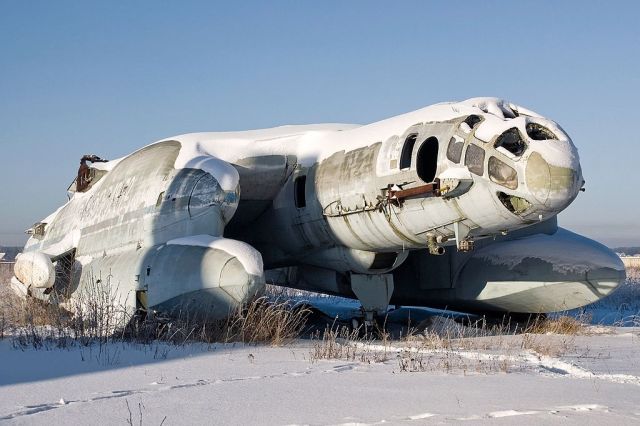
Aircraft specifications -
- Crew: 3
- Length: 25.97 m (85 ft 2 in)
- Wingspan: 30 m (98 ft 5 in)
- Height: 6.79 m (22 ft 3 in)
- Wing area: 217.79 m2 (2344 ft2)
- Armament: ordnance 2000 kg / 2 aerial torpedoes / 8 m IGMD-500
- Empty weight: 23,236 kg (51,119 lb)
- Gross weight: 52,000 kg (114,400 lb)
- Powerplant: (Cruise) 2 × D-30M turbofans, 67 kN (15062 lbf) thrust each
- Maximum speed: 760 km/h (472 mph)
- Cruising speed: 640 km/h (398 mph)
- Range: 2,450 km (1,522 miles)
- Service ceiling: 8,000-10,000 m (26,247-32,808 ft)
Bartini, in joint collaboration with the Beriev Design Bureau intended to develop the prototype VVA-14 in three phases. The VVA-14M1 was to be an aerodynamics and technology test-bed, initially with rigid and robust pontoons on the ends of the central wing section, and later with these replaced by inflatable pontoons. In 1974 the inflatable pontoons were installed, though their operation caused many problems. Flotation and water taxi tests followed, culminating in the start of flight testing of the amphibious aircraft on 11 June 1975.
The VVA-14M2 was to be more advanced, with two starting engines to blast into the cavity under the wing to give lift and later with a battery of lift engines to give VTOL capability, and with fly-by-wire flight controls.
The VVA-14M3 would see the VTOL vehicle fully equipped with armament and with the Burevestnik computerised ASW (anti-submarine warfare) system, Bor-1 MAD (magnetic anomaly detector) and other operational equipment.
In 1974 the inflatable pontoons were installed, though their operation caused many problems. Flotation and water taxi tests followed, culminating in the start of flight testing of the amphibious aircraft on 11 June 1975.
After Bartini's death in 1974, the project began to slow down gradually and eventually drew to a complete stop, after years of getting faded out, the aircraft having conducted 107 flights, with a total flight time of 103 hours. The only remaining VVA-14, No. 19172, was retired to the Russian Federation Central Air Force Museum, Monino in 1987. The aircraft still resides at the museum in a dismantled state, where it carries the number '10687' and 'Aeroflot'.
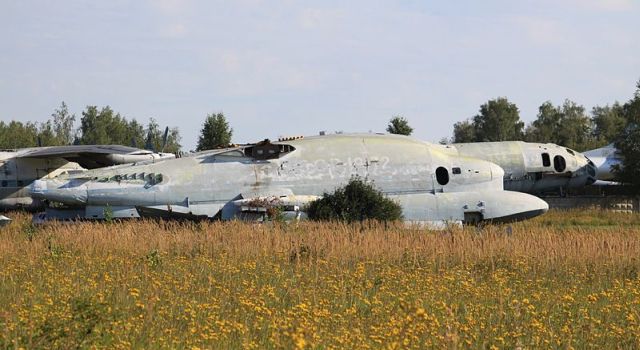
The VVA-14 first flight was held on September 4, 1972. It was tested by pilot Yu. Kupriyanov and navigator L. Kusnetsov. In 1975 the test program was completed, the plane performed 107 flights with a total flight time 103 hours.
The plane's all round metal airframe comprises a fuselage, middle portions of central wing, two side sections with floats, torsion-box central wing, two removable wing portions, tail, cruising engines' nacelles over fuselage.
The side sections are intended to fix horizontal and vertical tail, floats and main units of tricycle wheeled landing gear. The removable wing portions have slats, slotted flaps, and ailerons. The tail is provided with elevators and rudders.
Above the evolution speed, the plane is controlled with aerodynamic control surfaces. During vertical takeoff and landing as well as during transient process, the plane is controlled with jet vanes. The plane control system includes the SAU-M automatic control system.
Design, test and production of a LG pneumatic retractable floats was a complicated problem. It was solved only two years after the first plane's flight.
The powerplant comprises two cruising D-30M bypass turbojet engines designed by P. Solovyov and 12 lift RD-36-35PR turbofan engines designed by P.Kolesov as well as TA-6A turbo generator - an auxiliary airborne unit. There are fuel (15,500 kg of fuel capacity), deicing, and fire extinguishing systems.
The "Burevestnik" search-and-aim system was especially developed to let the crew detect, track, and destroy hostile submarines with high accuracy. The "Bor-1" airborne search magnitometer, radio sonobuoys and weapons automatic release mechanism, flight-and-navigation system operate jointly with this search-and-aim system. Crew members (a pilot, navigator and operator) are accommodated in ejection cockpit capsule that provide the possibility to save the crew in all flight attitudes and to stay for long time in it after landing to the ground or water. The third copy of the plane is supposed to use for the ejection cockpit capsule testing.
Additional Reading –- Read about the strangest and weirdest here!
- Fighter Jets in comparison right here!
- How they built the SR-71, one of the most interesting facts!
- Some of the best low landings ever seen
- wikipedia.org
- g1886.com
- testpilot.ru
Related Questions
What was the Bartini Beriev VVA-14?
The Bartini Beriev VVA-14 was an experimental Soviet aircraft developed in the 1970s. Its name stands for vertical take-off amphibious aircraft. It was designed to take off from water, fly at high speed and high altitude over long distances, and also skim efficiently just above the sea surface using ground effect — one of the strangest machines the USSR ever built.
Who designed the VVA-14?
The VVA-14 was designed by Robert Bartini, an inventive Italian-born Soviet aircraft designer, working with the Beriev Design Bureau. Bartini was known for unconventional ideas, and the VVA-14 reflected his ambition to merge an aircraft, a seaplane and a ground-effect vehicle into a single machine.
What was the VVA-14 designed to do?
The VVA-14 was conceived as a sub-hunter. The Soviets wanted an aircraft able to find and destroy United States Navy Polaris missile submarines. Later planned versions were to carry an anti-submarine warfare system and a magnetic anomaly detector — the same kind of mission flown for decades by the Lockheed P-3 Orion.
How does a ground-effect vehicle fly?
A ground-effect vehicle flies just a few metres above water or flat ground, riding on a cushion of high-pressure air trapped between its wings and the surface. This greatly reduces drag and boosts efficiency. The Soviets explored the idea most famously with the Caspian Sea Monster ekranoplan, and the VVA-14 was meant to use the same effect.
When did the VVA-14 first fly?
The first VVA-14 prototype was completed in 1972 and made its first flight from a conventional runway on 4 September 1972. Inflatable pontoons were fitted in 1974 but caused many problems, and flight testing of the amphibious version began on 11 June 1975.
How big was the VVA-14?
The VVA-14 was a large aircraft: about 25.97 metres long with a 30-metre wingspan and a gross weight of roughly 52,000 kg. It was powered by two D-30M turbofans, reached a maximum speed of about 760 km/h and had a range of around 2,450 km — yet needed a crew of only three.
Why was the VVA-14 never put into service?
The program ran into persistent technical trouble, especially with the inflatable pontoons and the complex vertical take-off systems that were never fully realised. The planned advanced versions with lift engines and full anti-submarine equipment were not completed, and the ambitious project was eventually abandoned.


The real name of the VVA designer is Roberto Oros di Bartini, it was italian and he ascaped in URSS in 1923.
It was a revolutionary mind and “contributions of Bartini were well appreciated at the highest levels of the Soviet government, and he was awarded the Order of Lenin in 1967. High esteem for his contributions to defense afforded him the help from Pontecorvo and Gershtein to publish his theoretical physics paper in the prestigious Proceedings of the Soviet Academy of Sciences (Doklady).”