
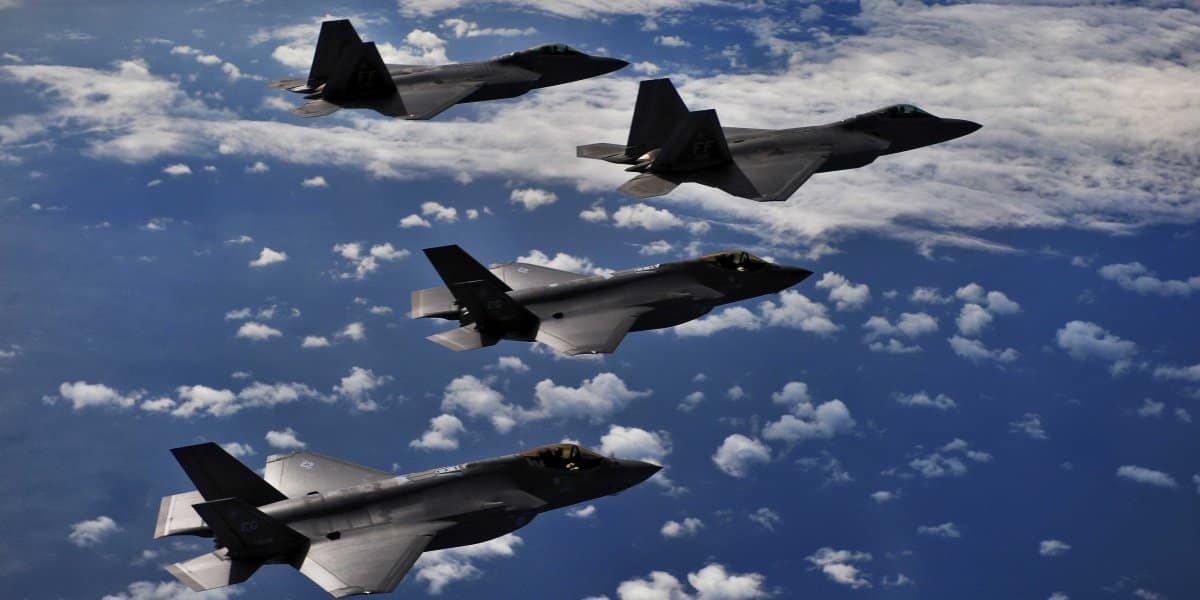
Cuatro F-22 Los Raptors pertenecientes al 94.º Escuadrón de Caza comenzaron recientemente un entrenamiento conjunto con la base local. F-35A Aviones Lightning II del 58.º Escuadrón de Caza.
El entrenamiento conjunto tuvo como objetivo mejorar la integración entre los dos aviones más avanzados con capacidad para evadir radares en servicio en la Fuerza Aérea de los Estados Unidos. Volando en formaciones mixtas, los F-22 y los F-35 realizaron misiones de contramedidas aéreas ofensivas, contramedidas aéreas defensivas y apoyo aéreo profundo. Esto maximizó las capacidades que ofrece la operación conjunta de dos plataformas de quinta generación.
Las capacidades de quinta generación hicieron su debut en combate con el Raptor en misiones aire-tierra durante las primeras etapas de la Operación Resolución Inherente, contra objetivos del ISIS en Irak y Siria. Este exitoso bautismo de fuego reafirmó el papel fundamental que desempeñan las tecnologías furtivas y las capacidades de fusión de sensores, integradas por los aviones de combate de quinta generación en los escenarios actuales.

Una formación mixta con los dos aviones mencionados.
Ambos cazas han tenido un desarrollo turbulento y accidentado, y el F-35 aún está lejos de estar completo, pero esta era la visión. El F-35 y el F-22 se unieron para combatir contra las fuerzas aéreas del primer mundo.
Fuerza como China o Rusia. Los oficiales de la Fuerza Aérea no dieron muchos detalles sobre las misiones de entrenamiento, pero las imágenes hablan por sí solas. Incluso los más escépticos del programa deben detenerse a reconsiderar la historia de los dos controvertidos cazas furtivos que realizaron misiones de entrenamiento juntos.
El F22 Raptor
El F-22 es el único caza del mundo capaz de realizar simultáneamente misiones de combate aire-aire y aire-tierra con casi total impunidad. Esto se logra gracias a un nivel de supervivencia sin precedentes, incluso frente a sofisticadas amenazas aéreas y terrestres.
Antes de ser seleccionado como ganador de la competición conocida como Advanced Tactical Fighter (ATF), el equipo del F-22 llevó a cabo un extenso programa de demostración y validación de 54 meses. Este programa consistió en el diseño, la construcción y las pruebas de vuelo de dos prototipos del avión YF-22. Asimismo, se desarrollaron y probaron exhaustivamente dos prototipos de motores: el Pratt & Whitney YF119 y el General Electric YF120. El programa de demostración y validación finalizó en diciembre de 1990.
En agosto de 1991, se adjudicó a la industria Boeing y Lockheed Martin un contrato de 14.000 millones de dólares para el desarrollo de ingeniería y fabricación del F-22. Desde entonces, las modificaciones contractuales han elevado el valor total del contrato a una estimación aproximada de 14.000 millones de dólares. Según los términos del contrato, el equipo del F-22 habría completado el diseño de la aeronave, producido las herramientas de producción para el programa y construido y probado nueve aeronaves aptas para el vuelo y dos para pruebas en tierra.
El sistema de aviónica y software del F-22 es uno de los más avanzados integrados en una aeronave. Es el primer avión en utilizar aviónica integrada, donde el sistema de gestión de armas, el sistema de guerra electrónica y el radar AN/APG-77 trabajan conjuntamente, proporcionando al piloto una conciencia situacional sin precedentes. El radar AN/APG-77 fue diseñado para operaciones de superioridad aérea y ataque, y cuenta con una antena de barrido electrónico de apertura activa y baja detectabilidad, con capacidad para detectar múltiples objetivos en cualquier condición meteorológica.

Estelas de vapor se dispersan tras el paso de un avión F-22A Raptor de la Fuerza Aérea de los Estados Unidos en el 42º espectáculo aéreo de la Base Naval del Condado de Ventura (NBVC) en Point Mugu, California, el 1 de abril de 2007.
El F-22 utiliza una versión más nueva y mejorada del asiento eyectable ACES II (Advanced Concept Ejection Seat) que se utiliza ampliamente en casi todos los demás aviones de combate a reacción de la Fuerza Aérea (por ejemplo,. F-16, F-117, F-15, A-10, B-1 y B-2El asiento cuenta con un control de eyección central situado entre las piernas del piloto. La versión F-22 del ACES II, fabricado por McDonnell Douglas, incluye varias mejoras con respecto a los modelos de asiento anteriores. Estas mejoras incluyen:
- La incorporación de un sistema activo de sujeción de brazos para evitar lesiones por movimientos bruscos de los brazos durante eyecciones a alta velocidad.
- Un sistema mejorado de paracaídas de frenado de acción rápida para la estabilización del asiento, que ayuda a proporcionar mayor estabilidad y seguridad al piloto durante las eyecciones a alta velocidad.
- El paracaídas de frenado mencionado anteriormente está ubicado detrás de la cabeza del piloto, en lugar de en el respaldo del asiento, y se despliega como un mortero.
- Un nuevo sistema electrónico de secuenciación de asientos y aeronaves que mejora la precisión de la sincronización de los distintos eventos que deben ocurrir para que el piloto pueda eyectarse de forma segura (inicio, desprendimiento de la cabina y encendido de la catapulta del asiento).
- Una botella de oxígeno de mayor capacidad proporciona al piloto eyectado más aire para respirar, lo que le permite mantener la eyección a mayor altitud cuando sea necesario.
El sistema de eyección F-22 ACES II utiliza el secuenciador de asiento analógico estándar de tres modos que detecta automáticamente la velocidad y la altitud del asiento, y luego selecciona el modo adecuado para un rendimiento óptimo del asiento y una recuperación segura del piloto.
- El modo 1 es de baja velocidad y baja altitud;
- El modo 2 es de alta velocidad y baja altitud;
- El modo 3 es para gran altitud.
Se han experimentado varios problemas operativos, algunos de los cuales han provocado costosas inmovilizaciones de toda la flota. De manera crítica, los pilotos han experimentado una disminución del estado mental, incluyendo la pérdida de conciencia, lo cual es un problema grave. Se reportaron algunos casos en los que se encontró que los pilotos presentaban un nivel reducido de alerta o pérdida de memoria después del aterrizaje. Los pilotos de F-22 han sufrido problemas respiratorios persistentes y tos crónica; otros síntomas incluyen irritabilidad, labilidad emocional y cambios neurológicos. Se investigaron varias posibles causas, incluyendo la posible exposición a agentes químicos nocivos a través de los tubos respiratorios, el mal funcionamiento del traje presurizado, los efectos secundarios de la administración de oxígeno en concentraciones superiores a la atmosférica y las interrupciones en el suministro de oxígeno. Otros problemas incluyen fallas mecánicas menores y fallas en el software de navegación. La flota estuvo inmovilizada durante cuatro meses en 2011 antes de reanudar los vuelos, pero los informes de problemas con el oxígeno persistieron.
El F35 Lightning II
Lecturas adicionales - El Airbus A400M Atlas Ejercicio de bandera roja Autor - Jake MeilakPreguntas relacionadas
¿Pueden los F-22 y F-35 operar juntos?
Sí. La Fuerza Aérea de los Estados Unidos entrena a los F-22 Raptor y a los F-35 Lightning II en formaciones mixtas para mejorar la integración entre sus dos cazas furtivos. Volando juntos, combinan las fortalezas de superioridad aérea del F-22 con la fusión de sensores del F-35, como se ve cuando Los Raptors entrenaron junto a los F-35 aliados..
¿Qué es el F-22 Raptor?
El F-22 Raptor es el principal caza furtivo de superioridad aérea de la Fuerza Aérea de los Estados Unidos, y el único capaz de realizar misiones aire-aire y aire-tierra simultáneamente con una altísima capacidad de supervivencia. Surgió del programa Advanced Tactical Fighter (ATF) como un referente de quinta generación.
¿Cuándo se desarrolló el F-22?
El contrato para el desarrollo de ingeniería y fabricación del F-22 se adjudicó a un consorcio formado por Boeing y Lockheed Martin en agosto de 1991, y posteriormente, modificaciones elevaron el valor total a unos 1.040.110 millones de dólares. El programa consistió en la construcción y prueba de aeronaves aptas para el vuelo y de pruebas en tierra antes de la producción.
¿Qué radar utiliza el F-22?
El F-22 utiliza el radar AN/APG-77, un radar de barrido electrónico activo de baja detectabilidad diseñado para la superioridad aérea y el ataque. Funciona como parte de un sistema de aviónica integrado que combina el radar, la guerra electrónica y los sistemas de gestión de armamento para brindar al piloto una conciencia situacional excepcional.
¿Cuándo entraron en combate por primera vez los cazas de quinta generación?
La capacidad de quinta generación hizo su debut en combate con el F-22 Raptor en misiones aire-tierra durante las primeras etapas de la Operación Resolución Inherente, atacando objetivos del ISIS en Irak y Siria. La misión validó el valor de la tecnología furtiva y la fusión de sensores en operaciones reales.
¿Qué es la fusión de sensores en un avión de combate?
La fusión de sensores combina datos del radar, el sistema de guerra electrónica y otros sensores de un caza en una sola imagen clara para el piloto. Es una característica definitoria de los aviones de quinta generación como el F-22 y el F-35, reduciendo la carga de trabajo del piloto y mejorando la percepción de la situación.
¿Por qué volar juntos el F-22 y el F-35?
Los vuelos en formaciones mixtas de F-22 y F-35 permiten que cada avión cubra las fortalezas del otro: el F-22 para el dominio aéreo, el F-35 para la detección y el ataque en red, preparando así a las tripulaciones para enfrentarse a fuerzas aéreas avanzadas como China o Rusia en un futuro conflicto.
¿NOS PREGUNTAMOS DE DÓNDE VA A SACAR EL MALVADO BORIS EL TITANIO PARA LLENAR EL NUEVO CAZA? ¿O ES SIMPLEMENTE
HECHO: NOSOTROS PODEMOS HACER ESTO Y USTEDES NO, UNA ESTRATEGIA
COMENTARIO.
(SÍ, SABEMOS QUE LOS RUSOS TIENEN EL METAL)