
In 1925, somewhere in the American countryside, Willard Ray Custer watched a windstorm peel the roof clean off a barn. Most people would have seen a repair bill. Custer saw physics. The roof had not moved forward — yet it rose. He reasoned that lift did not depend on an airfoil racing through the air, but on the speed of air moving over the airfoil. If you could artificially speed the air across a stationary wing, you could make lift almost from a standstill.
That single observation became a forty-year obsession. Custer called his principle ‘aerophysics’, and in 1929 he received a United States patent for a wing built around a semicircular channel — a half-barrel duct with a propeller mounted just behind it. Spin the propeller, and it would suck a torrent of air through the channel and over the curved surface, even while the aircraft sat still.
- Inventor: Willard Ray Custer, who patented the channel-wing idea in 1929
- CCW-1 first flew on 12 November 1942 — accidentally, with the non-pilot Custer at the controls
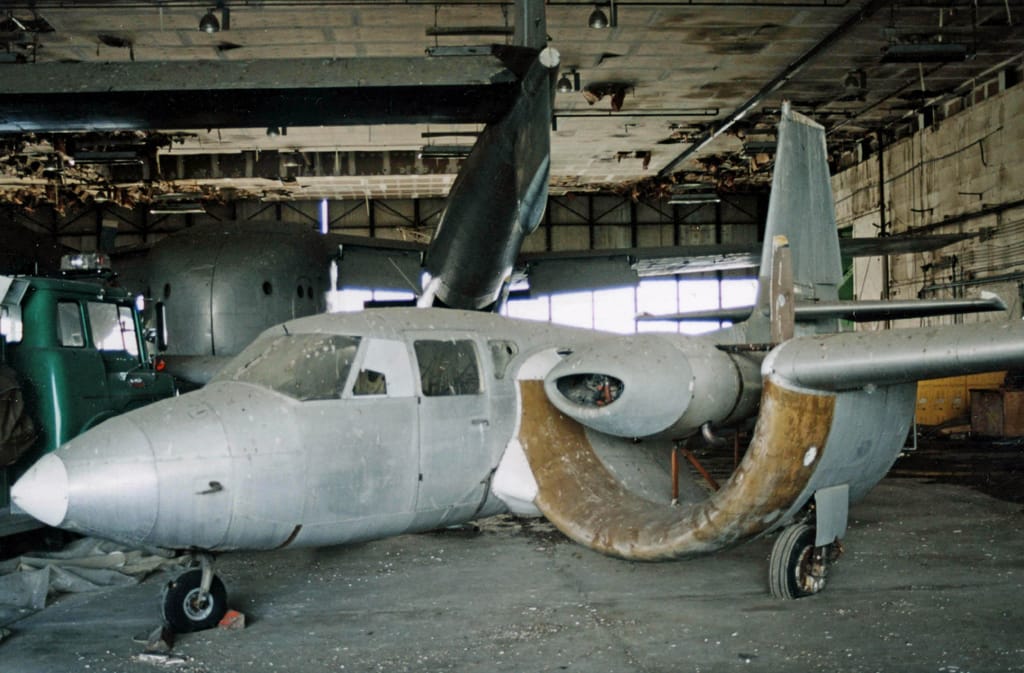
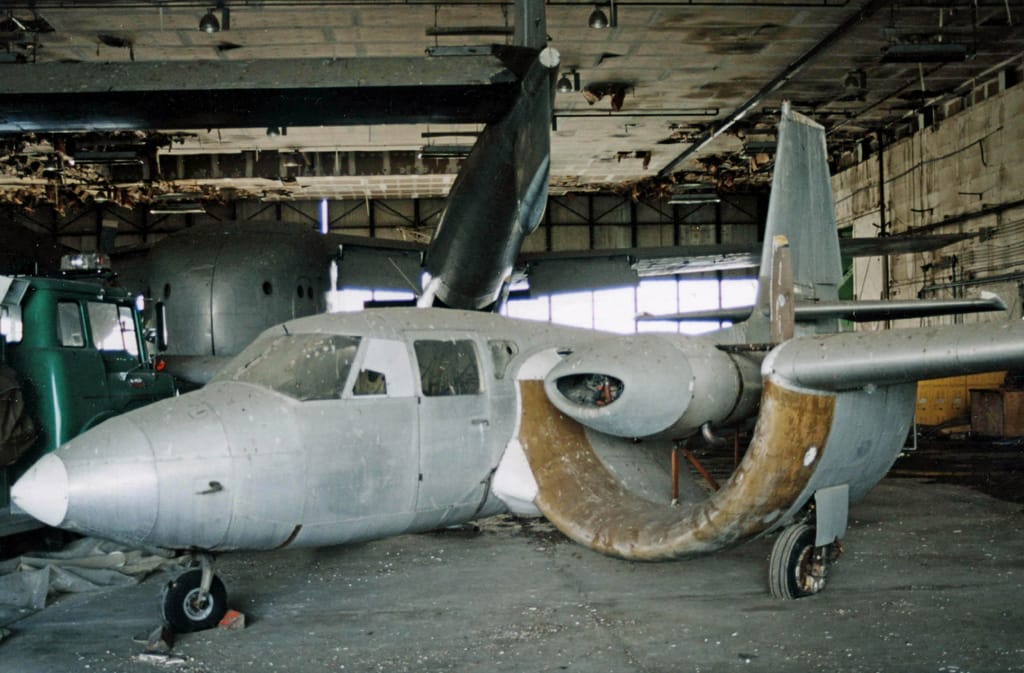
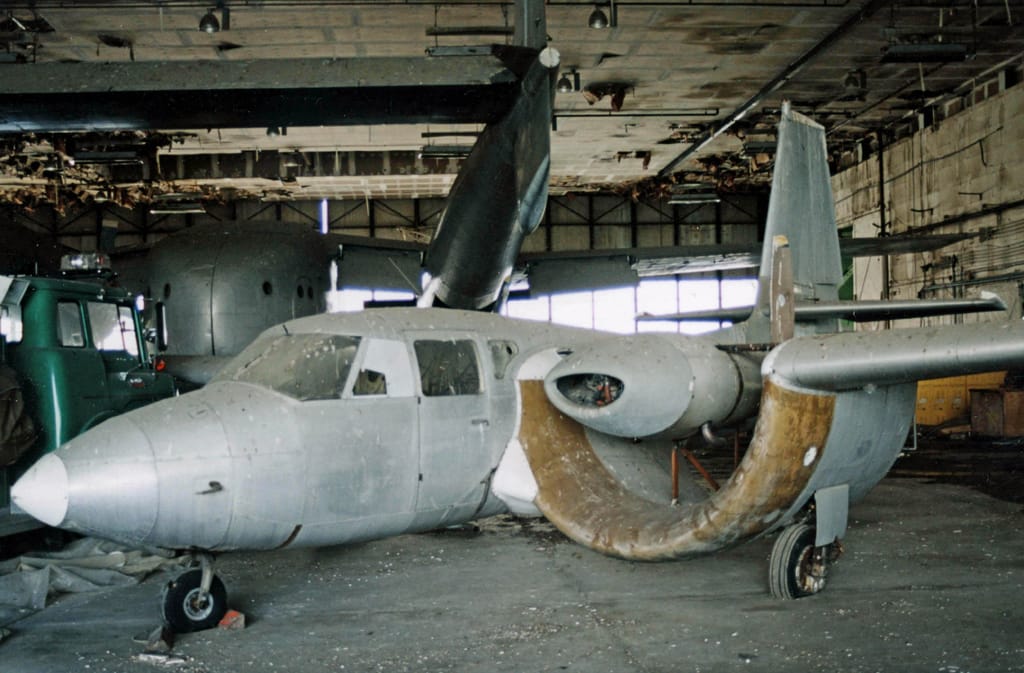
- The definitive CCW-5 first flew on 13 July 1953 at Oxnard, California; only two were built
- Power: twin pusher Continental O-470 flat-sixes (225 hp each); the second CCW-5 used 260 hp engines
- It could fly under control at very low speeds and lift off almost vertically into a headwind — but it never truly hovered
- The CCW-1 survives at the Smithsonian; a CCW-5 at the Mid-Atlantic Air Museum in Reading, Pennsylvania
How the channel wing actually worked
Conventional wings make lift by moving fast enough for the airflow over the top to drop the pressure there. Custer’s trick was to let the engine, not the airspeed, do that job. Each wing carried a near-semicircular channel roughly six feet across, with a pusher propeller sitting at the trailing edge. The curved channel walls constrained the propeller’s slipstream, forcing a much higher flow velocity over the wing surface than an ordinary pusher layout would manage — and crucially, it worked at zero forward speed.
Because the engines had to sit inside the wing channels, a twin-engine pusher was the natural configuration. The design used no flaps, no slots and no leading-edge devices of any kind. The channels did all the low-speed work by themselves.
The Bumblebee and its successors
The first flying proof was the CCW-1, a stubby single-seater. Its maiden flight, on 12 November 1942, was entirely unplanned: Custer, who was not a pilot, was taxiing the machine to impress financial backers when it simply leapt into the air. A hard landing collapsed part of the undercarriage — but the backers were sold. The CCW-1 went on to fly for more than 300 hours.
Next came the CCW-2 in 1948, a testbed built on the fuselage of a Taylorcraft light plane. It flew about 100 hours and could get airborne within 45 to 65 feet. Impressive — though sceptics noted a plain Piper Cub actually lifted more weight per horsepower.
The CCW-5: the one that almost made it
The masterpiece was the CCW-5, a modern-looking five-seat cabin twin. Rather than start from scratch, Custer took the fuselage and tail of an unfinished Baumann Brigadier and replaced its centre section with a pair of channel wings. Twin 225 hp Continental O-470 pushers hung on slender struts in the middle of each channel. The first example flew on 13 July 1953 at Oxnard, California.
The numbers, if you believe the promotional literature, were spectacular: a takeoff in three seconds after a 100-foot roll, and controllable flight anywhere between 22 and 200 mph. A second CCW-5 followed in 1964 with more powerful 260 hp engines.
The hover that never was
Here is where honesty matters, because the legend has grown taller than the aircraft. The Custer Channel Wing did not hover. It could fly very slowly, and in a stiff headwind the CCW-1 could rise almost vertically — the airflow doing the work while the ground stood still — but that is windborne short takeoff, not sustained hovering flight.
And the top end disappointed. The CCW-5 was designed for perhaps 300 mph but managed only about 220 mph in practice. All those bluff channel structures added weight and drag, so the aircraft ended up heavier and slower than the plain Brigadier it was based on. Brilliant at the bottom of the speed range, mediocre at the top.
Why it never entered production
It was not the aerodynamics that killed the channel wing so much as the man and the money. The US Air Force studied the concept in wind-tunnel tests through the mid-1940s, then dropped it in 1947 — officially for lack of postwar research funds. Manufacturer after manufacturer looked, then walked away.
Custer eventually raised enough capital to build his own factory, but the firm folded after completing that single second CCW-5. He even sued the designers of the A-10 in 1978, arguing they had borrowed his engine-over-wing lift idea; the case was thrown out. Willard Custer died in 1985 with his dream unfulfilled. Yet the idea refuses to stay buried: NASA and Georgia Tech researchers revisited the channel wing in the early 2000s, and a new generation of eVTOL designers is once again mounting propellers inside half-barrel wings.
Sources: Wikipedia (Custer Channel Wing; Custer CCW-5); HistoryNet / Aviation History (Robert Guttman).

0 commentaire