
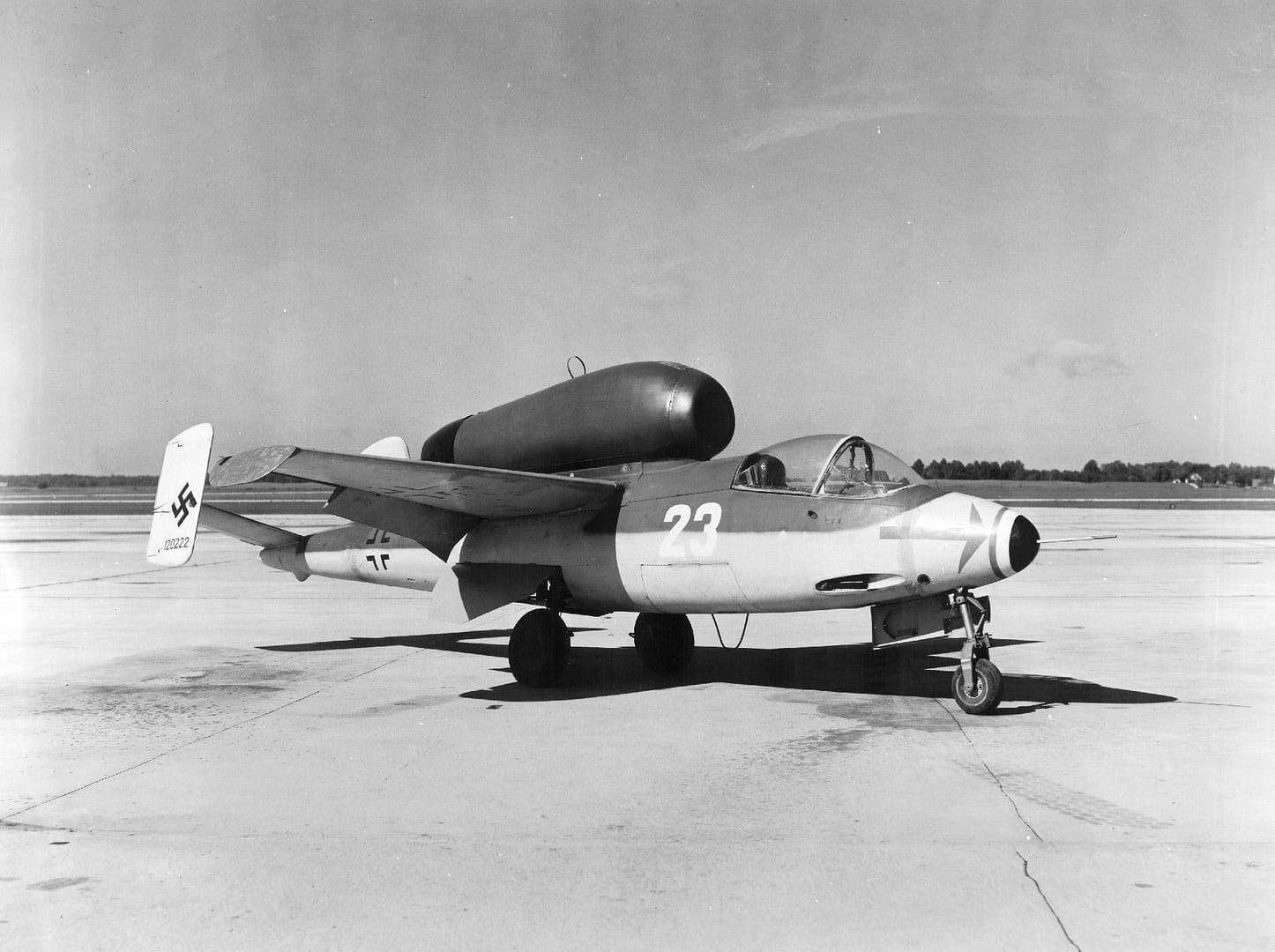
In September 1944, with Allied bombers reducing German cities to rubble and the Luftwaffe haemorrhaging experienced pilots at an unsustainable rate, the Reich Air Ministry issued one of the most desperate specifications in aviation history: design a jet fighter that can be built by unskilled labour from non-strategic materials, in factories dispersed to avoid bombing, and flown by pilots with minimal training. Delivery: ninety days.
The result was the Heinkel He 162 Volksjäger — the "People's Fighter" — a single-engine jet that went from specification to first flight in an astonishing 72 days. It was fast, fragile, and almost certainly a death sentence for the teenage pilots the Nazis intended to fly it. And it remains one of the most extraordinary — and chilling — stories in aviation history.
Seventy-Two Days From Drawing Board to Flight
The Volksjäger specification was issued on 8 September 1944. Heinkel's proposal won on 23 September. The first prototype, He 162 V1, flew on 6 December 1944 — just 72 days after the design was selected. To put this in perspective: modern fighter programmes take 15 to 20 years from concept to first flight. The F-35 programme took 22 years from the JAST requirement to initial operational capability. The He 162 did it in ten weeks.
The speed was possible because the aircraft was designed for simplicity above everything else. The fuselage was a simple semi-monocoque structure. The wings were straight, with plywood leading edges bonded with a special cold-setting adhesive (because Germany was running out of the heat-curing resins used in conventional aircraft construction). The single BMW 003 turbojet was mounted in a nacelle on top of the fuselage, behind the cockpit — a configuration chosen because it kept the jet exhaust clear of the wooden airframe and allowed the engine to be changed in under 30 minutes.
The first flight did not go well. During a high-speed pass for assembled dignitaries, the plywood leading edge of the starboard wing delaminated at speed. The aircraft crashed, killing Heinkel's chief test pilot, Flugkapitän Gotthard Peter. The cause was traced to the acidic adhesive used on the wooden components, which degraded the bonding under aerodynamic stress. The fix — a different adhesive and metal leading-edge strips — was implemented immediately, and flight testing resumed.
Performance: Faster Than a Mustang
Despite its rushed development and improvised construction, the He 162 was a genuinely fast aircraft. The BMW 003E-1 turbojet produced 7.83 kN of thrust, pushing the tiny fighter to a maximum speed of 905 km/h (562 mph) at sea level — faster than any piston-engined Allied fighter, including the P-51D Mustang and the Supermarine Spitfire Mk XIV.
At altitude, the He 162 could reach 840 km/h (522 mph) at 6,000 metres. Its rate of climb — 1,400 metres per minute — was competitive with the Me 262, though its endurance was poor: the BMW 003's fuel consumption limited flight time to approximately 30 minutes on internal fuel. This was considered acceptable for the intended mission: short-range, point-defence interception of Allied bomber formations.
Armament was two MG 151/20 20 mm cannon with 120 rounds per gun — enough to destroy a B-17 in a single firing pass, but only if the pilot could get close enough and hold the aim steady. The He 162's handling, unfortunately, made that last part extremely difficult.
The People Who Were Supposed to Fly It
The darkest aspect of the Volksjäger programme was who the Nazis intended to put in the cockpit. By early 1945, the Luftwaffe had lost the vast majority of its experienced fighter pilots. The He 162 was explicitly designed to be flown by graduates of the Hitler Youth glider programme — teenagers with as little as 50 hours of glider time and no powered-aircraft experience.
This was not pragmatism. It was institutional delusion. The He 162, despite its simple construction, was an exceptionally difficult aircraft to fly. It was longitudinally unstable at high speed. The top-mounted engine created severe yaw coupling during power changes. The landing gear was weak. And the BMW 003 engine was notoriously unreliable, prone to flameouts and compressor stalls that required immediate and precise corrective action.
Experienced test pilots were killed during the evaluation programme. The idea that a 17-year-old with fifty hours in a glider could fly, fight, and survive in this aircraft was not just optimistic — it was homicidal. The Volksjäger was, in the most literal sense, a weapon designed to consume its own pilots.
Production: The Forest Factories
Despite the war's increasingly desperate trajectory, production of the He 162 was ramped up at extraordinary speed. Underground factories in salt mines at Tarthun (near Magdeburg) and dispersed workshops in forests produced components that were assembled at Heinkel's facilities in Rostock-Marienehe, Junkers' factory at Bernburg, and Mittelwerk — the same underground complex that built V-2 rockets using concentration camp slave labour.
Approximately 320 He 162s were completed by the war's end, with components for hundreds more in various stages of assembly. Only one operational unit — I./JG 1 based at Leck in Schleswig-Holstein — received the type, and it saw minimal combat before surrendering to British forces in May 1945. The unit's pilots — who were experienced Luftwaffe veterans, not Hitler Youth teenagers — reported that the aircraft was fast and could have been effective in the hands of trained pilots with adequate fuel and time. They had neither.
Legacy: Desperation as Innovation
The He 162 is often dismissed as a footnote — a desperate last-ditch weapon from a regime in its death throes. That is true, but it misses the engineering achievement. In 72 days, Heinkel designed a jet fighter that was faster than anything the Allies had in service, that could be built from non-strategic materials by semi-skilled workers, and that worked — badly, dangerously, but it worked.
The parallels to modern military thinking are uncomfortable but unavoidable. Today's drone warfare advocates make a strikingly similar argument: that cheap, rapidly produced, expendable combat aircraft — built to be "good enough" rather than exquisite — can overwhelm expensive, sophisticated systems through sheer numbers. The He 162 was the 1945 version of that idea, with one crucial difference: it still had a human being sitting in it.
Surviving He 162s can be found in museums across the world — the Smithsonian, the RAF Museum, the Musée de l'Air. They are small, surprisingly elegant, and deeply unsettling. Each one is a reminder of what happens when a regime values speed over safety, production over people, and numbers over the lives of the children it intended to sacrifice.
Sources: Smithsonian National Air and Space Museum, RAF Museum Cosford, Heinkel company records, Luftwaffe: A History
Related Questions
What was the Heinkel He 162 Volksjäger?
The Heinkel He 162 Volksjäger ("People's Fighter") was a single-engine German jet fighter of the Second World War, designed and flown in just 72 days during late 1944. Built from wood and other non-strategic materials by semi-skilled labour, it was meant to be flown against Allied bombers by minimally trained Hitler Youth pilots. It was fast but dangerously unstable.
How fast was the Heinkel He 162?
The He 162 was genuinely fast for its time. Its single BMW 003E-1 turbojet produced 7.83 kN of thrust and pushed the small fighter to a maximum speed of 905 km/h (562 mph) at sea level — quicker than any piston-engined Allied fighter then in service, including the P-51D Mustang. Its airframe, however, was rushed and fragile.
Why was the He 162 built so quickly?
The He 162 was rushed because Nazi Germany was desperate by September 1944, with Allied bombers devastating its cities and the Luftwaffe losing experienced pilots faster than they could be replaced. The Volksjäger specification was issued on 8 September 1944, Heinkel's design won on 23 September, and the prototype flew on 6 December 1944. It was one of several late-war German "wonder weapons".
Was the Heinkel He 162 dangerous to fly?
Yes. Despite its simple construction, the He 162 was exceptionally difficult to fly. It was longitudinally unstable at high speed, its top-mounted engine caused severe yaw during power changes, its landing gear was weak, and the BMW 003 engine was prone to flameouts. Experienced test pilots were killed during evaluation, which made the plan to use teenage glider pilots effectively homicidal.
Who was supposed to fly the He 162?
The He 162 was explicitly intended to be flown by graduates of the Hitler Youth glider programme — teenagers with as little as 50 hours of glider time and no powered-aircraft experience. This reflected institutional delusion rather than pragmatism: the aircraft demanded skill that even experienced pilots struggled with, so it was, in a literal sense, designed to consume its own pilots.
Why did the He 162's first flight end in a crash?
During a high-speed pass for assembled dignitaries on the first flight, the plywood leading edge of the He 162's starboard wing delaminated, causing a crash that killed Heinkel's chief test pilot, Flugkapitän Gotthard Peter. The cause was an acidic wood adhesive that degraded under aerodynamic stress. A new adhesive and metal leading-edge strips fixed the problem and testing resumed.
Where was the engine mounted on the He 162?
The He 162's single turbojet was mounted on top of the fuselage, directly behind the cockpit. This unusual layout kept the jet exhaust clear of the wooden airframe and let the engine be swapped in under 30 minutes. The drawback was severe yaw coupling during power changes, which made the aircraft tricky to handle.
Why is the He 162 compared to modern drone warfare?
The He 162 embodied an idea echoed by today's drone-warfare advocates: that cheap, rapidly produced, expendable combat aircraft built to be "good enough" rather than exquisite can overwhelm sophisticated systems through sheer numbers. Germany's late-war engineers — some of whom later designed supersonic fighters abroad — pursued many radical concepts. The crucial difference is that the He 162 still had a human pilot inside.
0 commentaire