
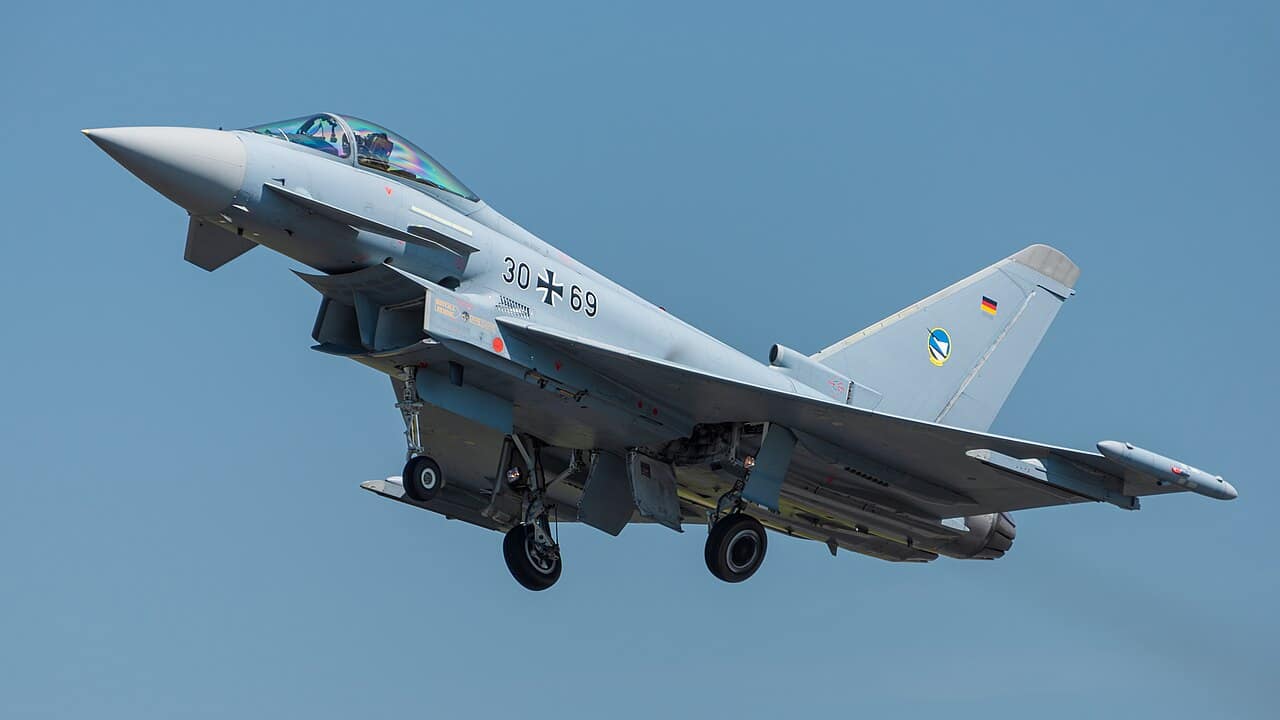
At 34 minutes past the hour on 14 July, a single-seat Eurofighter in plain grey primer rolled down the runway at Airbus’s Manching site in Bavaria, lit its two EJ200 engines and climbed away. The aircraft carried the German military registration 34+02. It was the first Eurofighter built to the new Tranche 4 standard under Berlin’s Quadriga programme to leave the ground — and with it, the Luftwaffe’s long-delayed fleet renewal finally became a flying reality.
Airbus test pilot Stefan Auer held the jet aloft for just over an hour. The sortie was a production flight acceptance test: not a display, but a methodical checklist to confirm that a factory-fresh airframe behaves exactly as its drawings promise. Auer worked through basic handling, engine response, the flight-control system, hydraulics, the electrical system, and the cockpit instruments and navigation suite. Airbus reported that every system performed as intended.
Informations clés
| Aéronef | Eurofighter Typhoon, Tranche 4 (single-seat) |
| Registration | 34+02 |
| Premier vol | 14 July 2026, Manching, Germany |
| Test pilot | Stefan Auer (Airbus Defence and Space) |
| Programme | Project Quadriga — 38 jets (30 single-seat, 8 two-seat) |
| Total on order | 58 new-build Eurofighters for the Luftwaffe |
| Key upgrade | Captor-E / ECRS Mk1 AESA radar; new mission computer |
| Deliveries | From late 2026 through 2030 |
A first flight by the book
There is a deliberate lack of drama in a production acceptance flight, and that is the point. The Eurofighter design is more than two decades mature; what is new here is the manufacturing standard and the equipment fit, not the aerodynamics. The task on 14 July was to verify that this specific airframe — assembly line number one of the Quadriga batch — came off the Manching line correctly. An hour of steady evaluation, no surprises, is precisely the outcome the programme wanted.
What Tranche 4 actually changes
The visible aircraft is familiar; the important changes are inside it. The Tranche 4 standard delivered to Germany centres on the Captor-E active electronically scanned array (AESA) radar — the ECRS Mk1 variant — replacing the mechanically scanned Captor-M of earlier jets. An AESA antenna scans electronically rather than physically slewing a dish, which brings longer detection ranges, the ability to track many targets at once, and far greater resistance to jamming.
Behind the radar sit a more powerful mission computer and reworked cockpit displays, giving the aircraft the processing headroom to absorb future weapons and software without another hardware rebuild. In plain terms, Tranche 4 turns a capable but ageing airframe into a sensor platform fit for the 2030s and beyond.
Filling the gap until FCAS
Project Quadriga covers 38 aircraft — 30 single-seat and eight two-seat — ordered to replace Germany’s oldest Tranche 1 Typhoons, which entered service in the early 2000s and are approaching the end of their useful lives. Counting a follow-on commitment, Germany now has 58 new-build Eurofighters on order. Deliveries of the Quadriga jets are due to begin later in 2026, once type certification is complete, and run through 2030.
The timing matters. The Future Combat Air System (FCAS) that France, Germany and Spain are developing is not expected to field a combat aircraft before the 2040s, and the programme has had its share of industrial friction. Until then, a modernised Typhoon fleet is the backbone of German and NATO air defence in Europe. The quiet, hour-long flight of 34+02 is the first tangible step in keeping that backbone current.
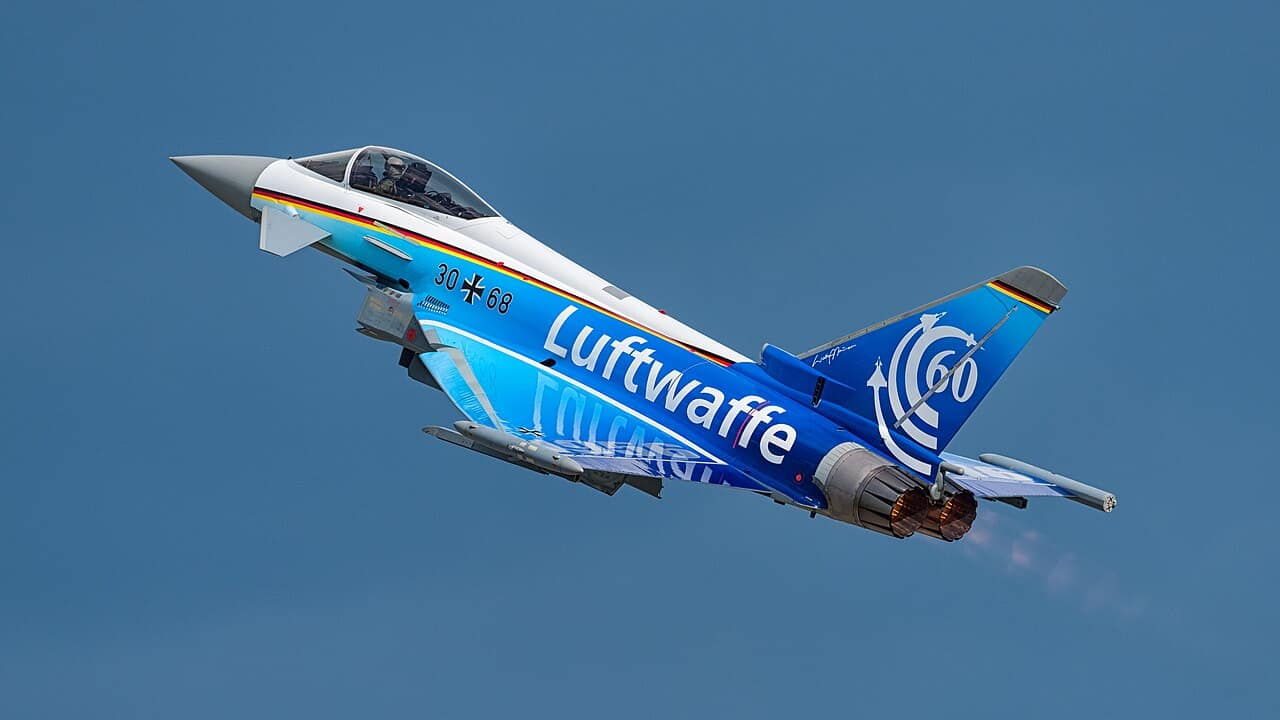
A Luftwaffe Eurofighter Typhoon on full afterburner — the type now being renewed under the Quadriga programme.
Sources: FlightGlobal; Janes; Airbus Defence and Space; Eurofighter Jagdflugzeug GmbH.
Articles similaires
0 commentaire