
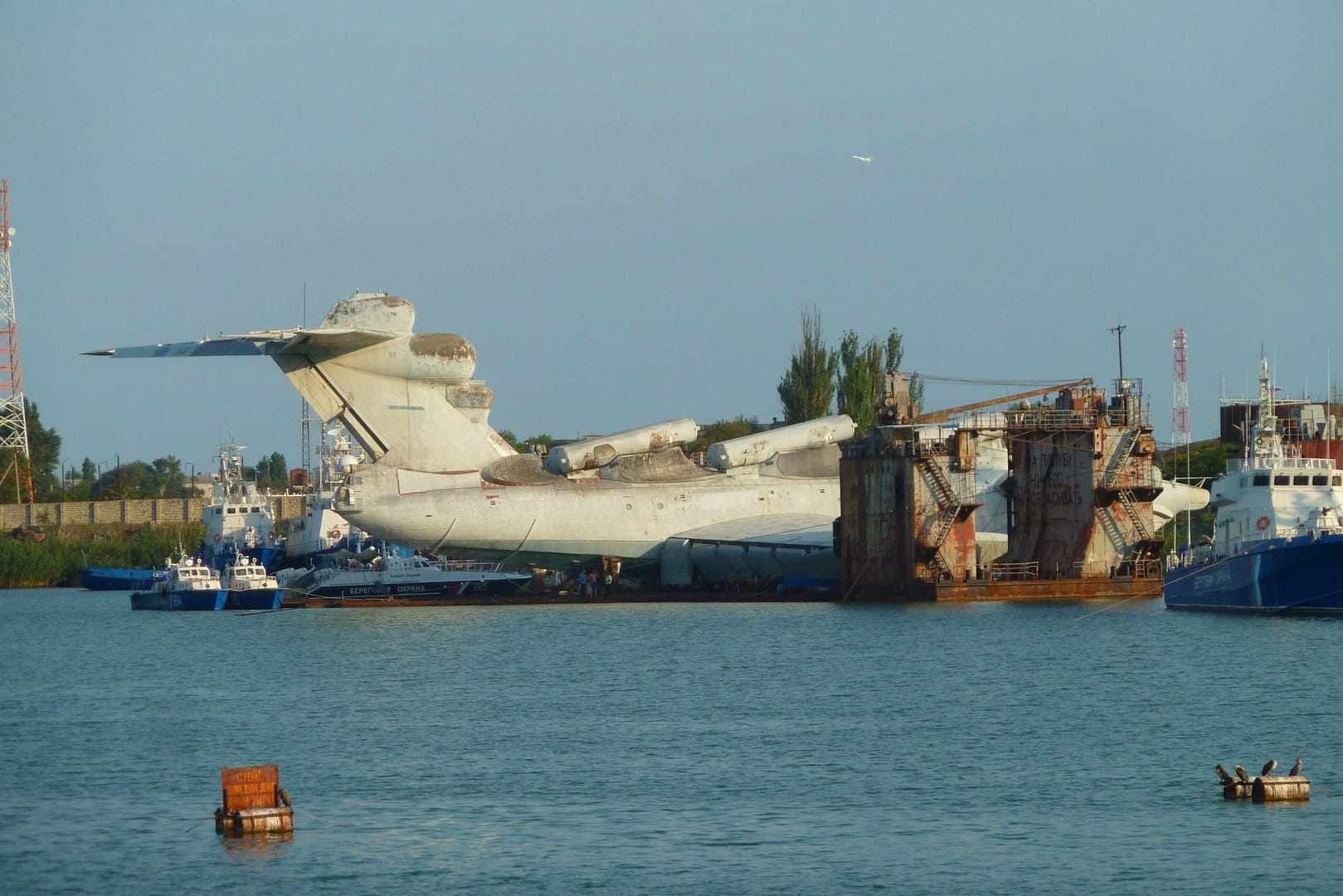
In the late 1960s, a CIA analyst sat staring at a grainy satellite photograph of the Caspian Sea and could not make the numbers work. The machine in the frame was nearly 100 metres long — longer than a Boeing 747 — yet it was clearly skimming the water, throwing spray, sitting just a few metres above the surface. It had stubby wings and ten engines clustered at its nose. It was not quite a ship and not quite a plane, and nothing in the West's reference library matched it. Someone scrawled a label on the file that stuck for half a century: the Caspian Sea Monster.
The truth was stranger than the espionage. This was no propaganda mock-up. It was a real, flying, 544-tonne machine, and the man behind it had just rewritten the rulebook on how heavy things move over water.
Informations clés
| Designer | Rostislav Alexeyev, Central Hydrofoil Design Bureau |
| KM | First flight 16 Oct 1966; max takeoff ~544 t |
| KM record | World’s heaviest aircraft until 1988 |
| KM fate | Crashed in the Caspian, 1980 (pilot error, no fatalities) |
| Lun-class (MD-160) | In service 1987–late 1990s; only one completed |
| Lun armament | Six P-270 Moskit anti-ship missiles |
Alexeyev's impossible idea
The designer was Rostislav Alexeyev, a hydrofoil genius from the Central Hydrofoil Design Bureau in Gorky (today's Nizhny Novgorod). His insight was to exploit "ground effect" — the cushion of high-pressure air trapped between a wing and the surface below it. Fly low enough, within a wingspan or so of the water, and drag collapses while lift soars. A craft that could harness it would carry enormous loads at aircraft speeds while sipping fuel.
The result was the KM, short for Korabl-Maket, roughly "ship-prototype." It first ran in 1966 and was, on completion, the largest and heaviest aircraft in the world — a title it held until the Antonov An-225 flew in 1988. Ten turbojets hauled it off the water; eight shut down once airborne, leaving two on the tail to cruise at up to 500 km/h, just metres above the Caspian. Because it never climbed into the radar horizon, it was effectively invisible to the air-defence systems of the day.

Mustard’s superb explainer on the giant ekranoplans.
A ship that flew, flown by the man who built it
The Soviet bureaucracy could not decide what the KM was. Technically an aircraft, it was handed to the Navy, documented as a marine vessel, and christened with a bottle of champagne smashed across its nose like a destroyer. Its first flight, on 16 October 1966, was made partly by Alexeyev himself — almost unheard of for a Soviet chief designer, most of whom never went near the controls of their creations.
For Alexeyev, ground effect was not a gimmick but a third way of travelling, sitting between sea and sky.

The KM was tested relentlessly on the Caspian for some fifteen years. Then, in 1980, pilot error during a manoeuvre sent the giant slamming into the sea. Remarkably, no one was killed — but the machine was wrecked. Deemed too heavy to recover, it was left to float for about a week before sinking. It remains on the seabed to this day, and no second KM was ever built.
The Lun: a sea monster with teeth
The KM had proven the concept, and from it grew something purpose-built for war: the Lun-class ekranoplan, Project 903. Where the KM was a flying laboratory, the Lun was a weapon. Its name means "harrier" — the bird of prey — and it lived up to it. Across its broad back sat six launch tubes for the formidable P-270 Moskit anti-ship missile, a sea-skimming, supersonic ship-killer. The idea was chilling in its simplicity: a machine that could appear from below the radar at 500 km/h and salvo six missiles into a carrier group before anyone knew it was there.
Only one Lun, the MD-160, was ever completed. It entered service with the Soviet Navy's Caspian Flotilla in 1987 and served until the late 1990s. A second airframe was started but, after the Soviet collapse cut military funding, was reworked into a never-finished rescue craft called the Spasatel. The Lun's fatal flaw was the same one that limited every ekranoplan: it could only fly in calm seas, and it could not climb out of trouble. Beautiful in theory, it was a prisoner of the weather.
The monster crawls ashore
For two decades the MD-160 sat decaying at the Kaspiysk naval base. Then, on 31 July 2020, tugs and pontoons dragged the giant out to sea on a roughly 100-km journey toward Derbent, Dagestan, where it was to become the centrepiece of a planned Patriot Park. The move went badly: the Lun grounded short of its destination and sat beached in the surf for months before finally being hauled fully ashore.
The story did not end in the surf. Russian sources reported in December 2024 that MD-160 would be restored, and by autumn 2025 exterior and partial interior work was reported under way — the last Cold War sea monster being readied as a museum exhibit on the very water it once terrorised.
Period footage of the Caspian Sea Monster skimming the surface in ground effect.
The ekranoplan never conquered the seas the way Alexeyev dreamed. It was too fragile, too specialised, too far ahead of the systems that might have tamed it. But stand beneath the MD-160's missile-studded spine and the ambition is undeniable. The Caspian Sea Monster was the answer to a question almost nobody else had the nerve to ask — and for that, it earns its place among the strangest, boldest machines aviation has ever produced.
Sources: Wikipedia (Caspian Sea Monster; Lun-class ekranoplan); CNN Travel; The War Zone; The Aviationist; Forbes.
Foire aux questions
What was the "Caspian Sea Monster"?
The Caspian Sea Monster was the Western nickname for the KM, a giant Soviet ground-effect vehicle photographed by the CIA on the Caspian Sea in the late 1960s. Nearly 100 metres long with ten engines clustered at its nose, it skimmed just metres above the water and was neither quite a ship nor quite a plane.
What is an ekranoplan or ground-effect vehicle?
An ekranoplan is a craft that flies just above a surface using "ground effect," the cushion of high-pressure air trapped between a wing and the water below. Flying within a wingspan of the surface, drag collapses while lift soars, letting the craft carry huge loads at aircraft speeds while sipping fuel. The Soviet KM was the most famous example.
Who designed the Caspian Sea Monster?
The KM was designed by Rostislav Alexeyev, a hydrofoil genius from the Central Hydrofoil Design Bureau in Gorky, today's Nizhny Novgorod. He exploited ground effect to move heavy loads over water at high speed. Unusually for a Soviet chief designer, Alexeyev helped fly the KM's first flight himself, on 16 October 1966.
How big was the KM ekranoplan?
The KM had a maximum takeoff weight of around 544 tonnes and was nearly 100 metres long, longer than a Boeing 747. On completion it was the largest and heaviest aircraft in the world, a title it held from 1966 until the Antonov An-225 flew in 1988. Ten turbojets lifted it off the water, with two cruising it at up to 500 km/h.
Qu'était-ce qu'un ekranoplan de classe Lun ?
The Lun-class (Project 903) was a purpose-built military ekranoplan developed from the KM. Where the KM was a flying laboratory, the Lun was a weapon, carrying six P-270 Moskit anti-ship missiles on its back. It could skim below radar at 500 km/h and salvo missiles into a carrier group. Only one, the MD-160, was completed, serving from 1987.
Why did ekranoplans never succeed?
Ekranoplans were beautiful in theory but prisoners of the weather. They could only fly in calm seas and could not climb out of trouble, being designed to skim within metres of the surface. Too fragile and too specialised, they never replaced ships or aircraft. The KM crashed in 1980, and only one Lun was ever completed.
What happened to the last Caspian Sea Monster?
The original KM crashed in the Caspian in 1980 due to pilot error, with no fatalities, and sank. The military Lun-class MD-160 sat decaying for two decades, then in July 2020 was dragged toward Derbent, Dagestan, to become a museum exhibit. Russian sources reported in 2024 and 2025 that it would be restored.
Articles similaires
0 commentaire