
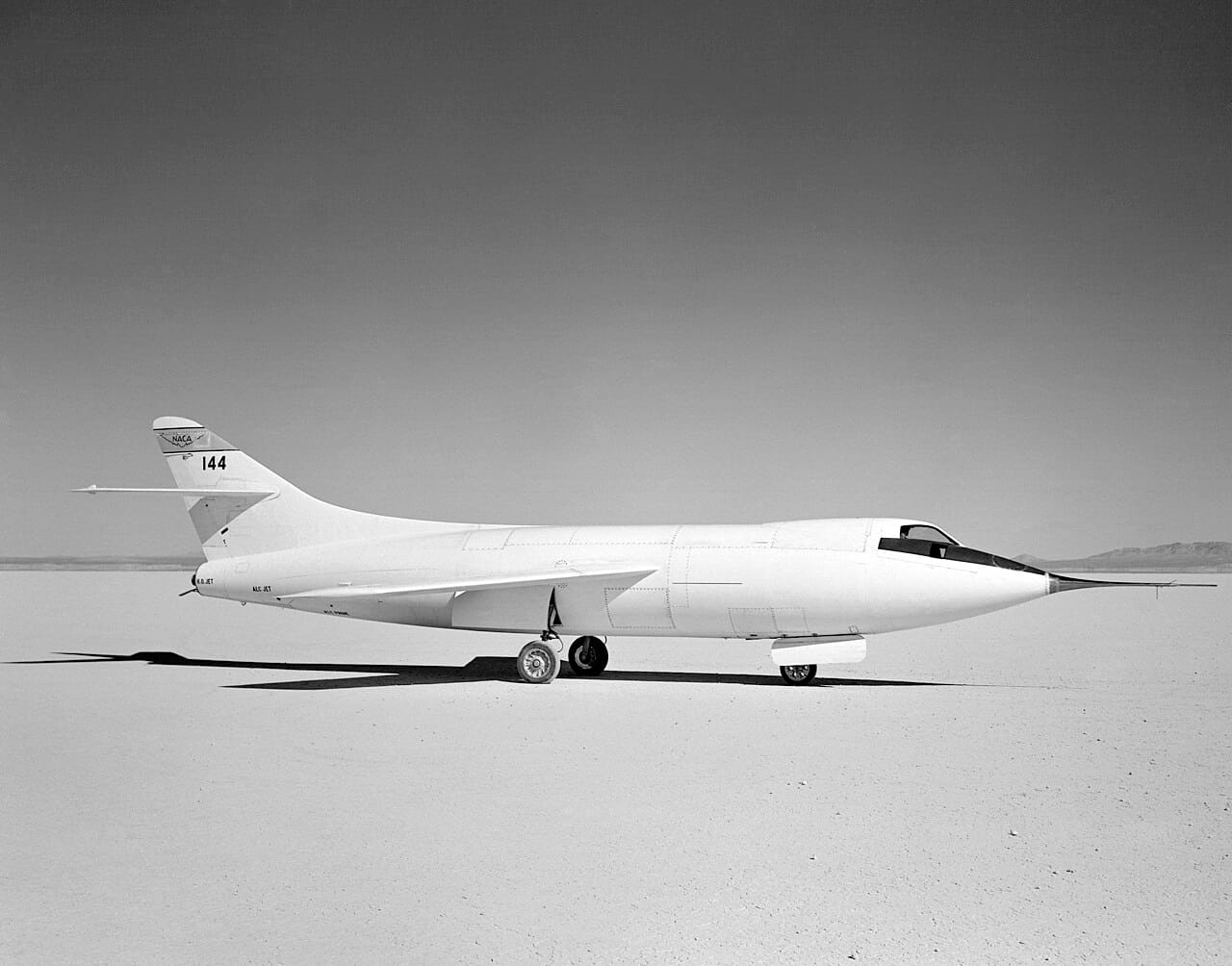
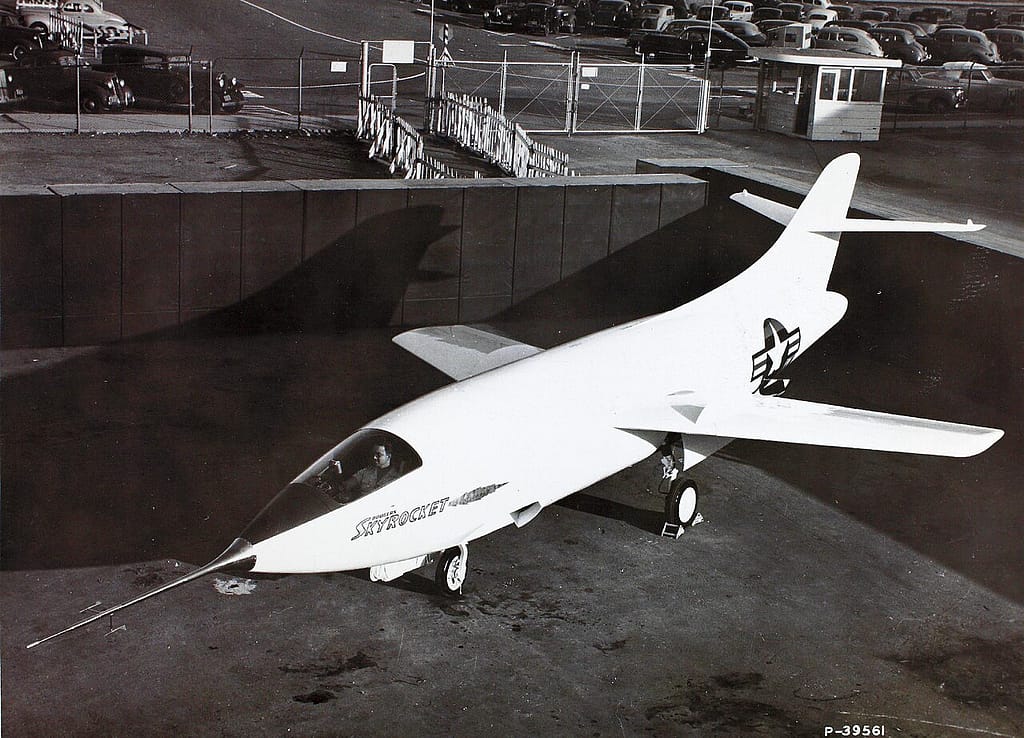
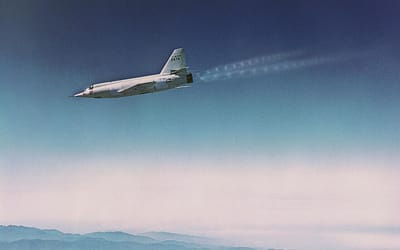
Almost everyone can tell you that Chuck Yeager was first to break the sound barrier. Far fewer can name the man who first flew at twice the speed of sound. He was Scott Crossfield, and he did it on November 20, 1953, in a sleek, snow-white rocket plane called the Douglas D-558-2 Skyrocket.
It was one of the most deliberate record attempts in aviation history — a carefully engineered dash to claim Mach 2 before the calendar, and the Air Force, could beat him to it.
Informations clés
- Aéronef: Douglas D-558-2 Skyrocket — swept-wing rocket research plane
- Pilote: A. Scott Crossfield (NACA)
- First Mach 2: November 20, 1953 — Mach 2.005 (1,291 mph) at 62,000 ft
- Lancement: Air-dropped from a Navy P2B (B-29) at 32,000 ft
- Construit: Three Skyrockets, 313 research flights in total
- Only once: No Skyrocket ever flew past Mach 2 again
A rocket built to learn
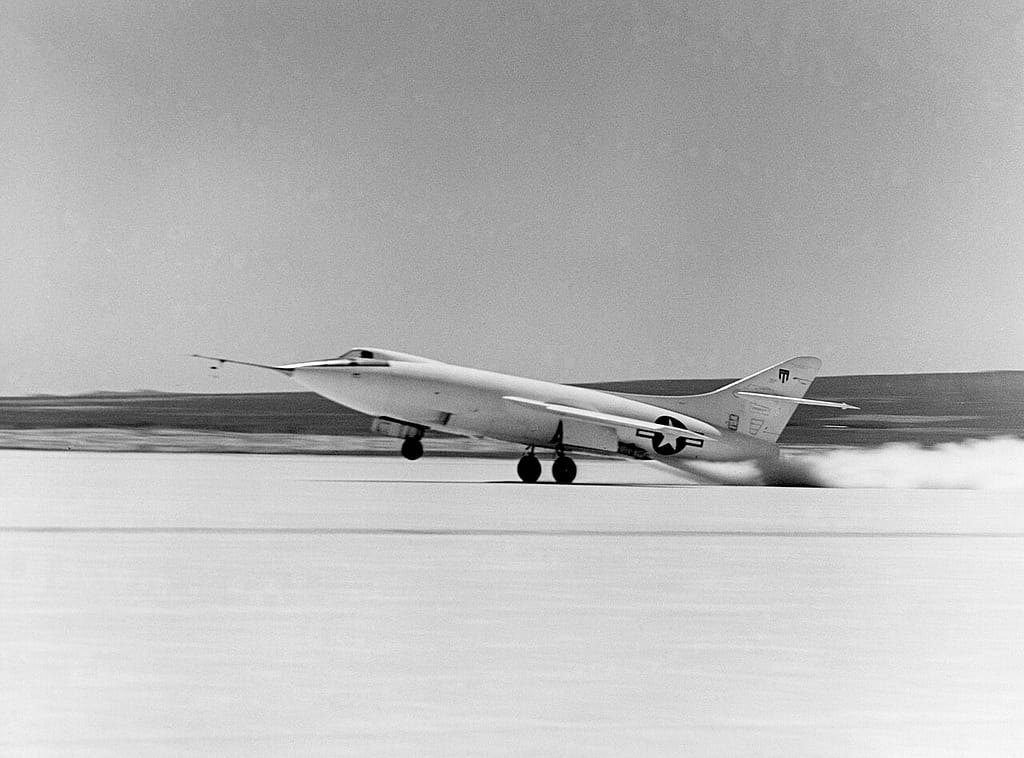
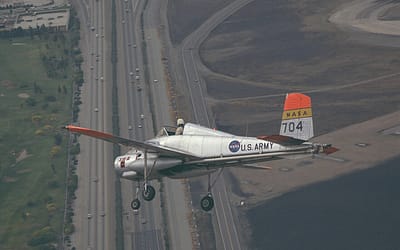
The Skyrocket was a joint Navy, NACA and Douglas research aircraft, built to study how swept wings behaved as speeds climbed toward and beyond the sound barrier. Like the Bell X-1, it was rocket-powered and air-launched: a modified Navy B-29, designated P2B, carried it aloft and dropped it, after which the pilot lit the engine and glided back to a dead-stick landing on the dry lakebed at Edwards. Three were built, and together they flew 313 research missions.
By 1953 the Skyrocket had already probed deep into supersonic flight. But Mach 2 — twice the speed of sound — remained unclaimed, and NACA wanted it, ideally before the 50th anniversary of the Wright brothers’ first flight that December.
Engineering an extra fraction of Mach
Getting the Skyrocket to Mach 2 took more than nerve; it took preparation bordering on obsession. Crossfield’s team waxed and sealed the airframe to cut drag, extended the exhaust nozzles to improve rudder response, and over-fuelled the aircraft. They even waited for a cold, blustery day, because the lower temperatures helped with the fierce aerodynamic heating a high-Mach run would generate.
After the P2B dropped him at 32,000 feet, Crossfield lit the engine and climbed to 72,000 feet, then pushed over into a shallow dive. As the Skyrocket burned off fuel it grew lighter and faster, and just before the tanks ran dry, it slipped through Mach 2.005 — about 1,291 miles an hour. It was the only time any Skyrocket ever exceeded Mach 2.
The reluctant record-holder
Chuck Yeager was not about to let the Navy’s civilian agency keep the crown quietly. Three weeks later, on December 12, he took the Bell X-1A to Mach 2.44 — and nearly died when it tumbled out of control in inertia coupling. But Crossfield had got there first. He was, and remained, the first human to fly at twice the speed of sound.
What set Crossfield apart was how little he made of it. A farm boy from Washington state who learned to fly at what he called a humble little field, he was an engineer first and a showman never.
He was equally blunt about the mythology that grew up around test pilots — the “right stuff” that would later make them legends.
The road to the X-15
Crossfield left NACA in 1955 to become chief engineering test pilot for North American Aviation, where he helped design and then fly the X-15 — making its first glide and first powered flights, and surviving a landing so hard the aircraft snapped in half. He shaped the machine that would fly to the edge of space.
He died in 2006, aged 84, when his small Cessna broke up in a thunderstorm over Georgia — a quiet, ironic end for a man who had ridden rockets to the edge of the known. But the record stands: before anyone reached Mach 3 or the fringes of space, Scott Crossfield doubled the speed of sound in a white rocket plane, on a cold morning, on his own careful terms.
Sources: Smithsonian National Air and Space Museum; NASA; HistoryNet / Aviation History; A. Scott Crossfield, “Always Another Dawn.”
0 commentaire