
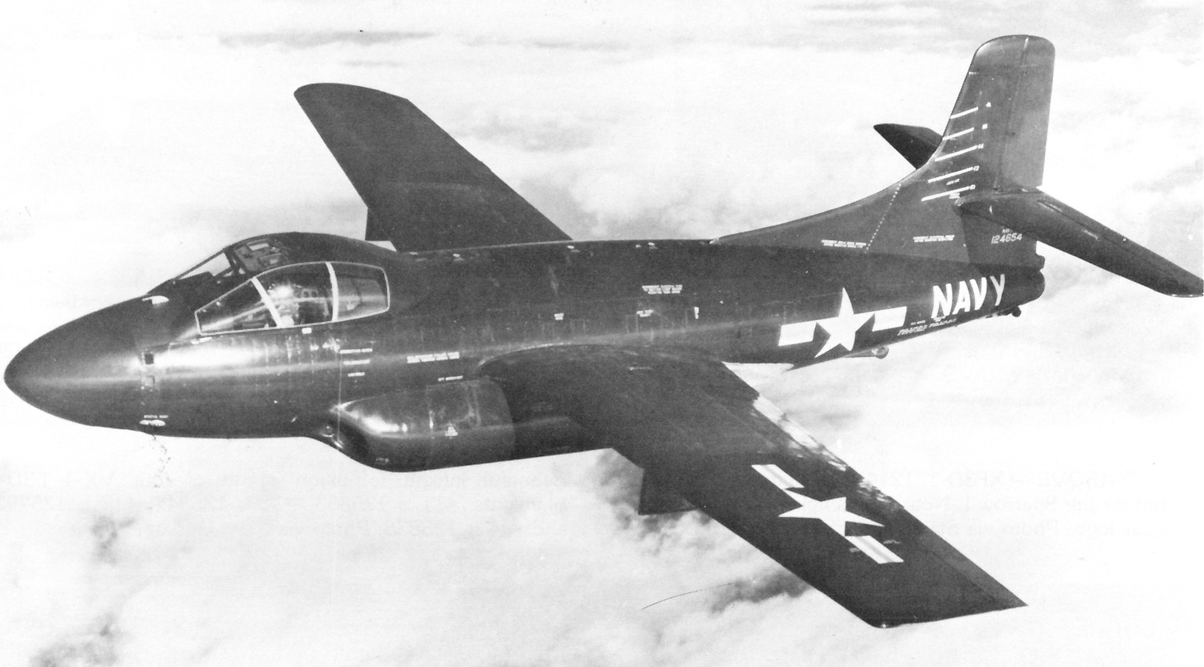
It was fat, slow, and so unlovely that the men who flew it simply called it “the Whale.” It set no speed records and never graced a recruiting poster. And yet the Douglas F3D Skyknight did something no glamorous day-fighter could claim: on a dark night over Korea in November 1952, a Skyknight became the first jet in history to shoot down another jet in the dark.
While the sleek F-86 Sabre dueled MiGs in the daylight of “MiG Alley,” the Skyknight owned the night — and by the end of the war it had killed more enemy aircraft after dark than any other jet night fighter.
Informations clés
- Aéronef: Douglas F3D Skyknight (later redesignated F-10)
- Rôle: the U.S. Navy’s first purpose-built jet night fighter
- Designer: Ed Heinemann; first flight 23 March 1948
- Équipage: two, seated side by side — pilot and radar operator
- Armement: four 20 mm cannon and three radars, including a tail-warning set
- Escape: no ejection seats — crews used a slide-out chute between the engines
- D'abord: scored what is generally recognised as the first jet-versus-jet kill at night, over Korea in November 1952
- Enregistrer: six confirmed and two probable kills — more than any other jet night fighter of the war
A fighter built around a radar
The Skyknight was designed by Ed Heinemann, the same engineer behind the wartime Dauntless dive bomber and, later, the diminutive A-4 Skyhawk. For the Navy’s first dedicated jet night fighter he faced a contradiction: it had to carry a bulky 1940s radar system and two crew, yet still perform. Something had to give, and it was speed.
The result was built quite literally around its radar. A 30-inch search dish sat in a bulbous nose radome, feeding a fire-control set and a novel tail-mounted radar that warned of threats sneaking up from behind. The pilot and his radar operator sat shoulder to shoulder, and four 20 mm cannon gave it a punch far heavier than the machine guns of rival night fighters. There were no ejection seats; to bail out, the crew slid down a chute between the engines and dropped clear.
A short history of the Douglas F3D / F-10 Skyknight, the Navy’s first jet night fighter.
Death in the dark over Korea
By mid-1952, MiG-15s had made daylight B-29 raids over North Korea suicidal, and even night raids grew deadly once the enemy learned to vector MiGs onto the bombers by ground radar. The Marines’ land-based Skyknight squadron, VMF(N)-513 — the “Flying Nightmares” — was sent to ride shotgun.
On the night of 2–3 November 1952, Major William Stratton and his radar operator, Master Sergeant Hans Hoglind, downed an enemy jet in the dark — the first jet-versus-jet night kill in history. Days later, on 8 November, Captain Oliver Davis and radar operator Dramus Fessler bagged the first MiG-15 to fall to a Skyknight. Most remarkable of all came on 10 December, when Lieutenant Joseph Corvi and Master Sergeant Dan George destroyed a low-flying enemy biplane they never saw with their eyes at all — their guns aimed entirely by radar.
By the armistice, Skyknights had claimed six confirmed and two probable kills — more than any other jet night fighter of the Korean War — for the loss of a single Skyknight in air combat. The ugly Whale had quietly become the deadliest night fighter of the war.
The Whale that wouldn’t fade away
Nobody pretended it was quick. Underpowered by feeble Westinghouse turbojets, the Skyknight’s sluggishness became the stuff of pilot legend — and affection.
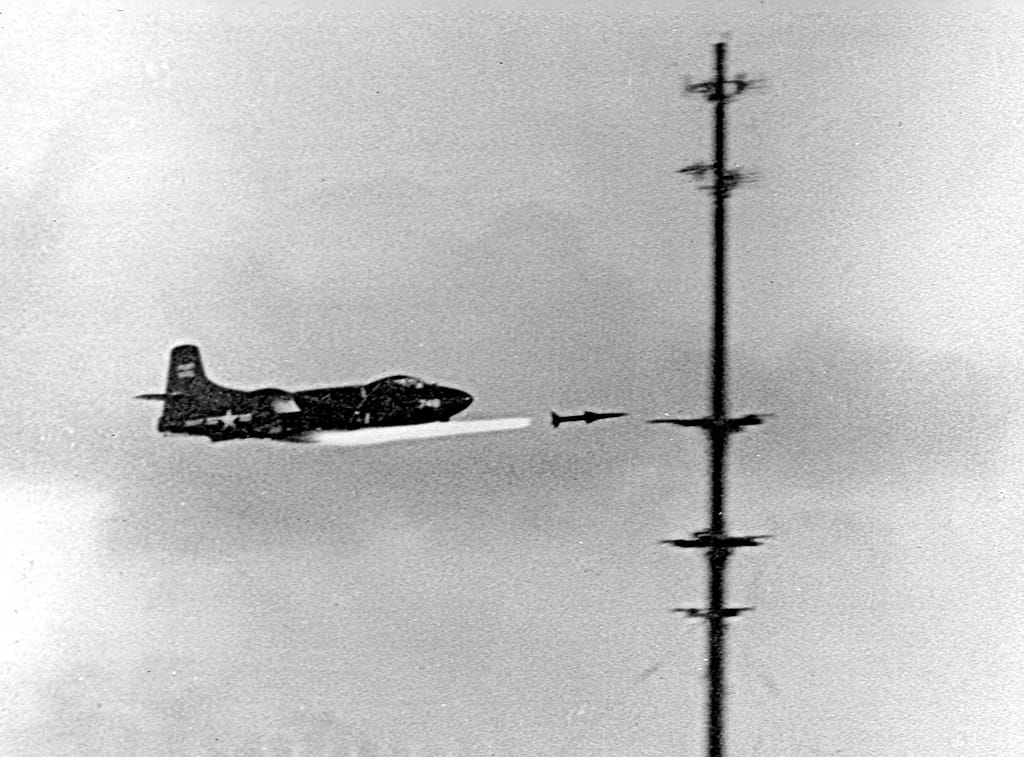
That commodious, radar-friendly nose gave the Whale an unusually long career. Its size and steadiness made it the ideal test bed for the first Sparrow guided missiles, and the frugal Marines kept reinventing it.
The Skyknight’s night-fighter legend in brief.
A second life as a jammer
In 1962, 35 of the old fighters were rebuilt as EF-10B electronic-warfare aircraft, their noses packed with jamming gear. They monitored Soviet radars during the Cuban Missile Crisis, and early in the Vietnam War the EF-10B was one of the few American aircraft able to find and jam the radars guiding North Vietnamese missiles and guns — flying ahead of Air Force and Navy strike packages to blind the defences.
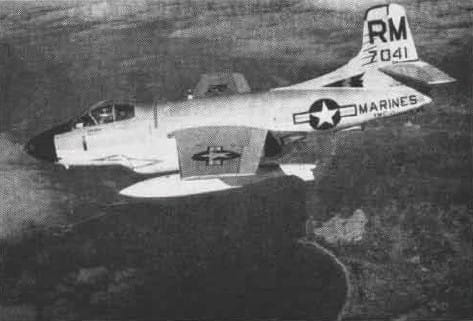
The Skyknight finally flew its last combat missions in 1969, and the Marines gave it a fitting send-off: the pilot chosen to fly the very last official Skyknight mission, in 1970, was Oliver Davis — the same man who, eighteen years earlier, had shot down that first MiG-15 in the dark. Only 268 Skyknights were ever built, but the Whale had spent two decades quietly being present at one aviation first after another.
The Douglas F3D Skyknight in action.
Sources: Robert Bernier, “The Deadliest Night Fighter in Korea,” Smithsonian Air & Space; Naval History & Heritage Command; Wikipedia.
0 commentaire