
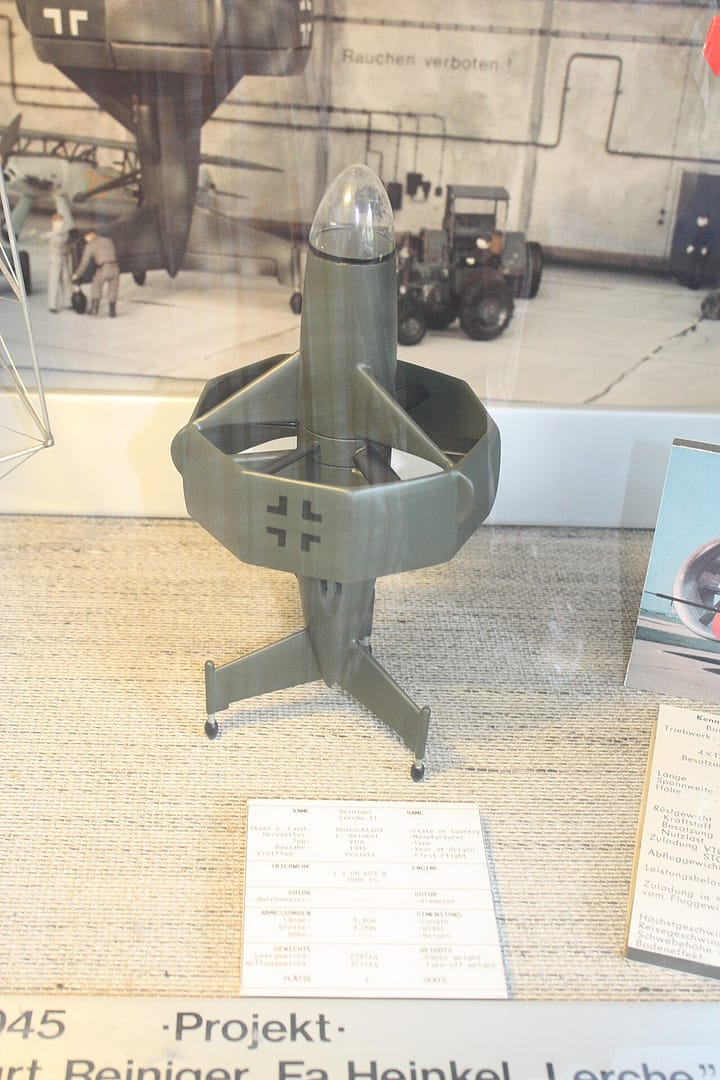
In the last winter of the war, with Allied fighters strafing German airfields almost at will, Heinkel’s engineers asked a radical question: what if a fighter needed no airfield at all? Their answer, drawn up between 1944 and March 1945, was the Lerche — “Lark” — an aircraft that would stand on its tail, rise straight up like a rocket, and fly hidden inside its own wing.
It never left the drawing board. But as a piece of engineering imagination, the Heinkel Lerche remains one of the strangest machines the Third Reich ever conceived.
Informations clés
- Taper: VTOL “coleopter” tailsitter fighter (project study)
- Designer: Ernst Heinkel AG, 1944–1945
- Aile: annular (ring-shaped), enclosing the propellers
- Pouvoir: two Daimler-Benz DB 605 engines, contra-rotating propellers
- Pilote: lay prone in the nose
- Statut: never built — paper project only
An aircraft inside a ring
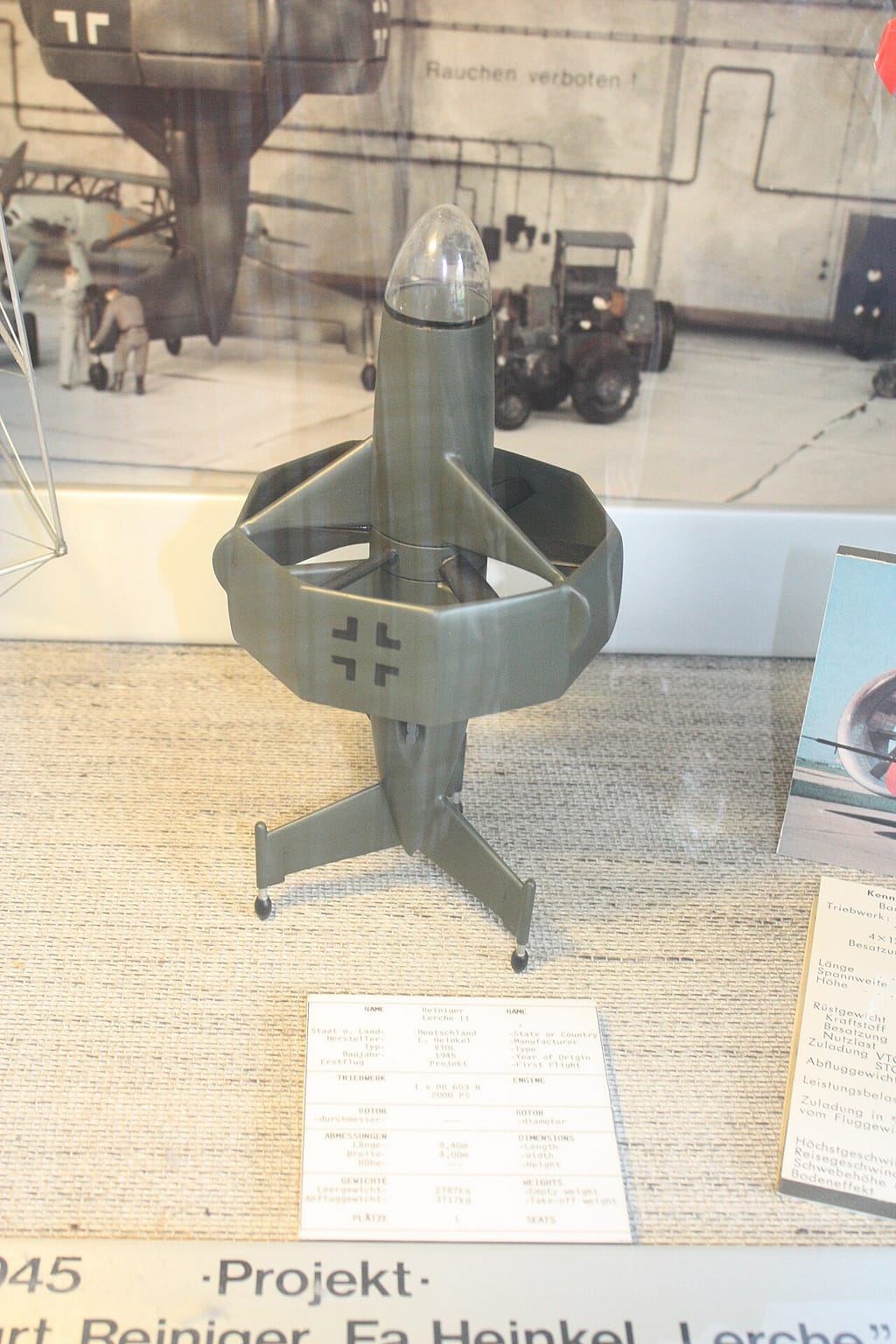
The Lerche belonged to a rare class of aircraft called the coleopter: a tailsitter whose wing forms a complete ring around the fuselage. Inside that ring, two Daimler-Benz DB 605 piston engines were to drive a pair of contra-rotating propellers. The pilot lay prone in the nose, looking forward. On the ground the machine balanced on four small tail fins fitted with castoring wheels.
To fly, it would power up and climb vertically, needing no runway. Once high enough, it would tip forward into level flight and behave, more or less, like a conventional aeroplane. On paper, it neatly solved the problem of vulnerable airfields.
The problem was coming back down
Taking off vertically was, in theory, manageable. Landing was not. To touch down, the pilot had to reverse the whole process — descending tail-first, craning to look backward over his shoulder, judging his height above the ground with almost no visual reference and no way to soften the final drop onto those small tail fins. Even a gifted test pilot would have struggled; a hastily trained wartime conscript had no chance.
A family of desperation
The Lerche did not appear in isolation. It was one of several late-war German “point-defence” concepts meant to rise from forests and rubble to intercept Allied bombers — alongside the propeller-driven Focke-Wulf Triebflügel and the rocket-powered Bachem Natter. All shared the same desperation, and all shared the same fate: the war ended before any of them cut metal.
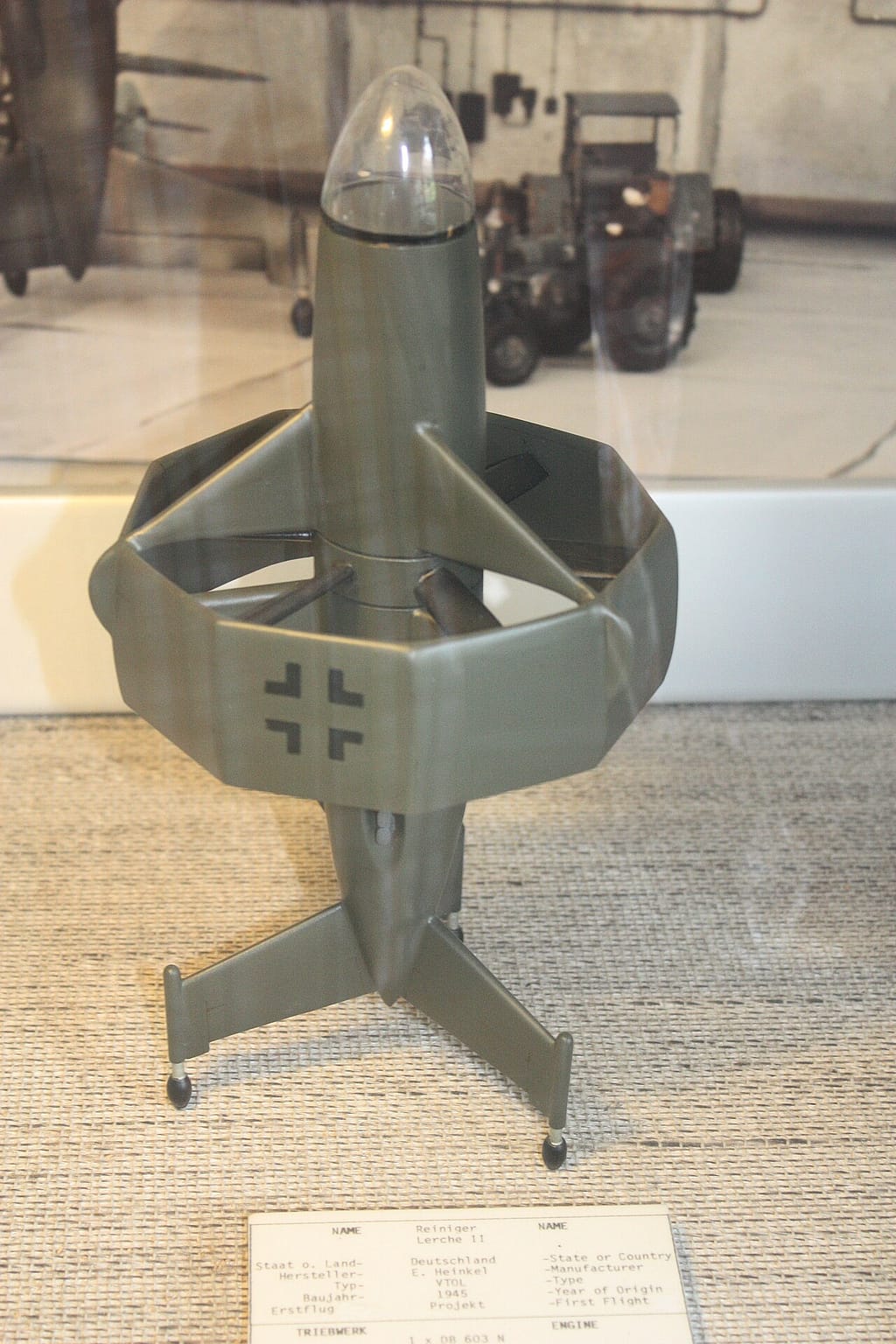
The Lerche identified a genuine problem — the fragility of runways — and reached for an answer decades ahead of its time. Postwar coleopters such as France’s SNECMA design would attempt the same trick and fail for exactly the same reason: getting a tailsitter safely back onto the ground is far harder than getting it into the air. The Lark was visionary, and quite possibly unflyable.
Sources: Wikipedia; MilitaryFactory; David Myhra; Secret Projects Forum.

0 commentaire