
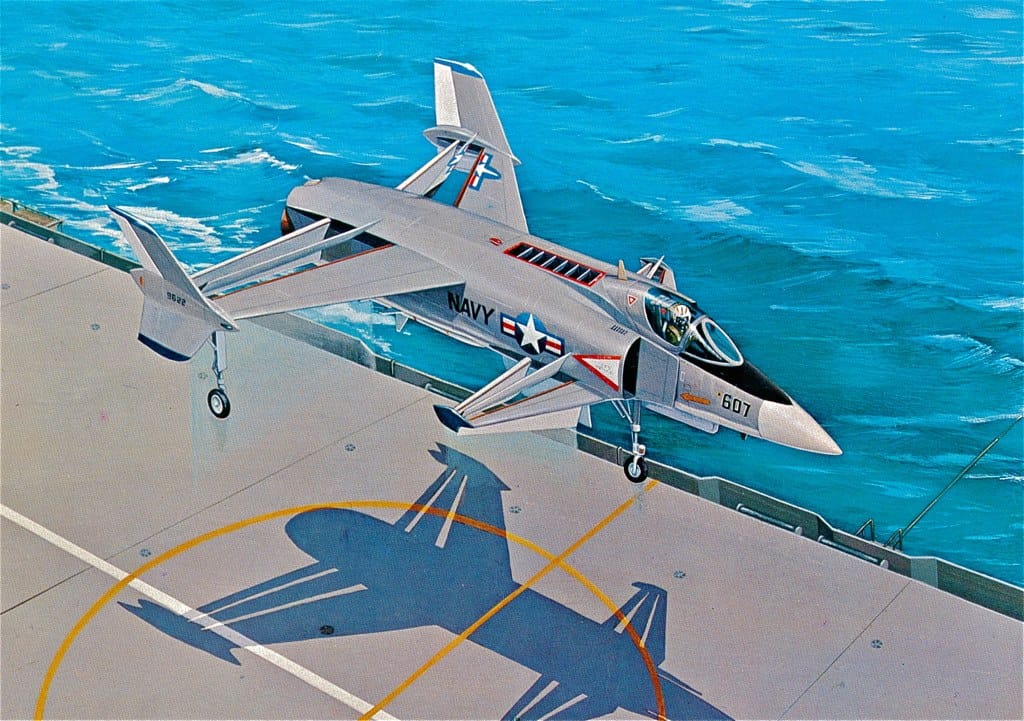
On paper, the Rockwell XFV-12 was a dream: a supersonic, Mach-2 fighter that could rise straight up off a small ship’s deck, fight like an F-4 Phantom, and land vertically in a space no runway could offer. The US Navy wanted it badly. Rockwell promised it could be done.
There was just one problem. When they finally hung it from a test rig and told it to lift off, the most advanced VTOL fighter America ever designed could not even pick itself up off the ground.
FAITS RAPIDES
| Rôle | Supersonic V/STOL fighter prototype |
| Premier vol | None — tethered hover tests only (1978) |
| centrale électrique | 1 × Pratt & Whitney F401 turbofan, ~30,000 lbf |
| Concept | "Thrust-augmented wing" — exhaust ducted through wing and canards |
| Nombre construit | 1 |
| Destin | Cancelled 1981; could lift only ~75% of its own weight |
The clever idea
The XFV-12 came from a 1972 Navy competition for a supersonic jump-jet to fly from small "Sea Control Ships." Rockwell’s answer was ingenious. To save money it borrowed a nose from the A-4 Skyhawk and intakes from the F-4 Phantom, and wrapped them around a single big Pratt & Whitney turbofan.
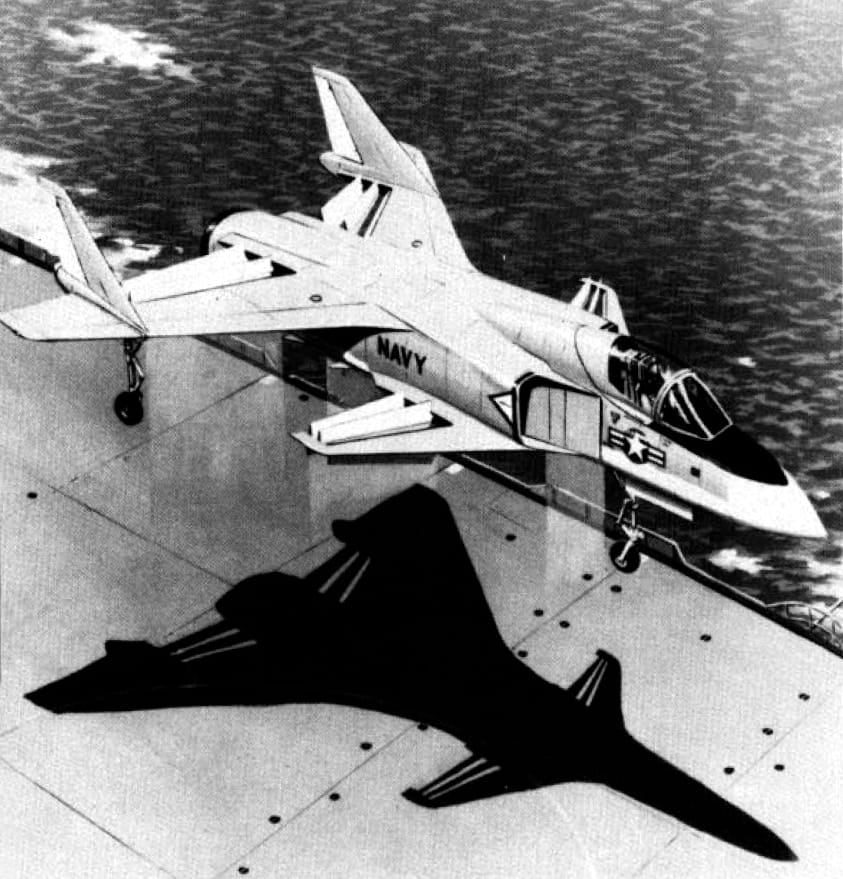
The magic was in the wing. For vertical lift, the engine’s exhaust would be sealed off from the tail and ducted instead into the wing and a pair of enormous canards, blasting downward through nozzles that opened like venetian blinds. As the fast exhaust rushed through, it would drag huge volumes of surrounding air along with it — "augmenting" the thrust, in theory multiplying it enough to heave the jet skyward.
When theory met the test rig
Laboratory tests had predicted the wing would augment thrust by around 55%. But scaling the concept up to a real aircraft wrecked the maths. The long, convoluted ducting bled away power, and the augmentation collapsed — to just 19% at the wing, and a feeble 6% at the canard.
Seventy-five percent is a catastrophic number for a jet whose entire reason to exist was vertical flight. Tethered to its gantry through 1978, the XFV-12 strained and never rose. The program’s own chief engineer chose his words carefully as the anomalies piled up.
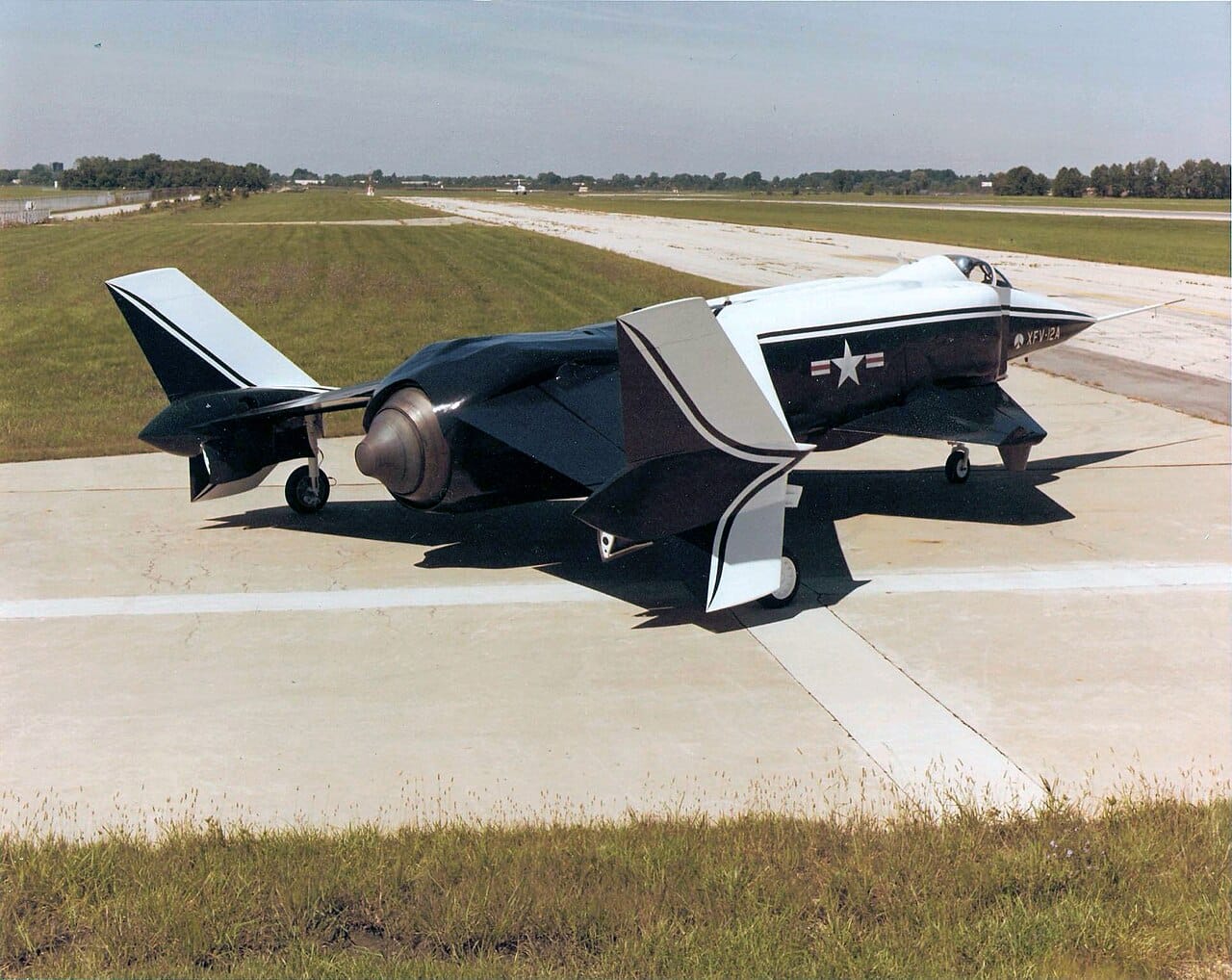
With the numbers refusing to improve and costs climbing, the Navy pulled the plug in 1981. The lesson was expensive but clear: a concept that shines in a wind-tunnel model can betray you completely at full scale. In the end, America’s only successful jump-jet of the era was not home-grown at all — it was the British Harrier, which simply pointed its engine nozzles down and flew.
Sources: GlobalSecurity.org; NASA Technical Reports; Vintage Aviation News; Wikipedia.
0 commentaire