
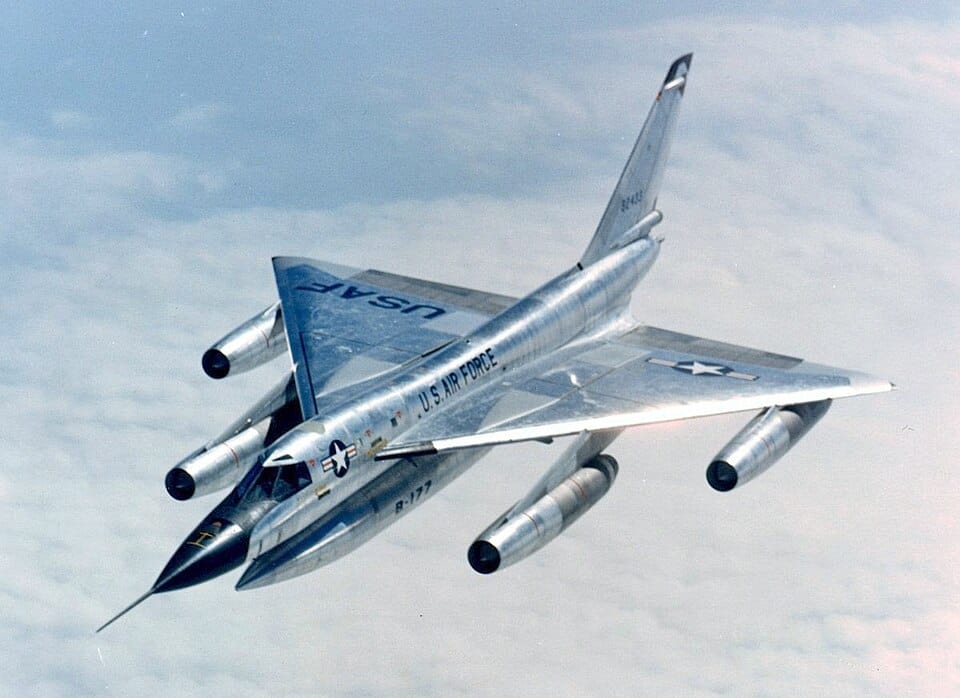
The Convair B-58 Hustler was the world's first operational supersonic bomber — a Mach 2 delta-wing marvel that could outrun every interceptor of its era. It was also one of the most dangerous aircraft in the United States Air Force inventory, killing more than one in five of its aircrews during barely a decade of service.
- Premier vol : 11 November 1956
- Rôle: Supersonic strategic bomber
- Fabricant: Convair (General Dynamics)
- Moteurs : 4 × General Electric J79-GE-5B turbojets
- Vitesse maximale : Mach 2.0 (1,319 mph / 2,124 km/h)
- Équipage: 3 (pilot, navigator-bombardier, defence systems operator)
- Construit: 116
- Service: 1960–1970 (USAF Strategic Air Command)
Born for Speed
In the early 1950s, the U.S. Air Force needed a bomber that could fly fast enough and high enough to penetrate Soviet air defences. Convair's answer was radical: a slim delta-wing airframe powered by four General Electric J79 afterburning turbojets — the same engines that would later power the F-104 Starfighter and F-4 Phantom II. Instead of an internal bomb bay, the B-58 carried its nuclear weapon and extra fuel in a massive external pod slung beneath the fuselage, which could be dropped over the target.
Test pilot Beryl Erickson took the first B-58 airborne on 11 November 1956 from Carswell Air Force Base in Fort Worth, Texas. The aircraft exceeded Mach 1 on its maiden flight — something no bomber had ever done before.
Speed Records and the Thompson Trophy
The Hustler was not just fast for a bomber — it was fast, period. Over its career it set 19 world speed records, more than any other bomber in history. Its most famous run came on 5 March 1962 during Operation Heat Rise, when a B-58 flew from Los Angeles to New York in 2 hours, 0 minutes, and 58.71 seconds, averaging 1,044 mph. The feat earned its crew the prestigious Bendix Trophy.
On the return leg the same day, the crew set another record flying back from New York to Los Angeles. The Thompson Trophy, Mackay Trophy, and Bleriot Trophy all went to B-58 crews during this period. No other Cold War bomber came close to matching its collection of speed awards.
The Escape Capsule Problem
Flying at Mach 2 above 40,000 feet created a problem no previous bomber crew had faced: conventional ejection seats were useless. At those speeds, windblast alone would kill any crewmember who ejected into the open airstream. The solution was the Stanley Aviation escape capsule — a clamshell pod that enclosed each crewmember before ejection, complete with its own oxygen supply and flotation gear.
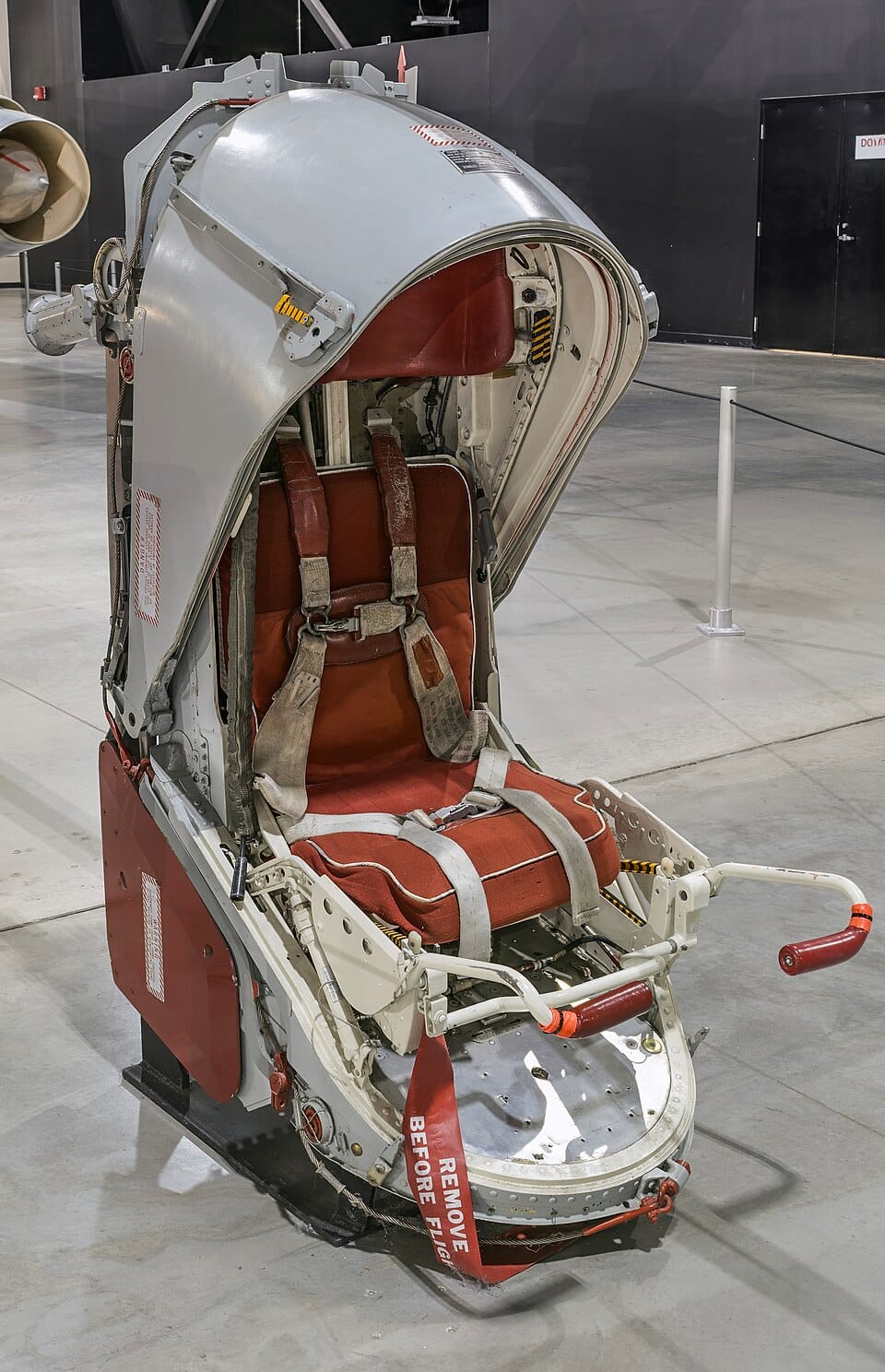
The capsule was revolutionary but complicated. It added weight, took valuable seconds to close before ejection, and gave crewmembers an uncomfortable feeling of being sealed into a coffin. Only one successful capsule ejection occurred in combat-speed conditions during the aircraft's service life.
A Deadly Record
The B-58's accident rate was staggering. Of the 116 aircraft built, 26 were destroyed in accidents — an attrition rate of 22.4 percent. The aircraft was unforgiving of pilot error, particularly during landing. Its thin delta wing required very high approach speeds and offered almost no margin for recovery if something went wrong.
The nuclear mission profile made things worse. Crews trained for low-level penetration runs at near-supersonic speed, threading between mountains and radar coverage. A single mistake at those altitudes and speeds left no time to react. The Hustler demanded the best pilots SAC had, and even they sometimes were not enough.
Retirement After Just Ten Years
By the mid-1960s, the Soviet Union had deployed surface-to-air missiles that could reach the B-58's operating altitude. The aircraft's design left no room for electronic countermeasures equipment, and its high operating costs — roughly three times those of a B-52 — made it an expensive platform to maintain. When Defence Secretary Robert McNamara ordered a review of SAC's bomber fleet, the Hustler's fate was sealed.
The last B-58s were retired on 31 January 1970, after barely a decade of operational service. Most were scrapped at Davis-Monthan Air Force Base. A handful survive as museum displays, including examples at the National Museum of the United States Air Force and the Strategic Air Command & Aerospace Museum.
Questions connexes
What was the Convair B-58 Hustler?
The Convair B-58 Hustler was the world's first operational supersonic bomber, a delta-wing strategic bomber that entered US Air Force service in 1960. Capable of Mach 2, it could outrun every interceptor of its era. It served with Strategic Air Command until 1970, but a high accident rate cut its career short. Only 116 were built.
Was the B-58 Hustler the first supersonic bomber?
Yes. The B-58 Hustler was the first operational bomber able to fly at supersonic speed in level flight, reaching Mach 2. It first flew on 11 November 1956 and exceeded Mach 1 on its maiden flight, something no bomber had done before. Later supersonic designs such as the XB-70 Valkyrie flew even faster but never entered service.
Why was the B-58 Hustler so dangerous to fly?
The B-58 was extremely demanding. Of the 116 built, 26 were lost in accidents, killing more than one in five of its aircrews during barely a decade of service. Flying at Mach 2 left little margin for error, and emergencies at high speed and altitude were often unrecoverable, which contributed to its early retirement in 1970.
What engines did the B-58 Hustler use?
The B-58 was powered by four General Electric J79 afterburning turbojets, mounted in individual pods under its delta wing. The same J79 engine also powered the Chasseur stellaire F-104 and the F-4 Phantom II, making it one of the defining jet engines of the Cold War.
How fast was the B-58 Hustler?
The B-58 Hustler could reach Mach 2, about 1,319 mph. It set 19 world speed records, more than any other bomber in history. During Operation Heat Rise in 1962, a B-58 flew from Los Angeles to New York in just over two hours, averaging 1,044 mph and earning its crew the Bendix Trophy.
Why did the B-58 carry its bombs in an external pod?
Instead of an internal bomb bay, the B-58 carried its nuclear weapon and extra fuel in a large external pod slung beneath the fuselage, which could be dropped over the target. Its slim delta-wing airframe had no room for a conventional bomb bay, so the pod let the bomber stay aerodynamically clean for Mach 2 flight.
What was the B-58's escape capsule?
Because conventional ejection seats were useless at Mach 2, the B-58 introduced the Stanley Aviation escape capsule, a clamshell pod that sealed each crewmember before ejection with its own oxygen and flotation gear. It was the first enclosed escape capsule designed for high-speed ejection, protecting crews from windblast that would otherwise be fatal.
How many B-58 Hustlers were built?
Only 116 B-58 Hustlers were built. It carried a crew of three, a pilot, navigator-bombardier and defence systems operator, and served with Strategic Air Command from 1960 to 1970. Its high cost and accident rate meant it was retired far sooner than most Cold War bombers.
Sources
- Wikipedia — Convair B-58 Hustler
- USAF Fact Sheet — B-58 Hustler
- National Museum of the USAF — Convair B-58A Hustler
0 commentaire