
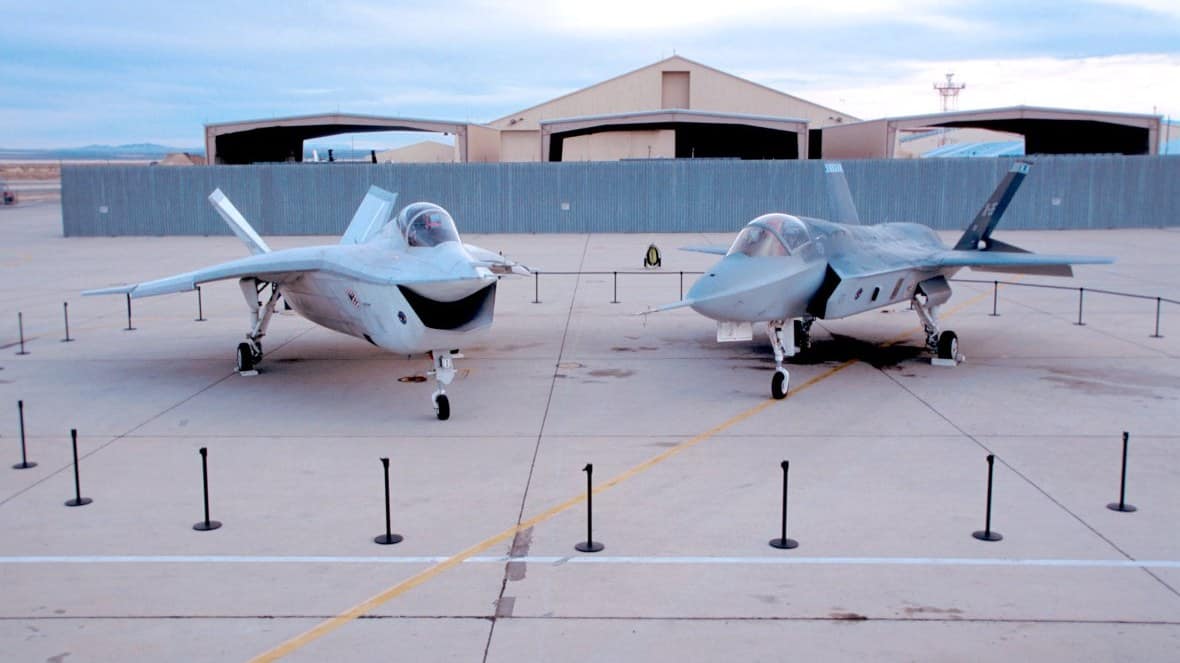
On the afternoon of Friday, 26 October 2001, the Pentagon’s acquisition chief, Edward “Pete” Aldridge, stepped up to a podium in Washington. Three thousand kilometres away, Boeing chairman Phil Condit and his Joint Strike Fighter boss, Frank Statkus, gathered around a television with their team. In Fort Worth, Texas, thousands of Lockheed Martin workers did the same. “We are here today to announce the largest acquisition program in the history of the Department of Defense,” Aldridge began. “The value of the program could be in excess of two hundred billion dollars.”
Five years of flying, fifteen years of studies and two of the strangest-looking aircraft ever built had come down to this sentence. The Joint Strike Fighter would be one aircraft, in three versions, for the US Air Force, Navy, Marine Corps and Britain’s Royal Navy and RAF — and one company would build all of it. Winner take all.
In one room that afternoon, people wept with joy. In the other, a man asked his chairman a question he already knew the answer to. This is the story of the X-32, the X-35, and the biggest bet in the history of the aircraft industry.
Quick Facts: X-32 vs X-35
| Competition | Joint Strike Fighter concept demonstration, 1996–2001 |
| Contenders | Boeing X-32A/B vs Lockheed Martin X-35A/B/C |
| Key difference | Boeing’s direct lift vs Lockheed’s shaft-driven lift fan for vertical landing |
| X-32A first flight | 18 September 2000 — Fred Knox |
| X-35A first flight | 24 October 2000 — Tom Morgenfeld |
| Decision | 26 October 2001 — Lockheed Martin wins it all |
| Stakes then | More than $200 billion; roughly 3,000 aircraft for the US and UK |
| Héritage | Le F-35 Lightning II — flown today by around 20 nations |
One Fighter for Everybody
The idea behind the JSF was seductive and slightly mad: replace the F-16, le A-10, le F/A-18 et le Harrier — four wildly different aircraft doing wildly different jobs — with variants of a single affordable stealth fighter. The Air Force needed a conventional jet, the Navy a beefed-up carrier version, and the Marines and the Royal Navy something that could land vertically like a Harrier without the Harrier’s habit of killing its pilots.
In November 1996 the Pentagon picked Boeing and Lockheed Martin to build two demonstrators each and settle it in the air. McDonnell Douglas, the company that had built the F-4 et le F-15, was eliminated — a shock that helped push it into Boeing’s arms a year later. The fly-off would be filmed from the inside by a NOVA documentary crew, which is why we know exactly what it looked like when the axe fell.
Direct Lift Versus the Lift Fan
The whole competition turned on a single engineering question: how do you make a supersonic stealth fighter hover? Boeing chose direct lift — point the engine’s thrust downward through swivelling nozzles, as the Harrier does. It is simple, proven and light, and it let Boeing build one airframe concept for all three variants.
Lockheed Martin gambled on something nobody had ever flown: a shaft-driven lift fan. In the X-35B, the engine drives a huge horizontal fan behind the cockpit, which blasts cool air downward while the main nozzle swivels aft — nearly doubling the lifting thrust and avoiding the searing-hot recirculating exhaust that plagues direct-lift designs. BAE test pilot Simon Hargreaves, who would fly the first hover, was frank about the risk: “Nobody’s ever tried to model a propulsion system that’s quite as complex as this … quite as integrated as this.”
Simple and proven against complex and revolutionary. On paper, Boeing’s approach should have won. In the air, physics had other ideas.

Monica and the Mid-Game Redesign
Let us address the intake in the room. The X-32’s enormous chin-mounted inlet and portly one-piece delta wing made it, by broad consensus, one of the least beautiful fighters ever flown — crews at Boeing itself took to calling it “Monica,” after the White House intern then dominating the news. Statkus was proud of that wing, “built as one piece from tip to tip,” and fighter pilots are not supposed to care about looks. They do, though.
The deeper problem was that Boeing was flying one aeroplane and selling another. When the Navy’s manoeuvring and payload requirements tightened mid-competition, Boeing redesigned its production aircraft with a conventional tail — but the demonstrators were already built in the old delta shape. The Pentagon would be asked to buy a fighter that existed only in briefing slides.
And direct lift carried its old curse: hot exhaust bouncing off the runway and back into the engine. During vertical-landing tests at Patuxent River, the X-32B wrestled with hot-gas ingestion, and Boeing stripped panels and parts off the jet to shed weight for its hover demonstrations. Every kilogram removed was an argument the Lockheed camp would later make for it.
Mission X
Lockheed’s campaign had begun with a whoop. “We’re airborne, gang, and it’s flying great,” chief test pilot Tom Morgenfeld radioed as the X-35A lifted off on 24 October 2000. But the knockout came the following summer with what the team called Mission X: on 20 July 2001, the X-35B took off in under 500 feet, dashed to supersonic speed, and returned to land vertically — the first aircraft in history to do all three in a single flight.
Hargreaves brought it down onto the pad as if he had done it for years. “That’s beautiful, no problems at all,” he called. The lift fan — the crazy, complex, never-before-flown lift fan — worked. Boeing’s demonstrators had done everything asked of them, but they had done it in pieces. Lockheed had done it in one afternoon, on camera.

The Envelope, Please
Which brings us back to 26 October 2001, and two rooms in front of two televisions. After Aldridge’s preamble, Air Force Secretary James Roche read the verdict.
In Fort Worth, pandemonium. In Seattle, Statkus turned to his chairman: “Is it a winner-take-all, Phil?” “At this point the answer is yes,” Condit replied, “that this decision they’ve held to is a winner-take-all.” When Statkus tried to apologise, Boeing vice chairman Harry Stonecipher cut him off: “No, you did a great job. I don’t know what we missed.”
What they had missed, most analysts concluded, was the lift fan — the performance margin and growth potential it promised — and the confidence gap created by Boeing’s mid-competition redesign. The contract that followed was worth about 19 billion dollars for development alone, with some 200 billion projected behind it.
Was Winner-Take-All Wise?
A quarter of a century later, the question has teeth. The F-35 became everything the JSF promised operationally — and a cautionary tale industrially: years late, far over its original budget, with a lifetime cost the US government now puts above two trillion dollars. With no competing production line, there was no plan B and precious little pricing leverage. Some veterans of the programme argue a split buy would have cost more per jet but bought insurance; others note the whole point of JSF was that America could no longer afford two of everything.
The verdict also reshaped the industry itself. Boeing, shut out of the fighter business at a stroke, did not field another new manned fighter design for a generation — until March 2025, when the US Air Force chose Boeing to build the F-47, its next-generation air dominance fighter. It took 24 years, but the loser of the last great fighter fly-off finally won the rematch.
Sources: PBS NOVA “Battle of the X-Planes” transcript, Wikipedia (Boeing X-32, Lockheed Martin X-35, Joint Strike Fighter program), Lockheed Martin news release (26 October 2001), The Seattle Times, Air & Space Forces Magazine, US GAO
Questions connexes
What was the X-32 vs X-35 competition?
The X-32 versus X-35 competition was the Joint Strike Fighter concept demonstration, run from 1996 to 2001, to choose a single stealth fighter for multiple US services and Britain. Boeing's X-32 flew against Lockheed Martin's X-35. Lockheed won in October 2001, and its design became the F-35 Lightning II, part of a long line of US aircraft fly-offs.
Quel avion a remporté le concours Joint Strike Fighter ?
Lockheed Martin's X-35 won the Joint Strike Fighter competition on 26 October 2001, beating Boeing's X-32. The victory, worth more than $200 billion for around 3,000 aircraft, gave Lockheed one of the largest defence contracts ever awarded. The winning design entered service as the F-35 Lightning II, now flown by about 20 nations.
What was the difference between the X-32 and X-35?
The main difference lay in how each achieved vertical landing. Boeing's X-32 used direct lift, venting engine thrust downward, while Lockheed's X-35 used a shaft-driven lift fan behind the cockpit. The X-35's lift-fan approach impressed evaluators and helped secure its win. The X-32A first flew on 18 September 2000 and the X-35A on 24 October 2000.
Why did the X-32 lose to the X-35?
Boeing's X-32 lost largely because its direct-lift system for vertical landing was seen as less capable and lower in growth potential than Lockheed's shaft-driven lift fan. The X-35 demonstrated smoother short-takeoff and vertical-landing performance. The stakes echoed other high-value contests such as the KC-X tanker war, where engineering and politics both mattered.
What became of the X-35?
The X-35 became the F-35 Lightning II, a family of stealth fighters in three versions for conventional, carrier and short-takeoff/vertical-landing operations. It is now operated by around 20 nations and forms the backbone of Western tactical air power, while newer efforts like sixth-generation fighter programmes aim to succeed it.
How much was the Joint Strike Fighter contract worth?
The Joint Strike Fighter contract was valued at more than $200 billion when awarded in 2001, covering roughly 3,000 aircraft for the United States and United Kingdom. It was described as the largest acquisition programme in the history of the US Department of Defense, a scale that made the X-32 versus X-35 fly-off unusually consequential.
0 commentaire