
On the night of 24 July 1943, 791 British bombers crossed the German coast toward Hamburg. In each aircraft, a crewman knelt by the flare chute with a stopwatch, shoving out one paper bundle every minute. Each bundle held 2,200 strips of aluminium-coated paper, exactly 27 centimetres long. By morning, German radar had chased thousands of phantom bombers across the sky — and only twelve real ones had been shot down, a quarter of the usual toll.
That was the combat debut of chaff, and it began an arms race between aircraft and guided weapons that has never stopped. Eight decades later, every combat jet still carries the descendants of those paper strips — alongside burning decoys, towed traps and laser jammers. This is how the art of not getting hit actually works.
Quick Facts: Aircraft Countermeasures
| Chaff | Clouds of aluminium-coated glass fibres, cut to half the wavelength of the threat radar; millions of dipoles per cartridge |
| First mass use | Operation Gomorrah, 24–25 July 1943 — RAF losses fell to ~1.5% from ~6% |
| Flares | Magnesium/Teflon/Viton pyrotechnics burning hotter than engine exhaust, in service since 1959 |
| The dispenser | AN/ALE-47 and kin: manual, semi-automatic or fully automatic ejection modes |
| The counter-counter | Imaging infrared seekers (AIM-9X, IRIS-T) that recognise a flare and ignore it |
| Modern exotica | Towed decoys (ALE-50), DRFM jamming rounds (BriteCloud), laser dazzlers (LAIRCM) |
Foil Against Physics
The fear that made countermeasures necessary predates the technology by a decade. In 1932, Britain’s once and future prime minister told Parliament the brutal arithmetic of the coming air age:
Chaff was invented to make him right. It works because radar cannot tell metal from meaning: a dipole cut to half the radar’s wavelength resonates and reflects brilliantly, and a cartridge packed with several million such fibres blooms into a target that looks bigger than the aircraft that dropped it. The Würzburg gun-laying radars of 1943, which steered Hamburg’s flak and night fighters, were helpless — their operators watched a sky full of bombers that did not exist.
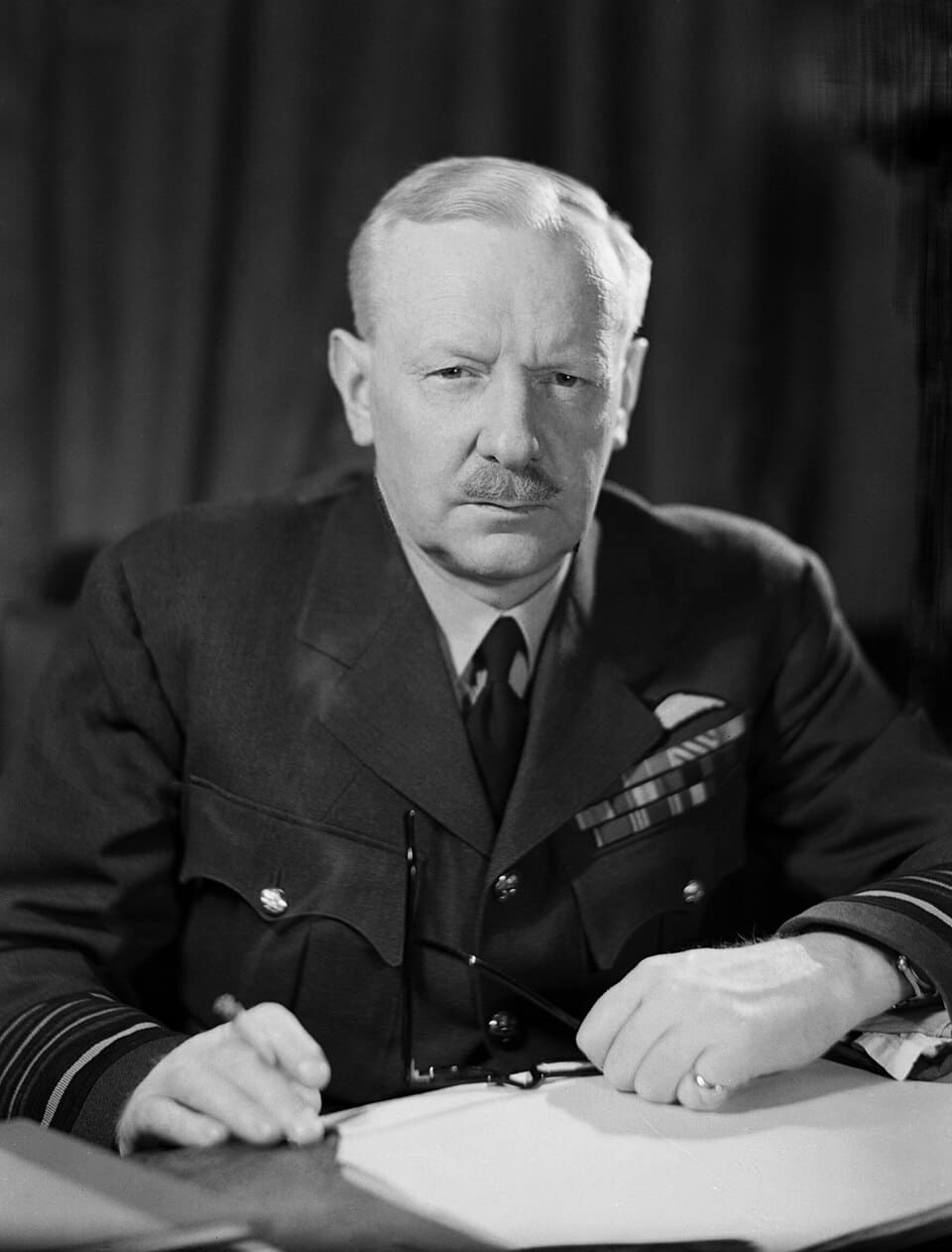
Remarkably, both Britain and Germany had invented the trick by 1942 — and both sat on it, terrified the other would copy it. Bomber Command’s chief had no patience for that logic:
Modern chaff is subtler stuff — glass fibres 25 microns thick — and modern radars fight back with Doppler filtering: a chaff cloud decelerates instantly to wind speed, while a jet does not. The duel that started over Hamburg simply moved into the signal-processing domain.
Burning Brighter Than a Jet Pipe
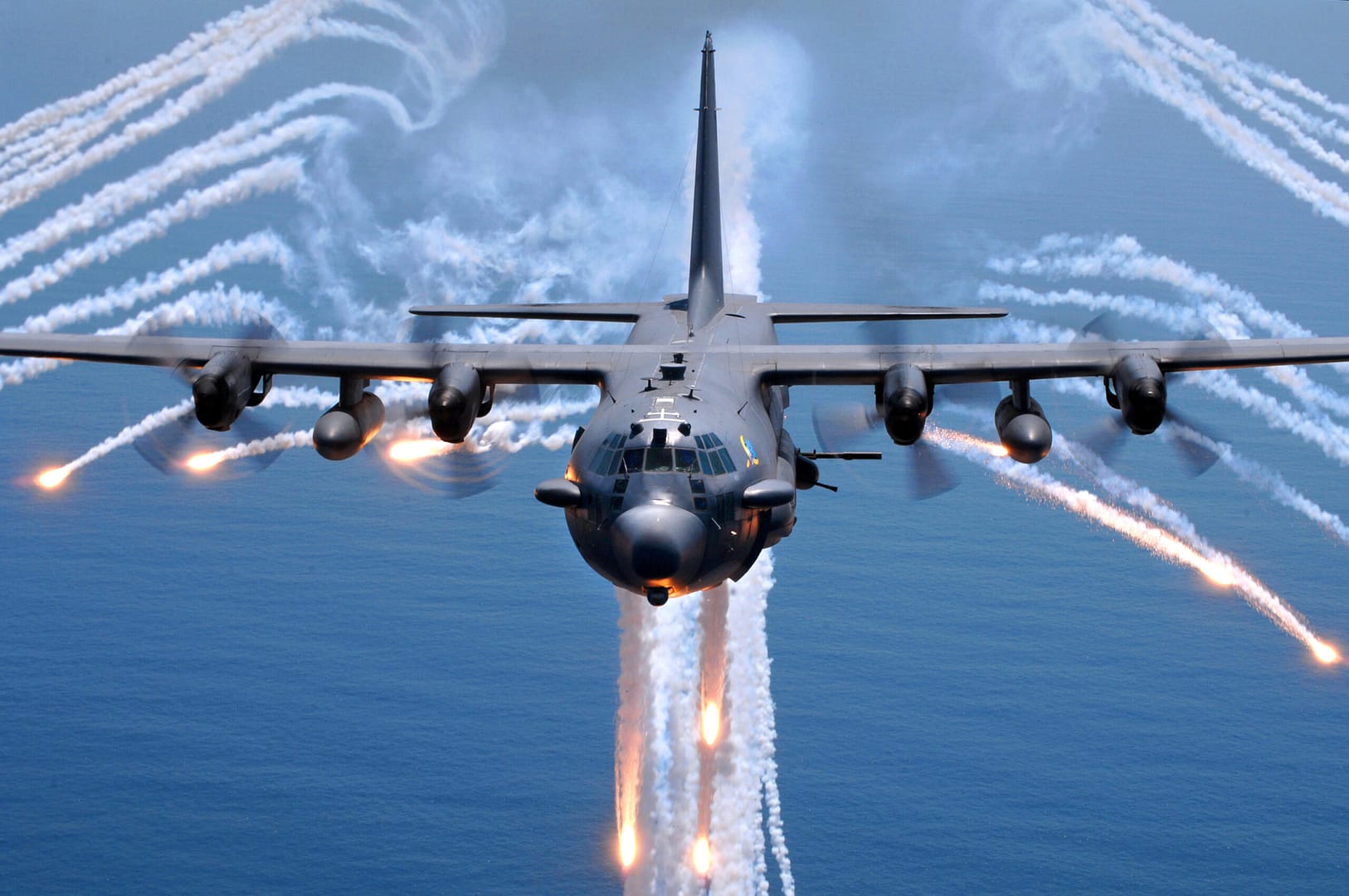
Heat-seeking missiles demanded a different lie. Since 1959, the standard answer has been the MTV flare — magnesium, Teflon and Viton — burning at around 2,000°F for a handful of seconds, comfortably outshining an engine exhaust in the seeker’s infrared band. Dispensers like the AN/ALE-47 eject them singly or in programmed salvos, paired with hard evasive manoeuvring to break the missile’s track.
The spectacular “angel” patterns photographed at airshows are not choreography for its own sake: big, slow transports and gunships survive by saturating a seeker’s field of view in every direction at once.
When the Missile Stopped Falling for It
The flare’s golden age ended when seekers learned to see pictures instead of points of heat. The AIM-9X, in service since 2003, carries an imaging focal-plane array and reprogrammable counter-countermeasures logic: it recognises the geometry of a flare separating from an airframe and simply stays on the airframe. Europe’s IRIS-T and Russia’s later R-73 derivatives play the same game. Against such weapons, a classic magnesium flare is less a lie than a confession.
So the countermeasure business went high-tech. Spectral flares mimic an airframe’s exact infrared signature across multiple bands. Directional infrared countermeasures like the AN/AAQ-24 LAIRCM — fitted to C-17s, C-130s and CV-22s — track an incoming missile and blind its seeker with a modulated laser, autonomously, before the crew even knows they were shot at. Raytheon’s ALE-50 towed decoy, dragged behind B-1Bs over Serbia in 1999, ate all ten of the SAMs that locked onto the bombers. And Leonardo’s BriteCloud packs a full digital radio-frequency memory jammer into a cartridge the size of a drinks can — a fired decoy that captures the enemy radar’s own waveform and retransmits a ghost aircraft flying somewhere else.
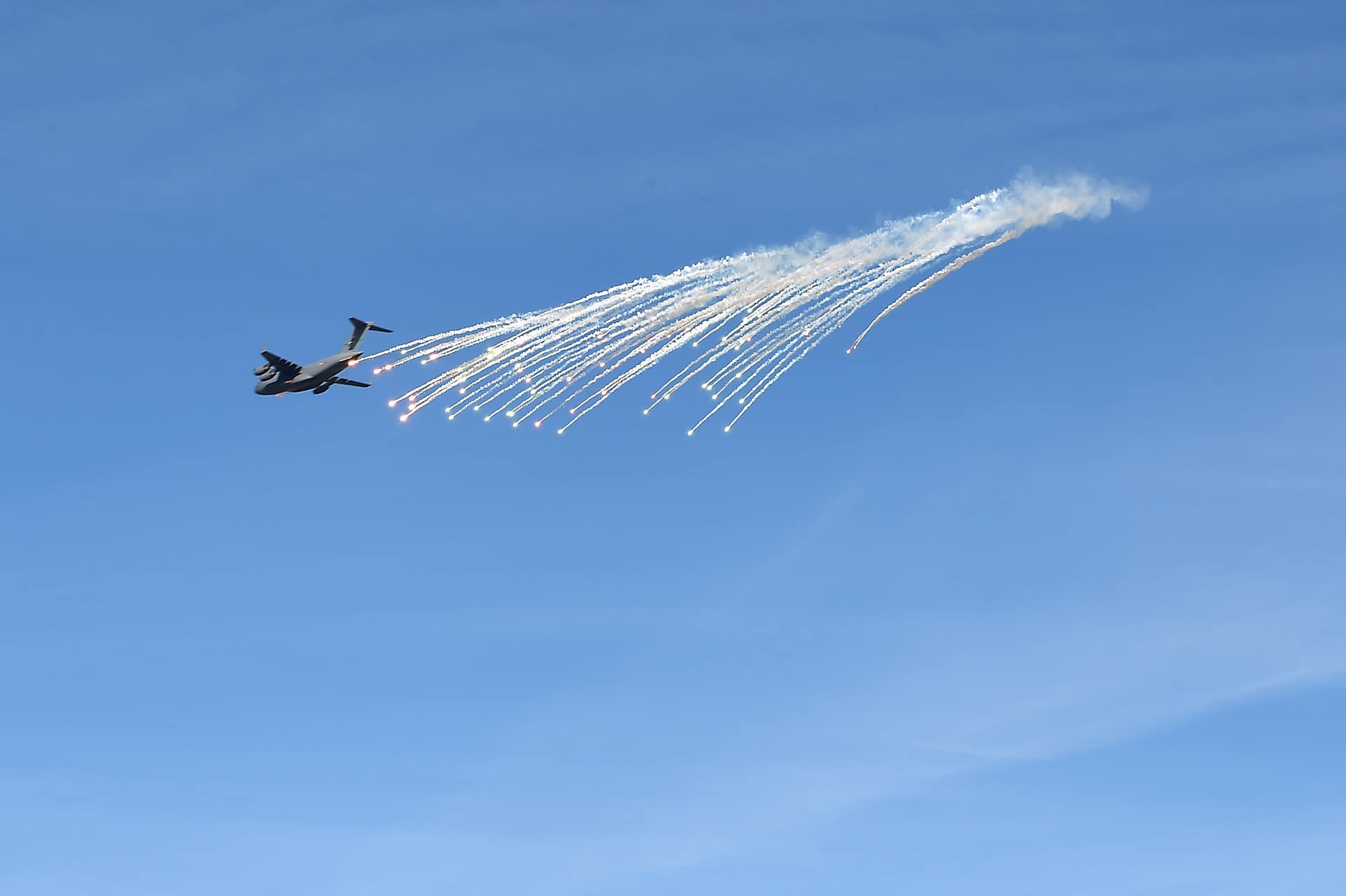
The C-130’s party trick, in motion — the “angel wing” flare pattern:
Eighty-three years separate a bundle of paper strips over Hamburg from a self-jamming decoy round. The principle has not moved an inch: make the weapon believe something that is not true, for just long enough. For the pilots whose whole job was baiting SAMs into missing, read our story on the Wild Weasels.
Sources: Air Force Magazine (Rebecca Grant, “Operation Gomorrah”, 2007); Wikipedia; GlobalSecurity; Northrop Grumman; Leonardo; Defense Industry Daily; IEEE AESS; DTIC
Related Questions
How do fighter jets defeat guided missiles?
Combat aircraft defeat missiles with countermeasures that fool a weapon's guidance. Against radar-guided missiles they release chaff, clouds of tiny metal-coated fibres that create a false radar echo. Against heat-seeking missiles they fire flares that burn hotter than the engine exhaust. Modern jets add electronic jammers, towed decoys and laser systems, usually combined with hard evasive manoeuvring.
What is chaff and how does it work?
Chaff is a cloud of aluminium-coated fibres cut to half the wavelength of a threat radar. Each fibre resonates and reflects the radar signal strongly, and a single cartridge holding millions of them blooms into an echo larger than the aircraft. This confuses radar-guided weapons. Chaff was first used in mass on the night of 24 to 25 July 1943 during the RAF raid on Hamburg.
When was chaff first used in war?
Chaff made its combat debut on the night of 24 to 25 July 1943, when RAF bombers dropped aluminium-coated paper strips over Hamburg during Operation Gomorrah. German radar tracked thousands of false targets and only twelve real bombers were shot down, roughly a quarter of the usual loss rate. Both Britain and Germany had invented the trick by 1942 but withheld it, fearing the enemy would copy it.
What are flares used for on military aircraft?
Flares are pyrotechnic decoys that defeat heat-seeking missiles. The standard MTV flare, made of magnesium, Teflon and Viton, burns at around 2,000 degrees Fahrenheit for a few seconds, outshining an engine exhaust in the infrared band a missile seeker looks for. Large, slow aircraft like transports and gunships eject flares in programmed salvos to saturate a seeker's field of view.
What is the difference between chaff and flares?
Chaff defeats radar-guided missiles by creating false radar echoes with clouds of metal-coated fibres, while flares defeat heat-seeking missiles by burning brighter than the engine in the infrared. Aircraft carry both, plus jammers, and match the countermeasure to the threat. The same principle protects against modern threats layered defences meet, from missiles to those countered by Israel's Iron Dome and Iron Beam laser.
Can countermeasures stop anti-ship missiles?
Countermeasures can help but are not foolproof against sea-skimming anti-ship missiles, which fly low and fast to compress reaction time. Chaff, decoys and jamming can seduce a seeker away, yet a single leaker can be catastrophic, as shown when Exocet missiles struck Royal Navy ships in the Falklands. Layered defences and hard manoeuvring remain essential.
0 Commenti