
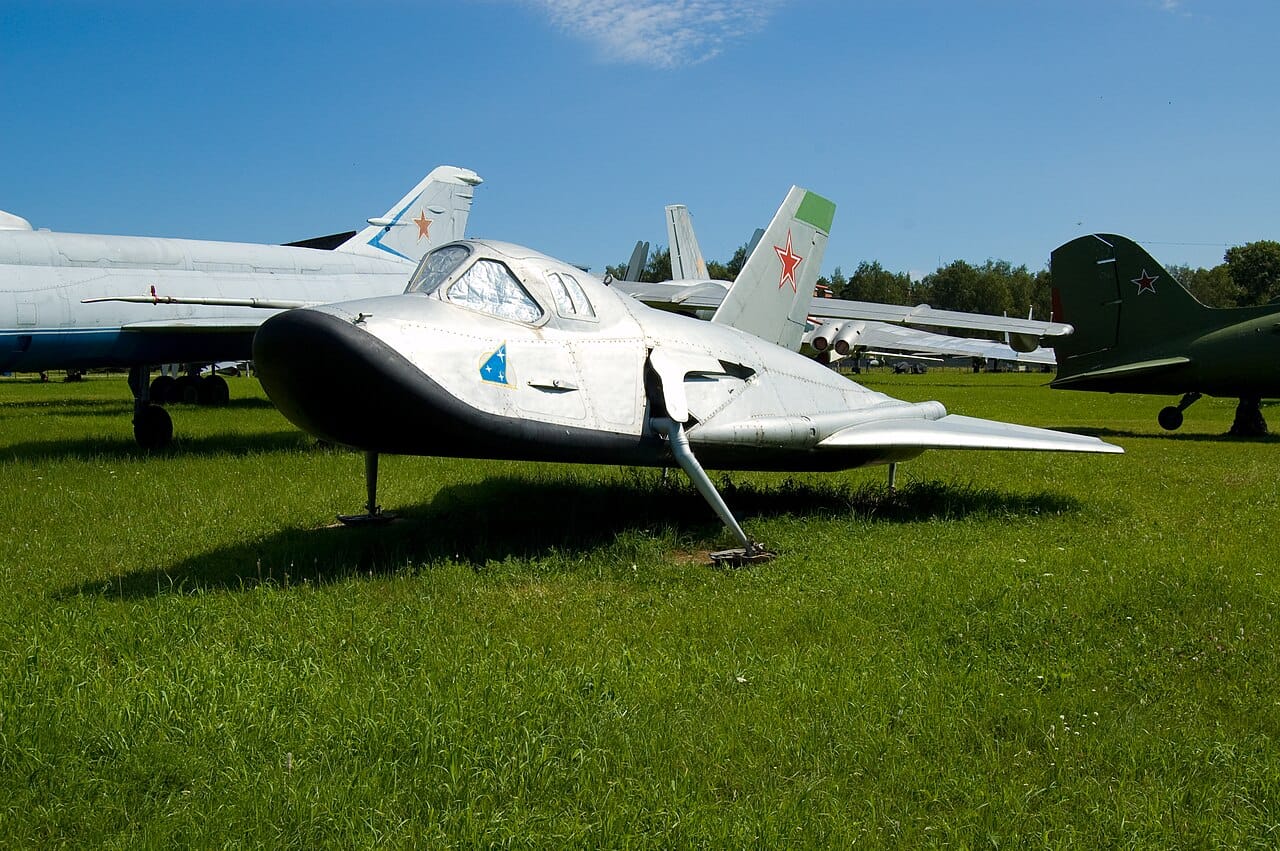
When the United States cancelled its X-20 Dyna-Soar spaceplane in 1963, the idea did not die. It moved east. In the design bureau of Artem Mikoyan, Soviet engineers set out to build their own winged spacecraft — one that would ride a rocket toward orbit and then glide home to a runway. They called the programme Spiral, and the little test aircraft at its heart wore a nickname that stuck: Lapot, the wooden shoe.
It never reached space. But the stubby, snub-nosed MiG-105 flew eight times over the deserts and airfields near Moscow between 1976 and 1978, and it remains one of the strangest and most inventive flying machines the Cold War ever produced.
Informazioni rapide
- Aeromobili: Mikoyan-Gurevich MiG-105.11 (EPOS), test article of the Spiral spaceplane
- Soprannome: “Lapot” — Russian for a bast shoe, after its upturned nose
- Chief designer: Gleb Lozino-Lozinsky, who would later lead the Buran shuttle
- Equipaggio: one pilot, seated in an ejectable escape capsule
- Gross mass: 4,220 kg (9,300 lb)
- Voli di prova: 8, from 11 October 1976 to September 1978
- Standout feature: variable-dihedral wings that folded upward for reentry and down for gliding
- Destino: cancelled for Buran; preserved at the Central Air Force Museum, Monino
Moscow’s answer to Dyna-Soar
Work on Spiral began in 1965, and on 26 June 1966 the Soviet government formally authorised development with Gleb Lozino-Lozinsky as project manager. The full concept was staggeringly ambitious: a reusable hypersonic carrier aircraft would accelerate to around six times the speed of sound, release a rocket stage from its back, and that stage would boost a small, single-seat orbital spaceplane the rest of the way to orbit.
The orbital vehicle was to be a genuine military machine, designed in versions for photo-reconnaissance, radar reconnaissance, satellite interception and strike. It was, in other words, exactly the kind of vehicle the Dyna-Soar’s planners had imagined — conceived, from the start, as a direct answer to the American programme.
The Soviet spaceplane that was built to glide back from orbit — the story of the Spiral programme.
The wooden shoe
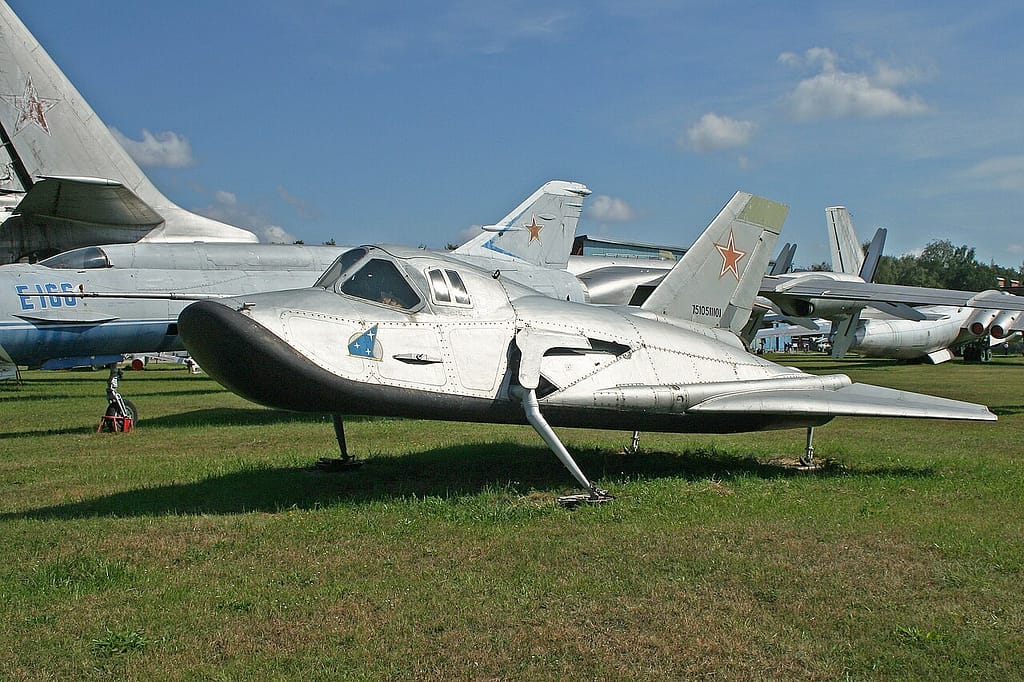
The MiG-105.11 itself was an atmospheric test article — a subsonic analogue built to prove out the low-speed handling and landing of the orbital design. It was a flat-bottomed lifting body with a sharply upturned nose, and that nose gave it its name.
The shape was not styling. Engineers found the upturned nose sharply reduced heating on the rear of the fuselage during reentry — a solution so sound that NASA later borrowed the concept for its HL-20 lifting-body proposal in the 1980s. Like the American X-20 before it, the structure was a network of struts and longerons, wrapped in an outer skin articulated to expand as it heated.
Wings that folded to the sky
The most extraordinary feature was the wings. During launch, orbit and the fiery plunge back through the atmosphere, the MiG-105’s wings were folded steeply upward at roughly sixty degrees, where they acted as vertical stabilisers and kept their surfaces out of the worst of the reentry heat. Once the craft slowed to subsonic speed, electric actuators swung them down to horizontal — and only then did they become wings, giving the vehicle the lift it needed to glide and land.
A small turbojet, fed by a dorsal intake, even let the test aircraft take off under its own power and gave the planned orbiter a chance to go around and divert to another airfield in bad weather — a capability the American Space Shuttle was originally meant to have before it was deleted to save weight.
Eight flights from a dirt strip
On 11 October 1976, the MiG-105 made its first flight, taking off from an old dirt airstrip near Moscow, climbing straight ahead to about 560 metres, and landing at the Zhukovsky flight-test centre 19 kilometres away. The pilot was Aviard Fastovets. A year later, the aircraft was carried aloft and air-dropped from a Tu-95K bomber at 5,000 metres, gliding down to land on its skids.
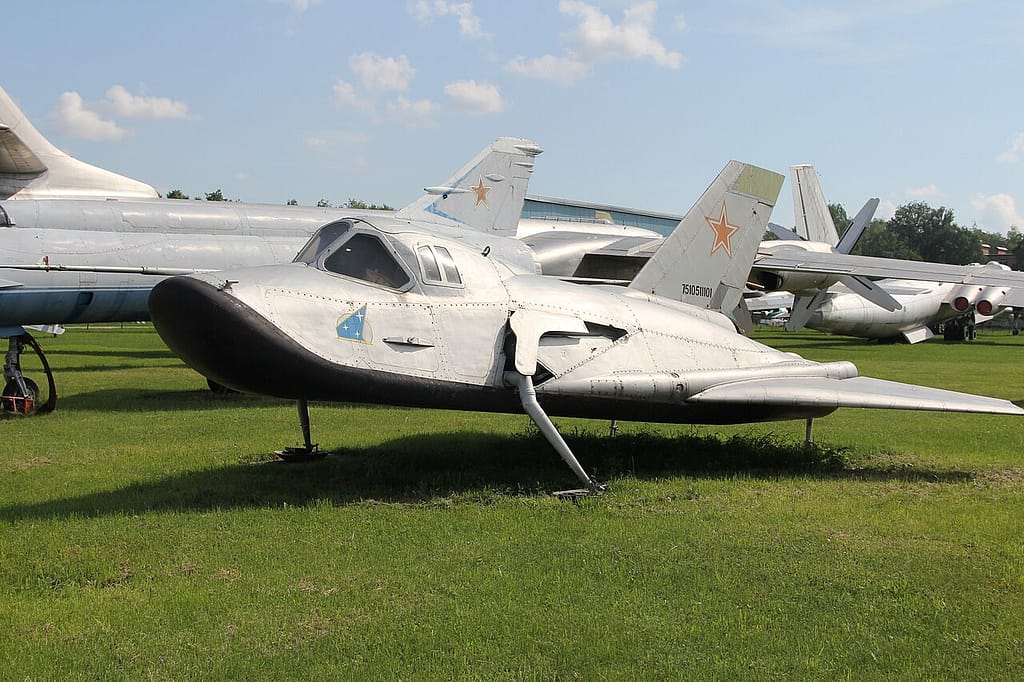
There were eight flights in all. The last, in September 1978, ended in a hard landing that wrote the aircraft off. Fastovets, who had flown the first, flew the last as well. The flights were judged enough to characterise the design’s subsonic behaviour — and behind the modest test programme lay a very large ambition.
From Spiral to Buran
Spiral never got its hypersonic carrier aircraft — the technology of the era simply could not deliver a Mach-6 mothership. The programme was interrupted in 1969, briefly revived in 1974 as the Soviets scrambled to answer the American Space Shuttle, and finally set aside altogether when Moscow committed to the far larger Buran orbiter.
Lozino-Lozinsky and his team carried their hard-won knowledge straight into Buran, which flew once, unmanned, in 1988. The little wooden shoe that pointed the way now sits quietly in the Central Air Force Museum at Monino, outside Moscow — a folded-wing monument to a spaceplane that was always just ahead of what its engineers could build.
The Spiral project’s vehicles — the MiG-105 and the unmanned BOR test craft that followed.
Sources: Encyclopedia Astronautica (Mark Wade); GlobalSecurity.org; Central Air Force Museum, Monino; Wikipedia.
0 Commenti