
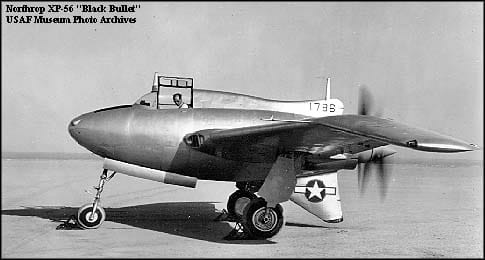
Roll it out onto the sun-bleached hardpan at Muroc in 1943 and the Northrop XP-56 looked less like a fighter than a dark, headless projectile. There was almost no tail, no nose propeller, and a fat belly fin slicing the desert air. Jack Northrop called it the Black Bullet, and it was one of the most radical machines America built during the war.
The idea was born in 1939, when Northrop chased a flying-wing fighter with the lowest possible drag. No horizontal tail, only a stub of a vertical fin, and a pusher engine buried behind the pilot spinning a pair of contra-rotating propellers. To prove the tailless layout would even fly, Northrop first tested the little N-1M mockup, which confirmed the concept enough for the Army to order prototypes.
INFORMAZIONI RAPIDE
| Tipo | Single-seat prototype interceptor |
| Primo volo | 30 September 1943 |
| centrale elettrica | 1 x Pratt & Whitney R-2800 radial, pusher, contra-rotating props |
| Velocità massima | 465 mph design estimate (never reached) |
| Numero costruito | 2 |
| Construction | Magnesium airframe, Heliarc welding |
| Destino | One crashed; the other survives at the Smithsonian |
Built from magnesium and desperation
What truly set the XP-56 apart was its skin. With aluminium forecast to run short under wartime demand, Northrop built the airframe from magnesium, a metal roughly a third lighter but notoriously hard to weld. His team developed the Heliarc welding process to join it, a technique that outlived the aircraft and became an industry standard.
The powerplant was a compromise from the start. The exotic Pratt & Whitney X-1800 engine was cancelled, forcing Northrop to cram in a bigger, heavier R-2800 radial. The swap added weight, widened the fuselage, and cost months. The Black Bullet was already fighting itself before it ever flew.
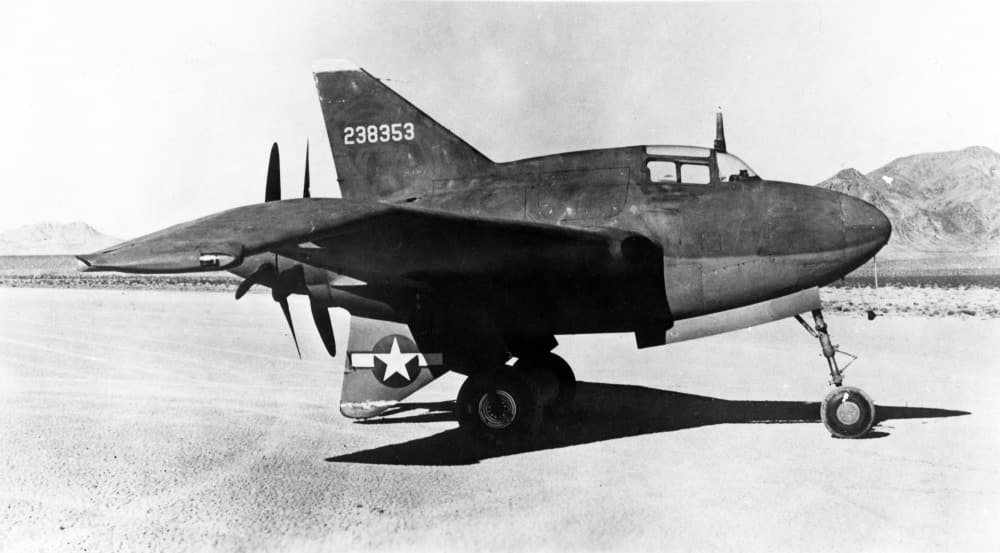
A short, unhappy flying career
On 30 September 1943 the first prototype finally lifted off, plagued by a vicious yaw problem traced to poor aerodynamic stability. Just over a week later a tire blew during a high-speed taxi run and the aircraft cartwheeled across the dry lake. Test pilot John Myers walked away, crediting the polo helmet he had improvised for the job.
The second prototype flew in March 1944 with a much larger fin, but it never came close to its promised 465 mph. It was nose-heavy, thirsty, and unstable, and after just ten flights the Army grounded it as too hazardous.
By 1946 jets were on the drawing board and nobody wanted a troubled propeller fighter. The surviving Black Bullet was crated up and eventually joined the Smithsonian. It sits in storage today: a menacing, beautiful dead end that pushed metallurgy forward even as it flopped as a fighter.
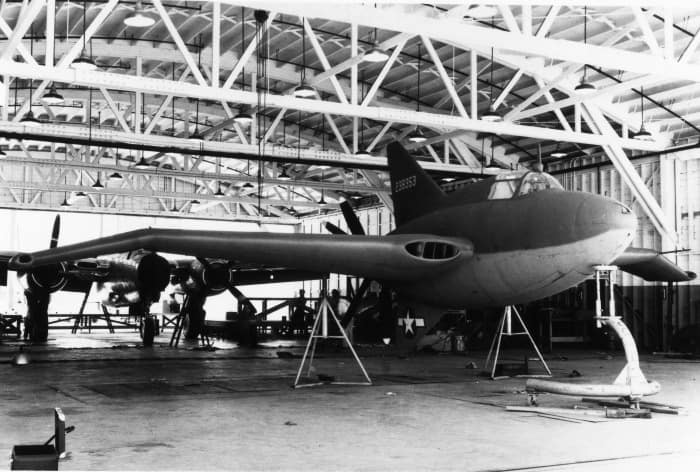
The full, strange story of the Black Bullet and the ideas it left behind:
Sources: National Air and Space Museum; Wikipedia; Ray Wagner Collection.
0 Commenti