
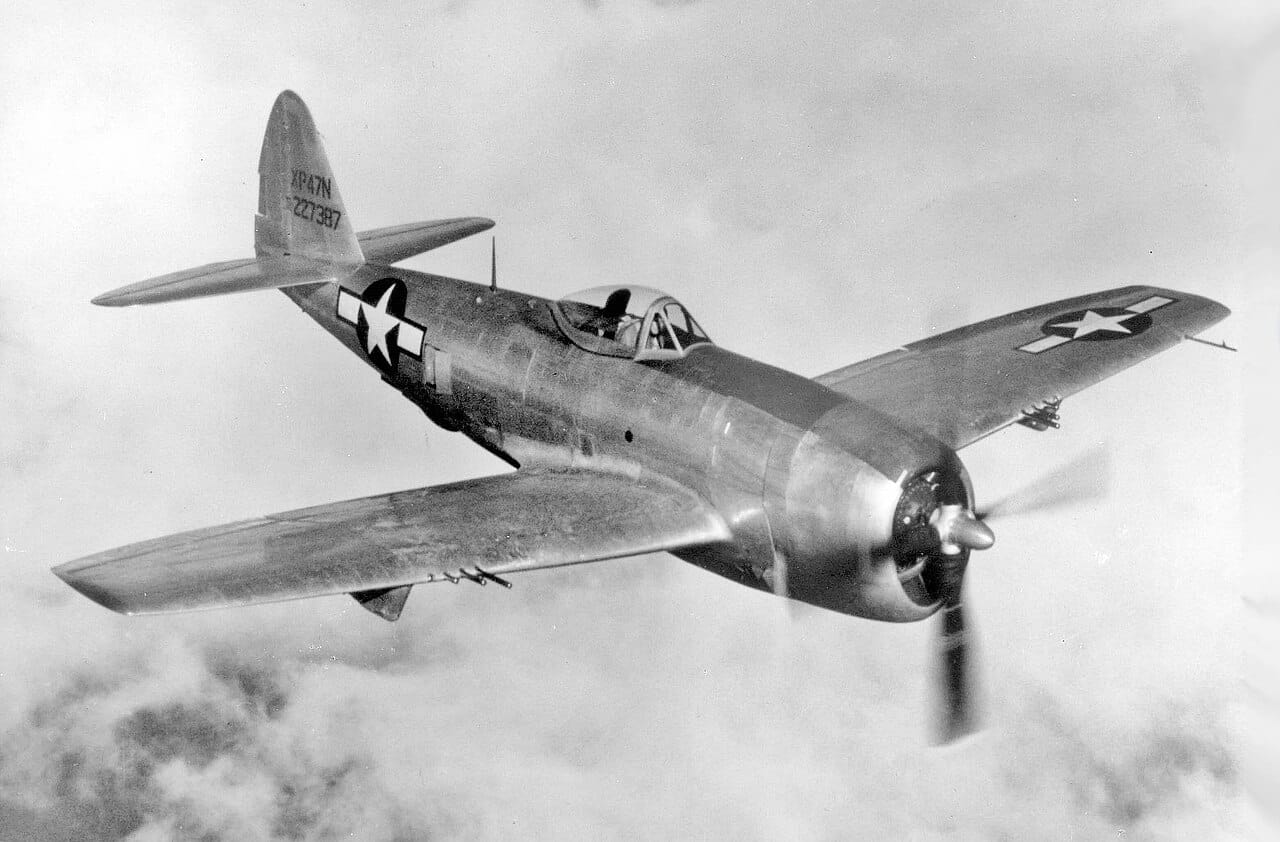
A German fighter pilot once emptied his guns into an American P-47, then pulled up alongside to watch it fall out of the sky. It did not fall. Baffled, he flew wing-to-wing with the shredded aircraft, stared at the damage, shook his head, and peeled away. The P-47 flew home.
That was the Republic P-47 Thunderbolt — the biggest, heaviest single-engine fighter of the Second World War, so solidly built that pilots called it the “Jug” and trusted it to bring them back no matter what hit it. It was less a fighter than a flying fortress for one.
INFORMAZIONI RAPIDE
| Aeromobili | Republic P-47 Thunderbolt (“the Jug”) |
| Designer | Alexander Kartveli, Republic Aviation |
| Motore | Pratt & Whitney R-2800 Double Wasp, ~2,000 hp, turbo-supercharged |
| Guns | 8 × .50-cal Browning — about 100 rounds a second |
| Rivendicazioni di fama | Biggest, heaviest single-seat fighter of WWII |
| Costruito | More than 15,600 — the most-produced US fighter |
| Roles | High-altitude escort, then devastating ground attack |
A dinosaur with good proportions
The Jug’s designer, Alexander Kartveli, built the aircraft around one enormous idea: the Pratt & Whitney R-2800 radial engine and its bulky turbo-supercharger, whose ducting snaked all the way back through the fuselage. To feed and armour all that, the airframe had to be huge. Kartveli knew exactly what he was making.
Fully loaded, the P-47 weighed as much as some twin-engine bombers. But that mass bought two things money could not: the ability to soak up punishment, and the fastest dive of any fighter in the war. Eight half-inch machine guns did the rest.

The Thunderbolt story.
The plane that would not die
The Jug’s legend was built on survival. Its air-cooled radial had no vulnerable coolant system to puncture, and its sheer size meant it could lose cylinders, skin and control surfaces and still fly. The ace Robert S. Johnson brought one home riddled with more than a hundred hits, his guns and canopy shot away — the aircraft that so astonished the German pilot who tried to finish it off.
Early on, the P-47 escorted heavy bombers deep into Germany, its turbocharger giving it real teeth at high altitude. But it was thirsty, and range was its weakness.

From the stratosphere to the deck
When the longer-legged P-51 Mustang took over the deep-escort job, the Thunderbolt found its true calling lower down. It became one of the most feared ground-attack aircraft of the war, roaring across France and Germany to shoot up trains, trucks, tanks and airfields, absorbing flak that would have downed a lighter machine.
That ethos — a big, tough, gun-heavy aircraft built to take hits and keep fighting at treetop height — never went away. Decades later it was reborn in the A-10 Thunderbolt II, the “Warthog,” which inherited both the Thunderbolt name and the Jug’s stubborn refusal to leave its pilots behind. Fifteen thousand Jugs helped win a war; their spirit is still flying today.
P-47 Thunderbolts over Germany, in colour.
How the Jug helped win the air war.
Sources: Smithsonian; HistoryNet; Air & Space Forces Magazine; Robert S. Johnson, Thunderbolt!.
0 Commenti