
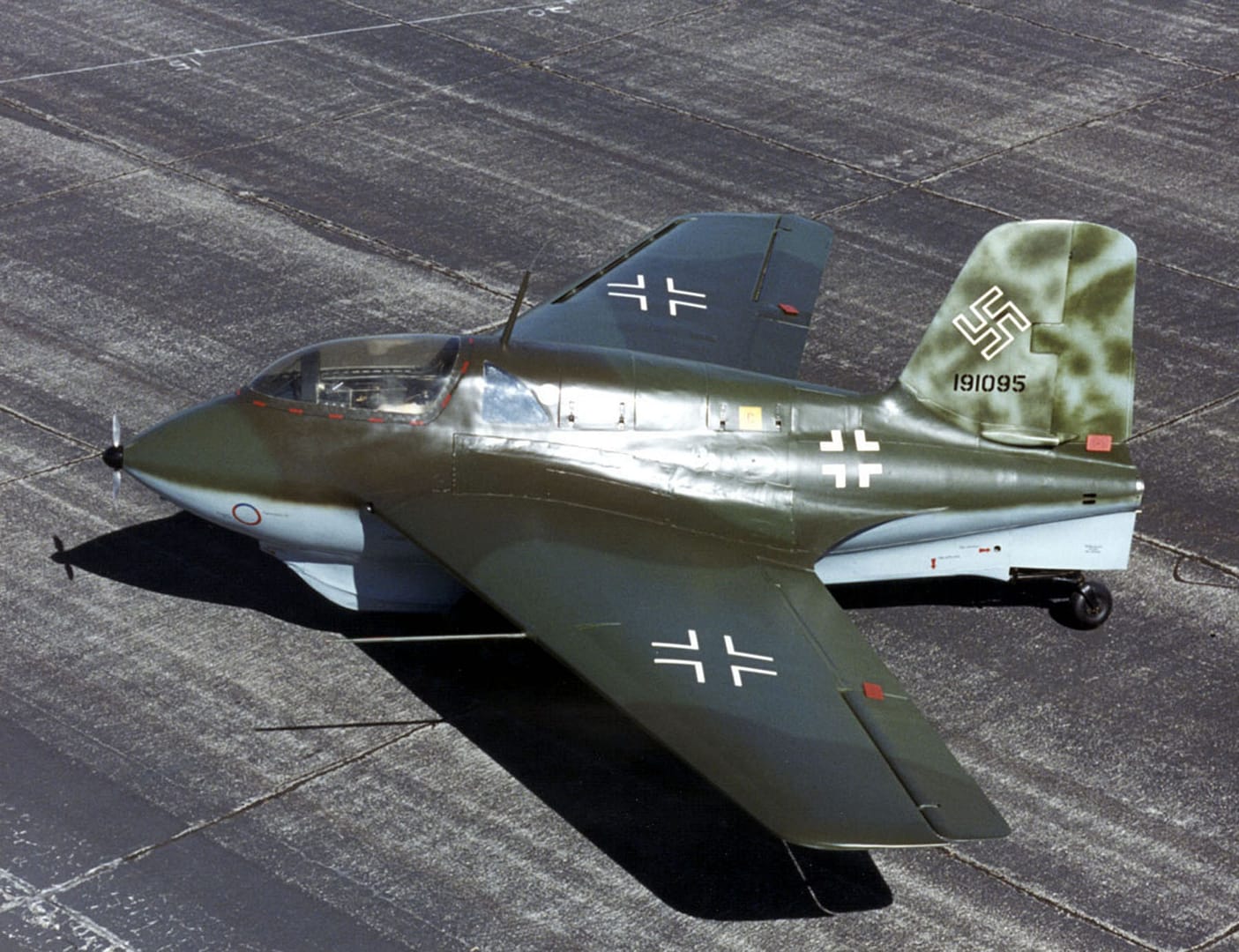
The Messerschmitt Me 163 Komet climbed at more than 3,600 metres per minute — so fast that Allied bomber crews, seeing it for the first time in the summer of 1944, could scarcely track it. In a single breathtaking arc it could reach the bombers, fire, and be gone. It was the only rocket-powered fighter ever to enter combat, and by any measure of speed it was a decade ahead of its time. It was also, for the men who flew it, one of the most lethal aircraft ever built — to its own pilots.
Designed by the brilliant aerodynamicist Alexander Lippisch, the Komet was a tailless swept-wing dart with no landing gear to speak of, powered by a Walter rocket motor of terrifying temperament. It burned two propellants that did not so much combust as detonate on contact — and which could, and did, dissolve the men strapped in beside them.
| Aircraft | Messerschmitt Me 163 Komet |
| Maker | Messerschmitt / design by Alexander Lippisch |
| Role | Rocket-powered point-defence interceptor |
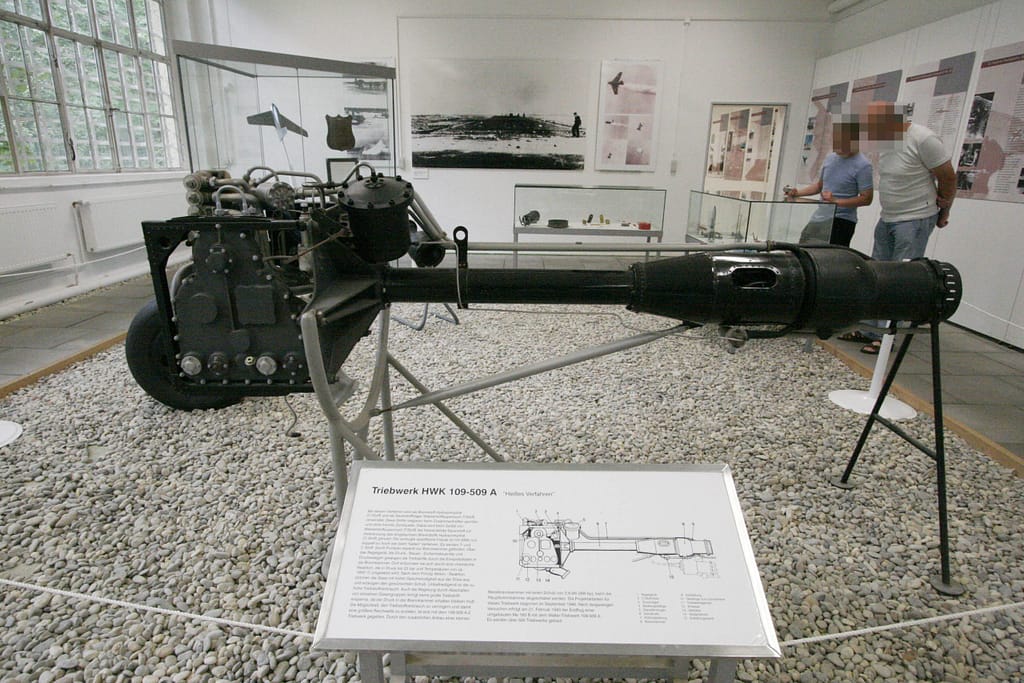
| Powerplant | Walter HWK 109-509 rocket motor |
| First flight | 1 September 1941 (powered) |
| Built | ~370 (about 339 delivered) |
A rocket with wings
The numbers still astonish. On 2 October 1941 the test pilot Heini Dittmar took an early Komet to 1,004 km/h — 624 mph — the first piloted aircraft to break 1,000 km/h in level flight. In 1944 he pushed a later machine to 1,130 km/h, a mark no turbojet aircraft would match until 1953. For those few minutes, nothing in the sky could catch it.
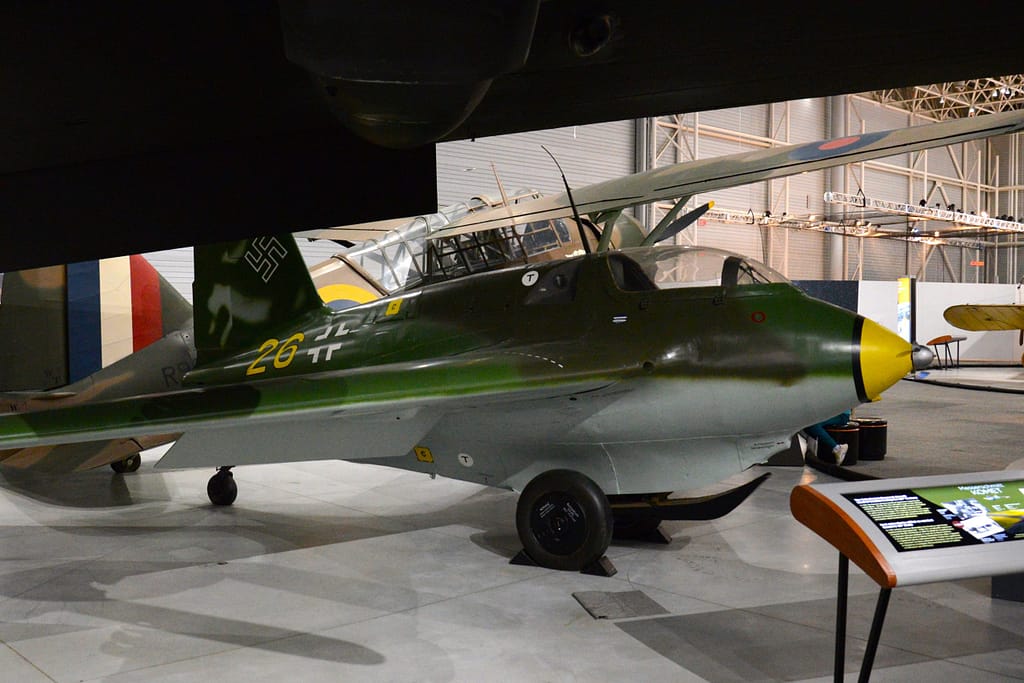
The catch was the word “few.” The rocket drank its propellant in around four to seven minutes. A Komet launched on a jettisoned dolly, clawed for altitude, made one or two firing passes as a glider once the fuel ran dry, then had to dead-stick back to base and land on a retractable skid — a violent, unforgiving arrival.
The propellant that killed
The real danger was the fuel. The Walter motor burned T-Stoff — concentrated hydrogen peroxide — and C-Stoff, a hydrazine-methanol mix. The two were hypergolic: they ignited the instant they met. T-Stoff was so corrosive it would attack organic matter, including a pilot. A hard skid landing that ruptured a fuel line could soak the cockpit; more than one flier was killed not by enemy fire but by his own aircraft dissolving around him. The ace Josef Pöhs died in 1943 when a fuel line failed on take-off.
Only one man flew a fully-fuelled Komet under power for the Allies after the war — the Royal Navy test pilot Eric “Winkle” Brown, who had few illusions about the experience.
Spectacular, and almost useless
Only one unit, Jagdgeschwader 400, flew the Komet operationally, first tangling with American B-17s on 28 July 1944. For all its speed, its combat record was thin: something like nine Allied aircraft destroyed against roughly the same number of Komets lost — and more pilots died in accidents, take-off explosions and propellant burns than in combat. Its combat radius was barely 40 kilometres; it could defend a single point and nothing more.
Around 370 were built, though far fewer flew in anger. Like the Me 262 jet, the Komet was a glimpse of the future arriving too early and too desperate to change the war. It was a magnificent, murderous dead end — the fastest way yet devised to frighten a bomber crew, and the men who flew it.
Sources: Smithsonian NASM; National Museum of the USAF; RAF Museum; Eric Brown, “Wings on My Sleeve”.
0 Comments