
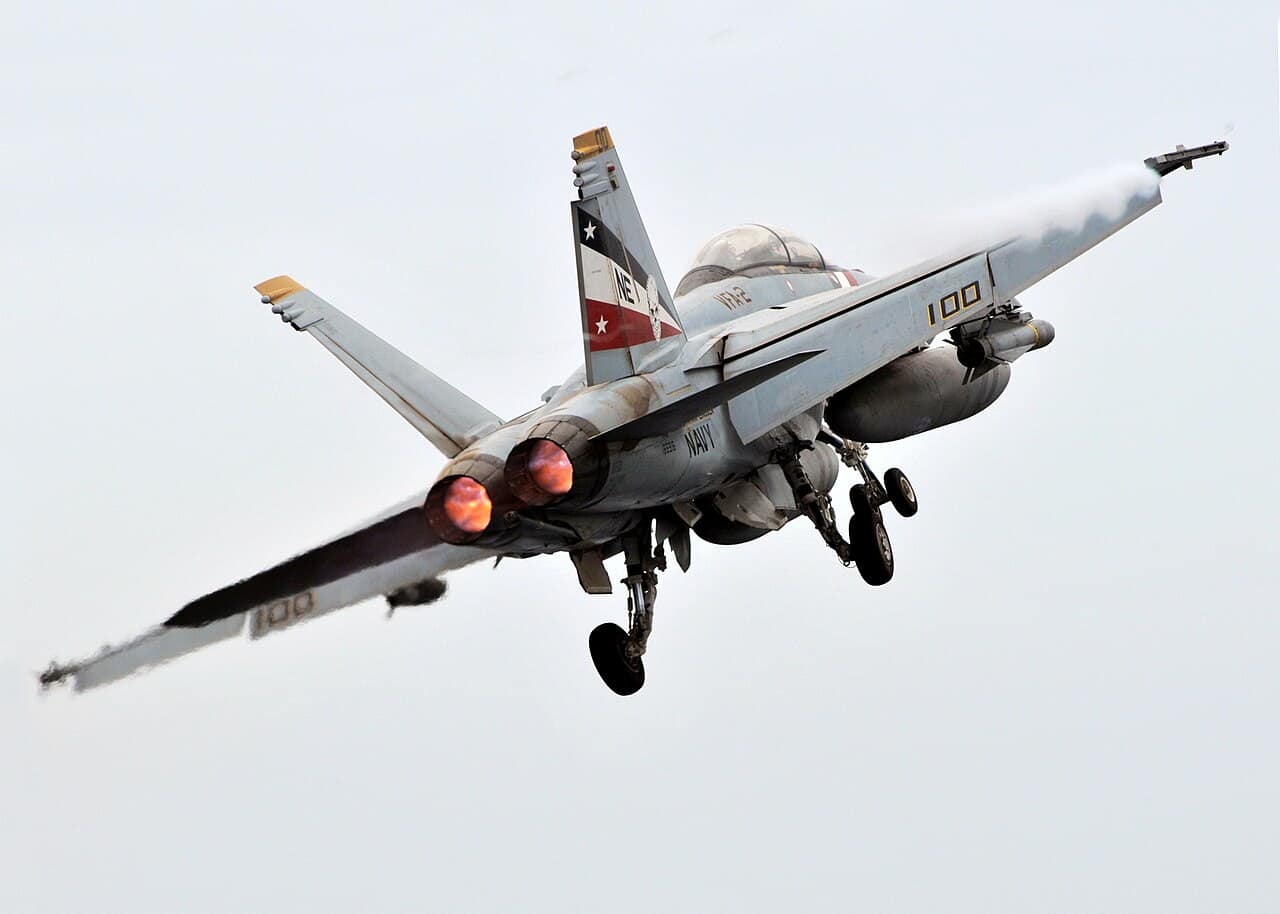
The video is grainy, shot from the ground near Chabahar — a port city on Iran's remote eastern coast. A U.S. Navy F/A-18 Super Hornet screams low overhead, its 20mm cannon blazing. Then a streak of smoke rises from below. The aircraft breaks hard left. The warhead detonates behind it. The jet flies on.
For several tense hours on March 25, 2026, the world debated whether the United States had just lost a fighter jet over Iran. The answer was no — but the close call was real, and the video proved it.
Iran Claimed a Kill. CENTCOM Said Otherwise.
The Islamic Revolutionary Guard Corps moved fast. Before the smoke had cleared, IRGC state media announced that the F/A-18 had been "accurately hit" using new advanced air defense systems and had subsequently crashed into the Indian Ocean. The claim went viral across Middle Eastern media within minutes.
U.S. Central Command fired back just as quickly. "No U.S. fighter aircraft have been shot down by Iran," CENTCOM posted on X — directly contradicting the IRGC account. Open-source analysts at GeoConfirmed pinned the footage to coordinates in Chabahar's port district and walked through it frame by frame: the missile detonated in the jet's wake. The Super Hornet kept flying.
The IRGC's kill claim was false. But the underlying event — an Iranian man-portable surface-to-air missile coming within metres of a U.S. Navy fighter — was not.
The Longest Reach of Operation Epic Fury
Chabahar sits at the far eastern edge of Iran, almost on the Pakistani border. The fact that U.S. aircraft are conducting low-level strafing runs there — well outside the Persian Gulf — shows just how broadly Operation Epic Fury has extended American air power across Iranian territory.
It also reveals a threat the Pentagon has been quieter about: Iranian MANPADS. These are not the sophisticated S-300 batteries that U.S. planners spent years preparing to suppress. They are small, mobile, shoulder-fired weapons — the kind a single IRGC soldier can carry into a port, a rooftop, or a fishing village. No radar warning. No electronic countermeasure will reliably detect them before the trigger is pulled.
The Super Hornet pilot appears to have reacted instinctively — or perhaps caught the missile's launch signature just in time. Either way, it was very close.
The Threat Is Not Gone
Iran's large fixed air defense networks have taken severe damage since Epic Fury began. But this incident is proof that the threat has not been erased. MANPADS are nearly impossible to pre-empt. They are everywhere. And the men holding them are still watching the sky.
Secretary of State Marco Rubio, speaking the same day, described "growing energy" in diplomatic channels and hinted at progress. Until a deal is struck, U.S. pilots are flying — and ducking.
Sources: The War Zone; U.S. Central Command; GeoConfirmed; Bellingcat
Related Questions
What is the F/A-18 Super Hornet?
The F/A-18E/F Super Hornet is a twin-engine, carrier-based multirole fighter built by Boeing for the US Navy. It flies both air-to-air and strike missions and is armed with a 20mm cannon plus missiles and bombs. It has been heavily used in US operations over Iran in 2026.
Did Iran shoot down a US F/A-18 in March 2026?
No. On March 25, 2026, ground video near the Iranian port of Chabahar showed a Super Hornet making a low pass as a surface-to-air missile detonated behind it. The jet broke hard and flew on. Iran's IRGC claimed a kill, but US Central Command denied any aircraft was lost.
What happened to the F/A-18 near Chabahar?
A US Navy F/A-18 Super Hornet flew low over Chabahar on Iran's eastern coast, firing its 20mm cannon, when a missile was launched at it. The warhead detonated behind the aircraft as it broke hard left, and the jet escaped undamaged. The grainy footage fuelled hours of debate before CENTCOM confirmed no loss.
Why did Iran claim it shot down the jet?
Iran's Islamic Revolutionary Guard Corps announced through state media that the F/A-18 had been hit and had crashed into the Indian Ocean, a claim that spread quickly across regional media. Such claims are common in wartime information battles, and US Central Command rejected it. It reflects the wider air war seen in the combat loss of an F-15E over Iran.
Has the US actually lost aircraft over Iran?
Yes, though not in the Chabahar incident. The first confirmed US fixed-wing combat loss of the campaign was an F-15E Strike Eagle downed in early April 2026. Carrier aviation over the region remains demanding work, from strike sorties to the precision of night carrier landings.

0 Comments