
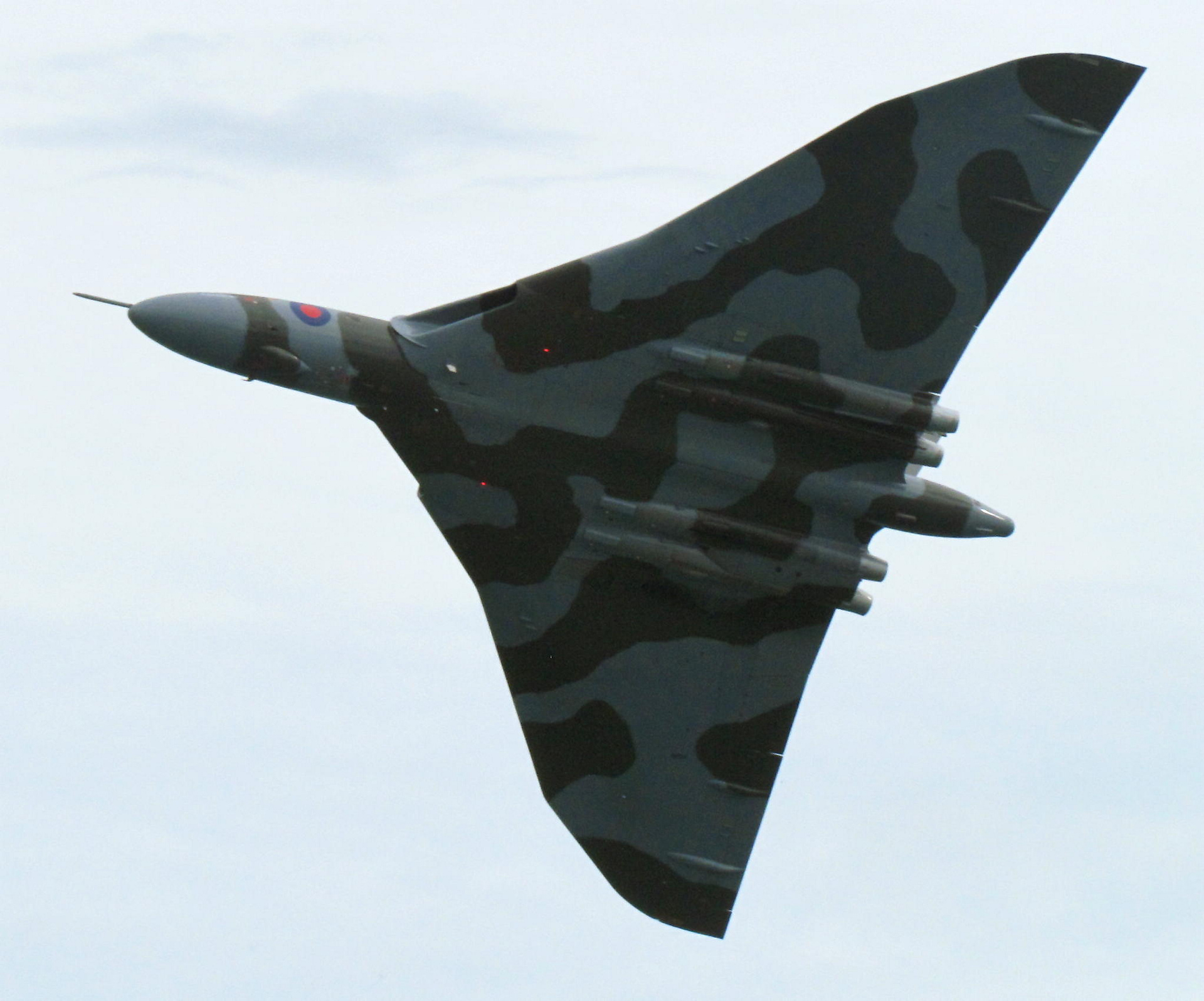
Avro Vulcan
“The Tin Triangle”
Britain’s great delta-wing V-bomber — a nuclear-armed giant that could roll like a fighter, howl like nothing else in the sky, and fly the longest bombing raid in history to a runway 8,000 miles from home.
The delta that carried Britain’s bomb
In 1947 the Air Ministry issued specification B.35/46 for a jet bomber able to carry a 4,500 kg nuclear weapon to a target 2,700 km away, at high subsonic speed and above 50,000 feet. A. V. Roe & Company — Avro — answered with one of the boldest shapes in aviation: a vast, tailless delta wing. The concept was championed within Avro’s design office under chief designer Roy Chadwick, the man behind the wartime Lancaster; after Chadwick was killed in a 1947 crash the programme was carried forward by his successor Stuart Davies, with the delta planform proven first on the little Avro 707 research aircraft.
The prototype Type 698 first flew on 30 August 1952, and the aircraft — named Vulcan — entered RAF service from 1956–57. It became one of the three “V-bombers” — Valiant, Victor and Vulcan — that carried Britain’s airborne nuclear deterrent. Armed first with free-fall atomic bombs and later with the Mach-2.5 Blue Steel stand-off missile, Vulcans stood Quick Reaction Alert around the clock, crews ready to be airborne in minutes.
As Soviet surface-to-air missiles made high-altitude penetration suicidal, the force switched in the mid-1960s to low-level flying beneath enemy radar. Britain handed the strategic deterrent to Royal Navy Polaris submarines in 1969, but the Vulcan flew on — and in 1982 stunned the world with the Black Buck raids of the Falklands War. Retired by the RAF in 1984, one aircraft, XH558, was restored to fly again as a civilian display aircraft until 2015, keeping the delta’s unmistakable howl alive for a generation that never knew the Cold War.
01How the Avro Vulcan’s giant delta wing was born — from the Lancaster to the atom bomb
The delta wing was a leap into the unknown. To carry a bulky early nuclear weapon fast and high, Avro’s team gambled on an all-wing triangle with no tailplane — a shape that offered enormous internal volume, a big fuel and bomb load, and a high service ceiling, but whose handling nobody yet understood. Rather than risk the full-size bomber, Avro built a family of scaled research gliders and jets, the Avro 707 series, to explore the delta’s low-speed and high-speed behaviour.
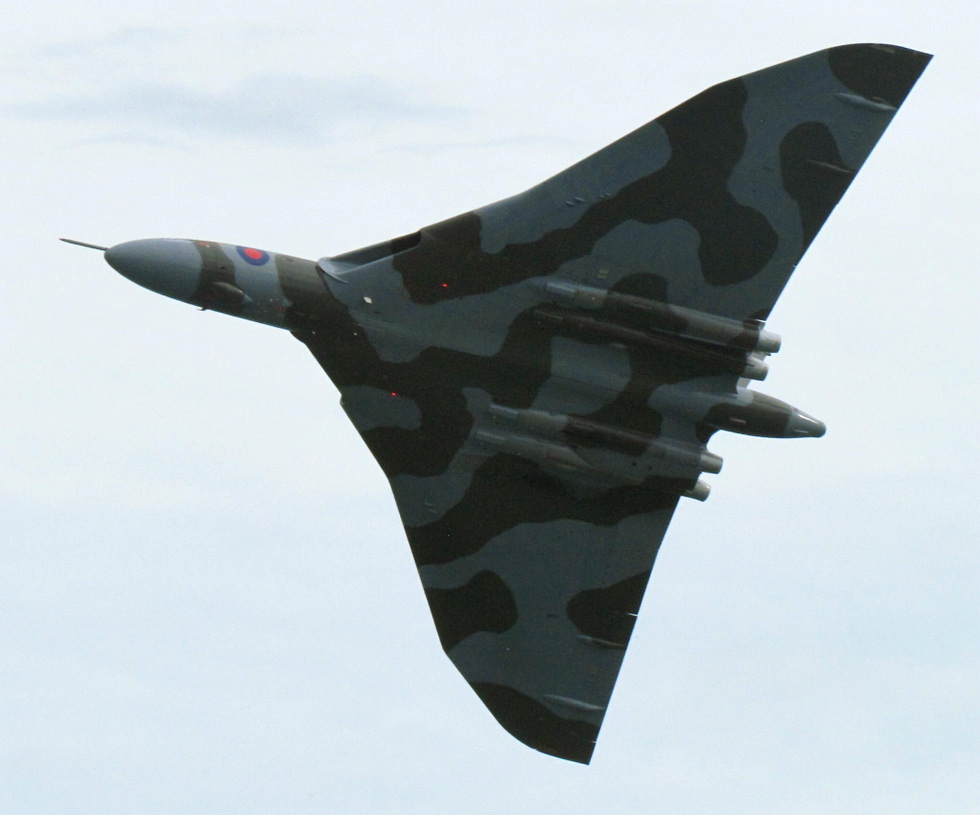
The production Vulcan refined the pure triangle with a kinked, cambered leading edge to tame buffet at height, and grew from the B.1 into the far more capable B.2, with a bigger wing, more powerful Olympus engines and a formidable electronic-warfare suite. The result was a bomber that looked like nothing else in the sky — and, thanks to that wing, could be flown with a lightness that astonished everyone who saw it displayed.
What makes the Vulcan special
A pioneering delta wing on four Olympus engines
The Vulcan’s defining feature is its enormous delta wing — about 34 m from tip to tip — buried in which sat four Rolls-Royce (originally Bristol) Olympus turbojets, two per side. The wing gave huge lift, vast internal volume for fuel and weapons, and a ceiling above 55,000 ft. The same Olympus engine line, much developed, later powered Concorde. It was one of the first large delta aircraft in the world to enter service.
Britain’s nuclear deterrent — and Blue Steel
As a V-bomber the Vulcan carried Britain’s strategic nuclear deterrent: first free-fall bombs such as Yellow Sun, then from the early 1960s the rocket-powered Blue Steel stand-off missile, which could be launched around 100 nautical miles from a defended target and flew at roughly Mach 2.5. Crews stood Quick Reaction Alert, ready to scramble in minutes — the sharp end of Britain’s Cold War.
Fighter-like agility — and the “Vulcan howl”
For a 90-tonne bomber the Vulcan was astonishingly nimble; test pilot Roly Falk famously rolled a prototype at Farnborough in 1955. And at high power the delta’s intakes produced a spine-tingling howl — a resonance created as a huge mass of air is drawn through the intake geometry, unique to the B.2 airframe and unforgettable to anyone who heard it at an air show.
02What causes the Avro Vulcan’s famous “howl”?
The howl is a product of the Vulcan’s intake design working at high power. At roughly 87–95% engine power, the B.2 draws around 100 kg of air per second through each intake — a square opening that narrows to an oval and then a round duct feeding the engine. That progressive constriction sets up a resonance, much like blowing across the neck of a bottle, and produces the distinctive rising howl. It is specific to the later 200-series airframe; the earlier B.1 did not sing the same way. For enthusiasts it became the single most beloved sound in British aviation.
03Why the Vulcan switched from high level to hugging the ground
The Vulcan was conceived as a high-altitude bomber, cruising above 50,000 ft where 1950s fighters and guns could not reach. That sanctuary vanished on 1 May 1960, when a Soviet SA-2 missile downed Gary Powers’ U-2 at high altitude. Suddenly height was a death sentence, not a shield. From the mid-1960s the V-force retrained for low-level penetration, threading below Soviet radar at a few hundred feet — a punishing regime that stressed the airframes and their crews far more than the high-level role they were designed for, and which changed the Vulcan’s paint from anti-flash white to disruptive camouflage.
Full specifications (Vulcan B.2)
Airframe & Performance
- Bemanning
- 5 (2 pilots, 2 navigators, 1 air electronics officer)
- Lengte
- ~30.5 m (99 ft 11 in)
- Spanwijdte
- ~33.8 m (111 ft)
- Hoogte
- ~8.3 m (27 ft 2 in)
- Vleugelgebied
- ~368 m² — a very large delta
- Max takeoff weight
- ~77,000 kg (~170,000 lb)
- Max speed
- ~1,040 km/h · ~Mach 0.96 (high subsonic)
- Serviceplafond
- ~55,000 ft (some sources higher)
- Bereik
- ~7,400 km with Blue Steel
Propulsion, Weapons & Programme
- Engines
- 4 × Rolls-Royce (Bristol) Olympus turbojets
- Thrust (each, B.2)
- ~89 kN (~20,000 lbf)
- Nuclear armament
- Free-fall bombs or 1 × Blue Steel stand-off missile
- Conventional load
- Up to 21 × 1,000-lb bombs (~9,500 kg)
- First flight
- 30 August 1952 (Type 698 prototype)
- Introduced
- 1956–57 (B.1)
- Retired
- 1984 (RAF) · 2015 (XH558, civilian)
- Number built
- 136 (all variants)
04What did an Avro Vulcan cost — and what does one cost to fly today?
The Vulcan was a state-funded Cold-War programme, never sold on an open market, so a clean modern flyaway price does not exist; period figures put each B.2 very roughly in the region of £750,000–£1 million in late-1950s money — an order-of-magnitude guide, not an audited number. The more revealing modern figures come from XH558: the Vulcan to the Sky Trust spent about £6.5 million returning it to flight by 2007, and keeping a single four-engined 1960s bomber airworthy cost on the order of £2 million a year — funded largely by public donations. When the specialist engineering support could no longer be guaranteed, no amount of money could keep it flying, and it was grounded in 2015.
From Cold-War deterrent to the last howl
The requirement
Air Ministry specification B.35/46 calls for a high-flying jet bomber to carry Britain’s atomic bomb; Avro answers with a radical delta.
First flight
The Type 698 prototype VX770 flies on 30 August, piloted by Roly Falk — the aircraft is soon named Vulcan.
The Farnborough roll
Falk rolls a Vulcan prototype before the crowd at Farnborough, showing a heavy delta bomber flying like a fighter.
Enters service
The Vulcan B.1 joins the RAF as part of the V-force nuclear deterrent alongside the Valiant and Victor.
Blue Steel & QRA
The Mach-2.5 Blue Steel stand-off nuclear missile enters service; Vulcan crews stand Quick Reaction Alert around the clock.
Down to the deck
Following the SAM threat exposed by the 1960 U-2 shootdown, the V-force switches to low-level penetration below enemy radar.
Operation Black Buck
Vulcans fly ~12,900 km round trips from Ascension to bomb Port Stanley — then the longest-range bombing raids in history.
Retirement & the last flight
The RAF retires the Vulcan in 1984; restored civilian XH558 flies until its final display on 28 October 2015.
Twelve Vulcan stories
Black Buck: the 8,000-mile bomb run
A single Vulcan flew from Ascension to Port Stanley and back — then the longest bombing raid ever flown.
Read the full story
The howl that stopped a crowd
The Vulcan’s delta intakes produced a rising howl unlike any other aircraft — a sound people travelled for miles to hear.
Read the full story
Rolling a bomber at Farnborough
Test pilot Roly Falk rolled a Vulcan prototype in front of the Farnborough crowd — and reportedly got a telling-off for it.
Read the full story
The delta and its baby brothers
Avro proved the radical delta wing on a family of small research aircraft, the Avro 707, before betting the bomber on it.
Read the full story
Blue Steel and the two-megaton stand-off
Rather than fly over the target, the Vulcan could launch a rocket-powered nuclear missile 100 miles short of it.
Read the full story
Four minutes to airborne
On Quick Reaction Alert, armed Vulcan crews lived beside their aircraft, ready to scramble before the missiles arrived.
Read the full story
Hugging the ground
After 1960, flying high went from being the Vulcan’s shield to its death warrant — so it learned to fly low.
Read the full story
Impressing the Americans
At US Red Flag exercises, Vulcan crews put the big delta through aggressive low-level flying that startled onlookers.
Read the full story
Back from the dead: XH558 flies again
A charity spent years and millions returning the last Vulcan to the air — a feat many thought impossible.
Read the full story
Kept flying by the public
XH558’s display years were funded not by government but by tens of thousands of ordinary supporters.
Read the full story
The last howl
On 28 October 2015 XH558 flew for the final time, ending the age of the airworthy Vulcan.
Read the full story
The bomber that only bombed once
For all its Cold-War menace, the Vulcan’s only combat drops came in a single 1982 campaign, never in the nuclear role it was built for.
Read the full story
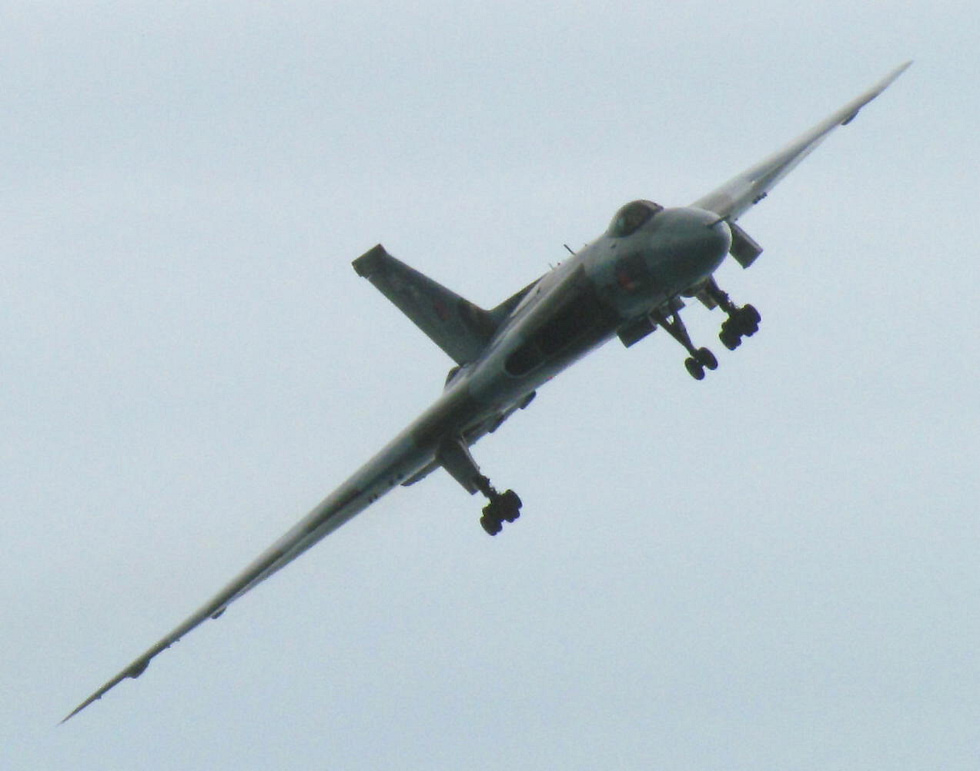
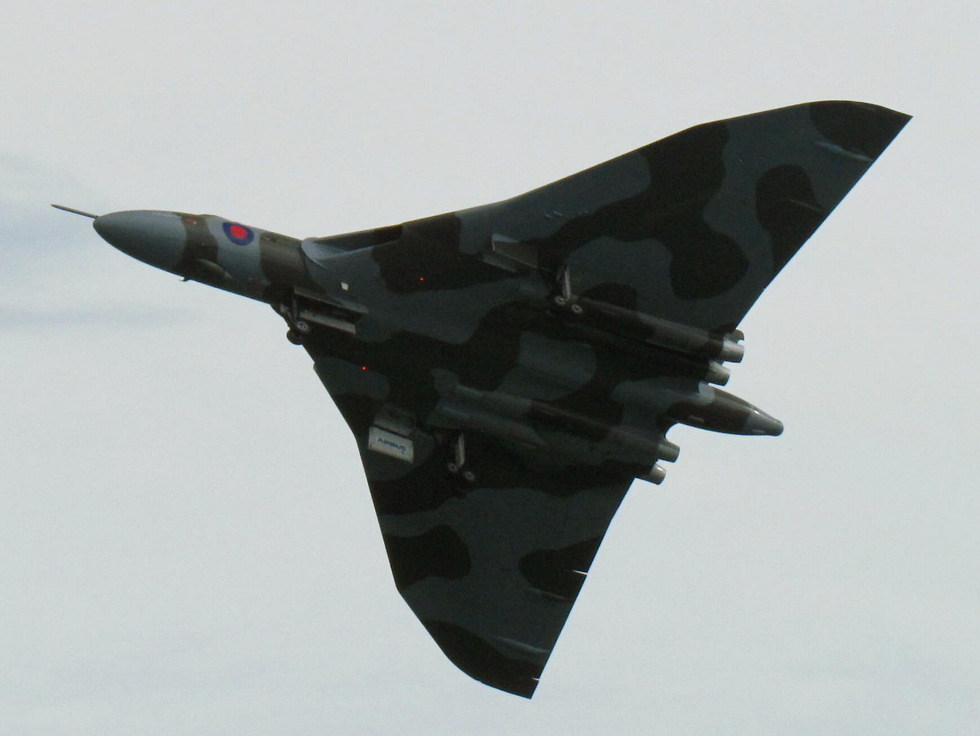
The Vulcan in pictures
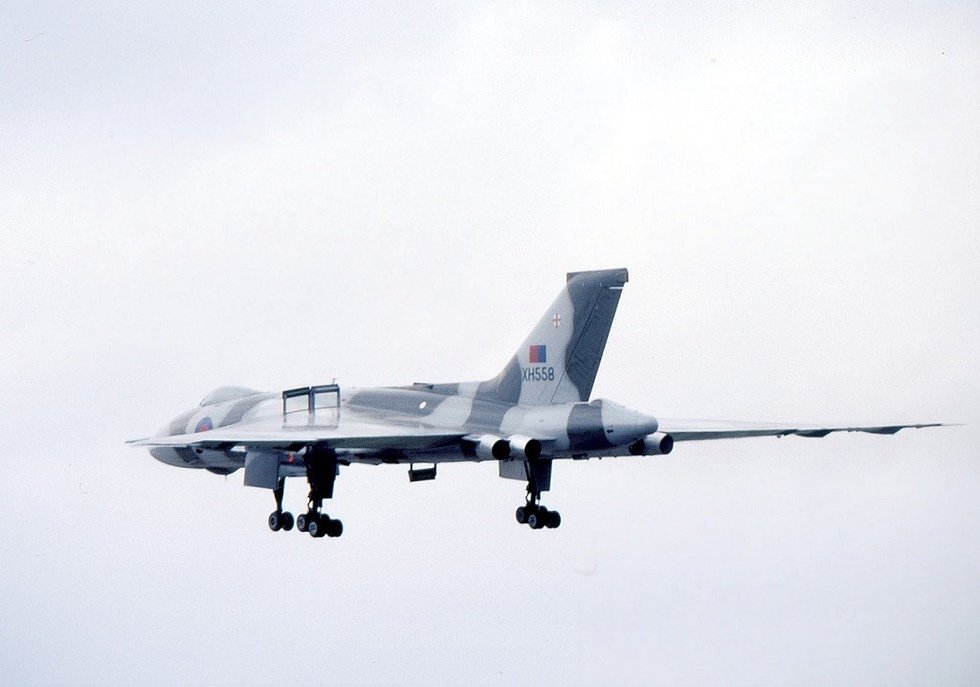
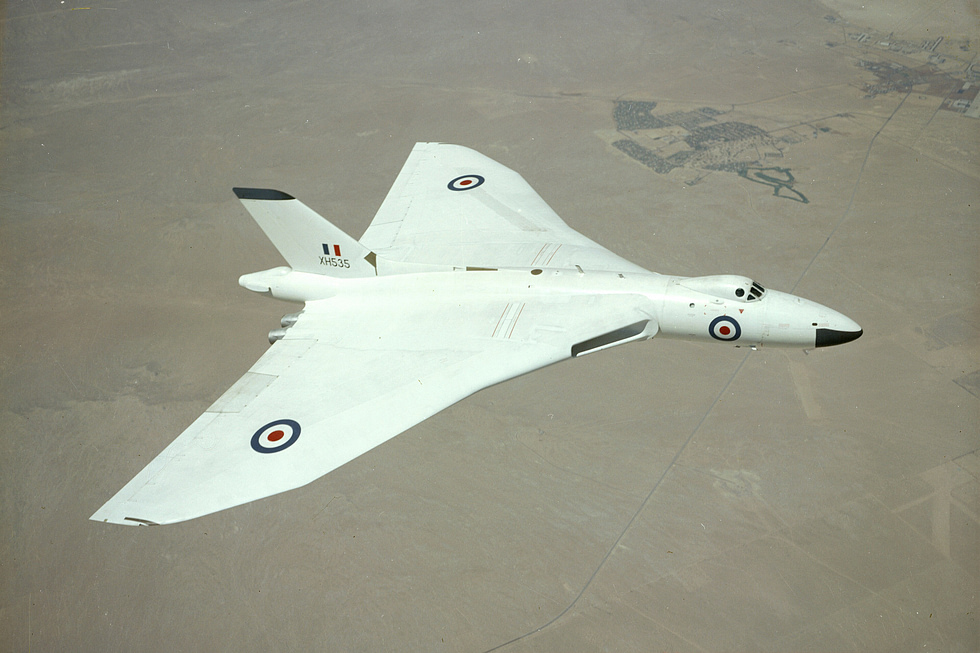
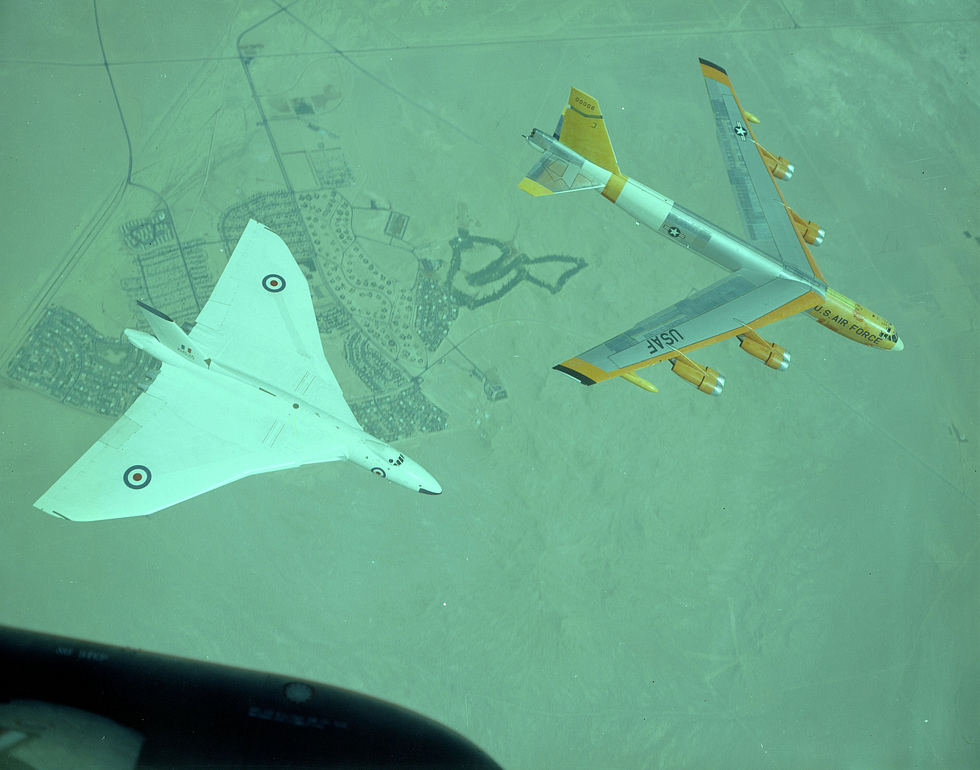
The Vulcan in motion
Video coming soon. In the meantime, the best way to understand the Vulcan is its sound: search for footage of XH558 displaying and turn the volume up — the rising Olympus “howl” is the reason crowds travelled for miles to hear this aircraft fly.
Where the Vulcan served
The score that defines it
The Vulcan was built to deliver nuclear weapons in a war that, mercifully, never came — so its true “combat record” is a deterrent that was never fired. In nearly 30 years of RAF service its only shots in anger came in a single 1982 campaign: the Black Buck raids of the Falklands War, when Vulcans flew from Ascension Island to attack Port Stanley. Those missions set a range record and are the aircraft’s lasting combat legacy.
Compare the combat record of every military aircraft. Figures as of July 2026.
Everything people ask about the Avro Vulcan
Can I fly in a Vulcan?
Can a civilian fly the Vulcan?
What was Operation Black Buck?
Why does the Vulcan “howl”?
Was the Vulcan supersonic?
What nuclear weapons did the Vulcan carry?
Why was XH558 grounded in 2015?
How many Vulcans were built, and how many survive?
You can’t fly the Vulcan.
These, you can.
Some legends only live in museums — others are fuelled and waiting. MiGFlug has put civilians in real military jet cockpits since 2004.
 Fly the L-39 AlbatrosThe world’s most-flown jet trainer — aerobatics included
 Fly the F-104 Starfighter“The missile with a man in it”
 Fly the MiG-21The Cold War’s most-produced jet
 Vlieg met de T-33 Shooting StarAmerica’s first jet trainer
 Fly the DH VampireA piece of early jet history
 Fly the S.211Agile Italian jet trainer
 Fly the MB-326The classic Aermacchi jet
 Fly the MiG-15The Soviet legend of the Korean War
Continue the tour
Every fact, checked
- Vulcan to the Sky TrustXH558’s history, restoration, display years and 2015 grounding, plus Black Buck background.
- Vulcan Restoration TrustQuick Reaction Alert, the nuclear-deterrent role and the Falklands conflict.
- RAF Museum — The Avro VulcanBlue Steel, QRA, the switch to low level and the Black Buck raids.
- Royal Air Force — Op Black Buck 40th anniversaryOfficial account of the 1982 Falklands Vulcan raids.
- Thunder & Lightnings — Avro VulcanDevelopment history, B.1/B.2 variants and specifications.
- Forces News — Avro VulcanSpecifications, service history and general reference.
- Simple Flying — the Vulcan howlTechnical explanation of the intake resonance behind the howl.
- ADS Group — the 1955 Farnborough rollRoly Falk’s Vulcan roll and the aircraft’s later Red Flag reputation.