
Germany’s twin-engine “Hornet” — the aircraft that redeemed the disastrous Me 210. A fast bomber over Britain, a reconnaissance racer, and a heavily-armed bomber-destroyer that could smash a B-17 — if the escorts let it live.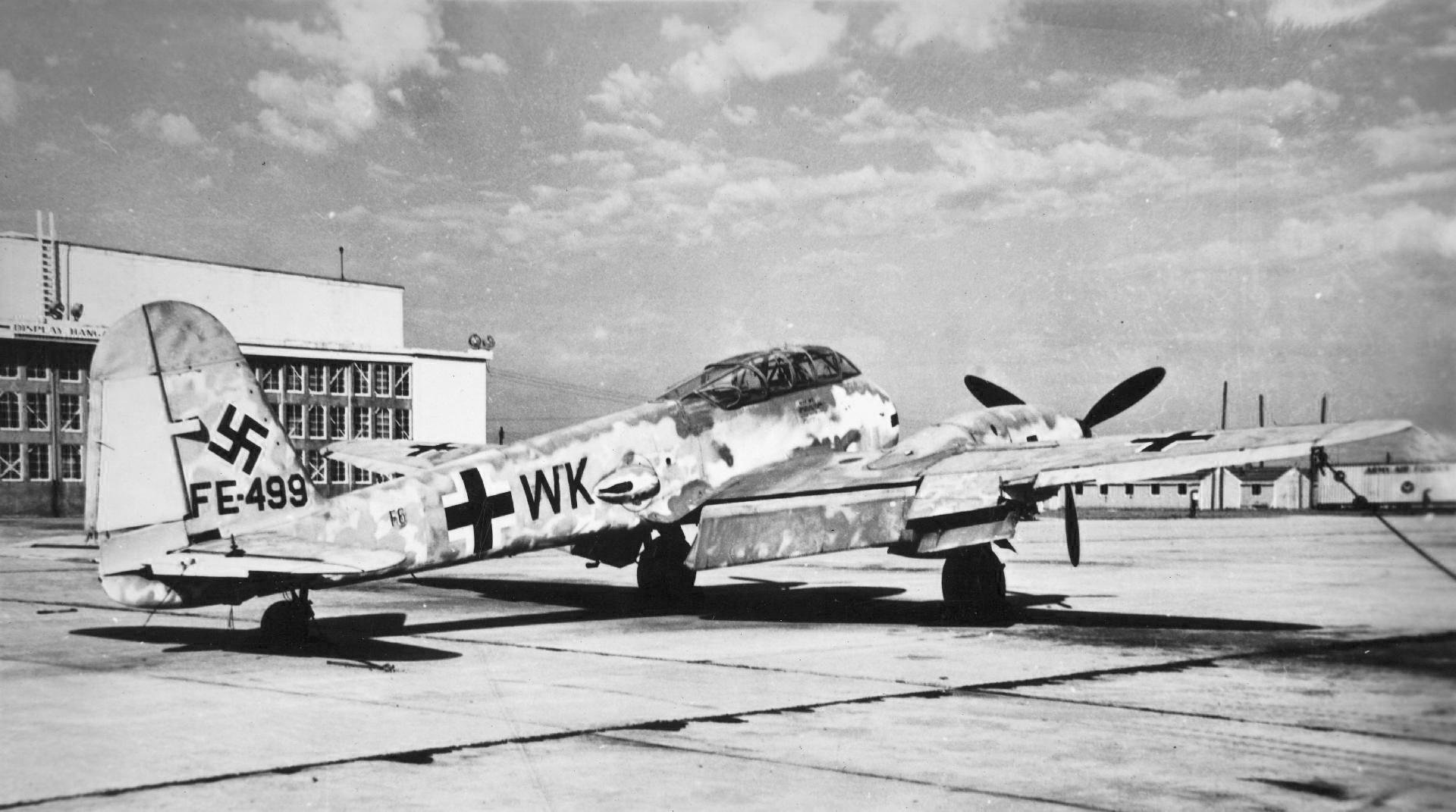
Messerschmitt Me 410
“Hornisse”
The redemption of a failure
Every great comeback needs a disaster to come back from. For the Messerschmitt Me 410 Hornisse — “Hornet” — that disaster was its own direct ancestor, the Me 210. Conceived in the late 1930s to replace the Bf 110 as the Luftwaffe’s standard Zerstörer (destroyer), the Me 210 was rushed into production before its flaws were understood, and those flaws were serious: it stalled viciously, dropped into spins, and was so treacherous near the ground that it wrecked airframes and killed crews. The programme became one of the worst industrial embarrassments of the German war effort.
The fallout was severe. Hundreds of near-complete Me 210s piled up, production was halted, and the affair cost the company dearly — contributing to the pressures around Erhard Milch’s aircraft-production regime and, reportedly, to Willy Messerschmitt’s own troubles at the head of the firm that bore his name. On paper the sensible answer was to cancel the whole idea. Instead, engineers went looking for what had actually gone wrong.
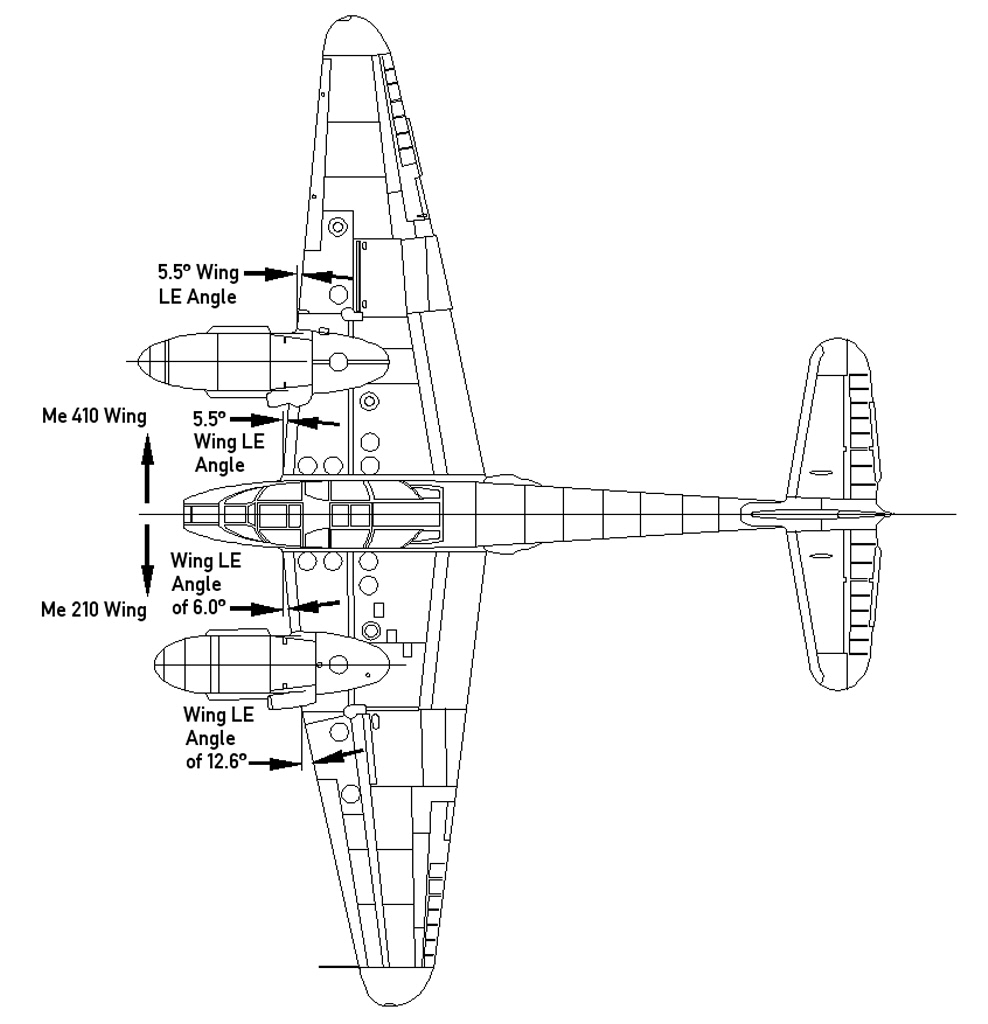
The fixes turned out to be surprisingly specific. A lengthened rear fuselage cured much of the instability; automatic leading-edge slats tamed the stall; and a switch to the far more powerful Daimler-Benz DB 603 engines gave the airframe the performance its designers had always promised. The reworked machine flew so much better that it was given a new designation to escape the poisoned reputation of the old one. The Me 210 had been a failure; the Me 410, first flown in 1942, was the same basic aircraft made to work.
And it did work. Fast — roughly 625 km/h — long-legged and steady, the Hornisse became a genuinely useful multi-role aircraft. It raided England as a fast bomber and night intruder during the “Baby Blitz” of early 1944; it ranged deep as a high-speed reconnaissance platform over Britain, the Mediterranean and the Eastern Front; and it fought as a heavily-armed bomber-destroyer in the Defence of the Reich. It even carried an unusual defensive trick: a pair of remotely-controlled barbettes on the fuselage sides, each with a rearward-firing 13 mm gun aimed from inside the aircraft.
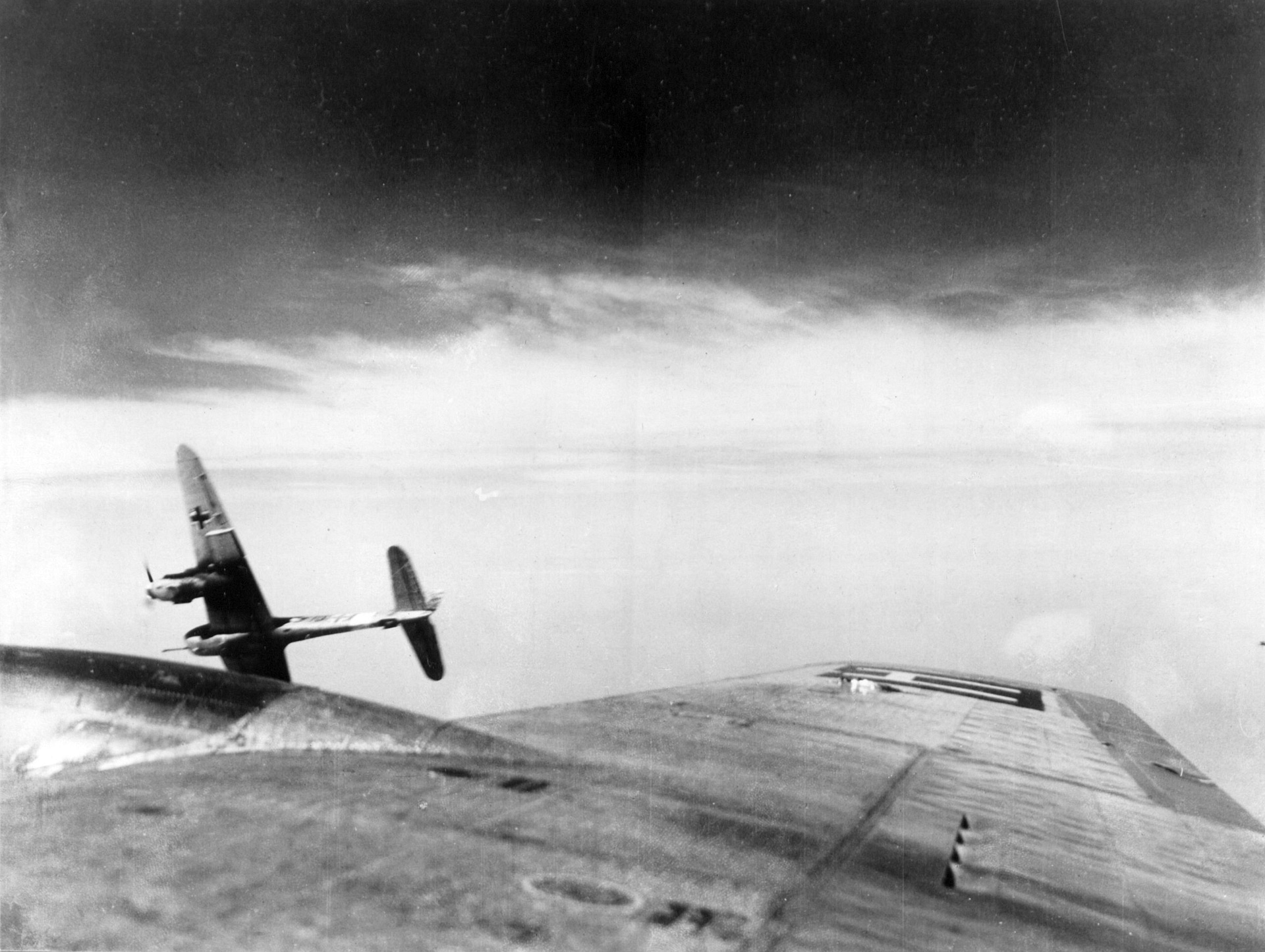
But the Hornisse arrived into a sky that was turning against it. As a bomber-destroyer hung with heavy cannon — up to a 50 mm BK 5 in some machines — it could tear a heavy bomber apart, yet all that weight and drag left it slow and clumsy the moment American escort fighters arrived. By 1944 the P-51 Mustang was ranging all the way to Berlin, and the twin-engine Zerstörer, like the Bf 110 before it, became easy prey. Production ended in 1944 after only about 1,160 had been built. The Me 410 was a good aircraft that had finally solved its own worst problems — just as the war left no room for it to matter.
01The Messerschmitt Me 210 disaster: the failure the Me 410 was built to fix
De Me 210 was meant to be a straightforward, better Bf 110: a modern twin-engine Zerstörer with a cleaner airframe, remote defensive guns and more speed. So confident was the Reich Air Ministry that it ordered the aircraft into series production off the drawing board, before flight testing had shown whether it was any good. It was not. Early machines revealed dangerous instability, a savage stall and a tendency to flick into spins, and the accident rate was alarming.
The consequences rippled through the whole programme. Production had to be suspended with large numbers of airframes built or half-built; enormous resources were written off; and the episode became a byword for mismanagement in German aircraft procurement, feeding the friction around Erhard Milch and reportedly damaging Willy Messerschmitt’s own standing within his company. It is remembered as one of the costliest development failures the Luftwaffe suffered.
What saved the concept was that the problems were fixable rather than fundamental. Wind-tunnel work and flight testing traced the worst handling to the aircraft’s short rear fuselage and wing behaviour; lengthening the fuselage and fitting automatic leading-edge slats transformed it. Re-engined with the DB 603, the rehabilitated design was renamed the Me 410 — partly on merit, partly to leave the Me 210’s reputation behind. Figures for exactly how many Me 210s were built, converted or scrapped vary between sources and should be treated as estimates.
What makes it special
A failure re-engineered into a fighter
The Me 410’s defining feature is what was fixed. A lengthened fuselage, automatic leading-edge slats and powerful DB 603 engines cured the Me 210’s deadly handling, turning a notorious failure into a fast, stable, long-range multi-role aircraft — roughly 625 km/h and steady enough to bomb, snoop and hunt.
Remotely-controlled barbettes
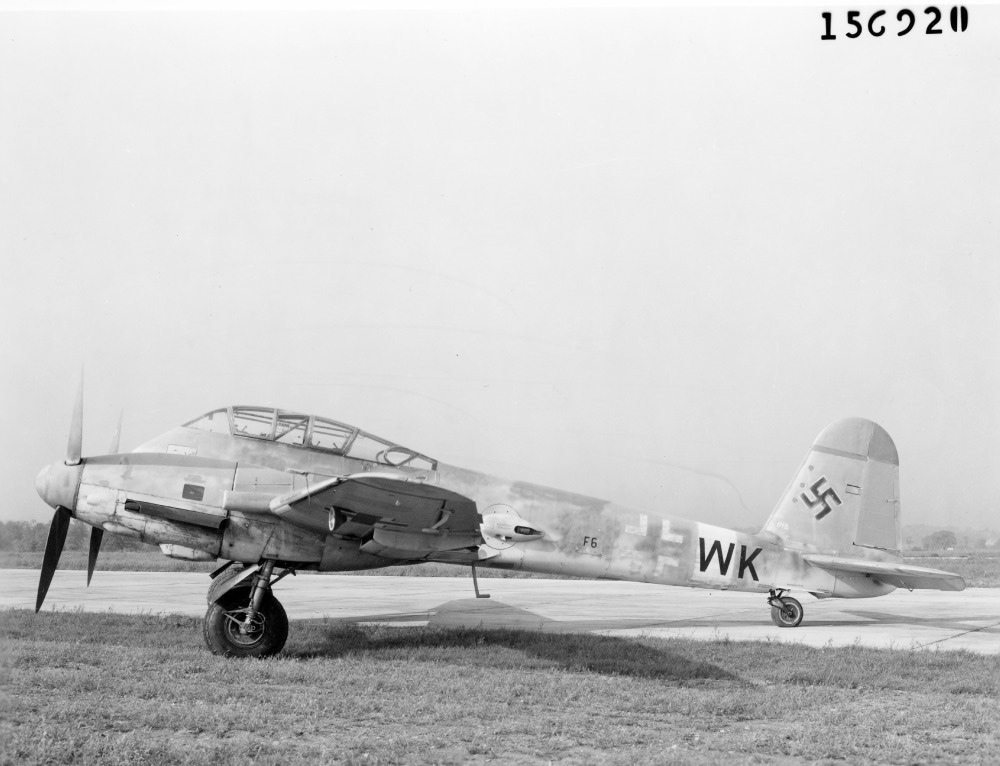
On each side of the rear fuselage sat an FDSL barbette housing a single rearward-firing 13 mm MG 131. The gunner aimed them from a sighting station instead of sitting behind the guns — an unusual, forward-looking defensive scheme that let one operator cover the aircraft’s vulnerable rear hemisphere on both sides.
Heavy guns — and a fatal trade-off
As a bomber-destroyer the Me 410 could carry devastating weapons: batteries of 20 mm and 30 mm cannon, underwing rockets, even a 50 mm BK 5. One good hit could wreck a B-17. But the weight and drag of that arsenal made the Hornisse slow and clumsy against nimble escort fighters — deadly to bombers, but easy prey itself.
02The Messerschmitt Me 410’s barbettes: remote-controlled guns that defended the rear
One of the Me 410’s most distinctive features was inherited from the Me 210 and made to work properly: a pair of remotely-operated gun barbettes, one faired into each side of the fuselage behind the cockpit. Each barbette carried a single 13 mm MG 131 machine gun that could traverse to cover the rear hemisphere. Crucially, the second crewman did not sit directly behind the weapons — he aimed and fired them by remote control from a sighting station, tracking an attacker through a periscopic sight while the guns themselves swung to follow.
The idea was clever. It let one man defend both sides of the aircraft, kept the guns in low-drag fairings rather than bulky manned turrets, and gave the gunner a better all-round view than a traditional rear cockpit. Against the Me 410’s worst enemy — a fast fighter diving from behind — the barbettes gave crews at least a fighting chance where the Bf 110’s single hand-held rear gun had often left them helpless. The mechanism was complex and its effectiveness varied, but as an engineering answer to the Zerstörer’s chronic tail vulnerability it was genuinely ahead of its time.
03The Messerschmitt Me 410 as bomber-destroyer: the 50 mm cannon and its fatal weakness
By 1943 the Luftwaffe’s central problem over Germany was the USAAF heavy bomber: massed, armoured, densely armed formations of B-17s and B-24s arriving by day. The Me 410 was pressed into the Zerstörer role against them, and it was armed to kill. Standard machines already carried a heavy nose battery of 20 mm cannon; specialist versions added far heavier weapons still — multiple 20 mm or 30 mm cannon, underwing 21 cm rockets to break up formations, and on the Me 410A-1/U4 a single enormous 50 mm BK 5 cannon adapted from an anti-tank gun. A single well-aimed round from that weapon could destroy a four-engine bomber outright.
The catch was physics. Every rocket rack, cannon and armour plate added weight and drag, and a heavily-armed Me 410 was slow, sluggish and predictable — exactly the wrong thing to be once long-range escort fighters arrived. When P-47 Thunderbolts and especially P-51 Mustangs began escorting the bombers all the way to their targets in 1944, the bomber-destroyers were hunted down before they could reach the bombers at all. The same heavy armament that made the Hornisse lethal to bombers made it a death-trap against fighters. It was, in the end, a weapon that had arrived just after the moment it might have won.
Full specifications
Figures are for the Me 410 A-1, the main production variant. Heavier bomber-destroyer sub-types (such as the A-1/U4 with the 50 mm BK 5) were slower and less agile. Several figures vary between sources and are given as ranges or approximations.
Airframe & Performance
- Bemanning
- 2 (pilot & radio-operator/gunner)
- Lengte
- ~12.5 m
- Spanwijdte
- ~16.4 m
- Hoogte
- ~4.3 m
- Max takeoff weight
- ~10,600 kg (loaded, varies by variant)
- Max speed
- ~625 km/h (~388 mph) at altitude
- Serviceplafond
- ~10,000 m
- Bereik
- ~1,600–2,300 km (with drop tanks)
- First flight
- 1942
Propulsion, Armament & Cost
- Engines
- 2 × Daimler-Benz DB 603 A (inverted V12)
- Power (each)
- ~1,750 PS (~1,290 kW)
- Nose armament
- 2 × 20 mm MG 151/20 + 2 × 7.92 mm MG 17
- Rear defence
- 2 × 13 mm MG 131 in remote barbettes
- Heavy options
- 50 mm BK 5, extra 20/30 mm cannon, 21 cm rockets
- Built
- ~1,160 (1942–1944)
- Unit cost
- Not reliably recorded (WWII state product)
- Cost per flight hour
- Not applicable — no airworthy example
04The Messerschmitt Me 410’s cost: why no reliable price exists
The Me 410 was a product of the wartime German state economy, built to state contracts and never sold on any open market, so a firm flyaway unit price in modern terms does not exist in the public record. Contemporary figures were quoted in Reichsmark and are hard to convert meaningfully across eight decades of inflation, currency reform and a command economy. There is likewise no reliable cost-per-flight-hour figure, and there never can be a modern operating cost, because no Me 410 is airworthy. Any precise dollar price attached to a Me 410 today should be treated as an estimate, not a sourced fact.
From disaster to Hornisse to obsolescence
The Zerstörer successor
The Luftwaffe seeks a modern replacement for the Bf 110; Messerschmitt develops the Me 210 with remote defensive guns and a cleaner airframe.
The Me 210 disaster
Ordered into production before proper testing, the Me 210 proves dangerously unstable; production is halted and the programme becomes a costly embarrassment.
The Me 410 flies
A lengthened fuselage, automatic slats and DB 603 engines fix the handling; the rehabilitated design is renamed the Me 410 Hornisse.
Into service
The Me 410 enters Luftwaffe service as a fast bomber, reconnaissance aircraft and Zerstörer across the Mediterranean, the Eastern Front and the West.
Baby Blitz over Britain
Me 410 fast bombers and night intruders raid England during Operation Steinbock, the “Baby Blitz,” using speed to slip in and out.
Bomber-destroyer
Heavily-armed Me 410s, some with the 50 mm BK 5, attack USAAF daylight formations in the Defence of the Reich — effective against bombers, deadly-vulnerable to escorts.
Production ends
With escort fighters dominating, the twin-engine Zerstörer concept collapses; Me 410 production stops after roughly 1,160 aircraft.
Two survivors
No Me 410 is airworthy; a Me 410A-1/U2 is preserved at the RAF Museum Cosford and an airframe is associated with the Smithsonian.
From the war: twelve Me 410 stories
The idea that killed its predecessor
The Me 410 exists because the Me 210 nearly killed the whole programme.
Read the full story
Three changes that saved a design
A longer tail, new slats and bigger engines turned a killer into a keeper.
Read the full story
Guns without a gunner behind them
Two remote barbettes let one man defend both flanks of the aircraft.
Read the full story
Fast bombers over England
In early 1944 Hornissen slipped across the Channel to bomb Britain by night.
Read the full story
The racer that outran its hunters
Stripped and fast, a recon Me 410 could show interceptors a clean pair of heels.
Read the full story
Hunting the heavy bombers
Against B-17 formations the Me 410 was a flying gun platform.
Read the full story
A field gun in the nose
One version carried a 50 mm cannon meant to kill a bomber with a single round.
Read the full story
When the escorts came
The arrival of the Mustang turned the bomber-destroyer into the destroyed.
Read the full story
Sand, sea and Sangro
Over Italy and the Mediterranean the Hornisse flew recon and strike work.
Read the full story
The man who aimed backwards
The Hornisse’s second crewman fought a very different war from the pilot.
Read the full story
Only about eleven hundred
For all its qualities, the Me 410 was never built in decisive numbers.
Read the full story
Two left in the world
Of more than a thousand built, only a couple of Me 410s survive intact.
Read the full story
The Me 410 in pictures
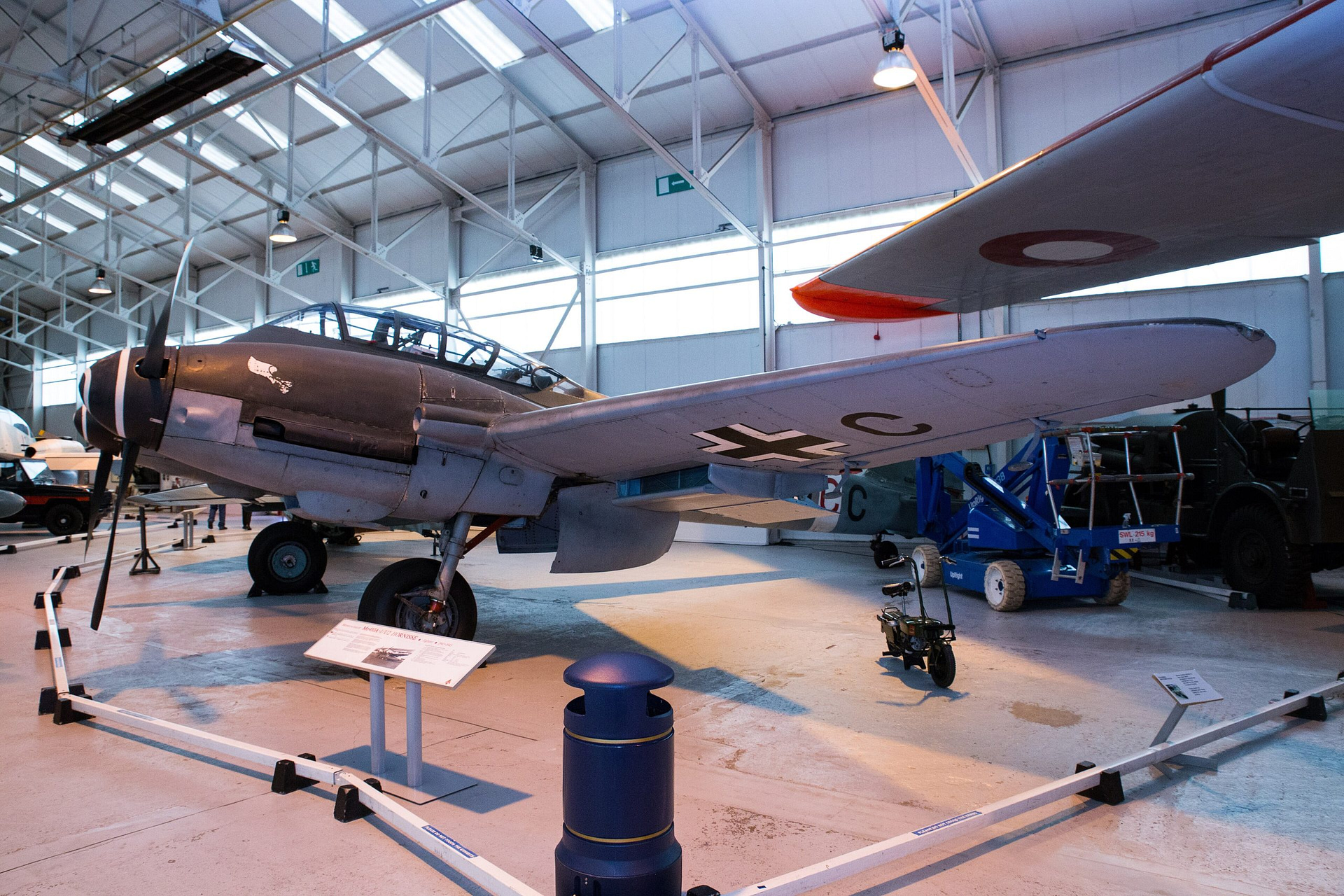
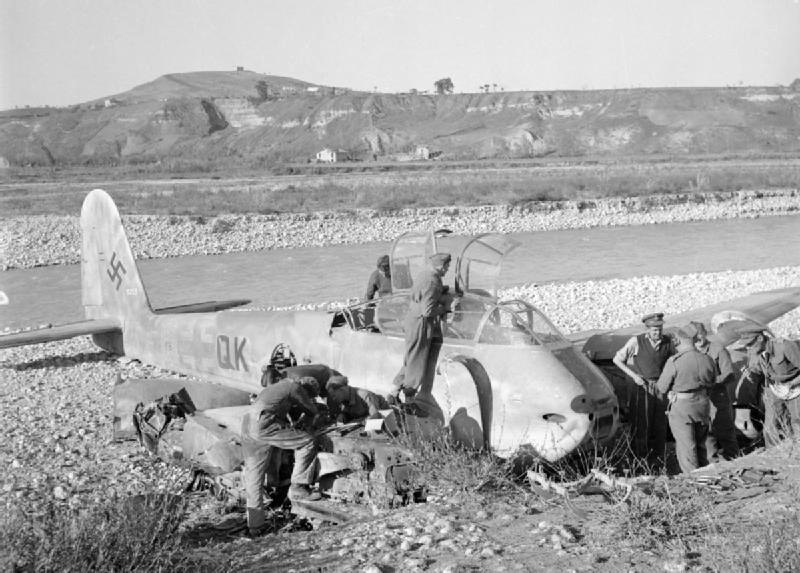
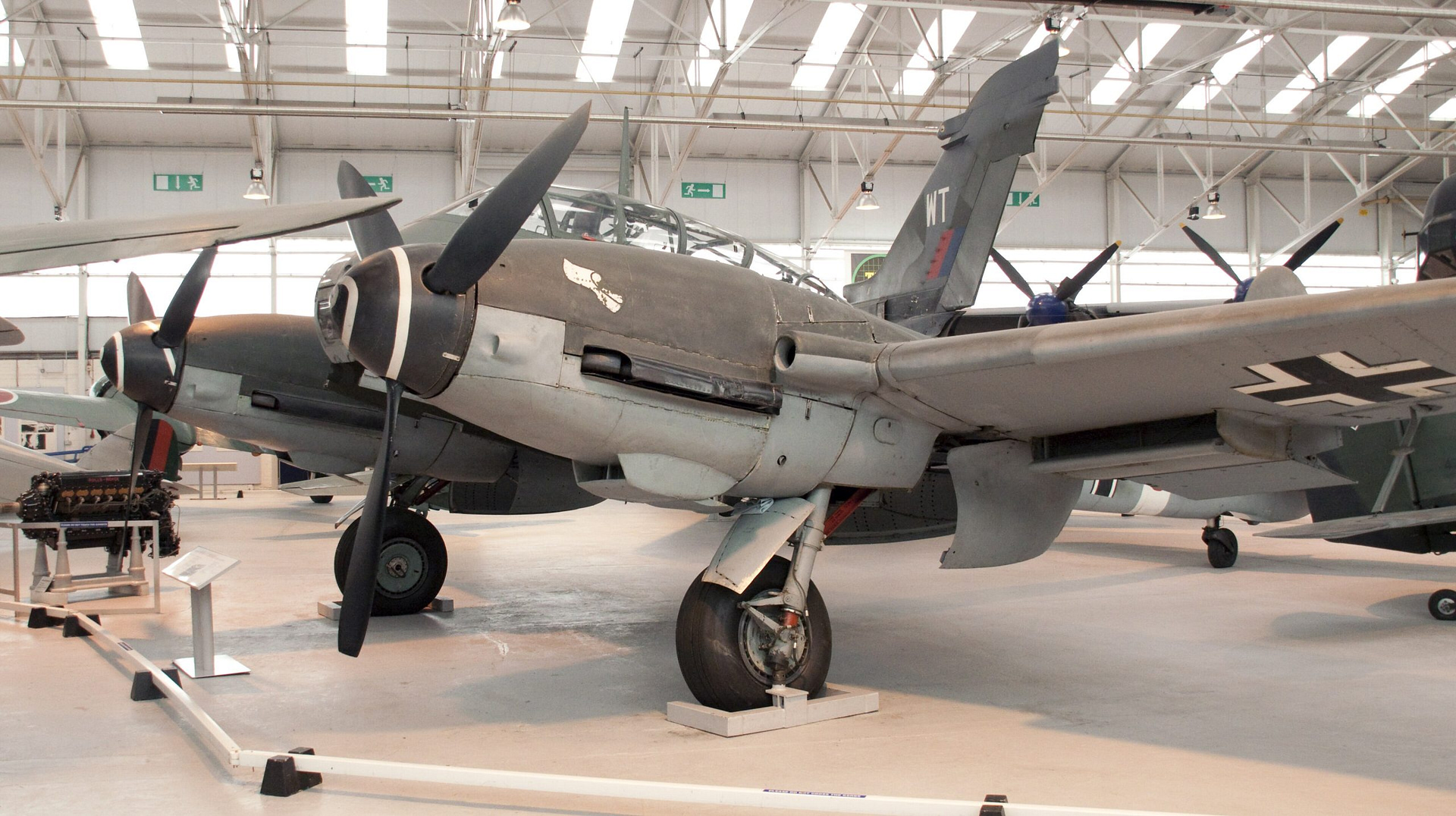
The Me 410 in motion
“Wrecking Tanks with a 50mm Cannon Nose — Me 410 Hornet” by the documentary channel Dark Skies (roughly 530,000 views) — a well-produced look at the Hornisse and its heavy anti-bomber weaponry.
Where the Me 410 flew
A war of fine margins
The Me 410’s record is the story of a good aircraft that arrived in the wrong year. Fast and well-armed, it could hurt bombers badly — but it could not survive the fighters that came with them. Three numbers frame the Hornisse.
Compare the combat record of every military aircraft. Figures are approximate and vary between sources.
Everything people ask about the Me 410
Can I fly in a Messerschmitt Me 410?
Why was the Me 410 a success when the Me 210 failed?
What were the barbettes on the Me 410?
What was the Me 410’s bomber-destroyer role?
How fast was the Me 410 and how far could it fly?
How many were built, and are any left?
Did the Me 410 raid Britain?
You can’t fly the Me 410.
These, you can.
Some legends only live in museums — others are fuelled and waiting. MiGFlug has put civilians in real military jet cockpits since 2004.
 Fly the L-39 AlbatrosThe world’s most-flown jet trainer — aerobatics included
 Fly the F-104 Starfighter“The missile with a man in it”
 Fly the MiG-21The Cold War’s most-produced jet
 Vlieg met de T-33 Shooting StarAmerica’s first jet trainer
 Fly the DH VampireA piece of early jet history
 Fly the S.211Agile Italian jet trainer
 Fly the MB-326The classic Aermacchi jet
 Fly the MiG-15The Soviet legend of the Korean War
Continue the tour
Every fact, checked
- RAF Museum — Messerschmitt Me 410A-1/U2The preserved Hornisse bomber-destroyer at Cosford, with its remote barbettes intact.
- Smithsonian National Air and Space MuseumReference on the Me 410 airframe associated with the US national collection.
- HistoryOfWar.org — Messerschmitt Me 410 HornisseDevelopment from the Me 210, variants, armament and combat record.
- Encyclopaedia BritannicaConcise reference on the Me 410’s design and role as a Zerstörer and fast bomber.
- MilitaryFactory — Me 410 HornisseSpecifications and variant breakdown cross-checked for this page.
- Airfix Workbench — Night intruders over LondonThe Me 410 as a Luftwaffe night intruder during the Baby Blitz of 1944.
- flugzeuginfo.net — Me 410 dataTechnical specifications and dimensions cross-referenced for the specs tables.
- Imperial War MuseumsContext on the Defence of the Reich and the USAAF daylight bombing campaign.