
Messerschmitt Me 410
“Hornisse”
Germany’s twin-engine “Hornet” — the aircraft that redeemed the disastrous Me 210. A fast bomber over Britain, a reconnaissance racer, and a heavily-armed bomber-destroyer that could smash a B-17 — if the escorts let it live.
The redemption of a failure
Every great comeback needs a disaster to come back from. For the Messerschmitt Me 410 Hornisse — “Hornet” — that disaster was its own direct ancestor, the Me 210. Conceived in the late 1930s to replace the Bf 110 as the Luftwaffe’s standard Zerstörer (destroyer), the Me 210 was rushed into production before its flaws were understood, and those flaws were serious: it stalled viciously, dropped into spins, and was so treacherous near the ground that it wrecked airframes and killed crews. The programme became one of the worst industrial embarrassments of the German war effort.
The fallout was severe. Hundreds of near-complete Me 210s piled up, production was halted, and the affair cost the company dearly — contributing to the pressures around Erhard Milch’s aircraft-production regime and, reportedly, to Willy Messerschmitt’s own troubles at the head of the firm that bore his name. On paper the sensible answer was to cancel the whole idea. Instead, engineers went looking for what had actually gone wrong.
The fixes turned out to be surprisingly specific. A lengthened rear fuselage cured much of the instability; automatic leading-edge slats tamed the stall; and a switch to the far more powerful Daimler-Benz DB 603 engines gave the airframe the performance its designers had always promised. The reworked machine flew so much better that it was given a new designation to escape the poisoned reputation of the old one. The Me 210 had been a failure; the Me 410, first flown in 1942, was the same basic aircraft made to work.
And it did work. Fast — roughly 625 km/h — long-legged and steady, the Hornisse became a genuinely useful multi-role aircraft. It raided England as a fast bomber and night intruder during the “Baby Blitz” of early 1944; it ranged deep as a high-speed reconnaissance platform over Britain, the Mediterranean and the Eastern Front; and it fought as a heavily-armed bomber-destroyer in the Defence of the Reich. It even carried an unusual defensive trick: a pair of remotely-controlled barbettes on the fuselage sides, each with a rearward-firing 13 mm gun aimed from inside the aircraft.
But the Hornisse arrived into a sky that was turning against it. As a bomber-destroyer hung with heavy cannon — up to a 50 mm BK 5 in some machines — it could tear a heavy bomber apart, yet all that weight and drag left it slow and clumsy the moment American escort fighters arrived. By 1944 the P-51 Mustang was ranging all the way to Berlin, and the twin-engine Zerstörer, like the Bf 110 before it, became easy prey. Production ended in 1944 after only about 1,160 had been built. The Me 410 was a good aircraft that had finally solved its own worst problems — just as the war left no room for it to matter.
01The Messerschmitt Me 210 disaster: the failure the Me 410 was built to fix
The Me 210 was meant to be a straightforward, better Bf 110: a modern twin-engine Zerstörer with a cleaner airframe, remote defensive guns and more speed. So confident was the Reich Air Ministry that it ordered the aircraft into series production off the drawing board, before flight testing had shown whether it was any good. It was not. Early machines revealed dangerous instability, a savage stall and a tendency to flick into spins, and the accident rate was alarming.
The consequences rippled through the whole programme. Production had to be suspended with large numbers of airframes built or half-built; enormous resources were written off; and the episode became a byword for mismanagement in German aircraft procurement, feeding the friction around Erhard Milch and reportedly damaging Willy Messerschmitt’s own standing within his company. It is remembered as one of the costliest development failures the Luftwaffe suffered.
What saved the concept was that the problems were fixable rather than fundamental. Wind-tunnel work and flight testing traced the worst handling to the aircraft’s short rear fuselage and wing behaviour; lengthening the fuselage and fitting automatic leading-edge slats transformed it. Re-engined with the DB 603, the rehabilitated design was renamed the Me 410 — partly on merit, partly to leave the Me 210’s reputation behind. Figures for exactly how many Me 210s were built, converted or scrapped vary between sources and should be treated as estimates.
What makes it special
A failure re-engineered into a fighter
The Me 410’s defining feature is what was fixed. A lengthened fuselage, automatic leading-edge slats and powerful DB 603 engines cured the Me 210’s deadly handling, turning a notorious failure into a fast, stable, long-range multi-role aircraft — roughly 625 km/h and steady enough to bomb, snoop and hunt.
Remotely-controlled barbettes
On each side of the rear fuselage sat an FDSL barbette housing a single rearward-firing 13 mm MG 131. The gunner aimed them from a sighting station instead of sitting behind the guns — an unusual, forward-looking defensive scheme that let one operator cover the aircraft’s vulnerable rear hemisphere on both sides.
Heavy guns — and a fatal trade-off
As a bomber-destroyer the Me 410 could carry devastating weapons: batteries of 20 mm and 30 mm cannon, underwing rockets, even a 50 mm BK 5. One good hit could wreck a B-17. But the weight and drag of that arsenal made the Hornisse slow and clumsy against nimble escort fighters — deadly to bombers, but easy prey itself.
02The Messerschmitt Me 410’s barbettes: remote-controlled guns that defended the rear
One of the Me 410’s most distinctive features was inherited from the Me 210 and made to work properly: a pair of remotely-operated gun barbettes, one faired into each side of the fuselage behind the cockpit. Each barbette carried a single 13 mm MG 131 machine gun that could traverse to cover the rear hemisphere. Crucially, the second crewman did not sit directly behind the weapons — he aimed and fired them by remote control from a sighting station, tracking an attacker through a periscopic sight while the guns themselves swung to follow.
The idea was clever. It let one man defend both sides of the aircraft, kept the guns in low-drag fairings rather than bulky manned turrets, and gave the gunner a better all-round view than a traditional rear cockpit. Against the Me 410’s worst enemy — a fast fighter diving from behind — the barbettes gave crews at least a fighting chance where the Bf 110’s single hand-held rear gun had often left them helpless. The mechanism was complex and its effectiveness varied, but as an engineering answer to the Zerstörer’s chronic tail vulnerability it was genuinely ahead of its time.
03The Messerschmitt Me 410 as bomber-destroyer: the 50 mm cannon and its fatal weakness
By 1943 the Luftwaffe’s central problem over Germany was the USAAF heavy bomber: massed, armoured, densely armed formations of B-17s and B-24s arriving by day. The Me 410 was pressed into the Zerstörer role against them, and it was armed to kill. Standard machines already carried a heavy nose battery of 20 mm cannon; specialist versions added far heavier weapons still — multiple 20 mm or 30 mm cannon, underwing 21 cm rockets to break up formations, and on the Me 410A-1/U4 a single enormous 50 mm BK 5 cannon adapted from an anti-tank gun. A single well-aimed round from that weapon could destroy a four-engine bomber outright.
The catch was physics. Every rocket rack, cannon and armour plate added weight and drag, and a heavily-armed Me 410 was slow, sluggish and predictable — exactly the wrong thing to be once long-range escort fighters arrived. When P-47 Thunderbolts and especially P-51 Mustangs began escorting the bombers all the way to their targets in 1944, the bomber-destroyers were hunted down before they could reach the bombers at all. The same heavy armament that made the Hornisse lethal to bombers made it a death-trap against fighters. It was, in the end, a weapon that had arrived just after the moment it might have won.
Full specifications
Figures are for the Me 410 A-1, the main production variant. Heavier bomber-destroyer sub-types (such as the A-1/U4 with the 50 mm BK 5) were slower and less agile. Several figures vary between sources and are given as ranges or approximations.
Baseline note: the figures are for the Me 410 A-1, the first production version and the one built in the largest numbers, in the form in which its performance was measured — the A-1/U2 Zerstörer, which is what the standard German technical table describes. The A-1 was a Schnellbomber with an under-nose bomb bay; the /U kits turned that bay into a camera bay, a gun bay or a cannon mount without changing the airframe, so one set of dimensions and one set of engine ratings serve the whole A-series. Weights and speeds here follow Green and Wagner and Nowarra, cross-checked against the German table drawn from Messerschmitt data. Deltas for the heavily armed BK 5 aircraft, for the B-series with MG 131 nose guns and DB 603AA engines, and for the reconnaissance A-3 are given in grey.
Dimensions & weights
- Crew
- 2 (pilot and a rear-facing gunner-observer who also worked the radio and the two remote barbettes)
- Length
- 12.48 m (40 ft 11 in) — against 12.20 m (40 ft 0 in) for the lengthened Me 210 "lang" and roughly 11.3 m for the original short-tailed Me 210
- Wingspan
- 16.35 m (53 ft 8 in); the projected high-altitude Me 410 C would have gone to 18.25 m or 20.45 m (59 ft 11 in or 67 ft 1 in)
- Height
- 4.28 m (14 ft 0 in)
- Wing area
- 36.20 m² (390 sq ft), aspect ratio 7.4
- Wing sweep
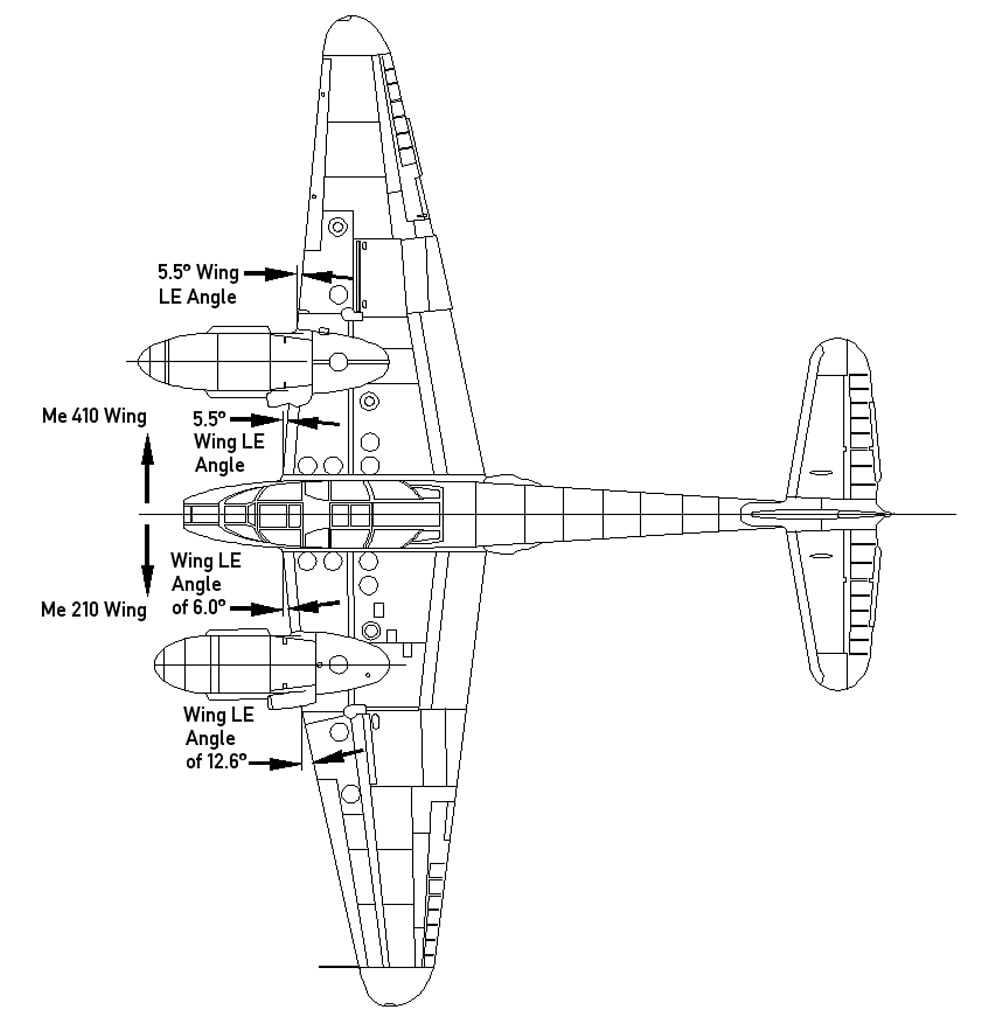
- 5.5° at the leading edge, inner and outer panels alike. On the Me 210 the outer panels swept 12.6° against 6.0° inboard, putting the aerodynamic centre too far aft; this single change is most of why the Me 410 flew and the Me 210 did not
- Empty weight
- 7,518 kg (16,574 lb); the Me 210 Ca-1 was 7,069 kg (15,585 lb)
- Loaded weight
- 9,651 kg (21,276 lb); the Me 410 added about 680 kg (1,500 lb) to the Me 210 design, and the DB 603 more than paid for it
- Wing loading
- 267 kg/m² (54.6 lb/sq ft) — roughly twice a Bf 109G’s, and the arithmetic behind every account of the Me 410 being unable to turn with a single-engined fighter
- Power loading
- 2.76 kg/PS (6.1 lb/hp)
- Internal fuel
- ~2,500 litres (550 imp gal, 660 US gal) in four wing tanks. The B-5 torpedo project deleted the barbettes for a further 700 litres and the bomb bay for another 650
- Disposable load
- Up to 1,000 kg (2,205 lb) of stores: an under-nose bomb bay plus underwing shackles for four 50 kg (110 lb) bombs, which were added only because the DB 603 gave more lift than the bay could hold
Performance
- Maximum speed, sea level
- 507 km/h (315 mph)
- Maximum speed, altitude
- 624 km/h at 6,700 m (388 mph at 21,980 ft)
- Maximum speed, 8,000 m
- 600 km/h (373 mph at 26,250 ft)
- Cruising speed
- 587 km/h (365 mph) — genuinely fast for a 1943 twin, and the whole basis of the Schnellbomber idea
- Speed with the BK 5 fitted
- Materially lower. The 50 mm gun and its magazine added 540 kg (1,190 lb) under the nose; with four WGr 21 tubes as well, the drag and weight together removed most of the margin the Me 410 had over a Bf 110
- Rate of climb
- 650 m/min (2,133 ft/min)
- Time to altitude
- 10 minutes 42 seconds to 7,000 m (22,970 ft); English-language tables usually attach the same figure to 6,000 m, which appears to be a transcription slip — the German source says 7,000
- Service ceiling
- 10,000 m (32,810 ft)
- Range
- 1,200 km at maximum continuous cruise (746 miles); 1,690 km (1,050 miles) at economical cruise
- Ferry range
- 2,300 km (1,429 miles)
- Endurance
- 3 hours 30 minutes
- Turning performance
- Worse than the Bf 110 it was meant to replace, and not remotely comparable to a P-51B or a Spitfire IX. The Me 410 was stable, fast in a straight line and pleasant to fly; none of that helps in a turning fight at 7,000 m
Propulsion & systems
- Engines
- 2 × Daimler-Benz DB 603A, inverted V12, liquid-cooled, 44.5 litres (2,716 cu in) each — against the 35.7-litre DB 605 of the Me 210C. The extra displacement is the second reason the Me 410 worked
- Power
- 1,750 PS (1,290 kW, 1,726 hp) each for take-off; 1,850 PS at 2,100 m, 1,625 PS at 5,700 m, 1,580 PS continuous. The 1,900 hp DB 603G planned for the B-series was cancelled in early 1944, so every Me 410 B flew on the 603A or the better-supercharged 603AA
- Propellers
- VDM three-blade constant-speed
- Defensive armament system
- Two FDSL 131/1B ferngerichtete Drehringseitenlafetten, half-teardrop remote barbettes flush in the fuselage sides, each with one 13 mm MG 131 firing rearward. Both elevated together on the gunner’s pistol-grip sighting unit and traversed separately outboard; an electrical contact breaker stopped the guns firing into the tailplane
- Sights
- Revi C 12/C reflector sight for the pilot. A telescopic sight was added for BK 5 aircraft to allow shots from beyond 900 m; in practice its narrow field lost a manoeuvring target instantly and crews reverted to the Revi
- Radar
- None as standard. The projected B-5 and B-6 anti-shipping variants carried FuG 200 Hohentwiel 550 MHz search radar in place of the nose guns; night-intruder Me 410s over England relied on ground control and the dark
- Airframe origin
- The first 460 production aircraft, prototypes excluded, were assembled from Me 210 sub-assemblies already built or on order — the direct reason the Me 410 existed at all, since about 370 Me 210s were part-built and material for 800 more was standing in the works
- First flight
- 14 March 1942 for the aircraft usually cited as the Me 410 prototype; the Me 410 V1 as such was one of six Me 210As taken off the line in late 1942 and converted, flying near the end of that year. The two dates are both defensible because the "prototype" was a modification standard, not a new airframe
- Service entry
- Deliveries began January 1943 — two years later than the Bf 110 replacement was wanted, and about a year after the point at which a heavy twin could still operate over Germany in daylight
- Production
- 1,189 built to September 1944 by Messerschmitt at Augsburg and Dornier at Munich, per the Bundesarchiv-Militararchiv returns, which break down as 18 prototypes, 394 A-1, 6 A-1/U1, 277 A-1/U2, 74 A-3, 61 B-1, 165 B-2, 48 B-2/U2, 111 B-2/U4 and 35 B-3. The commonly printed figure of 1,160 comes from Smith and Kay and excludes some prototypes and conversions
- End of production
- Cancelled in August 1944, the month after the Jägernotprogramm, to free capacity for Bf 109Gs. Surviving Me 410s spent the last months of the war flying reconnaissance
04The Messerschmitt Me 410’s cost: why no reliable price exists
The Me 410 was a product of the wartime German state economy, built to state contracts and never sold on any open market, so a firm flyaway unit price in modern terms does not exist in the public record. Contemporary figures were quoted in Reichsmark and are hard to convert meaningfully across eight decades of inflation, currency reform and a command economy. There is likewise no reliable cost-per-flight-hour figure, and there never can be a modern operating cost, because no Me 410 is airworthy. Any precise dollar price attached to a Me 410 today should be treated as an estimate, not a sourced fact.
Armament & payload
The Me 410 carried the heaviest gun ever fitted to a German fighter and two rear-firing barbettes that actually worked
The Me 410’s armament is more interesting than its combat record. The nose battery of two 20 mm MG 151/20 and two 7.92 mm MG 17 was conventional. What was not conventional was the bomb bay under the nose, which the Luftwaffe treated as a socket: cameras went in it, or a second pair of MG 151/20, or two 30 mm MK 103, or a 50 mm anti-tank gun off a Panzer III. And what was genuinely novel was the defence — two remotely operated barbettes in the fuselage sides, aimed by the gunner through a single pistol grip, giving rearward fire without a turret, without the drag of a turret and without asking a man to sit in a slipstream. Allied pilots who attacked Me 410s from astern found the arrangement unpleasantly effective. Almost every Me 410 was a kit-built variation on this theme, so any statement about "the Me 410’s armament" is really a statement about one Umrüst-Bausatz.
Gun
- 2 × 20 mm MG 151/20 in the nose, 350 rounds per gun, and 2 × 7.92 mm MG 17 in the nose, 1,000 rounds per gun. On the B-series the MG 17s were replaced by 2 × 13 mm MG 131 with 500 rounds per gun.
- 2 × 13 mm MG 131 rearward, one in each FDSL 131/1B barbette, 500 rounds per gun. Remote, electrically fired, and the only part of the Me 210 inheritance that had always worked well.
- WB 151A bomb-bay pack: 2 × additional 20 mm MG 151/20 with 250 rounds per gun. Fitted as the /U2 kit, jettisonable, and by common consent the most useful anti-bomber fit the Me 410 ever had — four 20 mm and two heavy machine guns forward.
- 2 × 30 mm MK 103 in the bay as the /U1 kit on the B-2. The A-2 Zerstörer was to have carried this as standard and was cancelled because the mounting was not ready.
- 50 mm BK 5 as the /U4 kit: the 5 cm KwK 39 L/60 tank gun adapted by Rheinmetall, 540 kg, 21 rounds in a semi-circular magazine plus one chambered, 40–45 rounds per minute. About 300 were made.
Air-to-air
- No guided air-to-air weapon existed. The Me 410’s answer to the B-17 was reach: fire a 50 mm shell from beyond 900 m, outside the 1,000-yard envelope of the bombers’ defensive .50s.
- Against unescorted formations this worked. II./ZG 26 flew a run of successful interceptions in the spring of 1944, and on 11 April 1944 its Me 410s brought down ten B-17s on a first sortie without loss.
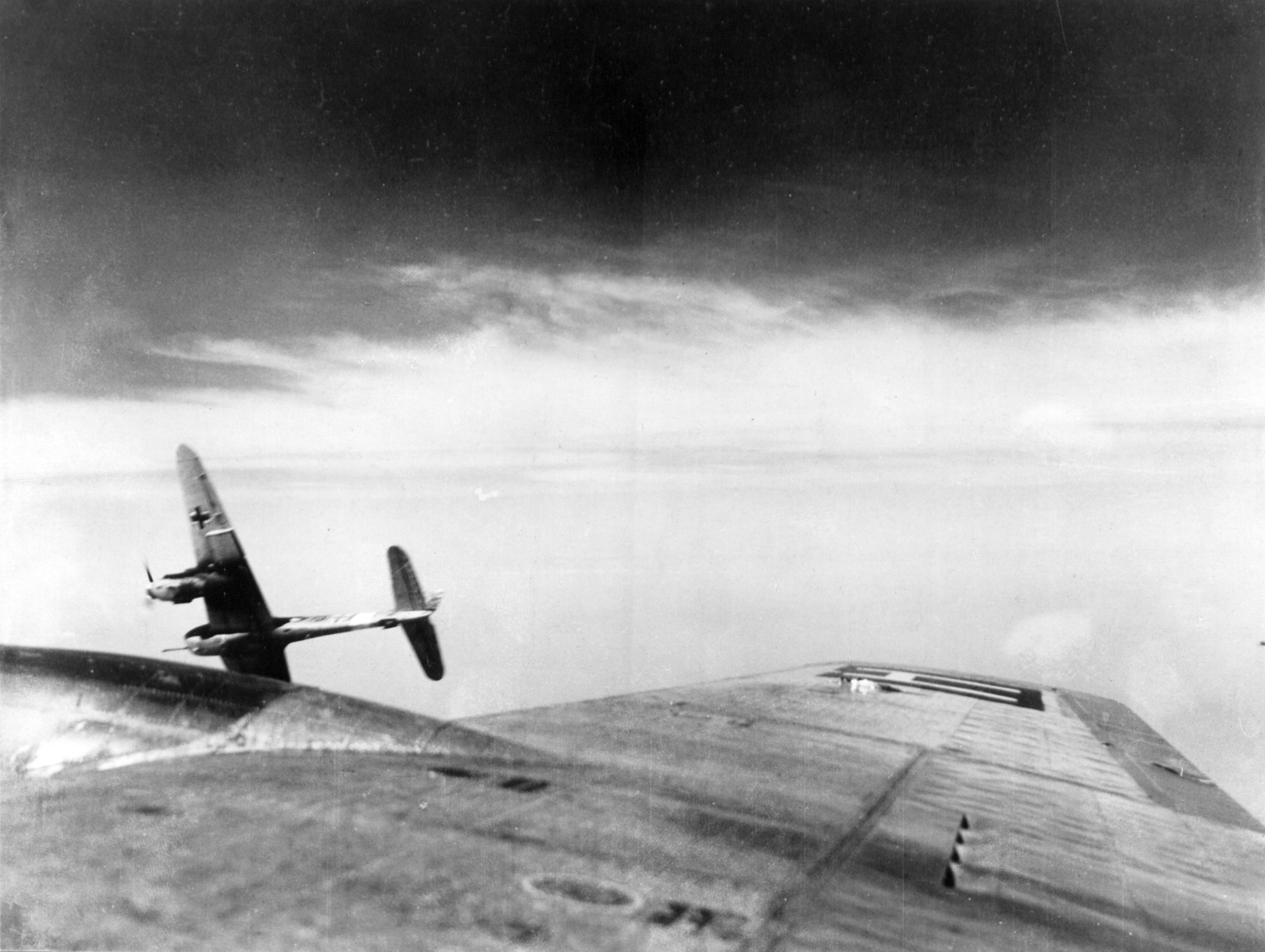
- On the second sortie that day, P-51s destroyed eight Me 410s and three Bf 110s and killed sixteen crewmen. That is the Me 410’s war in a single afternoon.
- The BK 5 was the trap. A 540 kg gun with 21 rounds firing at 40 rounds a minute is a bomber-killer and nothing else; the moment escorts arrived, the aircraft carrying it was a target that could neither turn nor shoot back forward with any effect.
- A widely repeated claim credits 53 BK 5-armed Me 410s of II./ZG 26 with 129 B-17s and four B-24s over five or six interceptions in early 1944 for nine losses. Treat it as an unverified claim total: overclaiming in mass bomber interceptions ran high on every side.
Air-to-surface guided
- None carried. Germany had guided anti-ship weapons in service from 1943 — the Fritz X glide bomb and the Hs 293 rocket-boosted missile — but they went to the Do 217, He 177 and Fw 200, not to the Me 410.
- The Me 410 B-5 was to have carried an unguided torpedo on fuselage shackles with FuG 200 radar to find the target. It never entered production.
- The B-6 was the short-range version of the same anti-shipping idea, radar but no torpedo, for coastal defence. Also not built in series.
- For everything else the Me 410 aimed through a reflector sight in a shallow dive, exactly as the Bf 110 had done in 1940.
Bombs
- Internal bay under the nose, inherited from the Me 210: normally 2 × 500 kg (1,102 lb) or eight 50 kg, carried without the drag penalty that had slowed the externally loaded Bf 110.
- Underwing shackles for 4 × 50 kg (110 lb), added on the Me 410 because the DB 603s could lift more than the bay would take.
- Up to 1,000 kg (2,205 lb) of disposable stores in total, per the Rechlin trials report.
- This was the load flown against London in Unternehmen Steinbock in the first months of 1944, by V./KG 2 with 27 aircraft and I./KG 51 with 37. As a fast night bomber the Me 410 was a genuinely hard target for RAF night fighters, and it took a Mosquito of No. 85 Squadron to get the first one, on the night of 13–14 July 1943.
Rockets
- 4 × 21 cm (8.3 in) Werfer-Granate 21 in tubular underwing launchers, two under each wing panel — the twin-engined Zerstörer allowance, against one per wing on single-seaters.
- A spin-stabilised adaptation of the 21 cm Nebelwerfer 42 barrage rocket: 40.8 kg (90 lb) warhead, 320 m/s, maximum useful range 1,200 m, time fuze set to burst between 600 and 1,200 m with a lethal radius of roughly 30 m.
- The point was not accuracy — a Staffel salvo scored perhaps 15 per cent — but to blow a combat box apart so that cannon-armed fighters could work on stragglers.
- The tubes had to be angled about 15° up to offset the rocket’s ballistic drop, which cost drag and speed. They were jettisonable, which the fixed underwing gun pods on Fw 190s were not, so an Me 410 could at least become clean again after firing.
Pods & other stores
- /U1: Rb-series cameras in the bomb bay for improvised reconnaissance, six aircraft only. /U2: the WB 151A twin 20 mm gun pack, the most-built kit of all with 277 A-1/U2 and 48 B-2/U2. /U4: the BK 5, fitted to A-1s as conversions and built new into 111 B-2/U4.
- The A-3 and B-3 were not kits but purpose-built reconnaissance airframes with a deepened fuselage for a larger camera fit and more fuel — 74 and 35 built. They equipped long-range Aufklärungsstaffeln on both fronts and outlived the fighter role.
- FuG 200 Hohentwiel maritime search radar on the projected B-5 and B-6.
- The Me 410 D would have replaced parts of the outer wing with wood to save light alloy. The scheme failed with the rest of German wartime wooden construction when the RAF bombed the Goldschmitt Tego-film plant at Wuppertal and the substitute adhesives turned out to be corrosive.
- No drop tanks in normal service: the Me 410 had ~2,500 litres internal and the range problem was never fuel, it was survivability.
Three typical loadouts
- Night intruder, Steinbock, January–May 1944
- A-1 with two 500 kg bombs in the under-nose bay, nose guns loaded, barbettes manned. Fast, low and hard to intercept; the Me 410 was one of the few German bombers of the last phase that RAF night defences found genuinely difficult. It is also the role in which the type did most of what it actually achieved, and the one nobody remembers.
- Bomber destroyer, Defence of the Reich, spring 1944
- A-1/U4 with the 50 mm BK 5 and 21 rounds, plus four WGr 21 tubes and the two nose MG 151/20. Devastating against a B-17 at 900 m and helpless against the P-51s now sweeping ahead of the boxes. On 6 March 1944, over Berlin, sixteen Me 410s were shot down for eight B-17s and four P-51s — and the Mustangs were downed by the Bf 109s and Fw 190s escorting the Me 410s, not by the Me 410s themselves.
- Long-range reconnaissance, 1944–45
- A-3 with the deepened fuselage, Rb 50/30 and Rb 75/30 cameras, extra fuel, guns retained. When the Me 410 was pulled out of Defence of the Reich from mid-1944 in favour of heavily armed single-engined Sturmböcke, this was the only job left — and the aircraft’s speed, ceiling and endurance suited it better than they ever suited combat.
Sourcing caveat: the /U kit designations are a mess in the literature. The Me 410 A-2 was allotted for the MK 103 Zerstörer and, on the German production returns drawn from the Bundesarchiv, was never built; the BK 5 aircraft were A-1/U4 conversions and 111 new-built B-2/U4. The widely printed designation "Me 410 A-2/U4" therefore describes an aeroplane that did not exist as a production type, and it appears in this article’s sources only because it has been copied forward for eighty years. Where English and German accounts differ on production totals, the Bundesarchiv breakdown has been preferred.
Variants
The Me 410 was the repair bill for the Me 210, one of the worst procurement decisions the Luftwaffe ever made
Messerschmitt began work on a Bf 110 successor in 1937, before the Bf 110 itself had entered service. Confidence in the resulting Me 210 was so high that the RLM ordered 1,000 of them off the drawing board, before the prototype flew. The prototype flew on 2 September 1939 and was immediately judged unsafe. It snaked in level flight, it was unstable in turns, and it stalled viciously into spins when the leading-edge slats opened at high angles of attack; the second prototype was lost that way in September 1940. The chief test pilot said it had "all the least desirable attributes an aeroplane could possess". Sixteen prototypes and ninety-four pre-production machines failed to fix it.
Production was ordered anyway in early 1941, deliveries began in April 1942, and on 14 April 1942 the line was stopped after 90 German-built aircraft, with 325 completed in total, 370 more part-built and material for 800 standing in the works. The Bf 110 had to be put back into production. The Me 210 is the reason the Luftwaffe fought the second half of the war with a heavy fighter designed in 1936.
The Me 410 was the least ambitious of the proposed fixes — the pressurised, re-engined Me 310 was rejected as too radical — and it did three things: lengthened the fuselage, restoring a length the Me 210 had lost to material economies; re-profiled the outer wing panels to the same 5.5° sweep as the inner ones, bringing the aerodynamic centre forward; and refitted automatic leading-edge slats, which had been deleted from the Me 210 because they made a fundamentally unstable aeroplane worse. On a stable aeroplane they were an asset. The result was competent, fast, well armed and well liked by its crews. It was also two years late, and by 1943 a 9.6-tonne twin over Germany in daylight was simply a slower target.
- Me 210 A-1 and A-2 (1941–April 1942, 90 delivered of 325 built)
- The disaster. Fighter-bomber and dive-bomber versions on DB 601F engines, with the internal nose bomb bay, the FDSL 131 barbettes and the fatal wing planform. Deliveries to front-line units in April 1942 made the type even less popular; production was stopped at the end of the month and 320 part-built airframes went into store.
- Me 210 C and Ca-1 (1942–March 1944, 267 built in Hungary)
- DB 605 engines and the lengthened "lang" rear fuselage. The Hungarians, alone, were satisfied with it: Dunái Repülőgépgyár built 267 under licence, of which the Luftwaffe took 108 under a two-in-three agreement, and the Royal Hungarian Air Force flew 179 with some success against Soviet aircraft. Some were fitted with a 40 mm Bofors in the lower fuselage for bomber interception.
- Me 310 and the Me 410 V-series (1942, project and 18 prototypes)
- The Me 310 was the ambitious fix — pressurised cockpit, high-altitude airframe, and the first use of the DB 603 in the family — and it was rejected as too radical, though the engine choice that saved the design came from it. What officials wanted instead became the Me 410 V-series: eighteen prototypes converted from Me 210 airframes and sub-assemblies. This time the RLM saw the aircraft fly before ordering production.
- Me 410 A-1 (January 1943–1944, 394 built)
- The Schnellbomber: two MG 151/20 and two MG 17 in the nose, two MG 131 in the barbettes, bomb bay under the nose, underwing shackles. 260 came from Me 210 sub-assemblies and 134 were new-build from February 1944. A great many were later converted to reconnaissance or Zerstörer standard, so probably fewer than 300 ever flew as fast bombers.
- Me 410 A-1/U2 (1943–1944, 277 built)
- The bay filled with the WB 151A pack of two more 20 mm MG 151/20. Four cannon and two machine guns forward, no great weight penalty, and the fit that III./ZG 1, ZG 26 and ZG 76 did most of their bomber-destroying with. The most numerous single Me 410 sub-type.
- Me 410 A-1/U4 and B-2/U4 (1944, conversions plus 111 new-built)
- The 50 mm BK 5. Hitler is on record as calling the Me 410 his favourite bomber destroyer, and this was the version he meant. Against B-17s beyond gun range it was formidable; against escorts it was a 9.6-tonne aeroplane carrying half a tonne of dead weight under its nose. Jamming, 21 rounds and 40 rounds per minute completed the case against it.
- Me 410 A-2 (1943, allotted but not built)
- The proper Zerstörer, with two 30 mm MK 103 in the bay. The mounting was not ready in time and the designation was quietly abandoned; the MK 103 pair finally appeared as the B-2/U1 kit in 1944. Its ghost survives in the many books that describe a "Me 410 A-2/U4".
- Me 410 A-3 and B-3 (November 1943–1944, 74 and 35 built)
- Purpose-built long-range reconnaissance aircraft with a deepened fuselage for cameras and fuel. Three Aufklärungsstaffeln flew them from early 1944, one Gruppe in the west and two in the east, and this was the last role the type held when it was withdrawn from Defence of the Reich in mid-1944.
- Me 410 B-1, B-2 and B-2/U2 (April 1944–August 1944, 61, 165 and 48 built)
- The second production series, differing chiefly in 13 mm MG 131 nose guns in place of the MG 17s. The intended 1,900 hp DB 603G was cancelled, so the B flew on the same engines as the A — a fair summary of German aero-engine development in 1944.
- Me 410 B-5 to B-8, C and D (1944, projects and prototypes)
- B-5 torpedo bomber and B-6 coastal anti-shipping aircraft with FuG 200 radar; B-7 and B-8 reconnaissance, prototypes only; the C, a high-altitude version with 18.25 m or 20.45 m wings and interchangeable turbocharged DB 603JZ, BMW 801J or Jumo 213E power eggs; the D, a simpler high-altitude B with partly wooden outer wings. None reached service, and the Me 510 remained a paper designation.
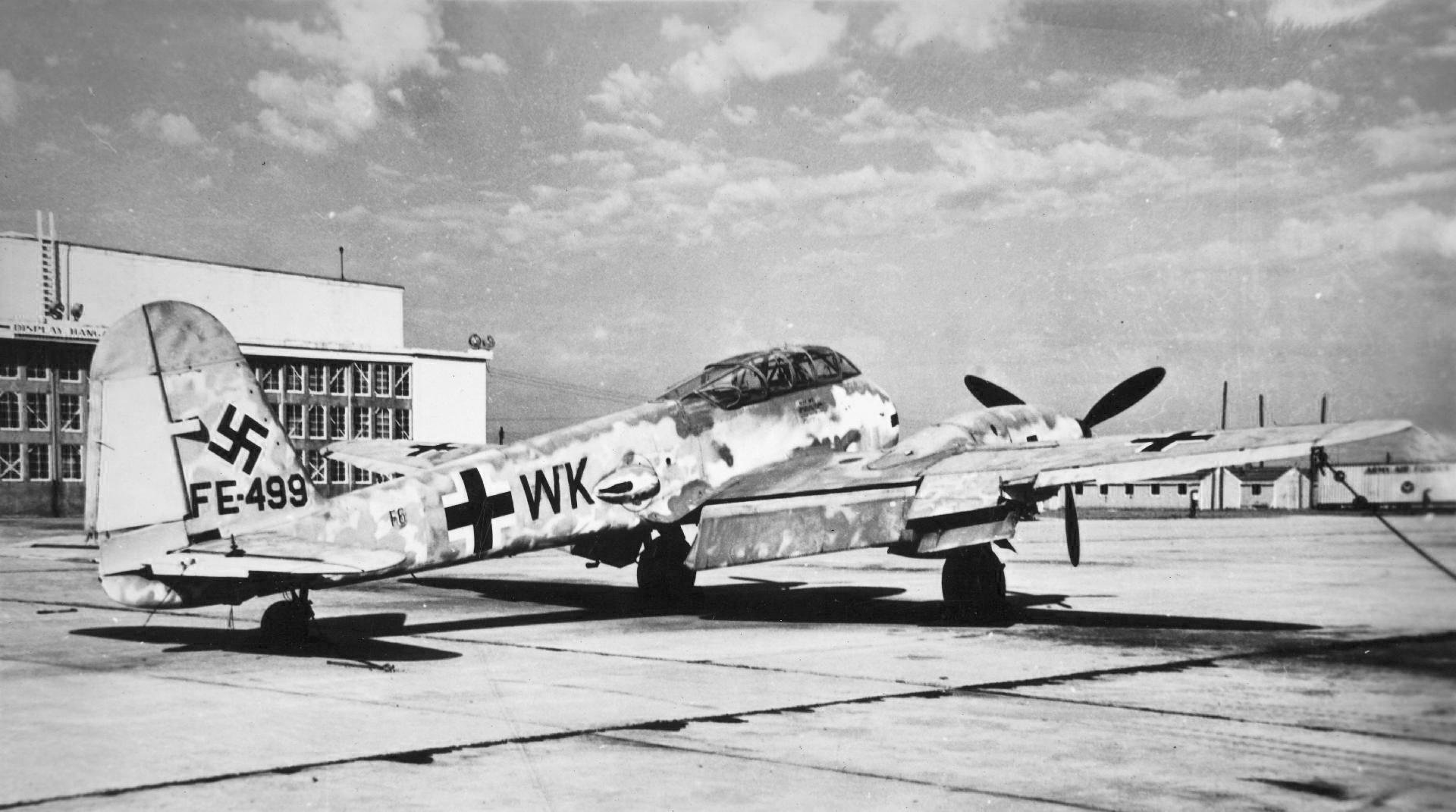
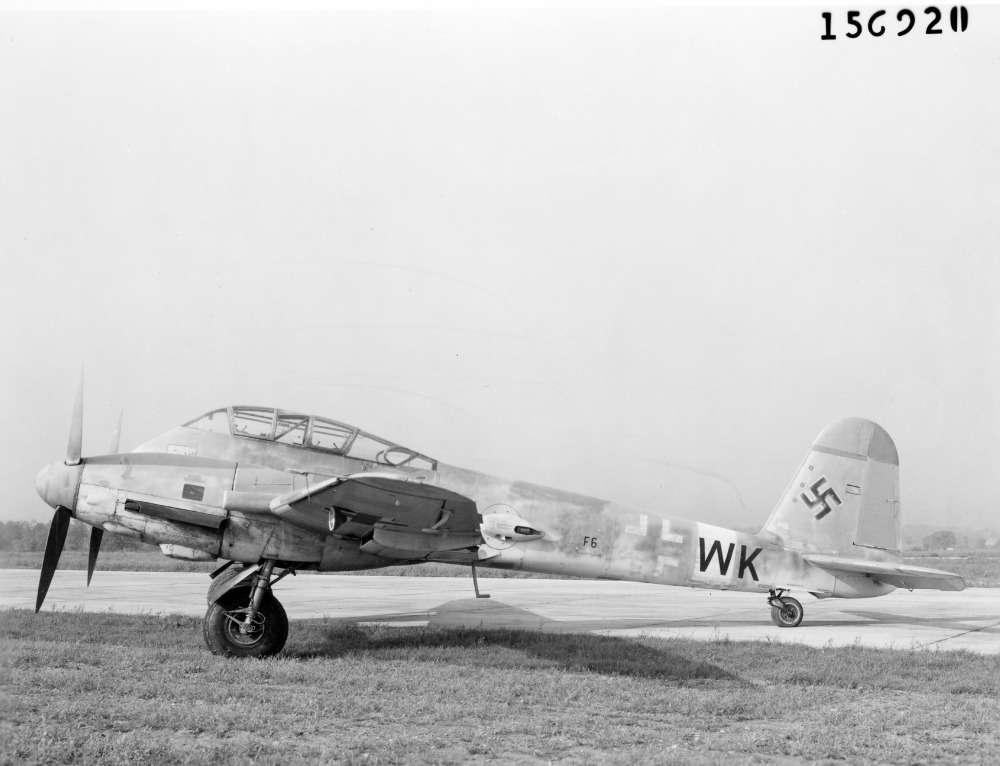
Closing caveat on survivors: two original Me 410s exist and neither is airworthy. W.Nr. 420430, an A-1/U2 built at Augsburg in late 1943 with evidence of service with ZG 26, was surrendered at Værløse in Denmark in May 1945 and flown to Farnborough on 13 October 1945. It was one of six taken to Britain for evaluation and the only one not scrapped; it was restored in 1986, when both DB 603s were successfully run on the ground, and it has been at the Royal Air Force Museum Midlands at Cosford since 1989. It is a complete, original, unrestored-to-flight aeroplane and the best Me 410 anyone will see. The second, W.Nr. 10018, is an A-1/U1 built from Me 210 sub-assemblies — often miscatalogued as an A-3 or A-2/U1 — found intact at Trapani in Sicily in August 1943 in the markings of 2.(F)/FAGr 122, shipped to the United States in 1944 as FE499, and now held by the National Air and Space Museum at the Paul E. Garber facility in Suitland, Maryland, awaiting restoration. No Me 210 of German manufacture is known to survive. Nothing of the family flies.
From disaster to Hornisse to obsolescence
The Zerstörer successor
The Luftwaffe seeks a modern replacement for the Bf 110; Messerschmitt develops the Me 210 with remote defensive guns and a cleaner airframe.
The Me 210 disaster
Ordered into production before proper testing, the Me 210 proves dangerously unstable; production is halted and the programme becomes a costly embarrassment.
The Me 410 flies
A lengthened fuselage, automatic slats and DB 603 engines fix the handling; the rehabilitated design is renamed the Me 410 Hornisse.
Into service
The Me 410 enters Luftwaffe service as a fast bomber, reconnaissance aircraft and Zerstörer across the Mediterranean, the Eastern Front and the West.
Baby Blitz over Britain
Me 410 fast bombers and night intruders raid England during Operation Steinbock, the “Baby Blitz,” using speed to slip in and out.
Bomber-destroyer
Heavily-armed Me 410s, some with the 50 mm BK 5, attack USAAF daylight formations in the Defence of the Reich — effective against bombers, deadly-vulnerable to escorts.
Production ends
With escort fighters dominating, the twin-engine Zerstörer concept collapses; Me 410 production stops after roughly 1,160 aircraft.
Two survivors
No Me 410 is airworthy; a Me 410A-1/U2 is preserved at the RAF Museum Cosford and an airframe is associated with the Smithsonian.
From the war: twelve Me 410 stories
The idea that killed its predecessor
The Me 410 exists because the Me 210 nearly killed the whole programme.
Read the full story
Three changes that saved a design
A longer tail, new slats and bigger engines turned a killer into a keeper.
Read the full story
Guns without a gunner behind them
Two remote barbettes let one man defend both flanks of the aircraft.
Read the full story
Fast bombers over England
In early 1944 Hornissen slipped across the Channel to bomb Britain by night.
Read the full story
The racer that outran its hunters
Stripped and fast, a recon Me 410 could show interceptors a clean pair of heels.
Read the full story
Hunting the heavy bombers
Against B-17 formations the Me 410 was a flying gun platform.
Read the full story
A field gun in the nose
One version carried a 50 mm cannon meant to kill a bomber with a single round.
Read the full story
When the escorts came
The arrival of the Mustang turned the bomber-destroyer into the destroyed.
Read the full story
Sand, sea and Sangro
Over Italy and the Mediterranean the Hornisse flew recon and strike work.
Read the full story
The man who aimed backwards
The Hornisse’s second crewman fought a very different war from the pilot.
Read the full story
Only about eleven hundred
For all its qualities, the Me 410 was never built in decisive numbers.
Read the full story
Two left in the world
Of more than a thousand built, only a couple of Me 410s survive intact.
Read the full story
The Me 410 in pictures
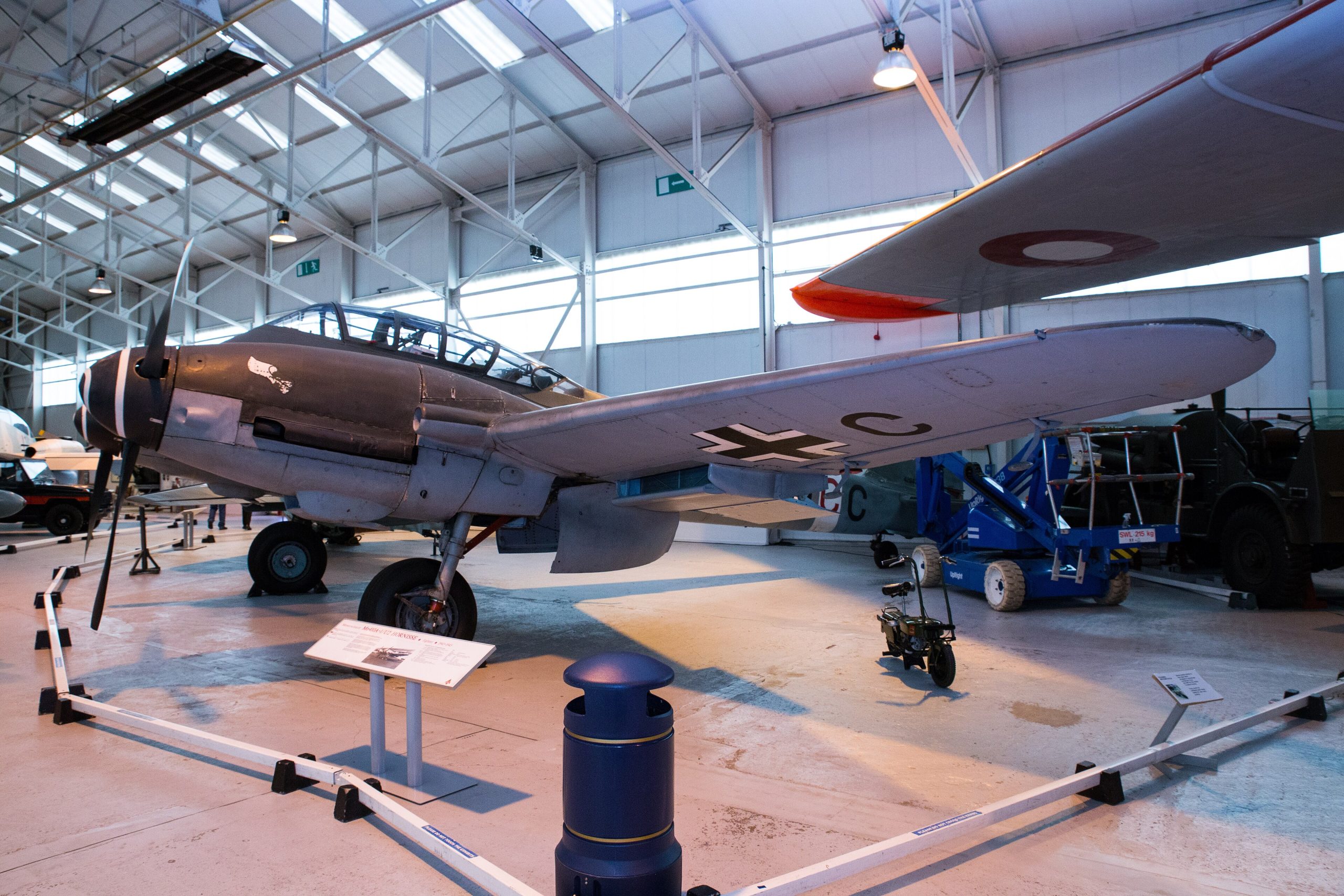
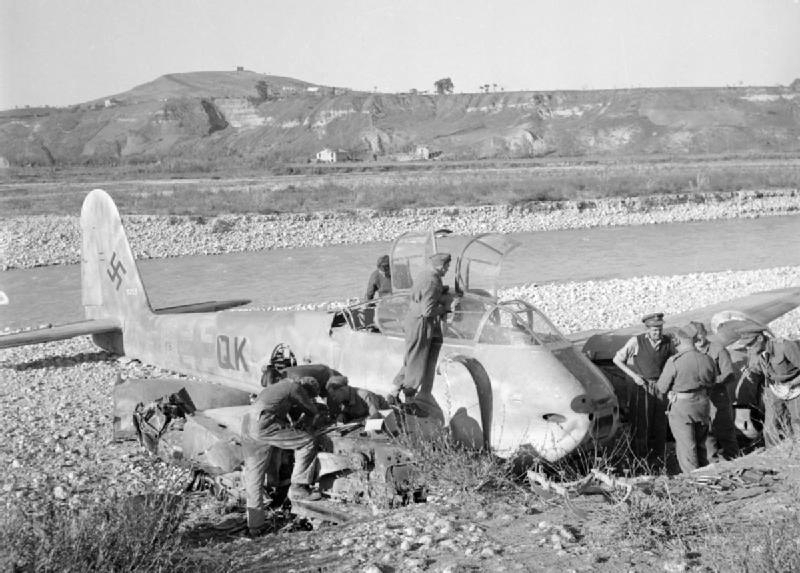
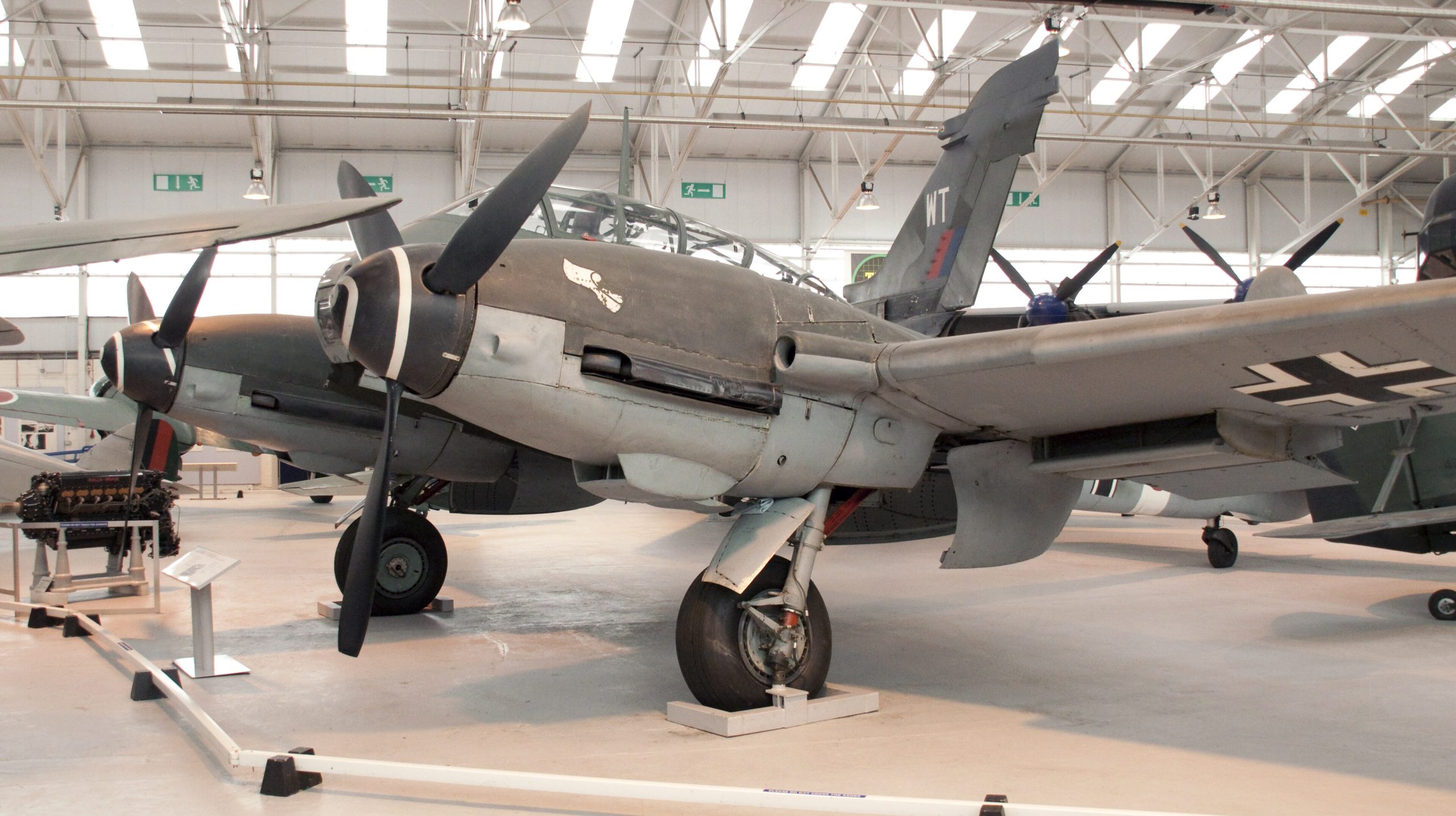
The Me 410 in motion
“Wrecking Tanks with a 50mm Cannon Nose — Me 410 Hornet” by the documentary channel Dark Skies (roughly 530,000 views) — a well-produced look at the Hornisse and its heavy anti-bomber weaponry.
Where the Me 410 flew
A war of fine margins
The Me 410’s record is the story of a good aircraft that arrived in the wrong year. Fast and well-armed, it could hurt bombers badly — but it could not survive the fighters that came with them. Three numbers frame the Hornisse.
Compare the combat record of every military aircraft. Figures are approximate and vary between sources.
Everything people ask about the Me 410
Can I fly in a Messerschmitt Me 410?
Why was the Me 410 a success when the Me 210 failed?
What were the barbettes on the Me 410?
What was the Me 410’s bomber-destroyer role?
How fast was the Me 410 and how far could it fly?
How many were built, and are any left?
Did the Me 410 raid Britain?
You can’t fly the Me 410.
These, you can.
Some legends only live in museums — others are fuelled and waiting. MiGFlug has put civilians in real military jet cockpits since 2004.
 Fly the L-39 AlbatrosThe world’s most-flown jet trainer — aerobatics included
 Fly the F-104 Starfighter“The missile with a man in it”
 Fly the MiG-21The Cold War’s most-produced jet
 Fly the T-33 Shooting StarAmerica’s first jet trainer
 Fly the DH VampireA piece of early jet history
 Fly the S.211Agile Italian jet trainer
 Fly the MB-326The classic Aermacchi jet
 Fly the MiG-15The Soviet legend of the Korean War
Continue the tour
Every fact, checked
- RAF Museum — Messerschmitt Me 410A-1/U2The preserved Hornisse bomber-destroyer at Cosford, with its remote barbettes intact.
- Smithsonian National Air and Space MuseumReference on the Me 410 airframe associated with the US national collection.
- HistoryOfWar.org — Messerschmitt Me 410 HornisseDevelopment from the Me 210, variants, armament and combat record.
- Encyclopaedia BritannicaConcise reference on the Me 410’s design and role as a Zerstörer and fast bomber.
- MilitaryFactory — Me 410 HornisseSpecifications and variant breakdown cross-checked for this page.
- Airfix Workbench — Night intruders over LondonThe Me 410 as a Luftwaffe night intruder during the Baby Blitz of 1944.
- flugzeuginfo.net — Me 410 dataTechnical specifications and dimensions cross-referenced for the specs tables.
- Imperial War MuseumsContext on the Defence of the Reich and the USAAF daylight bombing campaign.