
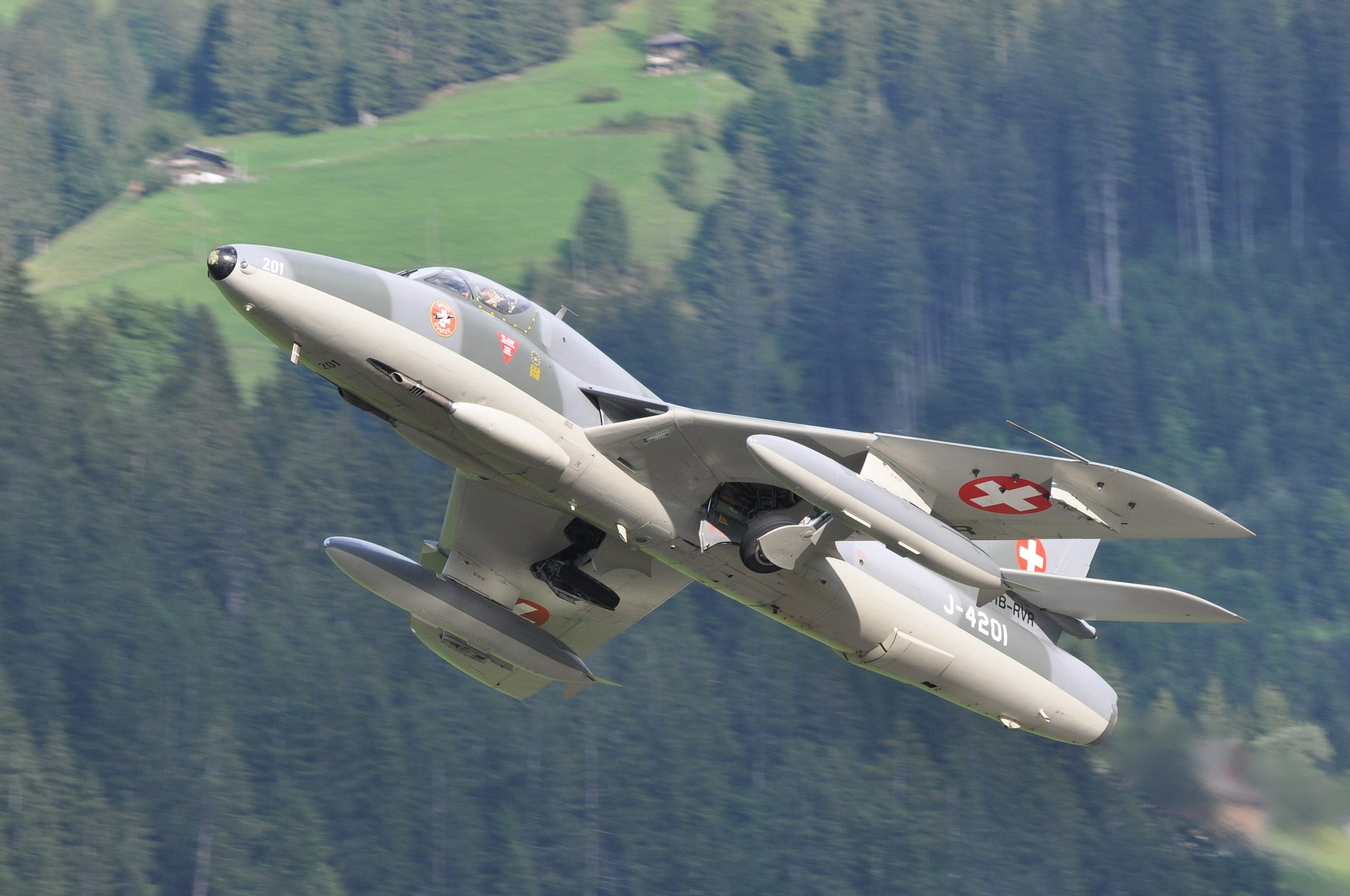
Straatverkoper Jager
Camm’s transonic masterpiece
Sydney Camm’s elegant swept-wing fighter — a 1953 world air-speed-record holder, RAF workhorse turned rugged ground-attacker, and one of the most exported and longest-serving jets Britain ever built.
Britain’s elegant transonic fighter
By the late 1940s the RAF’s first jet fighters — the straight-winged Meteor and Vampire — were already being outclassed. Hawker’s legendary chief designer Sydney Camm, the man behind the Hurricane, answered with the P.1067: a clean swept-wing single-seater built around the new Rolls-Royce Avon axial turbojet. It first flew on 20 July 1951 in the hands of test pilot Neville Duke, and it was, from the start, strikingly beautiful.
The Hunter looked as fast as it was. On 7 September 1953 Duke pushed a modified Mk 3 (WB188) to a world air-speed record of 727.63 mph (1,171 km/h) over the south coast. Entering RAF service in 1954, it matured from a pure day-fighter into a rugged multirole machine carrying four 30 mm cannon and a heavy load of bombs and rockets. Around 1,972 were built — more, licence production aside — and it was exported to some two dozen air forces.
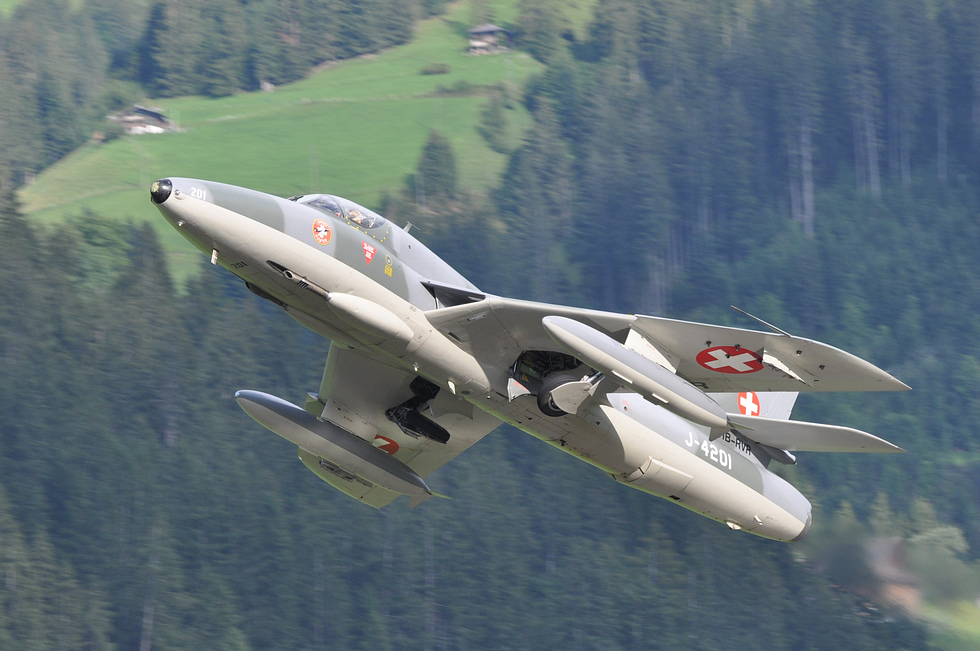
Superseded as an interceptor by the supersonic English Electric Lightning, the Hunter found a long second life as a ground-attack aircraft and fought in conflicts from Suez to the Indo-Pakistani wars. Switzerland flew its Hunters until 1994; today the survivors are prized warbirds and jet-experience aircraft. Few fighters have combined elegance, longevity and export success quite like it.
01How Sydney Camm turned a straight-wing RAF into a swept-wing air force
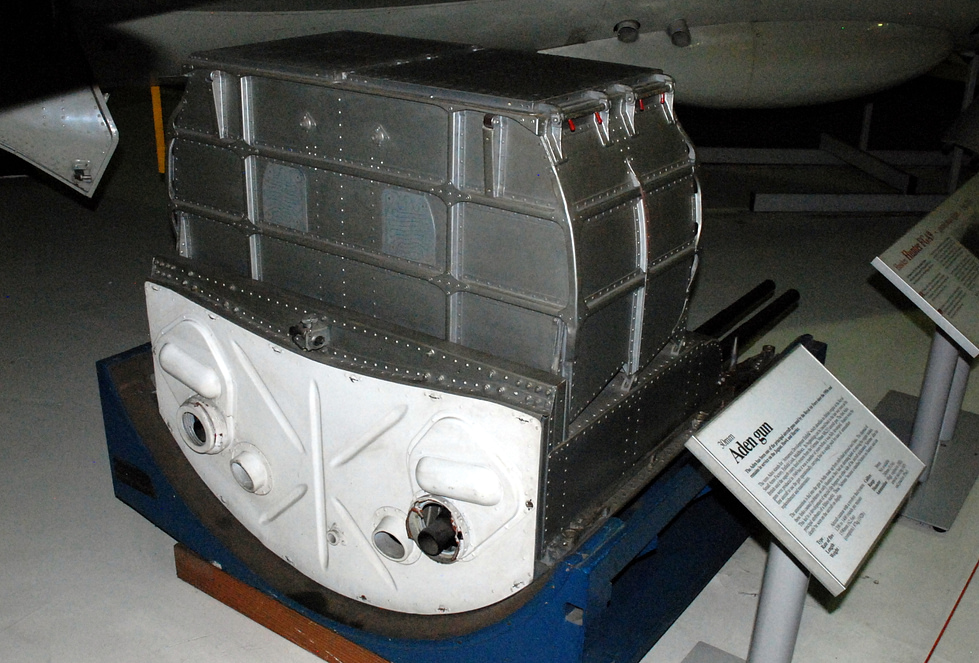
The Hunter was Hawker’s first swept-wing jet and its first jet built for RAF procurement. Camm’s team wrapped a slim, area-ruled fuselage around the Avon, gave the wing a 35° sweep, and produced an aircraft that was forgiving, fast and, crucially, easy to maintain in the field — the rear fuselage unbolted to expose the engine, and the four cannon lived in a removable “gun pack” that could be swapped for a freshly loaded one in minutes.
Early F.1s had real teething troubles — short endurance and engine surges when the guns were fired at altitude — but successive marks fixed them. By the definitive F.6 and ground-attack FGA.9, the Hunter had become one of the most polished and dependable fighters of its generation, and the backbone of RAF Fighter Command in the mid-1950s.
What makes the Hawker Hunter special
The Avon and a clean airframe
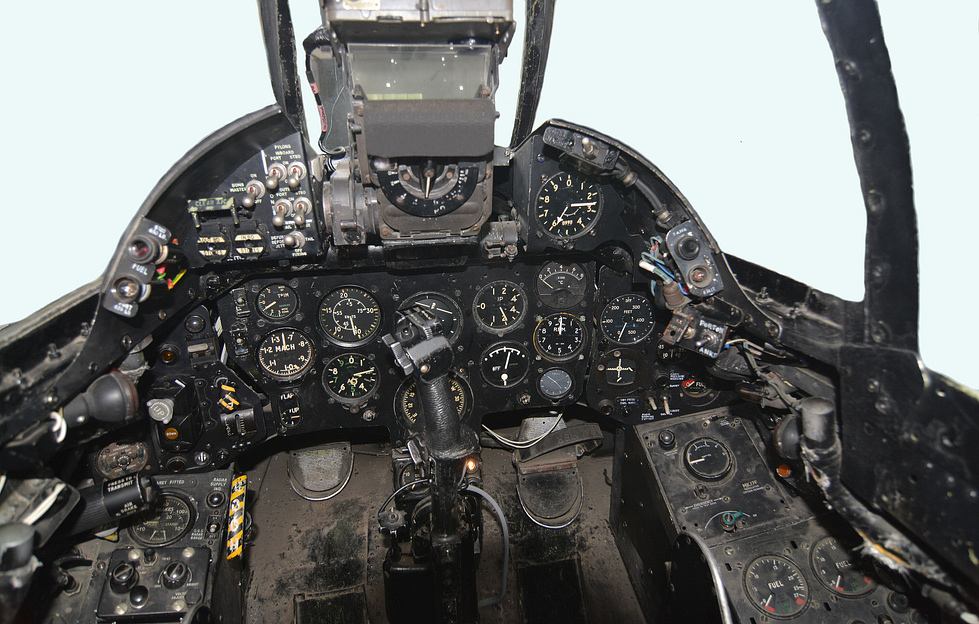
Power came from a single Rolls-Royce Avon axial-flow turbojet — about 10,000 lbf (45 kN) in the later Avon 207. Married to Camm’s low-drag, 35° swept wing and slim fuselage, it gave the Hunter a genuine Mach 0.94 and delightful handling. The aircraft was fast, stable and honest — qualities that made it a favourite of display pilots and a natural record-breaker.
The four-cannon ‘gun pack’
The Hunter’s punch was four 30 mm ADEN cannon, 150 rounds each, mounted in a single removable pack that dropped out of the belly for rapid rearming. Spent links and cases collected in bulbous fairings nicknamed “Sabrinas.” Concentrated in the nose, the four ADENs made it one of the hardest-hitting gun fighters of the 1950s.
Rugged multirole longevity
What kept the Hunter flying for decades was toughness and adaptability. The ground-attack FGA.9 hauled cannon, rockets and bombs into rough forward strips from Aden to Rhodesia, and export marks served on for half a century. Simple, robust and easy to fix, it outlasted far more advanced jets — and still flies as a warbird today.
02The Hawker Hunter’s gun problem — and the ‘fuel dipping’ fix
Firing the four ADEN cannon at high altitude could disturb the airflow into the Avon enough to cause a compressor surge or even a flame-out — alarming in a single-engined fighter. The cure was a system that automatically dipped the fuel flow for the fraction of a second the guns fired, keeping the engine stable. The bulbous cartridge-case collectors under the nose, added to stop discarded links damaging the airframe, earned the affectionate name “Sabrinas” after a well-known 1950s actress.
03Why the Hawker Hunter became a legendary display aircraft
The Hunter’s crisp handling and clean lines made it the star of a golden age of RAF formation aerobatics. No. 111 Squadron’s all-black “Black Arrows” famously looped 22 Hunters in formation at the 1958 Farnborough air show — a world record for the number of aircraft looped together that still stands. No. 92 Squadron’s blue “Blue Diamonds” flew 16. Those displays cemented the Hunter’s reputation as one of the most graceful jets ever built.
Full Hawker Hunter specifications
Figures below are anchored on the single-seat Hunter F.6 and the closely related ground-attack FGA.9 — the definitive Avon 200-series marks and the ones most people mean when they say "Hunter". Where the early F.1 or the side-by-side T.7 trainer differ materially, the delta is given in grey. Published Hunter numbers move around a good deal between marks, fits and sources, so treat single-decimal precision with suspicion.
Dimensions & weights
- Bemanning
- 1 (pilot) — 2 side by side in the T.7 and T.8 trainers
- Lengte
- 13.98 m (45 ft 11 in) — T.7 14.90 m (48 ft 11 in) with the wider two-seat nose
- Spanwijdte
- 10.26 m (33 ft 8 in) — unchanged across every mark
- Hoogte
- 4.01 m (13 ft 2 in)
- Vleugelgebied
- 32.4 m² (349 sq ft) — F.6 onward add the extended "dogtooth" leading edge
- Leeggewicht
- 6,405 kg (14,122 lb) — F.1 roughly 5,500 kg (12,150 lb)
- Loaded weight
- 8,050 kg (17,750 lb) clean, full internal fuel and gun pack
- Max takeoff weight
- 11,160 kg (24,600 lb) — FGA.9 with tanks and a full external load
- Interne brandstof
- ~1,770 L (~390 imp gal) — the F.1 carried only ~1,520 L (~334 imp gal), which was the mark’s central weakness
Performance
- Max speed
- 1,150 km/h at sea level (620 kn / 715 mph) — Mach 0.94 at 11,000 m; the Hunter was never supersonic in level flight
- Kruissnelheid
- 830 km/h (450 kn / 515 mph) at about 11,000 m (36,000 ft)
- Klimsnelheid
- 87 m/s (17,200 ft/min) at sea level, clean
- Serviceplafond
- 15,240 m (50,000 ft)
- Gevechtsradius
- ~700 km (~380 nmi) on a ground-attack profile with drop tanks; far less on internal fuel alone
- Ferry range
- ~3,060 km (~1,650 nmi) with two 230 imp gal tanks
- Takeoff run
- 640 m (2,100 ft) clean at sea level, ISA; considerably more at operational weights
- Landing run
- 730 m (2,400 ft) with the tail brake parachute of the FGA.9; roughly half as far again without it
- Load factor
- +7.5 g (design limit; -3 g negative)
Propulsion & systems
- Motor
- Rolls-Royce Avon 207 turbojet (F.6 and FGA.9) — single axial-flow turbojet, no afterburner. F.1 Avon 113, F.4 Avon 115/121; the parallel F.2 and F.5 marks used the Armstrong Siddeley Sapphire instead, largely to hedge against Avon delays.
- Thrust
- 45.1 kN (10,145 lbf) dry — F.1 33.8 kN (7,600 lbf), so the definitive marks had roughly a third more thrust than the first
- Gun pack
- Four 30 mm ADEN, 150 rounds per gun — the guns and their ammunition boxes sat in a single pack that was winched down out of the belly as one unit and swapped for a loaded spare in minutes, so a Hunter could be rearmed on the pan instead of being stripped in a hangar. It is the most quietly influential piece of engineering on the aircraft. Early gunnery work exposed two faults: firing at altitude fed gun gas into the intakes and could make the Avon surge or flame out, cured by muzzle blast deflectors and engine tuning; and spent links flung clear of the pack dented the underside, cured by the link-collector fairings under the nose that crews inevitably nicknamed "Sabrinas". The T.7 trainer kept just one gun.
- Hardpoints & ordnance
- 4 underwing pylons, ~3,400 kg (~7,400 lb) external on the FGA.9 — inboard pair plumbed for tanks or 1,000 lb bombs, outboard for rockets, pods or 100 gal tanks. Earlier F.1 and F.2 aircraft had no useful stores pylons at all.
- Schietstoel
- Martin-Baker Mk.2H / Mk.4H — early marks were not zero-zero capable; later export and refurbished aircraft fitted improved seats
- First flight
- 20 July 1951 — P.1067 prototype WB188, flown by Neville Duke
- Service entry
- 1954 — F.1 with No. 43 Squadron RAF, July 1954
- Built
- ~1,972 — including licence production by Fokker in the Netherlands and Avions Fairey in Belgium; sources differ by a few dozen depending on how rebuilds are counted
- Unit cost
- ~GBP 100,000 (1950s) — hedged deliberately. Contemporary flyaway figures for an F.6 cluster around six figures in mid-1950s pounds, but published costs mix airframe-only, flyaway and programme accounting, and export contracts were priced politically. Any single number here is indicative rather than authoritative.
- Cost per flight hour
- ~USD 7,000–12,000 — unusually, this can be estimated with some confidence, because a real fleet still flies in civilian and contractor hands. Fuel alone runs to roughly 2,000 L an hour at low level; add engine and airframe reserves, spares scarcity and insurance and operators land in that band. Adversary and target-towing sorties flown on defence contracts bill higher again, since the price covers mission systems and crew, not just the jet.
04What did a Hawker Hunter cost — and what does one cost to fly today?
As a 1950s British government aircraft built in the thousands across many marks, the Hunter never had a single published dollar flyaway price, and figures that circulate are best treated as rough period estimates. What is clearer is the modern picture: a flyable ex-military Hunter is an expensive warbird to own and operate, with turbine overhauls, fuel and specialist maintenance putting typical operating costs into the thousands of dollars per flight hour. Any precise number attached to a Hunter — then or now — should be read as an estimate.
Armament & payload
Hunter firepower: four ADEN cannon in a pack that came out in minutes
The Hunter was designed as a gun fighter and stayed one. Its four 30 mm ADEN cannon lived in a removable belly pack that could be winched out and replaced complete with ammunition between sorties — a piece of practical engineering that outlived the aircraft’s career as an interceptor. When the type was outclassed in the air it was handed rockets and bombs instead, and found a second life over Aden, the Rann of Kutch and the Rajasthan desert that lasted far longer than its first.
Gun pack
Four 30 mm ADEN revolver cannon with 150 rounds each, carried in a removable belly pack together with their ammunition boxes. Ground crew winched the whole assembly down and slid a loaded one up in its place, turning a rearm into a pan job measured in minutes. The ADEN was hard-hitting and short-ranged, which suited both the interception work the Hunter was bought for and the strafing it ended up doing. The T.7 and T.8 trainers kept a single gun for gunnery practice.
Rockets
The ground-attack marks leaned on rockets more than anything else. Standard fit was 3-inch rocket projectiles with 60 lb heads on underwing rails, typically 24 of them, salvoed or ripple-fired in a shallow dive. From the 1960s many operators moved to Matra SNEB 68 mm pods, which packed 18 or 19 rounds into a single store and were cleaner aerodynamically. Rockets plus guns was the classic Radfan and Indian Air Force load.
Bombs
500 lb and 1,000 lb bombs on the inboard pylons, retarded or slick depending on delivery height. The Hunter had no bombing computer worth the name for most of its RAF life, so accuracy came from the pilot, the sight and a lot of practice. Several export operators added napalm and cluster weapons; Switzerland later cleared the AGM-65 Maverick, which gave its Mk.58s a precision capability the RAF aircraft never had.
Air-to-air missiles
RAF Hunters never carried air-to-air missiles operationally — they fought with guns to the end. Export aircraft did: Sweden fitted the Rb 24 (AIM-9B Sidewinder) to its J 34s, making them among the first European fighters so armed, and Swiss, Chilean and other late marks carried Sidewinder variants. It extended the type’s useful life as a point defender, but never made a subsonic gun fighter into a modern interceptor.
Fuel tanks
Range was the Hunter’s weak point and drop tanks were the answer. The 100 imp gal (455 L) tank was the everyday fit, light enough to leave on for combat; the 230 imp gal (1,045 L) tank on the inboard pylons was a ferry and transit store that ate manoeuvre margin. A four-tank configuration could push a Hunter most of the way across Europe, at the cost of carrying no weapons beyond the gun pack.
Reconnaissance & trainer fits
The FR.10 traded the fighter nose for three Vinten F.95 cameras — one forward-facing, two oblique — while keeping the full gun pack, so it could shoot back on the way out. The T.7 put two crew side by side in a widened nose, a layout the RAF preferred to tandem for instruction; the naval T.8 added an arrestor hook, and late T.8M airframes carried Sea Harrier Blue Fox radar to train its operators.
Three typical Hunter fits
- Day fighter — RAF F.6, late 1950s
- Full gun pack, four ADEN at 150 rounds per gun, and two 100 imp gal drop tanks inboard with the outer pylons empty. No missiles, no radar of consequence: a clean, superbly handling gun fighter flown visually, and one of the best in the world at exactly that job for about five years.
- Ground attack — FGA.9 over the Radfan, mid-1960s
- Gun pack loaded, two 100 imp gal tanks on the inboard pylons and rocket rails outboard carrying 3-inch rockets, or a pair of SNEB pods in later years. Brake parachute streamed on recovery to short, hot strips. This is the load the Hunter is really remembered for.
- Reconnaissance — FR.10
- Three F.95 cameras in the nose, gun pack retained, two 100 imp gal tanks. Flown fast and low on a single planned pass, relying on speed and terrain rather than any defensive system, with the guns available if the run went wrong.
Fits varied enormously by mark and by operator, and it is easy to over-generalise. An F.1 had no meaningful stores pylons at all; an FGA.9 was built around them; a Swiss Mk.58A in the 1980s carried Sidewinders and Mavericks that no RAF Hunter ever saw. Where a specific weapon is quoted below or above, it belongs to a particular mark in a particular air force rather than to "the Hunter" in general.
Variants
Hunter variants: from a troubled interceptor to Britain’s most exported jet fighter
The Hunter is, by most honest measures, one of the most successful British jets ever built: close to 2,000 airframes and exports to more than twenty air forces, several of which flew it for decades. It also fought. Indian Hunters were heavily engaged against Pakistan in 1965 and again in 1971, most famously in the strikes that broke the Pakistani armoured thrust at Longewala; RAF FGA.9s flew ground attack over Aden and the Radfan and during the Borneo confrontation; Iraqi, Jordanian, Rhodesian and Chilean Hunters saw action of their own. The balancing truth is that it was subsonic and was outclassed as an interceptor within a few years of entering service — which is exactly why it found a long second life as a ground-attack aircraft, a trainer and, in the hands of the Black Arrows and their successors, one of the finest display aircraft ever flown.
- F.1
- The first production mark, Avon 113 and 139 built from 1954. Short-legged, and its guns caused trouble: firing at height could surge the engine, and spent links damaged the airframe. Useful chiefly as the aircraft on which the Hunter was made to work.
- F.4
- 365 built. Added wing fuel and usable underwing pylons, and standardised the blast deflectors and link collectors. The Sapphire-engined equivalents ran in parallel — F.2 (45 built) and F.5 (105) — and it was F.5s that flew escort during Suez in 1956.
- F.6
- The definitive fighter: roughly 380 for the RAF plus large export and licence runs, with the Avon 203/207 and the extended dogtooth leading edge that fixed the pitch-up. This is the Hunter of the display era and of most published specifications.
- FGA.9
- About 128 F.6 airframes converted for ground attack from 1959: strengthened wing, bigger pylons, tail brake parachute and improved cooling for hot-and-high work. The mark that fought in Aden and Borneo and kept the Hunter employed for another twenty years.
- FR.10
- 33 conversions from F.6 airframes with three Vinten F.95 cameras in the nose and the gun pack retained. Fast, low and unglamorous tactical reconnaissance, flown by the same squadrons as the FGA.9.
- T.7
- The side-by-side two-seat trainer, first flown in 1955; about 65 new-build for the RAF plus conversions and a healthy export trade. One ADEN retained for gunnery. Many outlived the single-seaters, and several fly today.
- T.8
- The Royal Navy trainer, roughly 40 aircraft, with an arrestor hook for airfield wires and naval instruments. Late T.8M airframes carried Sea Harrier Blue Fox radar in a bulged nose to train its operators — a job the Hunter was still doing in the 1990s.
- Export marks
- The commercial story of the aircraft. Switzerland took about 160 Mk.58/58A and flew them to 1994; India bought roughly 200 Mk.56/56A; Sweden operated 120 as the J 34; Belgium and the Netherlands built some 445 between them under licence with Avions Fairey and Fokker. Denmark, Jordan, Iraq, Lebanon, Kuwait, Saudi Arabia, Oman, Qatar, Abu Dhabi, Peru, Chile, Singapore, Kenya, Somalia and Rhodesia followed — more than twenty air forces in all.
Most air forces had retired the Hunter by the end of the 1990s: Switzerland stopped flying them in 1994, Zimbabwe in 2002. Lebanon was the outlier, returning a handful of stored Hunters to service in 2008 and flying them on internal operations into the mid-2010s, which makes it about the last military operator of the type. The civilian fleet is what keeps the Hunter genuinely airborne today: a couple of dozen airworthy aircraft between the United Kingdom, the United States, South Africa and elsewhere, several of them flown by contractors on defence work — adversary training, target towing, electronic warfare support and trials flying — alongside privately owned display jets. Several hundred more survive as gate guardians, museum exhibits and ground instructional airframes. Airworthy numbers move year to year with maintenance, funding and accidents, so treat any exact count with caution.
From record-breaker to Cold-War workhorse
Camm starts the P.1067
Hawker begins design of a swept-wing Avon fighter to meet the RAF’s need for a jet to replace the Meteor and Vampire.
First flight
The prototype flies on 20 July, piloted by Neville Duke from Boscombe Down.
World air-speed record
On 7 September, Duke sets a world record of 727.63 mph (1,171 km/h) in a modified Mk 3 over Littlehampton.
Enters RAF service
The Hunter F.1 joins RAF Fighter Command, soon becoming its principal day fighter.
Suez
RAF Hunters fly air-defence and escort sorties during the Anglo-French Suez operation.
The Black Arrows’ 22-ship loop
No. 111 Squadron loops 22 Hunters in formation at Farnborough — a record that still stands.
Indo-Pakistani wars
Indian Air Force Hunters fight through the 1965 and 1971 wars, including the Battle of Longewala.
Switzerland retires the Hunter
One of the last military operators stands its fleet down after wing-fatigue issues — the type passes into warbird hands.
Twelve Hawker Hunter stories
Camm’s first swept-wing jet
The Hurricane’s designer answered the jet age with the elegant P.1067.
Read the full story
The world air-speed record
On 7 September 1953 Neville Duke pushed a modified Hunter to 727.63 mph.
Read the full story
The Black Arrows’ 22-ship loop
No. 111 Squadron looped 22 Hunters together at Farnborough — still a record.
Read the full story
The Blue Diamonds
No. 92 Squadron’s 16 blue Hunters carried the aerobatic torch into the early 1960s.
Read the full story
The removable gun pack
Four 30 mm ADEN cannon lived in a pack that dropped out for rapid rearming.
Read the full story
First combat
RAF Hunters flew air defence and escort during the 1956 Suez operation.
Read the full story
War in the Radfan
FGA.9s pounded rebel positions in the mountains of southern Arabia.
Read the full story
Dogfighting the Sabre
Indian Hunters traded blows with Pakistani F-86 Sabres over the subcontinent.
Read the full story
The Battle of Longewala
Six IAF Hunters helped halt a Pakistani armoured thrust in the desert.
Read the full story
Saiful Azam’s day
A Pakistani exchange pilot flying an Arab Hunter downed multiple Israeli jets.
Read the full story
The African Hunters
Rhodesian — later Zimbabwean — Hunters flew hard through decades of bush conflict.
Read the full story
The Alpine Hunters
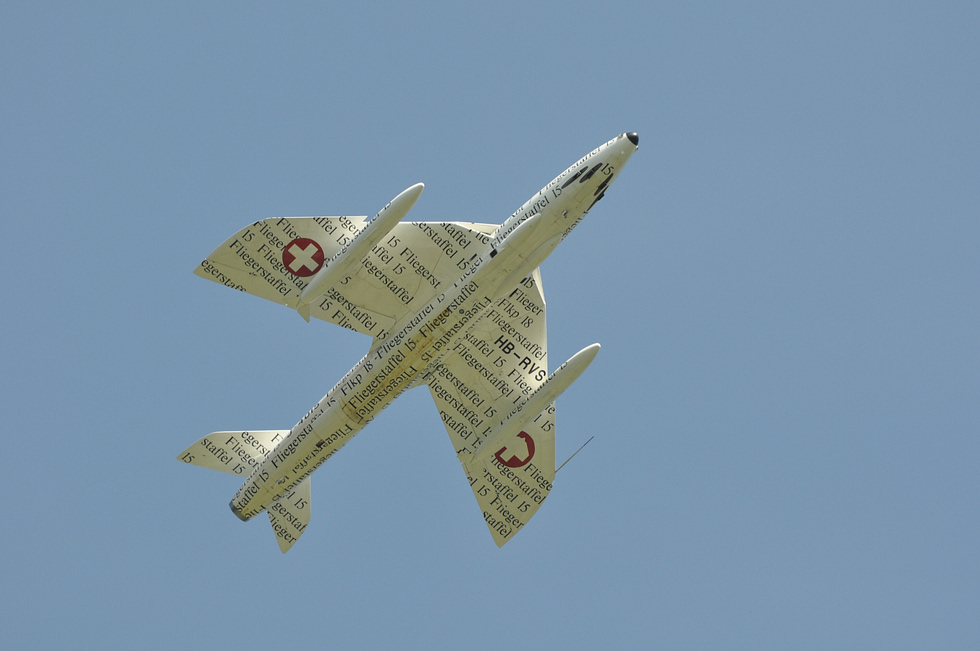
Swiss Hunters flew from mountain valleys until 1994 — and star as warbirds today.
Read the full story
The Hawker Hunter in pictures
The Hawker Hunter in motion
A hand-picked Hawker Hunter documentary is coming soon to this exhibit. In the meantime, explore the gallery above and the stories below for the record flights, the Black Arrows’ 22-ship loop and the Hunter’s long combat career.
The Hawker Hunter in motion
Megaprojects — one of the most-watched Hawker Hunter films on YouTube.
Where the Hawker Hunter flew
A fighter that fought everywhere
Few jets saw combat across so many flags. The Hunter fought at Suez, in Aden and the Radfan, through the Indo-Pakistani wars of 1965 and 1971, in the 1967 Six-Day War with several Arab air forces, and across decades of conflict in Africa. Air-to-air claims from these wars are contested and often inflated on all sides, so specific tallies should be read with caution — but the Hunter’s reputation as a rugged, hard-hitting multirole fighter is beyond doubt.
Compare the combat record of every military aircraft. Figures as of July 2026.
Everything people ask about the Hawker Hunter
Can I fly in a Hawker Hunter?
How fast is a Hawker Hunter?
What armament does the Hawker Hunter carry?
How many Hawker Hunters were built?
Did the Hawker Hunter see combat?
What was the Black Arrows’ 22-aircraft loop?
Why did Switzerland retire its Hunters?
Are any Hawker Hunters still flying?
You can’t fly the Hawker Hunter.
These, you can.
Some legends only live in museums — others are fuelled and waiting. MiGFlug has put civilians in real military jet cockpits since 2004.
 Fly the L-39 AlbatrosThe world’s most-flown jet trainer — aerobatics included
 Fly the F-104 Starfighter“The missile with a man in it”
 Fly the MiG-21The Cold War’s most-produced jet
 Vlieg met de T-33 Shooting StarAmerica’s first jet trainer
 Fly the DH VampireA piece of early jet history
 Fly the S.211Agile Italian jet trainer
 Fly the MB-326The classic Aermacchi jet
 Fly the MiG-15The Soviet legend of the Korean War
Continue the tour
Every fact, checked
- Dunsfold Airfield History Society — 1953 World Air Speed RecordPrimary account of Neville Duke’s 727.63 mph record in Hunter WB188.
- Thunder & Lightnings — Hawker Hunter HistoryDevelopment, marks, RAF service and display-team history.
- Airfix — The History of the Hawker HunterOverview of design, the Avon engine and the aircraft’s career.
- Fighter-Planes.com — Hawker HunterSpecifications, variants and combat record reference.
- Royal Air Force MuseumReference for the ADEN gun pack and preserved RAF Hunter airframes.
- BAE Systems Heritage — Hawker HunterManufacturer heritage record for the Hawker/Hawker Siddeley Hunter.
- Imperial War MuseumsContext for the Hunter’s Cold-War and export service.
- FAI records databaseOfficial world air-speed record classifications for 1953.