
North American B-25
Mitchell
The WWII medium bomber that launched off a carrier deck to hit Tokyo, then turned into the most heavily-gunned low-level strafer of the Pacific war — and one of the best-loved warbirds still flying.
The B-25 Mitchell: the bomber that struck back at Tokyo
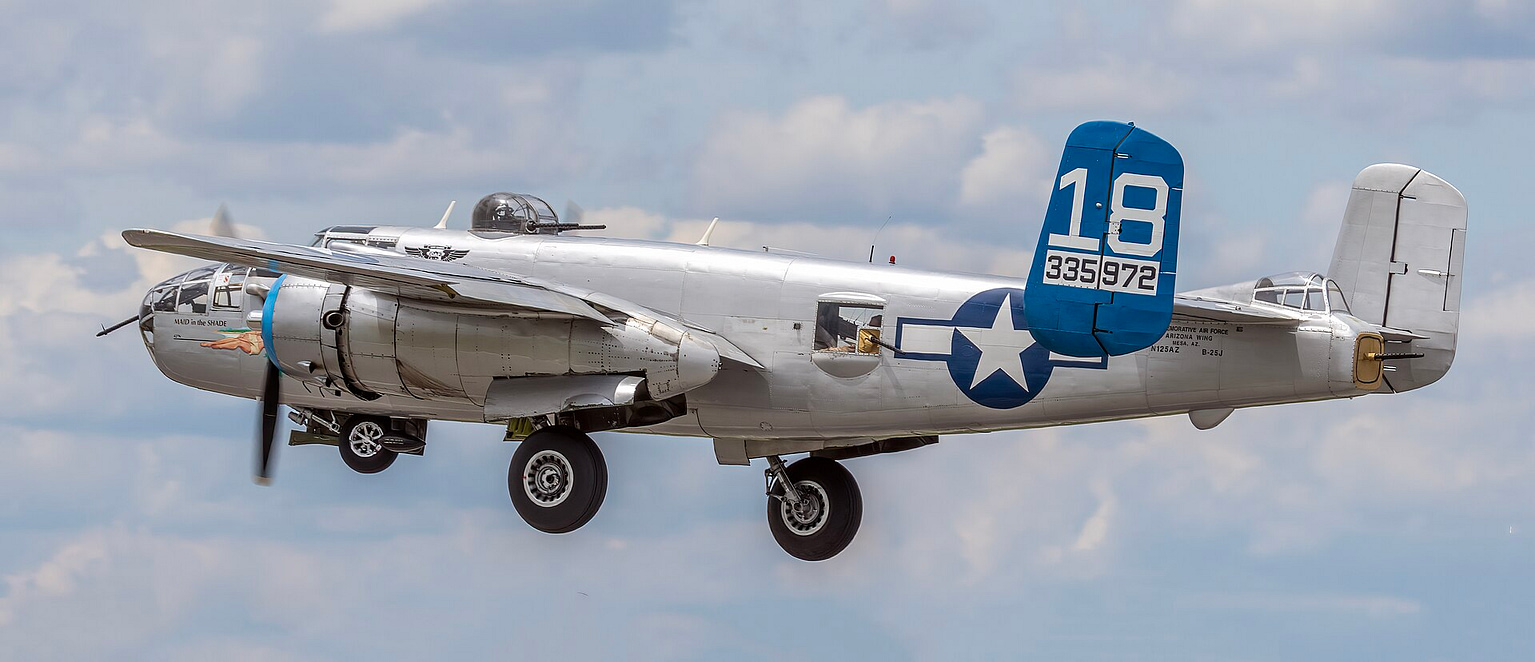
When North American Aviation flew the first B-25 on 19 August 1940, the company had never built a twin-engine bomber. What it delivered was one of the most versatile combat aircraft of the Second World War: a rugged, forgiving twin with a distinctive twin tail and tricycle landing gear that could be flown hard by young crews and absorb brutal punishment. It entered US Army Air Forces service in February 1941 and was named after Brigadier General William “Billy” Mitchell, the interwar prophet of American air power — the only US military aircraft named for a specific person.
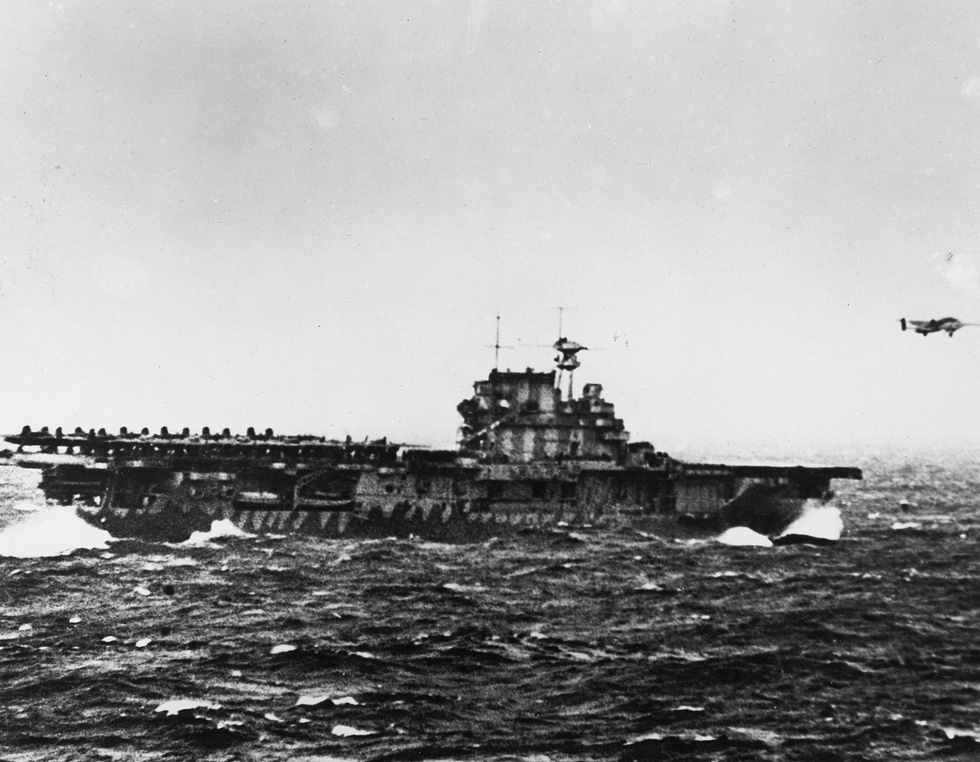
The Mitchell became a legend barely a year into the war. On 18 April 1942, sixteen B-25Bs led by Lieutenant Colonel James “Jimmy” Doolittle rumbled off the pitching deck of the carrier USS Hornet — something no one had thought a land-based medium bomber could do — and bombed Tokyo and other Japanese cities. The physical damage was slight, but the psychological effect was enormous: it proved to a shaken American public that Japan could be hit, and it rattled the Japanese high command into the fateful decisions that led to Midway.
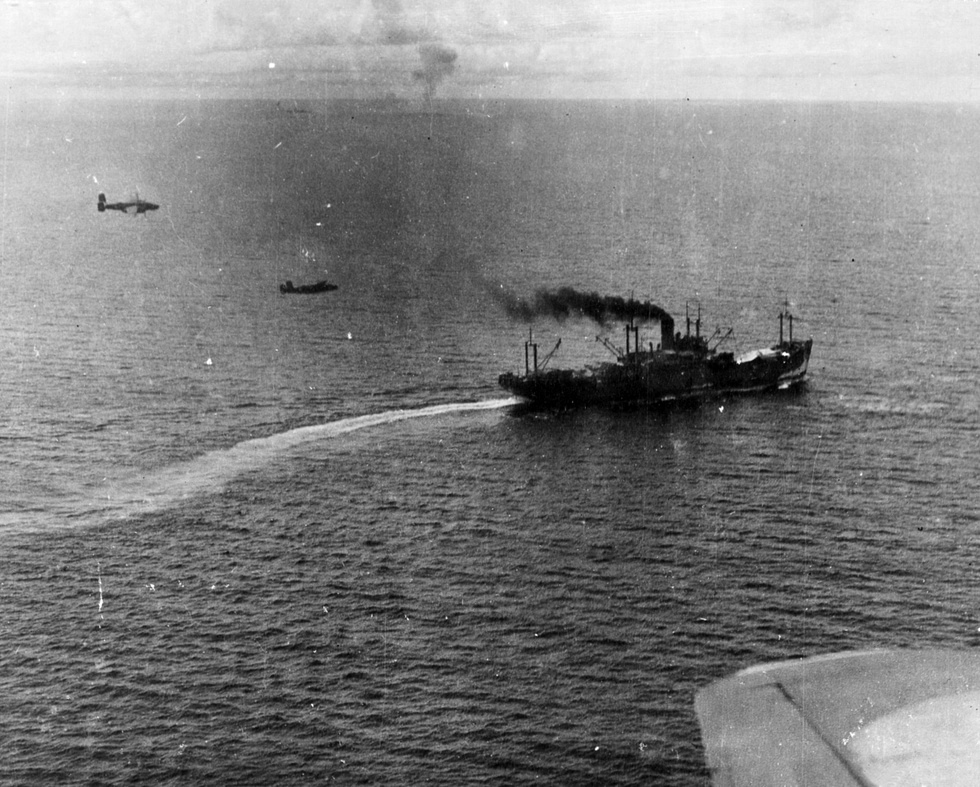
The B-25’s second act was arguably more important than its first. In the South-West Pacific, field engineer Major Paul “Pappy” Gunn and North American reworked the medium bomber into a devastating low-level gunship: the glass bombardier nose was replaced with a solid nose packed with fixed .50-calibre machine guns, and crews perfected skip-bombing and mast-height attacks against Japanese shipping. At the Battle of the Bismarck Sea in March 1943, B-25 strafers helped annihilate a Japanese convoy. Later the B-25G and B-25H even mounted a 75 mm cannon — a field gun in the nose — alongside a battery of machine guns.
Nearly 9,800–9,900 Mitchells were built before production ended in 1945. They served in every theatre of the war and with a long list of Allied air forces under Lend-Lease — the British RAF, the Soviet Union, the Netherlands and others. Cheap, tough and endlessly adaptable, the B-25 outlived the war in many air forces and remains one of the most numerous and best-loved warbirds flying today.
01Why the B-25 Mitchell is named after a court-martialled general
Em geral William “Billy” Mitchell was the most outspoken advocate of American air power in the 1920s. He argued that aircraft could sink battleships and that air power would decide future wars — and proved the first point in 1921 by having bombers sink the captured German battleship Ostfriesland. His relentless public criticism of army and navy leadership led to a famous court-martial in 1925, and he left the service. Vindicated after his death by the very air war he predicted, Mitchell was honoured when North American named its new medium bomber the Mitchell — the only US military aircraft named after a specific individual.
What makes the B-25 Mitchell special
A twin built to be flown hard
The Mitchell paired two Wright R-2600 Twin Cyclone radials of about 1,700 hp each with a twin-tail layout and tricycle landing gear that made it easy to land and take off from rough forward strips. It was famously forgiving and stable — docile enough for Doolittle’s crews to master short-field takeoffs in weeks, yet tough enough to fly home on one engine with large parts of the airframe shot away.
From level bomber to low-level strafer
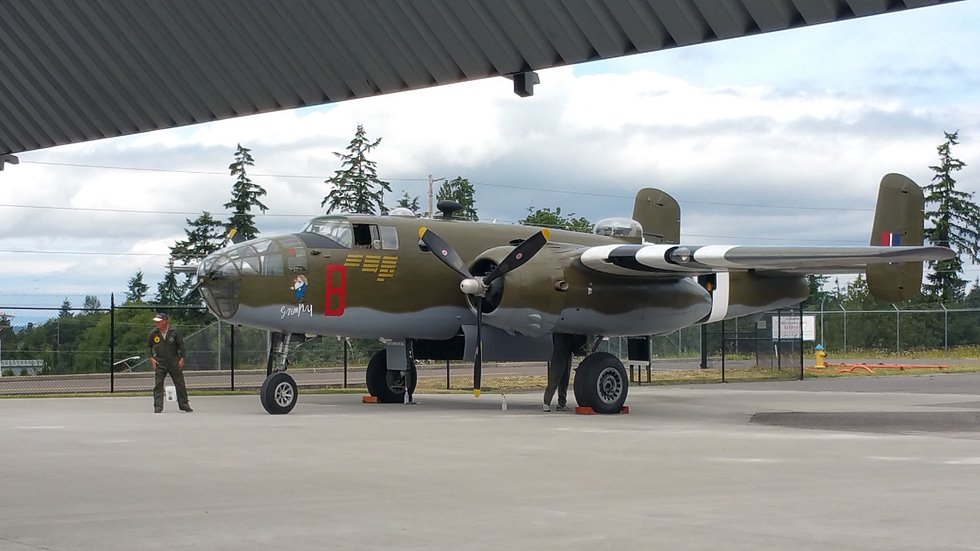
In the Pacific the B-25 was reinvented as a gunship. Major Paul “Pappy” Gunn replaced the glazed bombardier nose with a solid nose full of fixed .50-calibre machine guns, added “package” guns on the fuselage sides and forward-firing turret guns. Late B-25J strafers could bring twelve to eighteen .50-cal guns to bear — a wall of fire for skip-bombing ships and shredding airfields at treetop height.
A field gun in the nose
O B-25G and B-25H carried a 75 mm M4 cannon — a lightly modified tank/field gun, one of the largest weapons fitted to a production aircraft — hand-loaded by the navigator. Aimed at destroyers, barges and shore targets, it packed a heavy punch but was slow to reload and stressed the airframe. As machine-gun batteries proved more practical against shipping, many cannon were later removed.
02The B-25 Mitchell’s strafer conversion: how ‘Pappy’ Gunn turned a bomber into a gunship
Frustrated that medium bombers dropping from altitude rarely hit ships, Fifth Air Force engineer Major Paul “Pappy” Gunn field-modified B-25s in Australia and New Guinea: he stripped the bombardier station and bolted a battery of forward-firing .50-calibre machine guns into a solid nose, added guns in blisters on the fuselage sides, and cleared the aircraft to attack at masthead height. Crews combined this firepower with skip-bombing — bouncing bombs across the water into a ship’s hull — a tactic developed with RAF and Australian help. North American adopted the changes into factory-built strafer versions of the B-25G, H and J.
03The B-25 Mitchell over Europe and the Eastern Front: Lend-Lease service
Although the Mitchell is most associated with the Pacific, it fought everywhere. The RAF received nearly 900 Mitchells and flew them with No. 2 Group against targets in occupied Europe from 1943; Dutch crews of No. 320 Squadron flew alongside them. The Soviet Union was a major Lend-Lease recipient, using the B-25 as a long-range and night bomber on the Eastern Front. Mitchells also served US and Allied units across the Mediterranean and North Africa, and with China, Australia, Canada and Brazil — a genuinely global bomber.
Full B-25J Mitchell specifications
Airframe & Performance
- Equipe
- 5–6 (pilot, co-pilot, navigator/bombardier, gunners)
- Comprimento
- 16.13 m (52 ft 11 in)
- Envergadura
- 20.60 m (67 ft 7 in)
- Altura
- 4.98 m (16 ft 4 in)
- Peso vazio
- ~8,840 kg (19,480 lb)
- Max takeoff weight
- ~15,900 kg (35,000 lb)
- Max speed
- ~438 km/h (272 mph) at 13,000 ft
- Teto de serviço
- ~7,375 m (24,200 ft)
- Faixa
- ~2,170 km (1,350 mi)
Powerplant, Armament & Cost
- Engines
- 2 × Wright R-2600-92 Twin Cyclone radials
- Power (each)
- ~1,700 hp
- Guns
- 12–18 × .50-cal M2 Browning (strafer variants)
- Cannon (G/H)
- 1 × 75 mm M4
- Bomb load
- Up to ~1,360 kg (3,000 lb)
- First flight
- 19 August 1940
- Built
- ~9,800–9,900 (1940–1945)
- Unit cost (period)
- ~$96,000–$116,000 (estimate)
- Cost per flight hour (warbird)
- ~$3,000–5,000 today (estimate)
04The B-25 Mitchell’s operating costs: from wartime bargain to warbird budget
In wartime the Mitchell was prized as much for its price as its performance. Period figures commonly place a late-war B-25 at roughly $96,000–$116,000 — a fraction of a four-engine heavy like the B-29 — though exact numbers vary by source and year and should be read as estimates. No official cost-per-flight-hour figure exists for wartime operations. Today, keeping one of the ~30 airworthy Mitchells flying is a serious undertaking: warbird operators commonly cite something on the order of a few thousand dollars per flight hour in fuel, oil and maintenance for a twin-radial bomber — again, an operator estimate rather than a published figure.
From drawing board to warbird icon
First flight
North American’s NA-62 prototype flies on 19 August 1940; the design is named Mitchell after General Billy Mitchell.
Enters service
The B-25 joins the US Army Air Forces in February 1941 as a twin-engine medium bomber.
The Doolittle Raid
On 18 April, sixteen B-25s launch from USS Hornet to bomb Tokyo — a huge morale victory after Pearl Harbor.
Battle of the Bismarck Sea
Low-level B-25 strafers skip-bomb and gun a Japanese convoy to destruction in the South-West Pacific.
The 75 mm gunship
The B-25G and then B-25H enter service with a 75 mm cannon and heavy machine-gun batteries for anti-ship strafing.
Global Lend-Lease
Mitchells serve the RAF, the Soviet Union, the Netherlands and other Allies across Europe, the Mediterranean and Asia.
Production ends
Manufacture stops after roughly 9,800–9,900 aircraft — among the most-produced American bombers of the war.
The warbird era
Retired from front-line service, dozens of B-25s pass into museums and airshow fleets; around 30 remain airworthy today.
From the cockpit: twelve B-25 Mitchell stories
Off the deck of the Hornet
Sixteen medium bombers did what everyone said was impossible — a carrier launch to bomb Tokyo.
Read the full story
The long crash-landings in China
Out of fuel after the raid, almost every crew bailed out or crash-landed over China; most, but not all, survived.
Read the full story
Pappy Gunn’s gunship
A field engineer bolted a wall of machine guns into the nose and rewrote how the B-25 fought.
Read the full story
Minutes that sank a convoy
Skip-bombing B-25s helped destroy a Japanese troop convoy in one of the most lopsided air-sea actions of the war.
Read the full story
The 75 mm cannon in the nose
The Mitchell carried a field gun — one of the biggest weapons ever fitted to a production aircraft.
Read the full story
The 345th Bomb Group
One B-25 group painted Apache heads on their tails and became legends of the low-level war.
Read the full story
Mitchells over occupied Europe
Nearly 900 B-25s served the RAF, striking targets across occupied Europe from British bases.
Read the full story
The Soviet night bomber
The Red Air Force flew hundreds of Lend-Lease B-25s into the night skies of the Eastern Front.
Read the full story
The Marines’ Mitchell
The Navy and Marine Corps flew their own B-25 — the PBJ — on patrol and anti-ship strikes.
Read the full story
The bomber crews trusted
Pilots praised the Mitchell as tough, honest and able to fly home badly shot up.
Read the full story
“Thirty Seconds Over Tokyo”
The Doolittle Raid made the B-25 a movie star, and it has flown in films ever since.
Read the full story
Thirty still fly
Of nearly 10,000 built, around 30 airworthy Mitchells keep the type’s story alive today.
Read the full story
The B-25 Mitchell in pictures
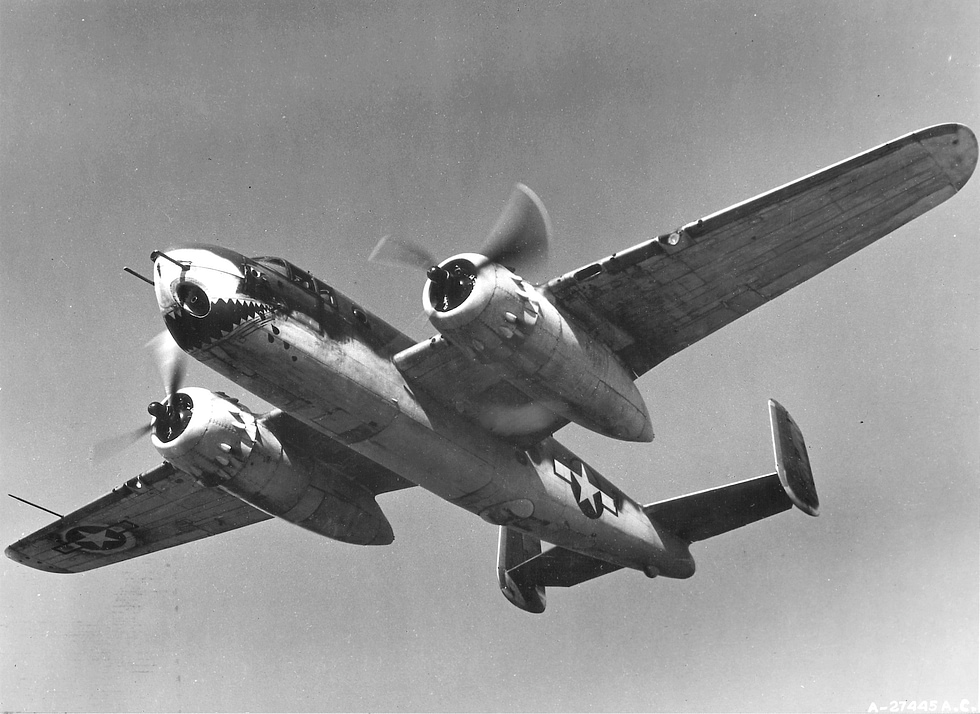
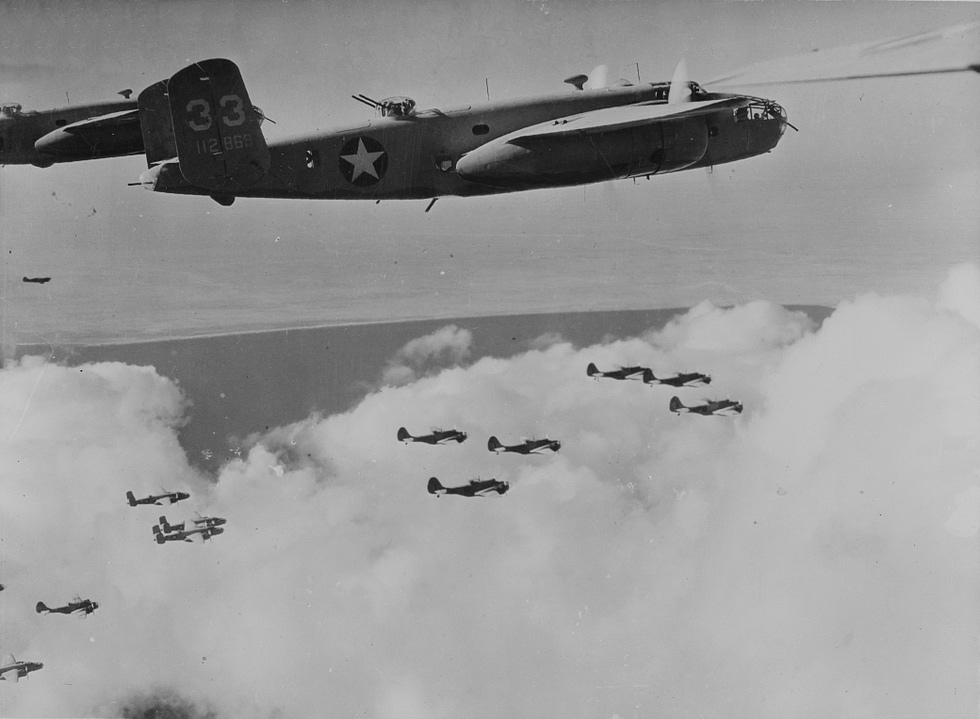
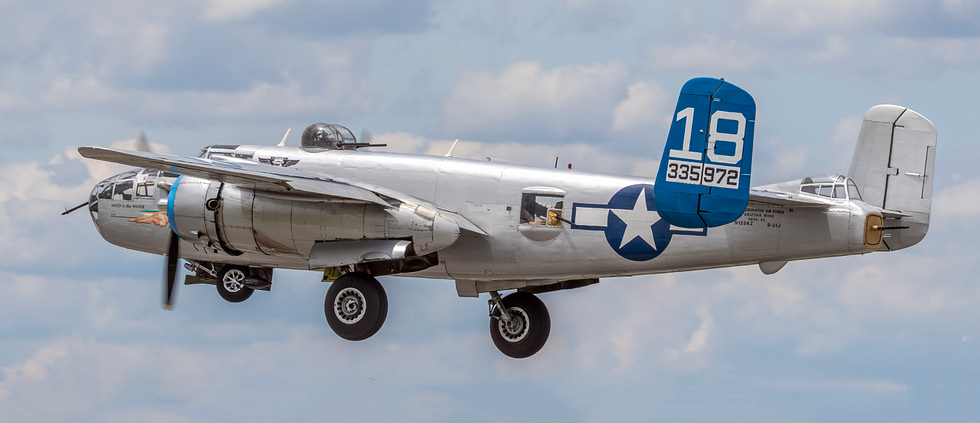
The B-25 Mitchell in motion
A hand-picked B-25 Mitchell video is coming soon — we are selecting a high-authority archive clip worthy of the aircraft. In the meantime, explore the photo gallery above and the twelve stories from the cockpit.
Where the B-25 Mitchell flew
The score that defines it
The B-25 was a bomber, not a fighter, so its record is measured in raids flown, ships sunk and airfields wrecked rather than aerial victories. Its combat legacy rests on two things above all: the audacious Doolittle Raid that struck Japan in 1942, and the low-level strafing campaign that made the Mitchell one of the deadliest anti-shipping aircraft of the Pacific war.
Compare the combat record of every military aircraft. Figures as of July 2026.
Everything people ask about the B-25 Mitchell
Can I fly in a B-25?
What was the Doolittle Raid?
Why is the B-25 called the Mitchell?
Did the B-25 really carry a 75 mm cannon?
How many B-25s were built?
How fast was the B-25 Mitchell?
Which countries flew the B-25?
Are any B-25s still flying?
You can’t fly the Mitchell.
These, you can.
Some legends only live in museums — others are fuelled and waiting. MiGFlug has put civilians in real military jet cockpits since 2004.
 Fly the L-39 AlbatrosThe world’s most-flown jet trainer — aerobatics included
 Fly the F-104 Starfighter“The missile with a man in it”
 Fly the MiG-21The Cold War’s most-produced jet
 Pilote o T-33 Shooting StarAmerica’s first jet trainer
 Fly the DH VampireA piece of early jet history
 Fly the S.211Agile Italian jet trainer
 Fly the MB-326The classic Aermacchi jet
 Fly the MiG-15The Soviet legend of the Korean War
Continue the tour
Every fact, checked
- The National WWII Museum — Doolittle’s Raider: the B-25Primary reference for the Doolittle Raid and the B-25’s wartime service.
- Naval History and Heritage Command — B-25J MitchellSource for the B-25J specifications and the naval PBJ variant.
- HistoryNet — How the B-25 Became the Ultimate StraferDetail on Pappy Gunn, the strafer conversion and the Bismarck Sea action.
- History of War — North American B-25 MitchellProduction, armament and the 75 mm cannon variants.
- Smithsonian National Air and Space Museum — B-25JReference for a preserved B-25J and design background.
- Warfare History Network — What Made the B-25 LegendaryOverview of the Mitchell’s versatility and combat record.
- The Armory Life — B-25 Mitchell: Birth of a GunshipThe gunship story, machine-gun batteries and the 75 mm cannon.
- Airplanes Online — B-25 MitchellProduction numbers, surviving aircraft and the Air Apaches.