
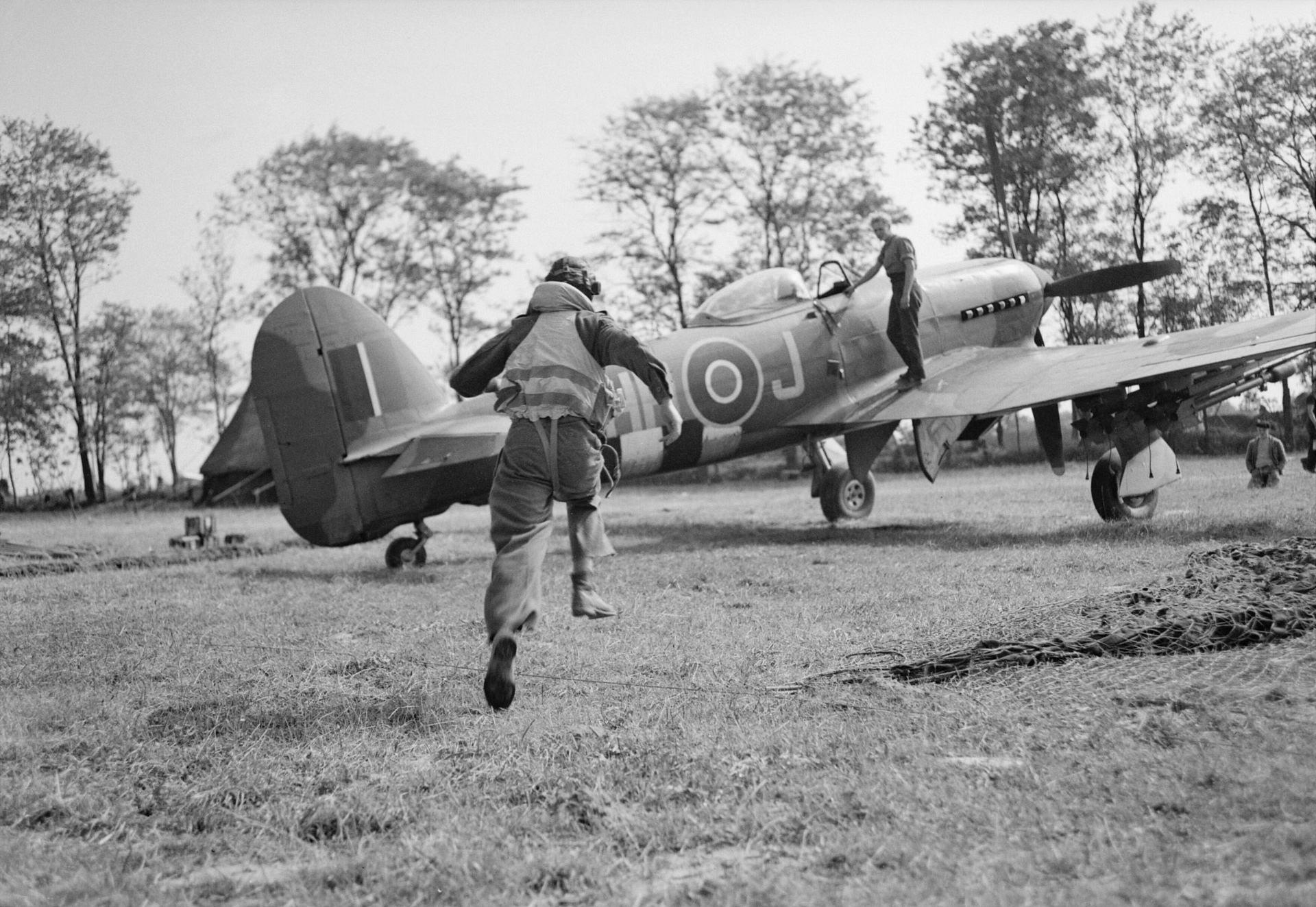
Hawker Typhoon
“Tiffy”
Britain’s big, brutal ground-attack fighter — nearly cancelled over a troubled engine and tails that broke off in flight, then reborn as the rocket-firing scourge of the Normandy battlefield.
The Hawker Typhoon: from near-failure to the RAF’s ground-attack scourge
In 1937 Hawker’s chief designer Sydney Camm set out to replace his own Hurricane with something far more powerful — a heavy interceptor built around one of the giant new 2,000-horsepower engines then on the drawing board. The aircraft that emerged, the Typhoon, was hung on the 24-cylinder Napier Sabre, a sleeve-valve monster of extraordinary output and even more extraordinary unreliability. The prototype first flew on 24 February 1940, and the type reached No. 56 Squadron in September 1941 as the RAF’s first fighter capable of more than 400 mph in level flight.
Its early service was close to a disaster. The Sabre was temperamental and prone to failure; the cockpit leaked carbon monoxide, so pilots flew on oxygen from take-off; and worst of all, aircraft began shedding their entire tail units in flight, almost always killing the pilot. Add a thick wing that strangled performance above about 20,000 ft — fatal for the high-altitude interceptor it was meant to be — and by 1942 the RAF came close to cancelling the whole programme.
It was saved by an accident of tactics. When Focke-Wulf Fw 190 fighter-bombers began fast “tip-and-run” raids on English coastal towns, the Typhoon turned out to be the only RAF fighter fast enough on the deck to catch them. From that low-level niche grew its real calling. Fitted with four 20 mm cannon, then bombs, then RP-3 rockets, the Typhoon became the spearhead of the 2nd Tactical Air Force — and in the Normandy summer of 1944 the most feared Allied aircraft over the battlefield.
01Why the Hawker Typhoon was almost cancelled in 1942
Three problems nearly killed the Typhoon before it found its role. The Napier Sabre was rushed into service half-developed — early engines managed only around ten flying hours between overhauls and had a habit of failing on take-off. Then came the structural failures: a run of aircraft lost their tails in the air, an accident sequence that eventually cost about two dozen pilots their lives before the cause was traced to a weak rear-fuselage joint and elevator flutter, and cured with riveted external “fishplates” by early 1943. On top of that, the Typhoon’s thick wing meant its performance fell away badly at height, so it failed at the very job — high-altitude interception — it had been designed for. Only the emergence of the low-level Fw 190 threat gave it a reason to survive.
What makes the Hawker Typhoon special
The Napier Sabre: 2,000+ hp and a maintenance nightmare
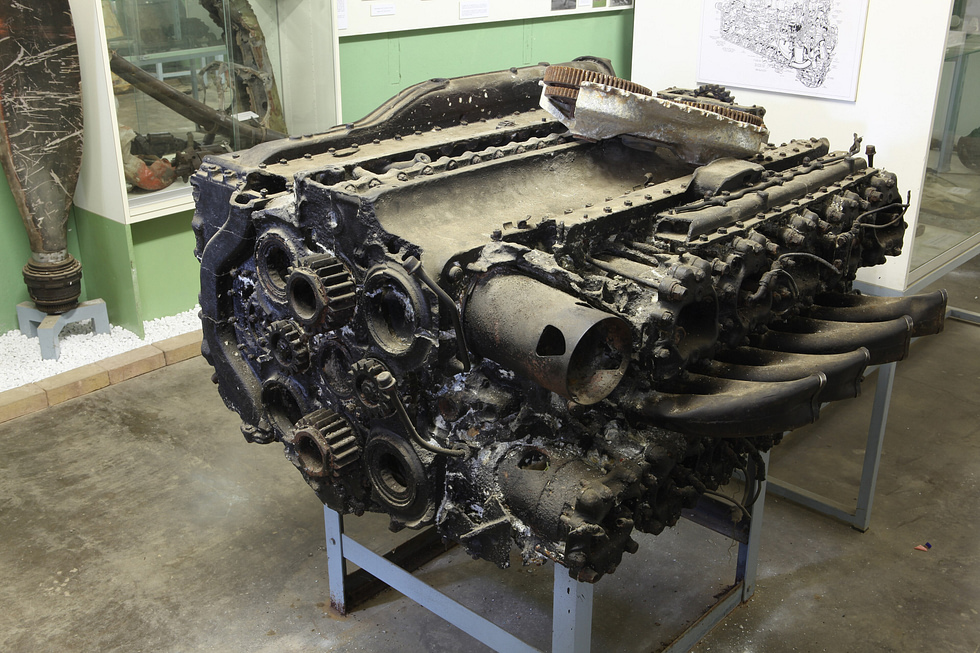
The Typhoon was built around the Napier Sabre, a liquid-cooled 24-cylinder “H”-configuration sleeve-valve engine of about 36.7 litres — effectively four six-cylinder blocks geared together. It gave roughly 2,180 hp, among the most powerful piston aero-engines of the war, but it was notoriously hard to start, prone to sleeve seizures and, early on, needed servicing every few flying hours. Taming the Sabre took years.
Fast and heavy at low level: four 20 mm cannon
Where the Typhoon shone was on the deck. At around 412 mph at low altitude it was the only RAF fighter that could run down the Fw 190 “tip-and-run” raiders. Its definitive Mk IB carried four 20 mm Hispano cannon — a devastating punch against locomotives, vehicles, shipping and aircraft, and the foundation of its later ground-attack career.
Rockets and the birth of modern close air support
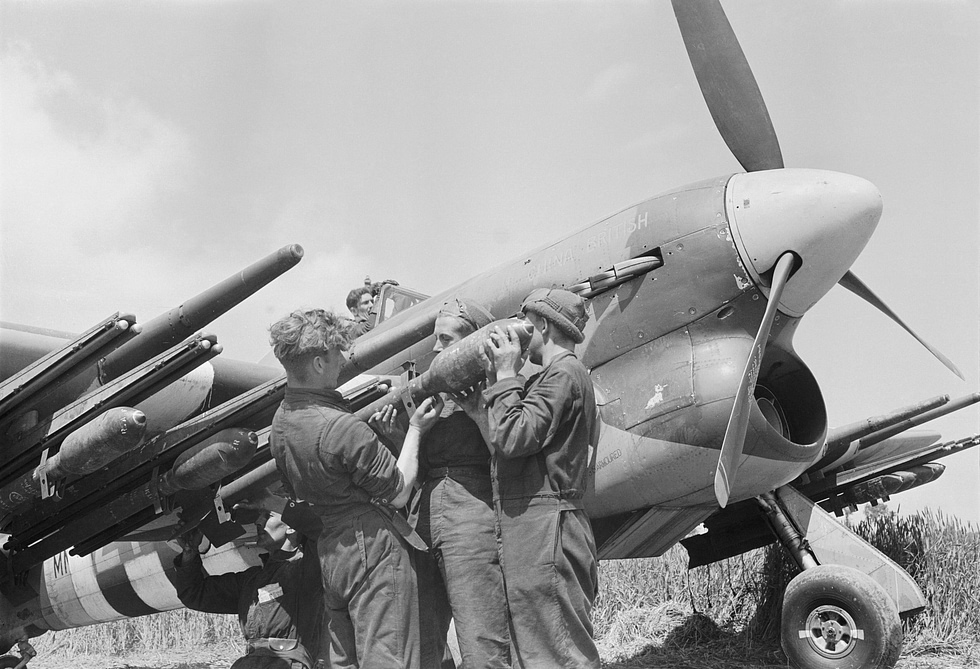
From late 1943 the Typhoon carried up to eight RP-3 “60-lb” rockets or two 500–1,000 lb bombs. Directed from the ground by the famous “cab rank” system, rocket Typhoons could be called down onto a target within minutes — a template for the close air support that armies still rely on today.
02The Hawker Typhoon’s Napier Sabre engine: power at a terrible price
The Sabre’s sleeve-valve design promised smoothness and huge power from a compact package, and at its best it delivered well over 2,000 hp. But Napier struggled to manufacture the sleeves to tolerance, and early Sabres suffered seizures, hard starting and fires. Reliability only came with better materials and, crucially, chromium-plated sleeves developed with Bristol. In Normandy the engine faced a new enemy — abrasive dust on forward strips — which Napier countered with a hastily designed high-efficiency air filter. The Sabre was a brilliant, exhausting engine that the Typhoon’s whole troubled early career was hostage to.
03The Hawker Typhoon’s rockets: fearsome reputation, imperfect weapon
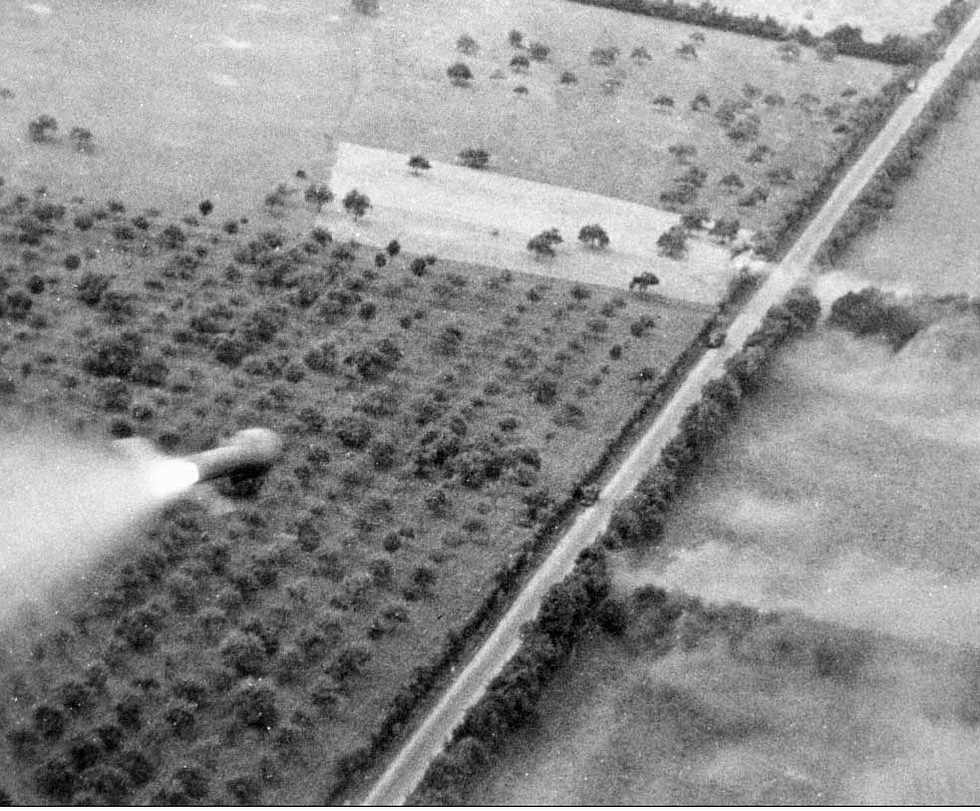
The RP-3 rocket projectile turned the Typhoon into a legend, but it was a blunt instrument. The unguided rockets left the rails in a spread and dropped steeply, so hitting a small moving target such as a tank was extremely hard — in one controlled trial four Typhoons fired all 64 rockets at a stationary Panther and scored just three hits. What made the Typhoon decisive was not pinpoint tank-killing but the sheer weight of cannon and rockets it could bring down on transport, supply columns and morale, forcing German armour to move only at night. (See the story carousel below for how post-war analysis punctured the tank-kill claims.)
Full Hawker Typhoon specifications
Airframe & Performance (Typhoon IB)
- Equipe
- 1
- Comprimento
- 9.73 m (31 ft 11 in)
- Envergadura
- 12.67 m (41 ft 7 in)
- Max takeoff weight
- ~5,170 kg (~11,400 lb)
- Max speed
- ~663 km/h (~412 mph) at low level
- Teto de serviço
- ~10,700 m (~35,200 ft)
- Faixa
- ~820 km; ~1,580 km with drop tanks
- First flight
- 24 February 1940 (prototype P5212)
Propulsion, Armament & Cost
- Motor
- 1 × Napier Sabre IIA, ~2,180 hp
- Configuration
- 24-cylinder H, sleeve-valve, liquid-cooled
- Guns
- 4 × 20 mm Hispano cannon
- Ordnance
- 8 × RP-3 rockets ou 2 × 500–1,000 lb bombs
- Built
- ~3,300 (1941–1945)
- Producer
- Gloster Aircraft (nearly all)
- Unit cost
- No reliable public figure (wartime)
- Cost per flight hour
- No meaningful modern figure exists
04The Hawker Typhoon’s cost: why there is no clean price tag
The Typhoon was a wartime state production run of around 3,300 aircraft (the RAF Museum cites 3,317; some sources 3,330), built overwhelmingly by Gloster Aircraft because Hawker had no spare capacity. Wartime unit costs were accounted in 1940s pounds under emergency contracts and are not comparable to a modern flyaway price, and no meaningful cost-per-flight-hour figure exists for a type retired in 1945 with a single airworthy-condition survivor. Any precise dollar figure attached to a Typhoon today is an estimate.
The Hawker Typhoon: from drawing board to Falaise
Design begins
Sydney Camm starts work on a Hurricane successor built around the new 2,000-hp Napier Sabre, to Air Ministry spec F.18/37.
First flight
The Sabre-engined prototype P5212 flies on 24 February 1940, in the middle of the Sabre’s worst reliability troubles.
Enters service
No. 56 Squadron receives the Typhoon in September — the first RAF fighter able to exceed 400 mph in level flight.
Crisis and reprieve
Tail failures and engine troubles nearly cancel the type; instead it is thrown against low-level Fw 190 tip-and-run raiders — and catches them.
The tank-buster is born
“Fishplate” fixes cure the tail; the fighter-bomber IB carries bombs, and on 25 October Typhoons fly their first RP-3 rocket attack.
D-Day and the cab rank
By 6 June, 26 Typhoon squadrons fly with the 2nd Tactical Air Force, orbiting on call to strike targets minutes after the army names them.
The Falaise pocket
Massed cannon and rocket attacks hammer the retreating German columns — the Typhoon’s most famous action, and its costliest month.
Retirement and the last survivor
Withdrawn in October 1945; the fleet is scrapped. Sole complete survivor MN235, in the USA since 1944, returns to the RAF Museum and goes on display at Hendon in 1972.
From the cockpit: twelve Typhoon stories
The engine that almost killed it
The Napier Sabre was so unreliable that the Typhoon nearly died before it could prove itself.
Read the full story
The tail that fell off
A run of Typhoons shed their entire tails in flight — and it took a test pilot’s death to crack the cause.
Read the full story
Catching the tip-and-run raiders
The Typhoon found its purpose chasing the Fw 190s that no other RAF fighter could catch on the deck.
Read the full story
Shot down by its own side
From head-on the Typhoon looked so like an Fw 190 that Allied gunners kept shooting it down.
Read the full story
Four cannon and a salvo of rockets
Cannon, bombs and rockets turned the Typhoon into a flying arsenal.
Read the full story
The cab rank over Normandy
Typhoons orbited the battlefield on call, minutes from any target the army named.
Read the full story
The killing ground
At Falaise the Typhoons fell on trapped German columns — the type’s most famous, and costliest, action.
Read the full story
Did Typhoons really destroy the German tank arm?
Post-war investigators found the famous tank-kill claims were wildly exaggerated.
Read the full story
A New Zealander leading a Typhoon wing
The Typhoon was RAF-only — but Commonwealth pilots flew it, some to the very top.
Read the full story
Did a Typhoon wound Rommel?
A famous strafing attack badly wounded Rommel — but the credited aircraft was probably a Spitfire.
Read the full story
MN235: the last complete Typhoon
Only one whole Typhoon survives — and it lived only because it left Britain in 1944.
Read the full story
From Typhoon to Tempest
The Typhoon’s fatal flaw — that thick wing — gave birth to one of the best fighters of the war.
Read the full story
The Hawker Typhoon in pictures
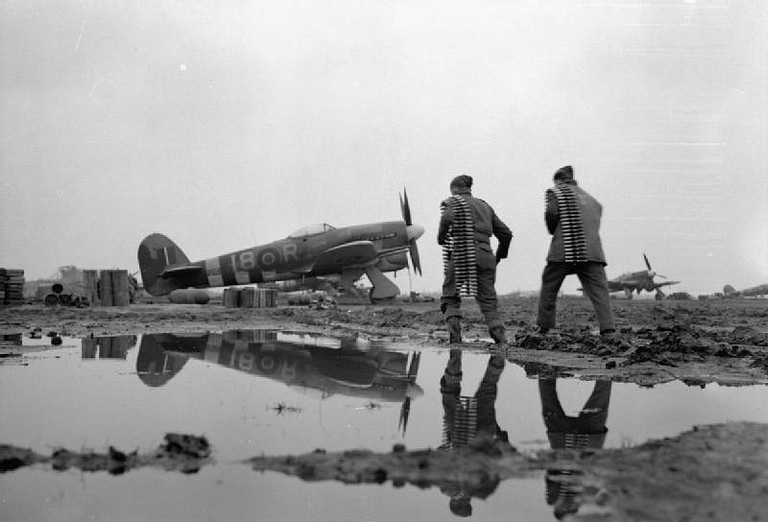
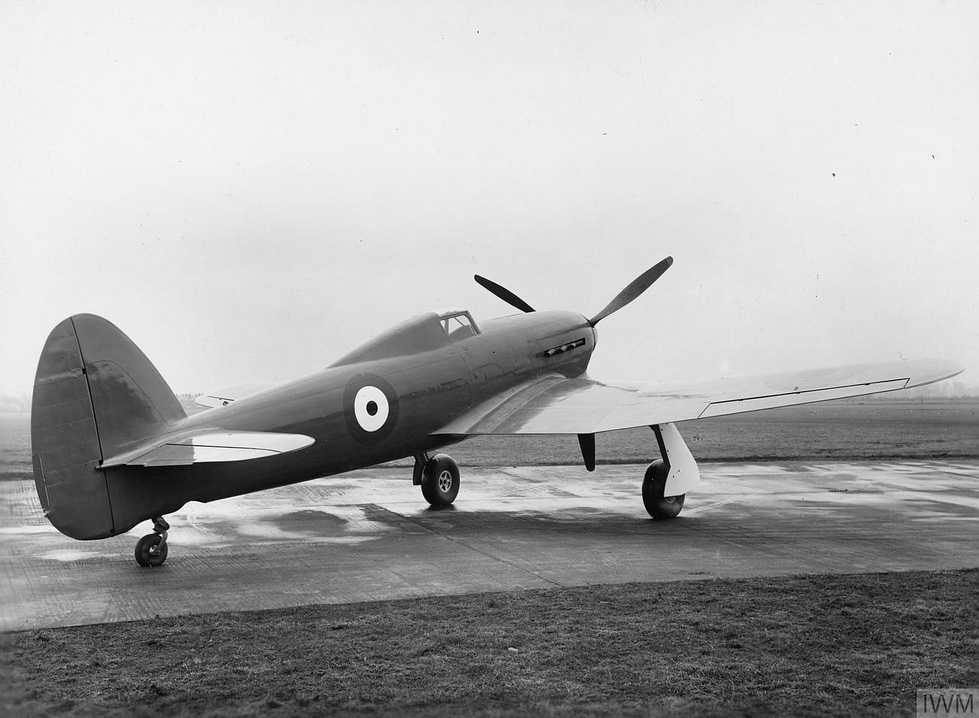
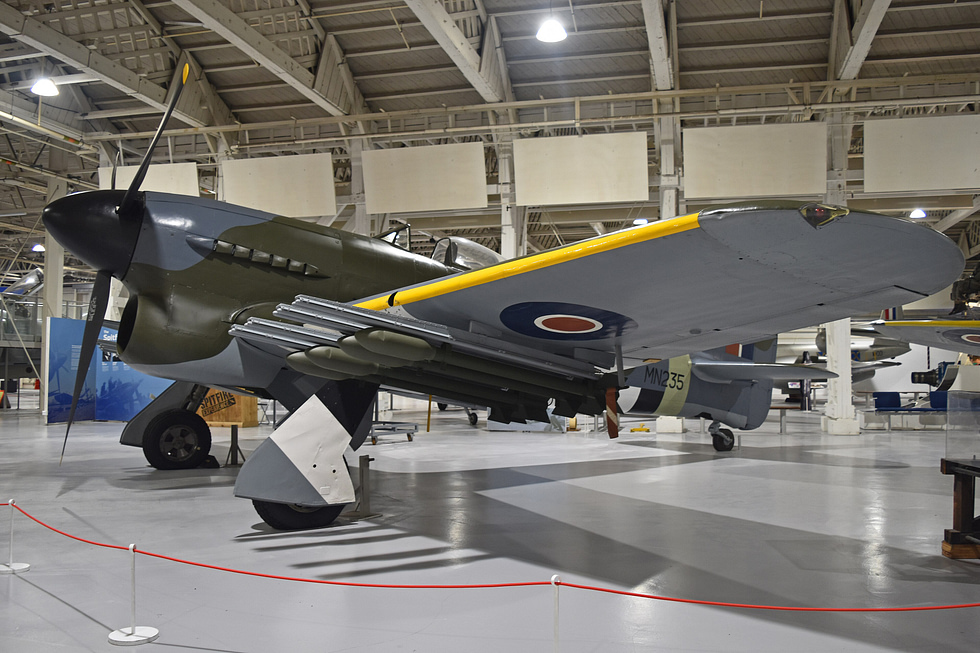
The Hawker Typhoon in motion
A hand-picked, high-authority Typhoon documentary is on the way. Video coming soon. In the meantime, explore the photo gallery and the twelve stories above.
Where the Hawker Typhoon flew
The Hawker Typhoon’s score, in context
The Typhoon was not a dogfighter — its record is written on the ground, not in aerial victories. Over Normandy it wrecked German transport and supply on a huge scale and terrified enemy tank crews, even if the celebrated tank-kill totals were later shown to be greatly overstated. Its most enduring numbers are the fleet that flew and the near-total loss of that fleet afterwards.
Compare the combat record of every military aircraft. Figures as of July 2026.
Everything people ask about the Hawker Typhoon
Can I fly in a Typhoon?
Why was the Hawker Typhoon nearly cancelled?
What was the Typhoon’s main job?
Did Typhoons really destroy hundreds of tanks?
How many Hawker Typhoons survive?
What is the difference between the Typhoon and the Tempest?
Did a Typhoon wound Rommel?
Who flew the Hawker Typhoon?
You can’t fly the Typhoon.
These, you can.
Some legends only live in museums — others are fuelled and waiting. MiGFlug has put civilians in real military jet cockpits since 2004.
 Fly the L-39 AlbatrosThe world’s most-flown jet trainer — aerobatics included
 Fly the F-104 Starfighter“The missile with a man in it”
 Fly the MiG-21The Cold War’s most-produced jet
 Pilote o T-33 Shooting StarAmerica’s first jet trainer
 Fly the DH VampireA piece of early jet history
 Fly the S.211Agile Italian jet trainer
 Fly the MB-326The classic Aermacchi jet
 Fly the MiG-15The Soviet legend of the Korean War
Continue the tour
Every fact, checked
- RAF Museum — Hawker Typhoon IB (MN235)Institutional record of the sole complete survivor, its provenance and service history.
- History of War — Hawker TyphoonDates, specifications, production totals and development troubles.
- Tanks Encyclopedia — Tank-busting in WWIIThe Operational Research surveys that debunked the Typhoon’s tank-kill claims.
- HistoryNet — Restored: The Last TyphoonThe full story of MN235’s journey to the USA and back.
- Warfare History Network — The Falaise Pocket ScourgeNormandy operations, the cab-rank system, pilots and squadrons.
- Smithsonian NASM — Napier Sabre IIAAuthoritative data on the Typhoon’s 24-cylinder engine.
- Key.Aero — 75 years since the Typhoon was retiredService career, leading pilots and the type’s retirement.
- Te Ara — Desmond James ScottBiography of the New Zealand Typhoon wing leader and memoirist.