
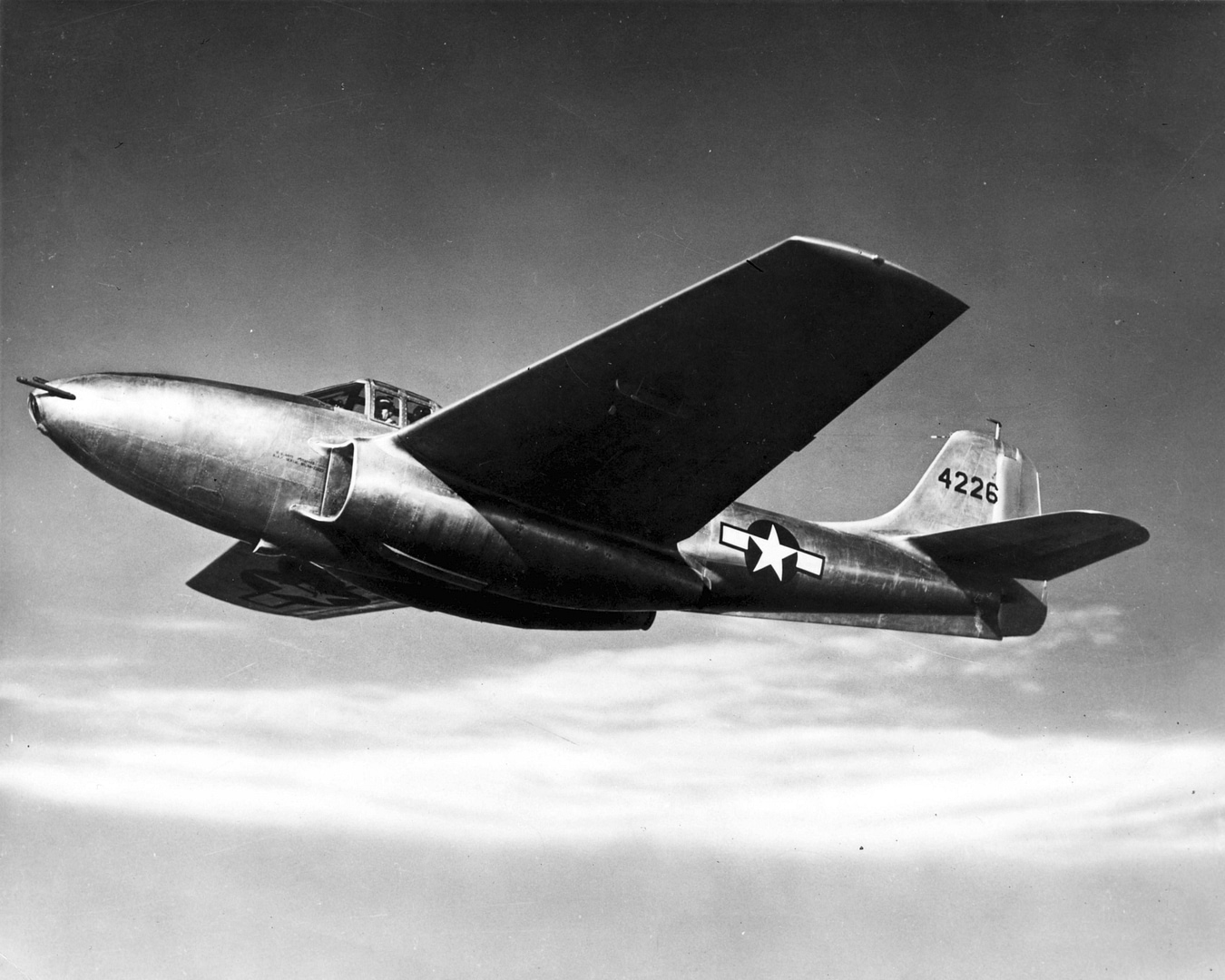
Bell P-59
“Airacomet”
America’s first jet aircraft — a wartime secret built around a British-designed turbojet. It was too slow to fight, never fired a shot in anger, and yet it carried the United States across the threshold into the jet age.
America’s first jet: born in secrecy, retired without a fight
In April 1941, with the United States still officially neutral, US Army Air Forces chief General Henry “Hap” Arnold visited Britain and was shown something extraordinary: the little Gloster E.28/39, flying on a jet engine designed by Frank Whittle. America had nothing like it. Arnold came home determined to close the gap, and secured British agreement to share Whittle’s engine. In September 1941 he handed the job to two firms: General Electric, with its turbine and turbosupercharger expertise, would license-build the engine; Bell Aircraft of Buffalo would build the aeroplane around it.
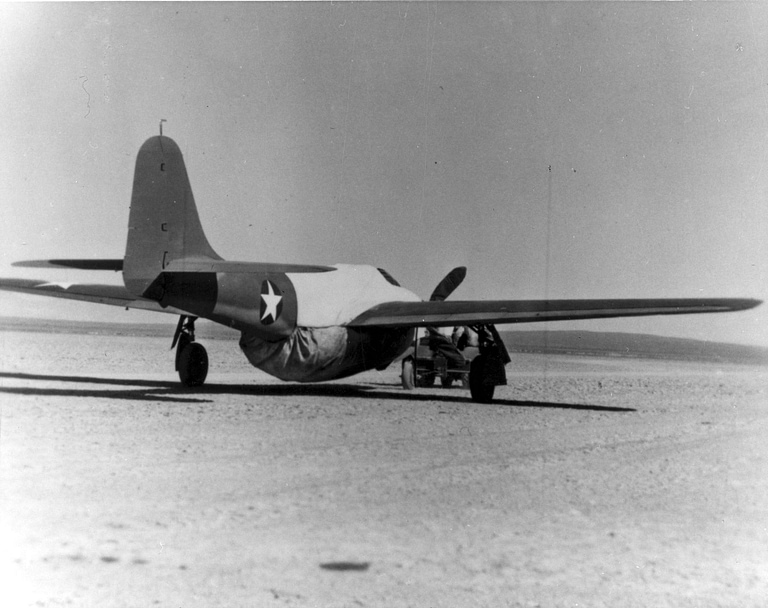
The whole programme was wrapped in extraordinary secrecy. Bell’s engineers worked behind windows welded shut and painted over, under 24-hour guard. The aircraft was deliberately mis-designated “XP-59A” to make it look like a continuation of a cancelled piston-engined fighter project, and the engine was code-named “I-A” to pass as a turbosupercharger. When the prototype was shipped to the remote Muroc Dry Lake in the California desert for testing, ground crews fitted a dummy wooden propeller to its nose whenever it was parked outside — so that any curious eyes would see nothing more than an ordinary fighter.
On 1 October 1942, Bell test pilot Robert Stanley lifted the XP-59A a few feet off the lakebed — the first flight of an American jet aircraft. Formal flights followed the next day, and Colonel Laurence Craigie became the first US military pilot to fly a jet. It was a genuine milestone, achieved barely thirteen months after the contract was signed.
And then came the disappointment. The Airacomet flew, but it was badly underpowered. Even the definitive P-59B managed only about 413 mph (660 km/h) — scarcely faster than the best piston fighters of the day, and far slower than Germany’s Me 262. Its engines were sluggish to respond and the airframe made an unsteady gun platform; in mock dogfights it was outflown by P-47 Thunderbolts and P-38 Lightnings. By 1944 the USAAF had concluded the type was not suited to combat. It never fired a shot in anger. Instead the roughly 66 Airacomets built became America’s first jet trainers, giving the 412th Fighter Group a nucleus of pilots and ground crews who understood jets. The lessons — and a Bell single-engine study — fed straight into the Lockheed P-80 Shooting Star, the fighter that would do what the P-59 could not.
01The Bell P-59 Airacomet’s secret birth: how a British jet engine crossed the Atlantic
The P-59 exists because of a transatlantic technology transfer. Britain had a working turbojet — Frank Whittle’s — and, courting American support in 1941, agreed to share it. A complete Whittle W.1X engine and drawings for the more powerful W.2B were flown to the United States, where General Electric at Lynn, Massachusetts, was chosen to reproduce them as the I-A. GE was picked precisely because its long experience with turbosuperchargers gave it the metallurgy and turbine know-how the job demanded.
Bell Aircraft, meanwhile, designed a conventional twin-engine airframe around two of these engines, buried in the wing roots either side of the fuselage. The result flew only thirteen months after the go-ahead — a remarkable pace — but it was fundamentally limited by engines that, even in their final form, produced only around 2,000 lb of thrust each. The airframe was never the problem; the young, low-thrust engines were.
What makes it special
Built around a borrowed British turbojet
The Airacomet’s heart was not American in origin. Its two General Electric I-A / J31 turbojets were license-built copies of Frank Whittle’s British design, buried in the wing roots on either side of the fuselage. GE won the work on the strength of its turbosupercharger expertise. It was the first jet engine mass-produced in the United States — the true breakthrough at the core of the aircraft.
A deliberately conventional airframe
Bell wrapped the radical new engines in an aggressively ordinary aeroplane: a straight wing, tricycle landing gear and gentle, forgiving handling. That was the point — with the propulsion so experimental, the airframe was kept safe and docile. It made the P-59 an excellent first jet to learn on (one was even converted into the world’s first two-seat jet), but it left no margin to chase speed.
Underpowered — the fatal flaw
Even in its final P-59B form, each J31 gave only about 2,000 lb (8.9 kN) of thrust, and the engines were slow to spool up. Top speed stalled at roughly 413 mph — barely ahead of piston fighters — and the poor throttle response made the jet an unsteady gun platform. In 1944 mock combats it was beaten by P-47s and P-38s, sealing its fate as a trainer rather than a warplane.
02The P-59 Airacomet’s dummy propeller: the disguise that hid America’s first jet
One of the enduring images of the programme is the dummy propeller. When the secret prototype sat outside at Muroc Dry Lake, ground crews bolted a wooden four-blade propeller to its nose, so that from a distance it looked like a conventional piston fighter rather than the revolutionary jet it was. The story has become the symbol of just how tightly the whole project was guarded: mis-designated on paper, its engine disguised as a turbosupercharger, and its true nature literally masked on the flight line. The propeller was, of course, removed before every flight.
03Why the Bell P-59 Airacomet never saw combat
The Airacomet was a technical success and a tactical failure. Its engines, derived from an early British design, simply did not produce enough thrust: top speed hovered around 413 mph, no better than a good propeller fighter and well short of the 500-plus mph the German Me 262 and He 280 were built for. Worse, the engines accelerated slowly and the aircraft proved an unsteady platform for its guns. When the USAAF flew it against P-47D Thunderbolts and P-38J Lightnings in early 1944, the piston fighters won. A Materiel Command evaluation concluded the P-59 was not operationally or tactically suited for combat. Production was cut from hundreds to around 66, and the type was steered into the training role instead — where its docile handling and twin engines made it genuinely useful for turning propeller pilots into jet pilots.
Full specifications
Figures below are for the definitive production P-59B. Several period figures vary between sources and are given as commonly cited values; the earlier XP-59A and YP-59A were lighter and slightly slower.
Airframe & Performance
- Equipe
- 1 (one prototype flew as a two-seater)
- Comprimento
- ~11.8 m (38 ft 10 in)
- Envergadura
- ~13.9 m (45 ft 6 in)
- Altura
- ~3.76 m (12 ft 4 in)
- Peso vazio
- ~3,700 kg (~8,165 lb)
- Max takeoff weight
- ~5,400 kg (~11,900 lb; up to ~13,700 lb quoted)
- Max speed
- ~660 km/h (~413 mph) at 9,150 m
- Teto de serviço
- ~13,000 m (~43,000 ft)
- Faixa
- ~1,530 km (~950 mi) with drop tanks
Propulsion, Armament & Cost
- Engines
- 2 × General Electric J31-GE-5 turbojets
- Thrust (each)
- ~8.9 kN (~2,000 lbf)
- Engine origin
- License-built from Whittle W.2B (GE I-A)
- Armamento
- 1 × 37 mm M4 cannon + 3 × .50-in MGs
- First flight
- 1 October 1942 (XP-59A)
- Built
- ~66, all variants (1942–1945)
- Unit cost
- No reliable public figure (wartime)
- Cost per flight hour
- No reliable public figure
04The P-59 Airacomet’s cost: what America’s first jet was worth
The P-59 was a secret wartime development contract, not a catalogue purchase, so a clean flyaway unit price was never published in the way modern aircraft costs are. The programme began with a $1.6 million research-and-development contract in 1941, and total procurement was tiny — only around 66 aircraft ever built — which kept unit costs high by the standards of mass-produced fighters. Any precise dollar figure attached to an individual Airacomet should be read as an estimate.
No reliable cost-per-flight-hour figure exists for the type either. As a short-lived experimental and training aircraft that never entered squadron combat service, its operating economics were never recorded in a form comparable to later, mass-produced jets.
From British secret to the dawn of the US jet age
A jet from Britain
General Hap Arnold sees the Gloster E.28/39 and secures Whittle’s engine; in September, GE and Bell get the secret contract.
America’s first jet flight
On 1 October the XP-59A lifts off Muroc Dry Lake with Robert Stanley at the controls — the first US jet aircraft to fly.
Into the shadows
YP-59A service-test aircraft appear; one is traded to Britain for a Gloster Meteor, and the 412th Fighter Group forms to train jet pilots.
Judged unfit for combat
Mock dogfights see P-47s and P-38s outfly the Airacomet; Materiel Command rules it unsuited to combat and production is slashed.
Production ends
Only about 66 are completed. The Airacomet settles into training and trials duty, never having fired a shot in anger.
Passing the torch
The Lockheed P-80 Shooting Star — whose lineage traces to a Bell single-engine study — becomes America’s first operational jet fighter.
Last of the line
The US Navy’s handful of evaluation Airacomets are retired; the type passes into museums as a first-of-its-kind.
Twelve P-59 Airacomet stories
Why “Airacomet”
Bell blended its “Aira” house name with “comet” for its streaking new jet.
Read the full story
Arnold’s British revelation
A 1941 visit to Britain showed the US Army chief a jet — and started the whole programme.
Read the full story
Windows welded shut
Bell’s jet was built behind painted-over windows under 24-hour guard.
Read the full story
The dummy propeller
A fake wooden propeller on the nose hid the jet whenever it sat outside at Muroc.
Read the full story
Twenty-five feet
On 1 October 1942 Robert Stanley eased the XP-59A a few feet off the desert — and into history.
Read the full story
Craigie’s flight
The day after the first hop, an Army colonel became the first US military pilot to fly a jet.
Read the full story
The two-seat Airacomet
One P-59 was rebuilt with a second cockpit — the world’s first two-seat jet.
Read the full story
Beaten by piston fighters
In 1944 mock combats, P-47s and P-38s comfortably outflew the jet.
Read the full story
A jet for a jet
The US traded a YP-59A to Britain in exchange for a Gloster Meteor.
Read the full story
Woolams’s barefoot walk
A test pilot bailed out when the tail tore off — then walked two miles through snow in his socks.
Read the full story
America’s first jet school
Denied combat, the P-59 became the aircraft that taught the USAAF how to fly jets.
Read the full story
The stepping stone to the P-80
The P-59 led directly to the Shooting Star, the jet that finally delivered.
Read the full story
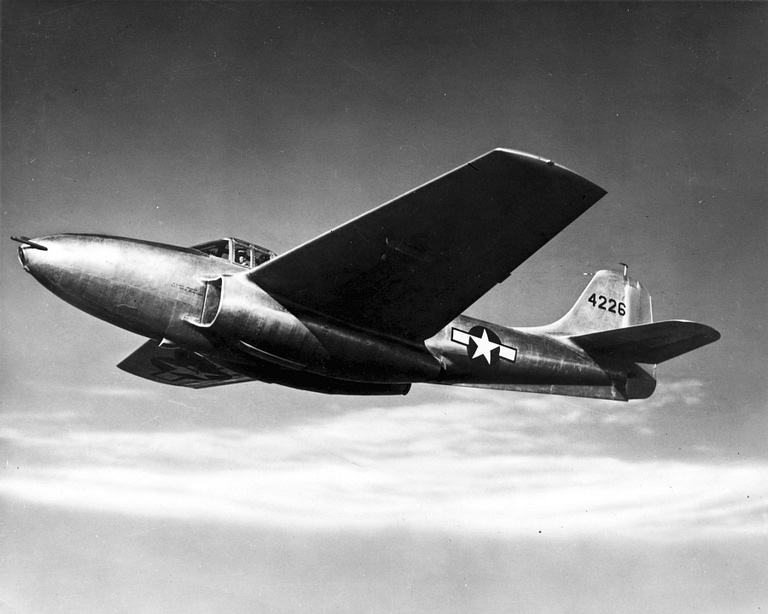
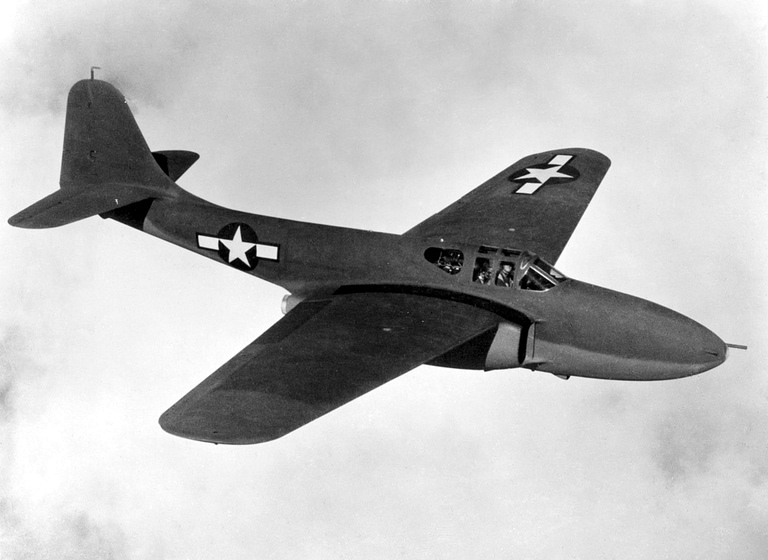
The Airacomet in pictures

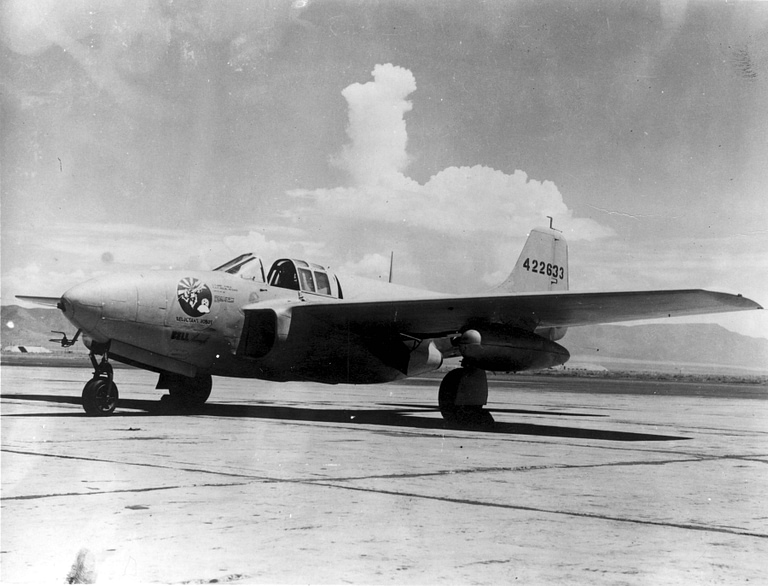
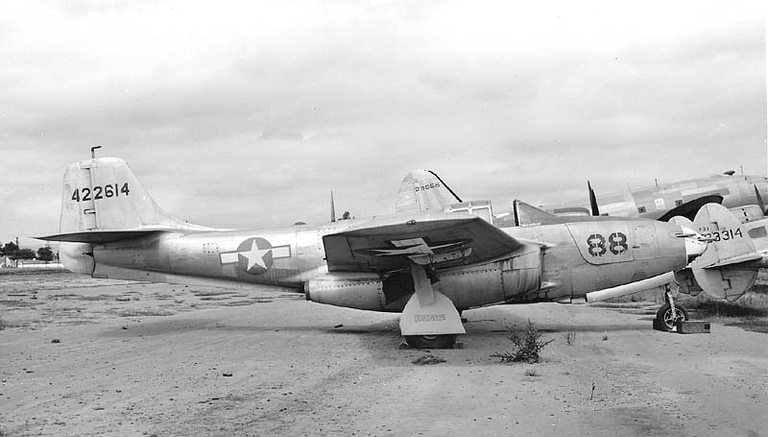
The Airacomet in motion
A curated video feature for the Bell P-59 Airacomet is coming soon. In the meantime, explore the photo gallery above and the operator map below.
Where the Airacomet served
Where the record stands
The P-59 never fired a shot in anger. It was judged too slow and too underpowered to fight, and by 1944 the USAAF had ruled it out as a combat aircraft. Its record is therefore not written in kills but in firsts: the first American jet to fly, the world’s first two-seat jet, and the aircraft that gave the United States its first cadre of jet-trained pilots and ground crews. Its true achievement was to prove jet propulsion practical and to open the road to the P-80 Shooting Star.
Compare the combat record of every military aircraft. Figures as of July 2026.
Everything people ask about the P-59 Airacomet
Can I fly in a P-59?
Was the P-59 really the first American jet?
Why did the P-59 never see combat?
What was the dummy propeller for?
How many P-59 Airacomets were built?
What engines did the P-59 use?
What did the P-59 lead to?
You can’t fly the Airacomet.
These, you can.
Some legends only live in museums — others are fuelled and waiting. MiGFlug has put civilians in real military jet cockpits since 2004.
 Fly the L-39 AlbatrosThe world’s most-flown jet trainer — aerobatics included
 Fly the F-104 Starfighter“The missile with a man in it”
 Fly the MiG-21The Cold War’s most-produced jet
 Pilote o T-33 Shooting StarAmerica’s first jet trainer
 Fly the DH VampireA piece of early jet history
 Fly the S.211Agile Italian jet trainer
 Fly the MB-326The classic Aermacchi jet
 Fly the MiG-15The Soviet legend of the Korean War
Continue the tour
Every fact, checked
- Smithsonian National Air and Space Museum — Bell XP-59A AiracometMuseum record for the first XP-59A, the first US jet and world’s first two-seat jet.
- National Museum of the US Air Force — Bell P-59B Airacomet fact sheetOfficial USAF specifications, production totals and development history.
- Joe Baugher — Bell P-59 AiracometDetailed serial-by-serial history, variant breakdown and performance figures.
- HistoryNet — How the P-59 Became America’s First Jet FighterNarrative of the secret programme, first flight and the combat evaluations.
- Vintage Aviation News — The Surviving AiracometsSurvey of the P-59 airframes preserved in US collections today.
- This Day in Aviation — 1 October 1942Dated account of the XP-59A’s first flight at Muroc Dry Lake.
- Air & Space Forces MagazineBackground on Arnold’s 1941 British trip and the origins of US jet development.
- Edwards Air Force Base — History (Muroc)Context on Muroc Dry Lake as the secret test site for America’s first jet.